

The modern enterprise security landscape is at a critical juncture, grappling with an overwhelming proliferation of security tools—often 40 or more within a single organization—that, paradoxically, fail to deliver comprehensive protection. While these diverse solutions provide extensive visibility into internal telemetry and asset data, they frequently operate in isolated silos, generating a deluge of often overlapping alerts and disparate data points. This architectural fragmentation directly contributes to stubbornly long breach dwell times, which hover around an average of 43 days, leaving precious little time for response before adversaries can inflict significant damage. Consequently, security analysts face unprecedented levels of burnout, constantly triaging a cacophony of noise rather than strategically confronting genuine threats. The core of this pervasive issue is not a lack of effort or investment, but a fundamental architectural flaw within current security paradigms.
The Evolving Threat Landscape and Architectural Imperatives
For decades, security programs were designed for a world where cyber threats evolved at a comparatively slower pace, allowing human teams sufficient time to manually coordinate responses. That era has definitively ended. The rapid acceleration of AI capabilities, particularly with the advent of frontier AI tools, has dramatically altered the threat calculus. Attackers are now capable of operating at machine speed, automating reconnaissance, exploit generation, and multi-stage attacks with unprecedented efficiency. This necessitates a radical shift towards a much more proactive security posture, demanding machine-speed responses to effectively combat fast-moving adversaries.
Recognizing this critical need, Gartner introduced the Continuous Threat Exposure Management (CTEM) framework. CTEM represents a strategic departure from traditional reactive, point-in-time security assessments, advocating for a continuous, iterative cycle encompassing scoping, discovery, prioritization, validation, and mobilization. However, despite its conceptual elegance and undeniable strategic value, operationalizing CTEM end-to-end has remained largely out of reach for most organizations. The primary impediment lies in the very problem CTEM seeks to address: the lack of seamless communication and integration among the disparate security tools required to execute its various phases. Without this cohesion, CTEM remains an aspirational framework rather than an actionable reality.
The Deep-Seated Architecture Problem
At its heart, the contemporary security stack is a complex, often fragmented collection of specialized tools. A typical enterprise might deploy a threat intelligence platform (TIP) to gather external threat data, a vulnerability scanner to identify weaknesses, a separate breach and attack simulation (BAS) tool to test defenses, and a Security Information and Event Management (SIEM) system attempting, often unsuccessfully, to stitch all this information together. Each of these tools generates vast quantities of data—alerts, logs, vulnerability reports, simulation results—but critically, none of them inherently "closes the loop."
This fragmentation creates significant operational bottlenecks. By the time raw threat intelligence is manually correlated with internal exposures, vulnerabilities are prioritized based on contextual risk, validation tests are run, and a remediation ticket is finally acted upon, the adversary has frequently already progressed deep within the network or achieved their objectives. The real bottleneck is not the inefficiency of any single tool, but the vast "white space" that exists between them—the manual handoffs, the data translation challenges, and the lack of automated, contextual understanding across systems.
This architectural conundrum is a primary source of anxiety for security leaders. It is also a problem that generic AI assistants, merely bolted onto existing workflows, cannot genuinely solve. While asking a chatbot to summarize a threat report can be useful for an analyst, it is fundamentally different from having an intelligent AI system that can autonomously correlate that report against an organization’s live exposure surface, validate whether existing controls are effective against the identified threat, and precisely prioritize which remediation actions should be taken first, all without human intervention at every step. The distinction highlights the urgent need for a more advanced form of artificial intelligence.
Defining Agentic AI: A Paradigm Shift
The term "AI" has become so pervasive and often misused in security marketing that it is imperative to be precise about what "agentic AI" truly signifies in this critical context. Understanding this distinction is key to appreciating its transformative potential for cybersecurity.
-
Assistive AI: This category of AI is designed to augment human capabilities. It waits for a specific prompt or query, then performs tasks such as summarizing documents, translating text, retrieving information from vast datasets, or generating basic code. Its primary function is to make human analysts faster and more efficient at performing the same tasks they were already undertaking. It operates within the confines of explicit instructions, lacking independent initiative or continuous operational oversight. Examples include advanced search functions, smart dashboards, or AI-powered report generators.
-
Agentic AI: In stark contrast, agentic AI is designed to act autonomously. It possesses a deeper understanding of context, can independently set priorities, and is capable of executing complex, multi-step workflows across diverse systems. Crucially, it does not operate as a one-time query but continuously, in the background, at machine speed. An agentic AI system can perceive its environment, form goals, plan actions, execute those actions, and adapt its behavior based on feedback, all with minimal human oversight. It’s not just processing information; it’s making decisions and taking actions.
This fundamental distinction matters immensely because the threat environment itself is increasingly operating at machine speed. With the rapid advancements in frontier AI models, the time window between a vulnerability’s discovery and its exploitation (the "discovery-to-exploit" timeline) is shrinking dramatically, often to mere hours or even minutes. Security teams that wish to stay ahead in this accelerated arms race will not be those with the largest number of human analysts, but rather those whose AI infrastructure can match and even exceed the pace of sophisticated, AI-powered attacks autonomously.
Operationalizing CTEM with Agentic AI: A Closed-Loop System

For the Continuous Threat Exposure Management framework specifically, agentic AI promises to bridge the critical gaps that have historically prevented its full operationalization. To transform CTEM from a conceptual framework into a continuous, living security process, three core functions must cease to operate as isolated, sequential workflows and instead integrate into a seamless, closed-loop system:
-
Continuous Threat Intelligence Correlation and Scoping: This involves autonomously ingesting, analyzing, and contextualizing global threat intelligence (e.g., emerging vulnerabilities, active campaigns, adversary tactics, techniques, and procedures – TTPs) against an organization’s specific digital assets, unique attack surface, and business criticality. An agentic system would not just summarize a threat report but would immediately map relevant threat actors and their TTPs to the organization’s specific infrastructure, identifying which assets are most likely to be targeted and creating a precise scope for further investigation.
-
Automated Exposure Discovery and Prioritization: Building upon the scoped intelligence, agentic AI systems would continuously discover and map vulnerabilities, misconfigurations, and potential attack paths across the entire IT estate. More importantly, they would then autonomously prioritize these exposures not just by severity, but by their real-world exploitability and relevance to active threats identified in the first phase. This moves beyond simple CVSS scores to a context-aware risk assessment, identifying the critical few vulnerabilities that truly matter right now.
-
Autonomous Validation and Mobilization for Remediation: The final, crucial step is the continuous validation of existing security controls and the efficient mobilization of remediation efforts. Agentic AI can leverage breach and attack simulation (BAS) tools to continuously test whether identified threats could bypass current defenses. It can validate the effectiveness of implemented patches or configuration changes and, upon confirmation, automatically trigger or significantly accelerate remediation workflows, integrating directly with ticketing systems, orchestration platforms, and asset management tools.
When these three functions operate as an interconnected, closed loop, with AI agents intelligently moving information and decisions between them without waiting for human handoffs or manual correlation, a CTEM program ceases to be merely a framework on a slide and genuinely becomes an operational reality. The continuous feedback loop ensures that as new threats emerge or the environment changes, the system adapts, reassesses exposures, and validates defenses in real-time.
The Agentic Threat Management Architecture
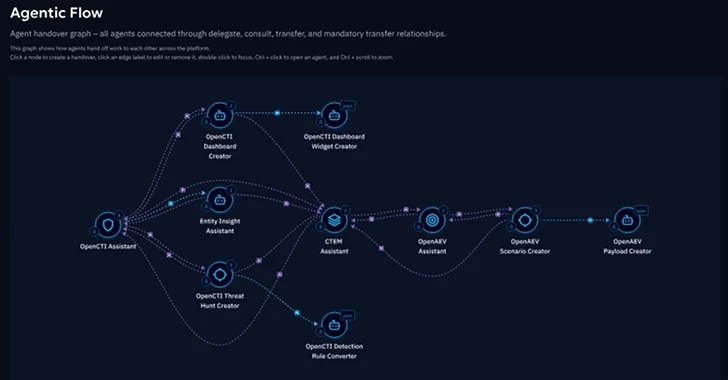
The architectural foundation that enables this transformative shift is an agentic threat management architecture. This is precisely what differentiates a CTEM framework confined to a strategy document from one that runs continuously, dynamically, and effectively in the background. Such an architecture mandates a dedicated AI orchestration layer that serves as a foundational, contextual intelligence hub with interconnected agents.
Instead of security analysts manually connecting disparate pieces of information—such as a new threat intelligence alert to a specific vulnerability scan report, then to a BAS test result, and finally to a remediation ticket—intelligent agents perform this heavy lifting continuously. These agents operate with deep contextual awareness and sophisticated reasoning capabilities. The entire workflow becomes largely autonomous, with agents seamlessly handing off tasks from one to another and across various security products, while crucially maintaining a "human-in-the-loop" for final decision-making, critical approvals, and strategic oversight. This empowers human analysts to evolve from reactive responders into proactive orchestrators of intelligence-driven security actions, focusing their expertise where it truly matters.
The Structural Advantage of Early Adoption
Organizations that are proactively building out this agentic capability today are not waiting for a mythical, perfect, all-in-one toolset. Instead, they are prioritizing the development of this new operational model first, confident that the underlying architecture will catch up and coalesce around their needs. Those who achieve this integration first will gain a profound structural advantage that will compound over time. This advantage manifests in several critical areas:
- Better Data: Autonomous agents consistently collect, normalize, and contextualize data from all integrated tools, leading to a richer, more accurate, and more actionable dataset.
- Better Analysis: With AI performing the initial correlation and analysis, human analysts receive pre-digested, high-fidelity insights, enabling more effective and faster decision-making.
- Better Evidence: Every action taken by an agent, every correlation made, and every validation performed creates an auditable trail, providing robust evidence for compliance, incident response, and continuous improvement.
- Better-Tuned AI: The continuous operational feedback loop allows the agentic AI system to learn and refine its models, becoming progressively more accurate and effective over time. This self-improvement is critical, distinguishing purpose-built agentic systems from general-purpose Large Language Models (LLMs), which, while powerful, lack the specific context, security domain expertise, and product-based know-how required for advanced threat management.
Ultimately, the organizations that are most rapidly closing their security gaps are those that perceive CTEM not as a standalone tool to be purchased, but as an overarching operating model. They are strategically choosing and developing AI infrastructure specifically designed to run this model end-to-end, enabling a level of proactive, adaptive security previously unattainable. Solutions like Filigran’s XTM One CTEM Assistant exemplify this operational model in practice, showcasing how agentic AI can integrate intelligence, exposure validation, and response into a single, continuous workflow.
Broader Impact and Implications
The widespread adoption of agentic AI in cybersecurity carries significant implications across the industry and for individual enterprises:
- For Enterprises: Beyond reduced breach dwell times and improved resilience, organizations can expect a more optimized security spending, deriving greater ROI from their existing tool investments by integrating them more effectively. Enhanced regulatory compliance will also be a natural outcome of the continuous, auditable nature of agentic CTEM.
- For Security Professionals: This shift will fundamentally redefine the role of the security analyst. Instead of being bogged down in manual, repetitive tasks and alert fatigue, analysts will elevate to roles of strategic orchestrators, threat hunters, and decision-makers, focusing on complex, nuanced problems that still require human ingenuity. This also presents significant upskilling opportunities in AI management and strategic security leadership.
- For the Cybersecurity Industry: The industry is likely to witness a drive towards greater consolidation and integration, as fragmented point solutions give way to more holistic, AI-orchestrated platforms. New product categories focused on AI orchestration and agent management will emerge, and there will be an increased emphasis on contextual intelligence and adaptive security frameworks.
- Challenges Ahead: While the promise is significant, challenges remain. These include ensuring high-quality, normalized data inputs for AI, building trust in autonomous decision-making, navigating ethical considerations around AI in security, managing the complexity of integrating diverse systems, and developing the specialized talent required to manage and optimize these advanced AI systems.
Conclusion
The convergence of rapidly escalating, AI-powered threats and the architectural limitations of traditional security stacks has created an imperative for change. Agentic AI, with its capacity for autonomous action, contextual understanding, and machine-speed operation, represents the most significant paradigm shift in cybersecurity since the advent of the SIEM. By enabling the full operationalization of frameworks like Continuous Threat Exposure Management, agentic AI promises to transform security from a reactive, human-burdened process into a proactive, adaptive, and highly efficient defense mechanism. This is not merely an incremental upgrade to existing tools; it is a fundamental re-imagining of the security operating model, one that will define the resilience and competitive advantage of enterprises in the coming decades. Organizations that embrace this transformation now will forge a structural advantage, not just in technology, but in their fundamental approach to cyber defense, ensuring they are prepared for the machine-speed realities of the future threat landscape.
