

The global telecommunications industry is currently witnessing a paradigm shift as satellite networks transition from niche, government-centric infrastructure to mainstream components of the global internet ecosystem. For decades, the primary discourse surrounding space-based communications focused on the "how"—the physics of rocket launches, the engineering of satellite constellations, and the technical hurdles of achieving direct-to-cell (D2C) connectivity. However, as thousands of new satellites enter Low Earth Orbit (LEO) and Medium Earth Orbit (MEO), the focus is rapidly shifting toward the "what"—the specific applications and data streams that are consuming increasingly precious orbital bandwidth. According to recent findings from the Global Internet Phenomena Report (GIPR) by AppLogic Networks, the usage patterns on satellite networks are beginning to mirror terrestrial networks in ways that present both opportunities and significant operational challenges for providers.
The Convergence of Terrestrial and Non-Terrestrial Data Consumption
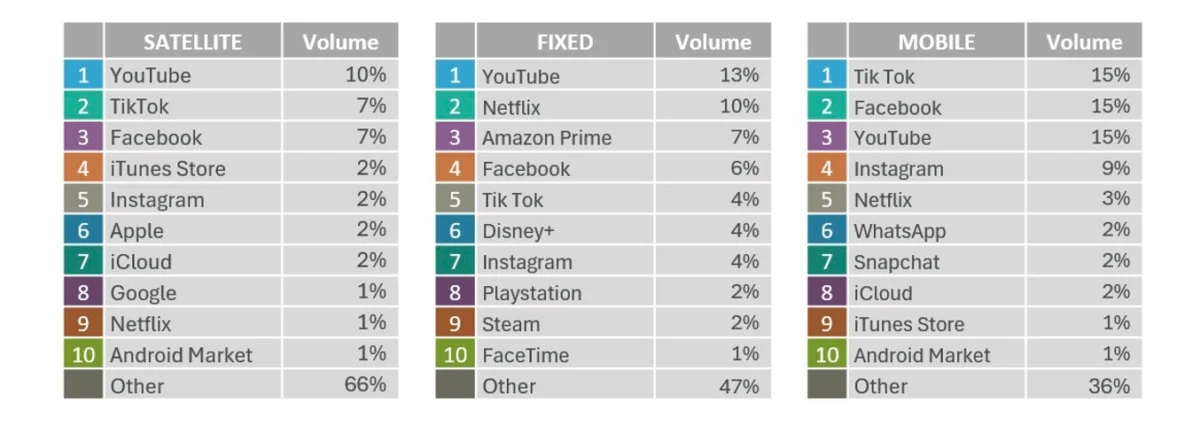
One of the most striking revelations in the current analysis of satellite traffic is the normalization of application usage. Historically, satellite internet was reserved for critical low-bandwidth communications, such as maritime distress signals, remote scientific telemetry, or high-security government transmissions. Today, however, the top ten traffic generators on satellite networks are almost indistinguishable from those found on fiber-optic or 5G mobile networks. Household names such as YouTube, TikTok, Facebook, and Netflix dominate the rankings, indicating that as satellite capacity increases, users expect a "terrestrial-grade" experience regardless of their geographic location.
Despite this familiarity, the underlying technical constraints of satellite systems create a vastly different operational environment. Unlike terrestrial fixed networks, which benefit from relatively stable capacity and low latency, satellite networks must contend with elevated latencies, atmospheric interference, and the physical limitations of orbital mechanics. For operators, understanding exactly which services are driving traffic is no longer a matter of curiosity; it is a fundamental requirement for maintaining operational efficiency and ensuring a high Quality of Experience (QoE) for end-users.
Historical Context: From GEO to the LEO Revolution
To understand the current state of satellite traffic, one must look at the chronological evolution of the industry. For much of the late 20th and early 21st centuries, satellite internet was synonymous with Geostationary (GEO) satellites. Positioned approximately 35,786 kilometers above the Earth, these satellites provided wide coverage but suffered from significant latency—often exceeding 600 milliseconds. This delay rendered real-time applications like online gaming or high-frequency stock trading nearly impossible.
The landscape began to shift dramatically around 2019 and 2020 with the aggressive deployment of LEO constellations, most notably SpaceX’s Starlink, followed by initiatives like OneWeb and Amazon’s Project Kuiper. These satellites orbit at much lower altitudes (between 500 and 2,000 kilometers), reducing latency to 20–40 milliseconds, which is comparable to many terrestrial connections. This technological leap has opened the floodgates for high-bandwidth, latency-sensitive applications, leading to the current surge in video streaming and social media traffic over satellite links.
Analyzing the Data: Satellite vs. Mobile and Fixed Networks
The AppLogic Networks GIPR data, derived from a representative sample of tens of millions of subscribers globally, highlights distinct profiles across different access technologies. While fixed networks (fiber and cable) are overwhelmingly dominated by long-form video streaming and large-scale downloads, mobile networks show a higher concentration of social media and short-form video content.
Satellite networks occupy a unique middle ground. In rural residential settings, satellite traffic mimics fixed networks, with a heavy emphasis on Netflix and YouTube. However, in the emerging D2C and aviation sectors, the profile leans heavily toward mobile-centric applications like TikTok and WhatsApp. The challenge for satellite operators is that they must support both profiles simultaneously, often within the same constellation.
Data suggests that while video remains the king of bandwidth, the "bursty" nature of social media—characterized by frequent, small packets of data—can be particularly taxing for satellite systems that utilize complex handoff protocols between moving satellites. This makes the classification of more than 3,000 application signatures, as performed by AppLogic, essential for network visibility.
Factors Differentiating Satellite Traffic Management
Several unique factors shape how traffic behaves in space compared to on the ground. Satellites serve diverse environments, including aircraft at 35,000 feet, maritime vessels in the mid-Atlantic, and remote IoT sensors in sub-zero climates. Each environment dictates a different traffic priority.
- Latency Sensitivity: Real-time gaming and financial applications require low jitter and low latency. In high-latency GEO environments, these applications often fail or are abandoned by users, whereas in LEO environments, they require precise traffic shaping to maintain performance during satellite handovers.
- Economic Constraints: Bandwidth via satellite still carries a price premium compared to terrestrial fiber. This creates a natural pressure for "bandwidth-saving" behaviors. For example, video platforms may automatically downscale from 4K to 1080p or 720p when a satellite connection is detected, and large software updates are often deferred.
- Environmental Policy: In aviation, for instance, certain conferencing applications may be restricted by the service provider to prevent cabin disturbances, or they may be deprioritized to ensure that critical cockpit communications remain unhindered.
The Surge of Direct-to-Cell (D2C) and IoT Complexity
The next frontier for satellite connectivity is Direct-to-Cell technology, which allows standard smartphones to connect directly to satellites without the need for specialized ground terminals. As companies like SpaceX, T-Mobile, and AST SpaceMobile push this technology into the mainstream, the volume of "unmanaged" traffic is expected to skyrocket.
In early D2C deployments, traffic optimization often falls on the device itself. However, industry experts, including Kris Kobernat, Senior Director at AppLogic Networks, argue that this is insufficient. Effective management requires a "core-network" approach. Operators must be able to identify applications before they reach the satellite link to prevent "application leakage"—a phenomenon where background processes or misconfigured apps consume large amounts of data without the user’s knowledge.
In the realm of the Internet of Things (IoT), the stakes are even higher. Satellite-connected IoT devices are often deployed in mission-critical infrastructure. These devices require "walled gardens" to protect against malicious traffic and fraudulent activities like SIM substitution. Given the scarcity of bandwidth in these environments, even a minor security breach or a rogue software update can saturate a link and disable an entire sensor network.
Multi-Orbit Orchestration and Technical Optimization
The future of satellite communications lies in multi-orbit architectures, where providers utilize a combination of GEO, MEO, and LEO assets to deliver a seamless service. This complexity necessitates advanced application-level observability.
In a multi-orbit system, a network controller must decide in real-time which path a data packet should take. Latency-tolerant traffic, such as a large file download or an on-demand movie, might be routed through a high-capacity GEO satellite. Conversely, a Zoom call or a voice-over-IP (VoIP) session must be routed through a LEO satellite to avoid the "lag" that disrupts human conversation.
Furthermore, LEO satellites present a unique challenge: capacity oscillations. As satellites move rapidly across the sky, users are frequently handed off from one beam to another. During these transitions, the available bandwidth can dip momentarily. Without granular visibility into content types, these dips can cause video buffering or dropped calls. By identifying and prioritizing jitter-sensitive traffic, operators can ensure that the most critical applications remain stable even when the physical link is fluctuating.
Industry Implications and the Road Ahead
The implications of these findings are profound for the global telecommunications market. The "space race" of the 2020s is no longer just about who can launch the most satellites, but who can manage the data on those satellites most effectively.
As satellite networks become an integral part of the 5G and future 6G standards—facilitated by the 3GPP Release 17 and 18 specifications—the distinction between "satellite" and "terrestrial" internet will continue to blur. For the consumer, the transition should be invisible. For the operator, however, the technical and economic realities of space remain.
The ability to see, shape, and prioritize traffic is becoming a competitive differentiator. Operators that invest in deep packet inspection (DPI) and AI-driven traffic management will be able to offer better QoE at lower operational costs. They will be better positioned to handle the massive influx of data from the next generation of D2C-enabled smartphones and the billions of IoT devices expected to come online this decade.
Ultimately, the narrative of satellite connectivity is evolving. It is a story of how ordinary applications—the same ones we use in our living rooms—are being adapted for the extraordinary environment of space. Success in this new era will be defined by observability. In the words of industry veterans, the future of the internet in space will be shaped less by the rockets that put the satellites there and more by the intelligence of the networks that manage the data flowing through them. As the digital divide continues to close, the strategic management of satellite traffic stands as the final hurdle in achieving truly global, high-quality connectivity for all.
