

The digital economy in the United Kingdom is currently undergoing a structural transformation driven by the rapid integration of artificial intelligence across all industrial sectors. At the forefront of this transition, Salesforce has intensified its multi-billion dollar investment in the UK market, with a strategic emphasis on cultivating a national skills base capable of navigating the complexities of the AI era. Central to this strategy is the "Future Trailblazers" initiative, a community-focused outreach program designed to democratize access to AI literacy and professional development for students, career-changers, and underrepresented demographics in the technology sector.
This initiative emerges at a critical juncture for the British economy. According to recent industry reports, the demand for AI-specific roles has surged by over 40% in the last two years, yet a significant portion of the workforce remains under-equipped to utilize these tools effectively. By deploying Salesforce personnel and volunteers directly into educational and community environments, the company aims to dismantle the barriers to entry that frequently prevent diverse talent from pursuing careers in high-tech fields.
The Genesis and Scale of Future Trailblazers
The Future Trailblazers initiative was conceptualized as a direct response to the UK Government’s "AI Boost Skills Boost" initiative. This government-led framework seeks to ensure that the British workforce remains competitive on a global stage as automated systems and generative AI become ubiquitous. Salesforce has operationalized this vision by creating a dedicated virtual team responsible for developing specialized educational content tailored for primary and secondary school students.
Julie Palmer, who serves as both a Solution Engineer Manager and the Regional Apprentice Manager at Salesforce, oversees the strategic direction of these efforts. According to Palmer, the program’s immediate roadmap is ambitious, with a target to reach 30,000 students across 1,000 schools over the next 12 months. The curriculum is designed to be interactive, moving beyond theoretical concepts to address the practicalities of the modern workplace. A primary focus of the content is the ethical and safe application of AI, ensuring that the next generation of workers understands both the capabilities and the responsibilities inherent in using advanced algorithmic tools.
Chronology of the Salesforce Apprenticeship Program
While the Future Trailblazers initiative focuses on broad-scale outreach, Salesforce’s internal apprenticeship program provides a deep-dive vocational pathway into the industry. Launched in 2019, the program was designed to offer an alternative to the traditional university route, allowing school-leavers to enter the workforce immediately while earning professional certifications.
The program’s history is defined by a focus on quality and retention rather than sheer volume. Since its inception, 22 individuals have transitioned from secondary education into the role of Solution Engineer Apprentices. Of these, 18 remain full-time employees at Salesforce today. This high retention rate—approximately 82%—stands in contrast to broader industry trends where entry-level turnover can be high. Palmer notes that the modest intake is intentional, as the program is structured to guarantee full-time career placement for those who successfully complete their training. This model prioritizes long-term human capital development over short-term recruitment metrics.
Practical Applications: AI as a Productivity Multiplier
The experiences of current apprentices highlight the shifting paradigm of how technology is taught and utilized. Moumita Grimm, a first-year Solution Engineer Apprentice who joined Salesforce directly after completing her A-Levels, represents a generation that is transitioning from educational environments where AI was often restricted to professional environments where it is mandatory.
Grimm’s daily workflow involves the use of Claude Code, an AI tool that assists in application development. She reports that the integration of AI has fundamentally altered the barrier to entry for technical roles. In the current ecosystem, the requirement to master complex syntax from day one has been superseded by the ability to direct AI agents to build websites and applications. Grimm observes that AI functions as a productivity multiplier, allowing her to delegate routine coding tasks and focus on higher-level problem-solving and client engagement. This shift reflects a broader trend in the software industry: the evolution of the "developer" into an "orchestrator" of AI-driven tools.
Furthermore, the apprenticeship model challenges traditional views on workplace discipline. Grimm noted that the transition from the rigid structure of a classroom to the autonomy of a corporate environment was the most significant adjustment. The Salesforce model emphasizes "big responsibilities" early on, such as hosting work experience sessions for younger students and managing client-facing demos. This autonomy, supported by a flexible schedule, is designed to foster a sense of ownership and professional maturity that is often delayed in four-year degree programs.
Navigating the Learning Curve of Agentic AI
For many entering the tech sector, the sheer velocity of innovation can be daunting. Jayda Aboelata, a second-year Solution Engineer Apprentice, began her journey using AI to develop educational content while tutoring mathematics and chemistry. Upon entering the Salesforce ecosystem, she realized that the theoretical knowledge she had acquired through independent research only covered a fraction of the practical reality of the industry.
Aboelata’s experience highlights the importance of "environmental learning." In the fast-moving field of "agentic AI"—where AI systems are designed to act autonomously to achieve specific goals—classroom curricula often struggle to remain current. Aboelata argues that the most valuable learning occurs simply by being present in a high-stakes professional environment. This "immersion" strategy allows apprentices to absorb the nuances of Customer Relationship Management (CRM) and solution engineering through observation and incremental participation. Her trajectory suggests that curiosity and the ability to operate under conditions of uncertainty are becoming more valuable than pre-existing technical knowledge.
From Apprentice to Architect: A Case Study in Career Progression
The long-term viability of the apprenticeship model is perhaps best illustrated by the career of Melissa Lupu. Having joined the program four and a half years ago as a Solution Engineer Apprentice, Lupu has since ascended to the role of Technical Architect. Despite being significantly younger than many of her peers in similar roles, Lupu’s progression demonstrates that vocational training can match or exceed the career velocity of traditional academic pathways.
Lupu’s journey was not without challenges, particularly regarding the development of "soft skills." Coming from a classroom setting, she initially found the requirement to build customer relationships and present to strangers to be uncomfortable. However, by adopting a "yes-to-everything" approach—accepting every opportunity to present, build, or troubleshoot—she was able to bridge the gap between technical proficiency and professional communication.
Today, Lupu utilizes Claude Code in a terminal environment to automate file creation, command execution, and code testing. Her recent success in using AI to troubleshoot and connect a new API to Microsoft systems resulted in her being recognized as an internal subject matter expert. This rapid acquisition of expertise underscores the efficiency of the apprenticeship model in producing highly specialized talent in response to immediate market needs.
Analysis: Apprenticeships vs. Academic Pathways
The ongoing debate between university education and vocational apprenticeships remains a central theme for school-leavers in the UK. The Salesforce model suggests that for sectors like Information Technology and AI, the practical choice may increasingly lean toward the latter.
While university offers a broad academic foundation and a unique social experience, apprenticeships provide a salary, a degree (in many modern schemes), and an immediate professional network. Lupu, who describes herself as having been "very academic" in school, notes that while she would have chosen university for a theoretical subject like pure mathematics, the fast-evolving nature of technology makes the apprenticeship route a more "wise choice" for the current economy.
Broader Implications for the UK Tech Sector
The success of these initiatives has broader implications for the UK’s ambition to become a global "AI superpower." By focusing on diversity and early-stage engagement, Salesforce is addressing two of the most persistent issues in the tech industry: the talent shortage and the lack of demographic representation.
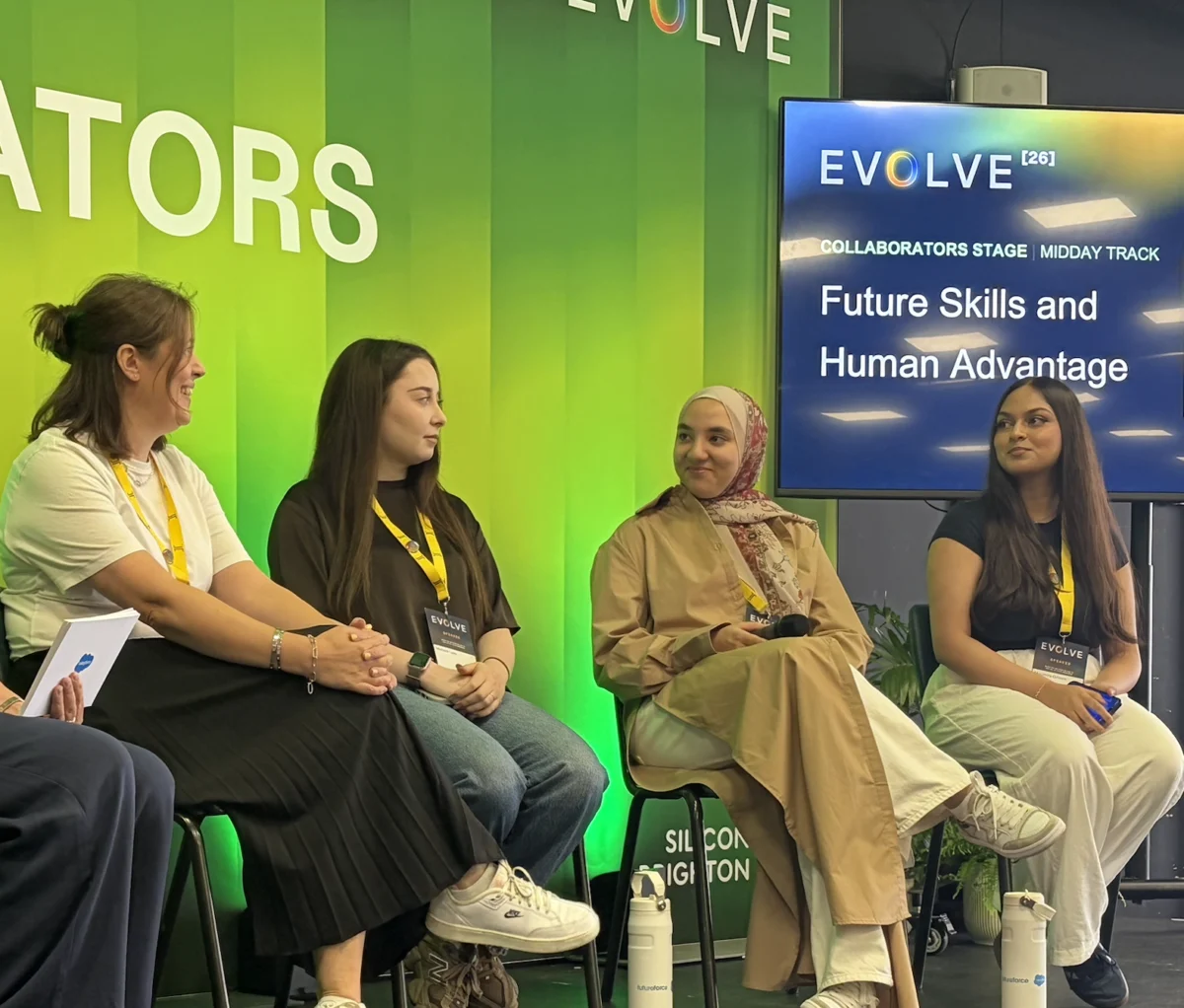
A notable aspect of the recent Evolve [26] conference in Brighton was the presence of a diverse panel composed entirely of women in tech, including the Salesforce apprentices. Industry analysts suggest that the visibility of such panels is crucial for changing the perception of the tech sector as a male-dominated field. Rather than being siloed into "Women in Tech" sessions, these professionals are increasingly being recognized for their technical contributions to AI and solution engineering.
Furthermore, the data from Salesforce’s operations in Ireland and the UK indicates a sustained commitment to these programs. By integrating these "Trailblazer" initiatives into the corporate culture, the company is creating a self-sustaining pipeline of talent that is already fluent in the language of AI before they even reach their mid-twenties.
Conclusion
As AI continues to redefine the requirements of the modern workforce, the burden of training is shifting from traditional educational institutions to the private sector. Salesforce’s Future Trailblazers and apprenticeship programs serve as a blueprint for how multinational corporations can collaborate with government initiatives to ensure national economic resilience. By prioritizing hands-on experience with tools like Claude Code and fostering a culture of continuous, autonomous learning, these programs are not only filling immediate job openings but are also shaping the future architecture of the British technology landscape. For the individuals involved, the choice to forgo the traditional university experience in favor of an apprenticeship is proving to be a calculated and successful risk, resulting in high-level technical roles and a head start in the most competitive sector of the global economy.
