
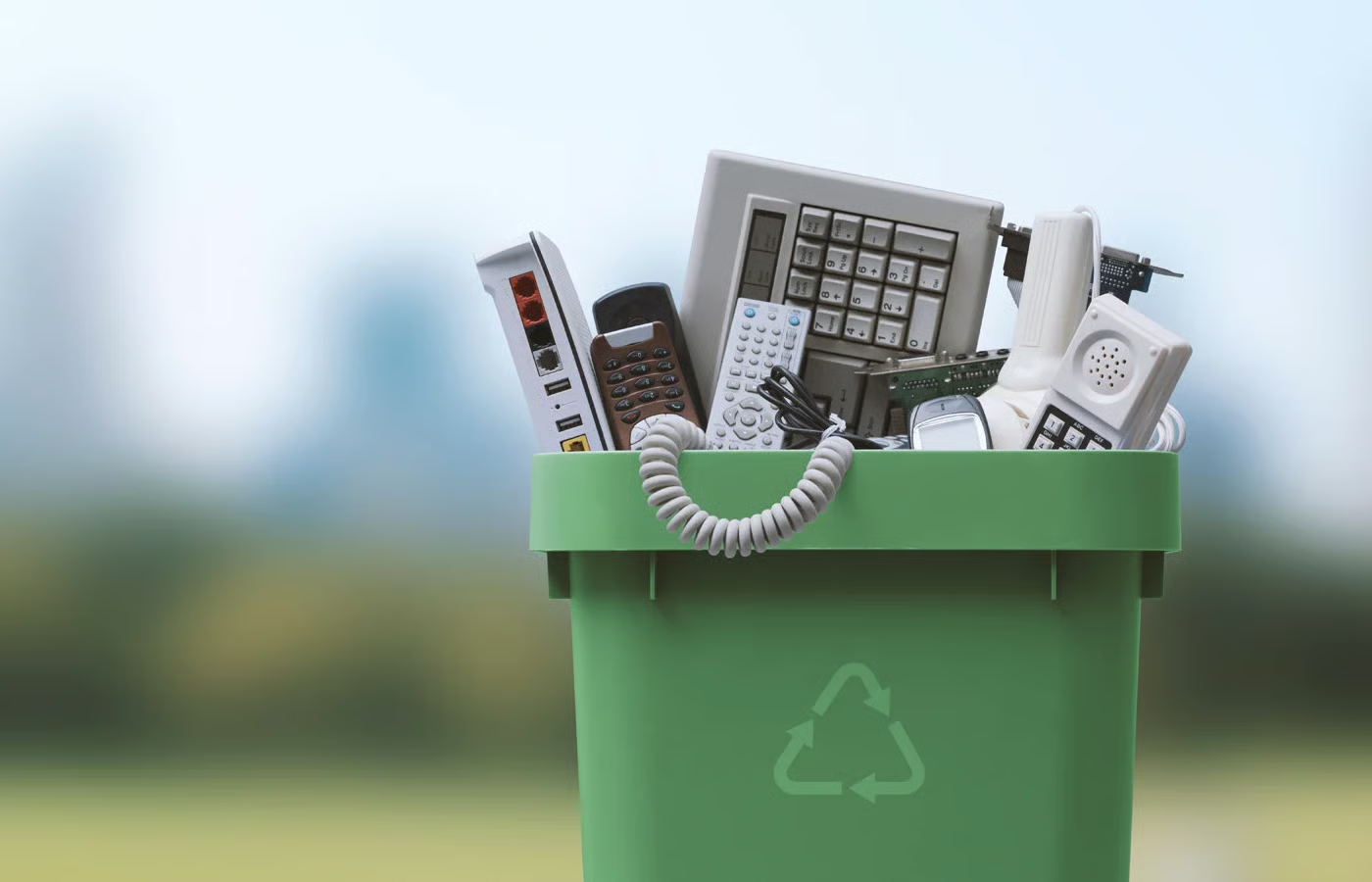

The proliferation of electronic devices has fundamentally transformed modern society, driving unprecedented levels of global connectivity, productivity, and economic growth. However, this digital revolution has ushered in an unintended consequence of monumental proportions: the rapid escalation of electronic waste, or e-waste. Comprising everything from pocket-sized smartphones and discarded MP3 players to massive commercial refrigerators, air conditioning units, and enterprise-grade server hardware, e-waste has emerged as one of the most pressing environmental, economic, and public health challenges of the twenty-first century. As global demand for cutting-edge technology accelerates, understanding the lifecycle of electronic goods, the hazards associated with improper disposal, and the systemic shifts required to achieve sustainable management has become an urgent imperative for governments, corporations, and individual consumers alike.
To contextualize the scale of this contemporary crisis, it is necessary to examine the historical trajectory of consumer electronics over the past several decades. The widespread commercialization of personal computers in the 1980s and 1990s, followed by the mobile phone boom of the early 2000s and the subsequent smartphone revolution, dramatically shortened product life cycles. Historically, durable goods were manufactured to last for decades, with an implicit cultural and economic emphasis on repair and maintenance. Toward the end of the twentieth century, however, rapid advancements in semiconductor technology, coupled with aggressive marketing strategies and planned obsolescence, shifted consumer behavior toward a disposable mindset. Devices that were once treated as long-term investments are now frequently replaced every two to three years. This accelerated turnover has transformed e-waste from a minor municipal concern into the fastest-growing waste stream on the planet.
The fundamental danger of e-waste lies in its unique and complex chemical composition. Unlike organic waste or traditional municipal refuse, electronic devices are an intricate amalgamation of highly valuable resources and toxic hazardous substances. On one hand, discarded electronics contain significant quantities of critical raw materials, including copper, gold, silver, palladium, and rare earth elements. Recovering these materials through proper recycling provides a sustainable alternative to environmentally destructive primary mining operations, effectively closing the loop in the manufacturing supply chain. On the other hand, these same devices harbor lethal and persistent pollutants such as lead, mercury, cadmium, hexavalent chromium, and brominated flame retardants. When e-waste is improperly treated—often dumped in unregulated landfills or subjected to crude backyard burning techniques in developing nations—these hazardous materials leach into local soil and groundwater tables or escape into the atmosphere, posing severe, long-term risks to ecosystems and human health.
The sheer volume of discarded electronics has reached staggering proportions. According to milestone data compiled by the World Health Organization (WHO) and international monitoring agencies, an estimated 53.6 million tonnes (59 million U.S. tons) of e-waste were generated worldwide in a single baseline year. Yet, amidst this colossal accumulation, a mere 17.4% of that total was officially documented as being properly collected, processed, and recycled. The vast majority of global e-waste—over 82%—disappears into undocumented channels, ending up in municipal waste streams, being incinerated, or being illegally shipped to informal recycling hubs in the Global South. This vast deficit between generation and formal recycling highlights the profound inadequacies of current global waste management infrastructure and underscores the urgent need for systemic reform.
Understanding the various categories of e-waste is essential for developing targeted collection and processing frameworks. Electronic waste is generally classified into several distinct segments, each presenting unique logistical and environmental challenges. Temperature exchange equipment, commonly referred to as cooling and freezing appliances, contains hazardous refrigerants and insulating foams that deplete the ozone layer and contribute significantly to global warming if vented improperly. Screens, monitors, and televisions incorporate large quantities of leaded glass, mercury-backed panels, and various plastics treated with toxic flame retardants. Lamps, including fluorescent and LED lighting, contain heavy metals that require specialized containment during disposal. Large equipment, such as washing machines, electric stoves, and commercial server racks, demands heavy machinery for safe dismantling, while small IT and telecommunication equipment—ranging from laptops and routers to printers and mobile phones—represents the highest-volume category driven by rapid consumer turnover.
The environmental and human health impacts stemming from the mismanagement of these electronic categories are well-documented by public health organizations and environmental scientists. Informal e-waste recycling operations, frequently located in regions with lax environmental enforcement, rely on primitive extraction methods like open-air acid baths and thermal wire burning to recover valuable metals such as copper. These processes release toxic fumes laden with dioxins, furans, and heavy metal particulates directly into the surrounding air, resulting in high rates of chronic respiratory illness, neurological damage, cardiovascular disease, and developmental disorders among local populations, particularly children who often work in or live adjacent to these sites. Furthermore, soil contamination severely degrades agricultural productivity, while aquatic pollution devastates local fisheries, compromising food security in vulnerable communities.
Addressing these pervasive impacts requires a robust, multi-stage recycling process capable of safely neutralizing hazards while maximizing material recovery. Formal e-waste recycling typically begins with comprehensive collection and sorting, where devices are separated by category and assessed for potential reuse or refurbishment. Once sorted, the material undergoes manual dismantling to remove hazardous components—such as lithium-ion batteries, mercury switches, and capacitors—that could cause explosions or toxic contamination during mechanical processing. The remaining components are then subjected to mechanical shredding, where heavy industrial mills reduce the electronics into manageable fragments. Advanced separation technologies, including magnetic separators, eddy current systems, and optical sorting machinery, subsequently isolate ferrous metals, non-ferrous metals, and plastics. Finally, specialized hydrometallurgical and pyrometallurgical refining processes extract high-purity precious and critical metals, preparing them for reintroduction into the global manufacturing supply chain.
Despite the establishment of these sophisticated recycling protocols, the industry continues to face persistent challenges that hinder widespread adoption. Economic barriers remain formidable; the cost of establishing compliant, environmentally sound recycling facilities is exceptionally high, making it difficult for formal recyclers to compete with unregulated operators who externalize their environmental and labor costs. Logistical hurdles, including consumer apathy, a lack of convenient drop-off infrastructure, and the sheer geographic dispersion of discarded devices, further suppress collection rates. Additionally, modern product design often actively impedes efficient recycling. As consumer electronics become increasingly miniaturized, manufacturers frequently rely on proprietary adhesives, soldered batteries, and integrated components that make non-destructive disassembly nearly impossible, rendering repair and component harvesting economically unviable.
The responsibility for transforming this broken ecosystem is shared across multiple sectors of society, with the corporate world holding a pivotal position. Original equipment manufacturers (OEMs) dictate the material composition, repairability, and lifecycle trajectory of electronic goods. In response to mounting regulatory pressure and consumer demand, progressive corporations are increasingly adopting corporate social responsibility (CSR) frameworks centered on sustainability. These initiatives include voluntary take-back programs, investments in closed-loop supply chains, and public commitments to increase the percentage of recycled plastics and secondary metals used in new product lines. By integrating sustainability into corporate governance, businesses can mitigate regulatory risks, enhance brand reputation, and secure a stable supply of critical raw materials independent of volatile geopolitical mining markets.
Consumers also play a critical, albeit often underutilized, role in effective e-waste management. Individual purchasing and disposal choices directly influence market dynamics. When consumers demand durable, repairable products, reject planned obsolescence, and actively utilize certified e-waste recycling drop-off points rather than discarding electronics in household trash, they send a powerful economic signal to manufacturers. Furthermore, the cultural normalization of buying refurbished electronics and extending the functional lifespan of existing devices through minor repairs or software updates significantly dampens the rate of primary e-waste generation. Public awareness campaigns and educational initiatives are vital in shifting consumer perceptions away from the traditional throwaway culture toward a more mindful approach to technology consumption.
Governments at regional, national, and international levels establish the overarching legal frameworks necessary to enforce accountability and standardize e-waste handling. Internationally, multilateral agreements such as the Basel Convention on the Control of Transboundary Movements of Hazardous Wastes and Their Disposal have been instrumental in curbing the illegal export of hazardous electronic waste from developed nations to developing countries, where environmental oversight is often weak. The Basel Convention’s Ban Amendment, which entered into force for ratifying states, explicitly prohibits the export of hazardous wastes from member countries of the Organisation for Economic Co-operation and Development (OECD) to non-OECD countries, providing a crucial legal bulwark against environmental dumping.
At the regional and national levels, governments have implemented stringent legislative directives to mandate responsible e-waste stewardship. The European Union’s Waste Electrical and Electronic Equipment (WEEE) Directive stands as a global benchmark, establishing legal collection, recycling, and recovery targets for all types of electrical goods. Under the WEEE framework, the principle of Extended Producer Responsibility (EPR) is heavily enforced, legally obligating manufacturers to finance the end-of-life management of their products. Similar EPR laws and mandated recycling stewardship programs have been enacted in numerous jurisdictions worldwide, compelling companies to internalize the environmental costs of their merchandise and encouraging the design of more sustainable products from the outset.
Looking toward the future, the continuous escalation of global e-waste volumes necessitates the deployment of advanced innovations and forward-thinking paradigms in waste handling. Emerging recycling technologies are rapidly transforming traditional operations through automation and precision engineering. Artificial intelligence (AI)-driven sorting robots, equipped with advanced computer vision and hyperspectral imaging, can now rapidly identify, classify, and separate distinct types of polymers, circuit boards, and metallic components with unprecedented speed and accuracy, drastically reducing the need for hazardous manual labor. Concurrently, chemical and biological processing innovations, such as bioleaching—which utilizes specific microorganisms to selectively dissolve and extract precious metals from electronic scrap—offer clean, energy-efficient alternatives to traditional smelting and chemical leaching.
Parallel to advancements in end-of-life processing, the philosophy of product design is undergoing a profound evolution known as Design for Environment (DfE). Forward-thinking manufacturers are increasingly prioritizing sustainability during the initial engineering phase by minimizing the use of hazardous substances, standardizing fastening mechanisms to allow for easy disassembly with common tools, and enhancing the modularity of devices. Concepts such as modular smartphones and upgradeable enterprise servers, where individual defective or outdated components can be swapped out independently without discarding the entire unit, are gaining commercial traction and fundamentally reducing the rate at which complex waste is generated.
At a macro-economic level, the electronics industry is gradually pivoting toward circular economy models that decouple economic growth from the consumption of finite natural resources. This systemic shift emphasizes product-as-a-service (PaaS) business models, wherein consumers and enterprises lease hardware rather than purchasing it outright. Under a PaaS framework, ownership remains with the manufacturer, creating a strong financial incentive to design exceptionally durable, easily repairable, and fully recyclable electronics that can be continuously refurbished and redeployed across multiple lifecycles.
Ultimately, mitigating the global e-waste crisis requires a synchronized, collective effort across governments, industrial sectors, and consumer populations. The integration of cutting-edge recycling technologies, the widespread adoption of sustainable product architectures, and the rigorous enforcement of international and domestic policy frameworks are indispensable steps toward a cleaner, more resilient future. As digital infrastructure continues to expand globally, the imperative to adapt and refine our approach to electronic waste handling has never been more urgent. Beyond consumer devices, organizations must also address operational efficiencies—such as optimizing data center and server room power consumption—to comprehensively reduce their environmental footprint and operational overhead, proving that responsible resource management and technological progress can and must coexist.
