

Over the past year, Security Operations Centers (SOCs) across the globe have witnessed a structural shift in their alert telemetry. A new category of security event has emerged, driven not by malicious actors attempting to infiltrate networks, but by the rapid, unchecked integration of AI tools and autonomous agents within corporate environments. This transition represents a fundamental change in the threat landscape, as the legitimate, everyday activity of developers and non-technical staff increasingly mirrors the hallmarks of sophisticated cyberattacks.
According to a comprehensive analysis conducted by Intezer, which reviewed over 16.9 million security alerts, AI-related activity now represents the fastest-growing segment of the modern SOC stream. While these events account for a relatively modest 0.43% of total volume, the rate of increase is staggering: a 685% surge in AI-related alerts was recorded between February and June 2026. This trajectory suggests that security teams are currently operating in the calm before a data-saturation storm, as the "floor" of AI-driven noise continues to rise month-over-month.

The Anatomy of the AI Alert Surge
The proliferation of AI in the workplace has manifested in two distinct, yet equally challenging, behaviors. The first is technical in nature: developers are deploying sophisticated coding agents capable of spawning shells, accessing credential stores, initiating network tunnels, and executing security-focused scripts. To traditional detection engines—which were architected to flag these specific actions as signs of lateral movement or command-and-control (C2) communication—this activity is indistinguishable from the preliminary phases of a data breach.
The second behavior involves the quiet, yet pervasive, adoption of generative AI tools by non-technical employees. This often takes the form of granting OAuth consent to third-party applications, pasting proprietary corporate documentation into public LLM interfaces, and sharing sensitive data to "optimize" workflows. While these actions rarely trigger endpoint detection systems, they represent a significant increase in the organization’s attack surface and potential for data exfiltration.
Chronology of a Growing Security Challenge
The data indicates that the influx of AI-related alerts is not a linear progression but an accelerating trend. Throughout the first quarter of 2026, security teams began noticing a marginal increase in detections related to automated agents. However, the month of May 2026 marked a pivotal inflection point, where the volume of these alerts began to climb sharply.

By mid-year, the composition of these alerts became the primary concern for Chief Information Security Officers (CISOs). When broken down into categories, the data reveals a lopsided reality:
- 94.1% Noise: Legitimate, sanctioned business activity misidentified by legacy security rules.
- 5.8% Genuine Risk: Instances where AI agents are operating with "permission-bypass" flags or other misconfigurations that, while not currently compromised, leave the infrastructure exposed.
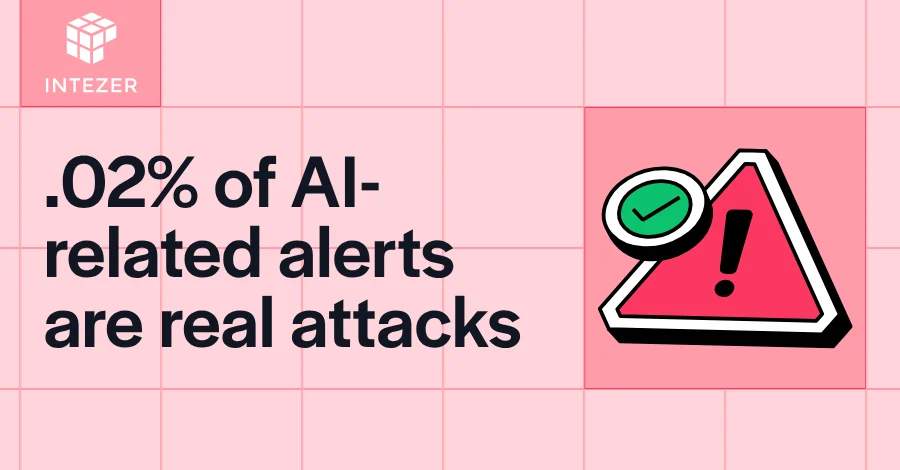
- 0.02% Real Attacks: Actual malicious operations that either exploit AI infrastructure or use AI branding to facilitate social engineering.
This distribution highlights a critical operational bottleneck. With the vast majority of alerts being false positives, human analysts are being forced to triage an unprecedented volume of data, increasing the likelihood that a genuine threat—hidden in the "noise"—will be overlooked.
Data-Driven Insights and Operational Reality
The implications for enterprise security architecture are profound. The current reliance on severity-based alert prioritization is failing when confronted with AI agents. For instance, a single developer’s coding agent performing a routine shell environment setup can trigger a "critical" alert regarding lateral tool transfer. Intezer’s findings suggest that nearly 55% of all critical-verdict alerts regarding specific Windows binaries (such as Expand.exe) were, upon investigation, found to be entirely benign agent behaviors.

Furthermore, the "real" attacks identified in the study were not breaches of the AI tools themselves, but rather opportunistic campaigns that weaponized the ubiquity of AI. Attackers are increasingly utilizing AI brand names—such as OpenAI, Anthropic, or Claude—in phishing lures. Because employees are now conditioned to receive routine notifications from these platforms, they are significantly more likely to engage with malicious emails that impersonate these services.
The Risk of "Permission-Bypass" Configurations
Perhaps the most concerning category for security teams is that of "Unsafe Use." This involves agents running with permission-bypass flags, a configuration that allows the agent to execute commands without user confirmation. While developers argue this increases productivity, it effectively removes the "human-in-the-loop" safeguard that prevents catastrophic errors.
Evidence from recent supply-chain attacks indicates that adversaries are already aware of this trend. If a developer launches a coding agent with these prompts disabled, the agent becomes an ideal vehicle for executing malicious payloads. The risk here is not necessarily current intent, but future vulnerability: the rail is off, and the system is waiting for the one instance where the code the agent is asked to run is malicious.

Industry Response and Future Mitigation Strategies
Industry leaders and security analysts suggest that the standard approach to SOC management is no longer sufficient. Organizations must shift from a reactive stance to a more proactive posture. This involves three core pillars of defense:
- Detection Tuning: Security teams must urgently audit and tune legacy detection rules. Rules that fire at high severity on routine agent behavior need to be updated to account for modern development workflows.
- Environment Isolation: To prevent agents from interacting with sensitive credentials or internal systems they do not need, organizations should mandate that AI tools run within isolated containers or virtual machines. This creates a sandbox that limits the agent’s reach and makes forensic analysis of its actions significantly clearer.
- Governance of Third-Party Integrations: As with any SaaS application, organizations must enforce strict policies regarding OAuth grants and data sharing with external AI platforms.
Broader Implications for the SOC
The "uncomfortable synthesis" of the current landscape is that AI adoption has not yet brought a massive wave of AI-enabled breaches, but it has brought a massive wave of administrative exhaustion. A SOC that persists in treating every agent action as a potential intrusion will eventually succumb to "alert fatigue," missing the subtle, quiet signals of a true attacker.
According to Nicole Fishbein, a Senior Security Researcher at Intezer, the distinction between a failing SOC and one that scales effectively lies in the ability to differentiate between routine AI activity and genuine malicious behavior. "The work ahead is less about detecting AI attacks and more about teaching detection engines what normal AI behavior looks like before the volume that is doubling and tripling month over month makes that work unavoidable," Fishbein noted.

Conclusion
The evolution of the SOC in the age of AI is an inevitability. As organizations continue to integrate autonomous agents into their daily operations, the boundary between "normal" and "malicious" will continue to blur. The data provided by current threat intelligence underscores the urgency of this transition; security teams must evolve their triage processes, adopt stricter isolation protocols, and move beyond legacy detection models.
For the modern enterprise, the primary threat is not the AI agent itself, but the lack of visibility into how those agents interact with the broader IT ecosystem. The organizations that thrive will be those that manage to harness the productivity gains of AI while simultaneously automating the triage of the resulting telemetry, ensuring that human analysts remain focused on the threats that truly matter. As the industry looks toward the remainder of 2026, the focus must remain on precision, automation, and a deep understanding of the new digital footprint being left by the AI revolution.
