
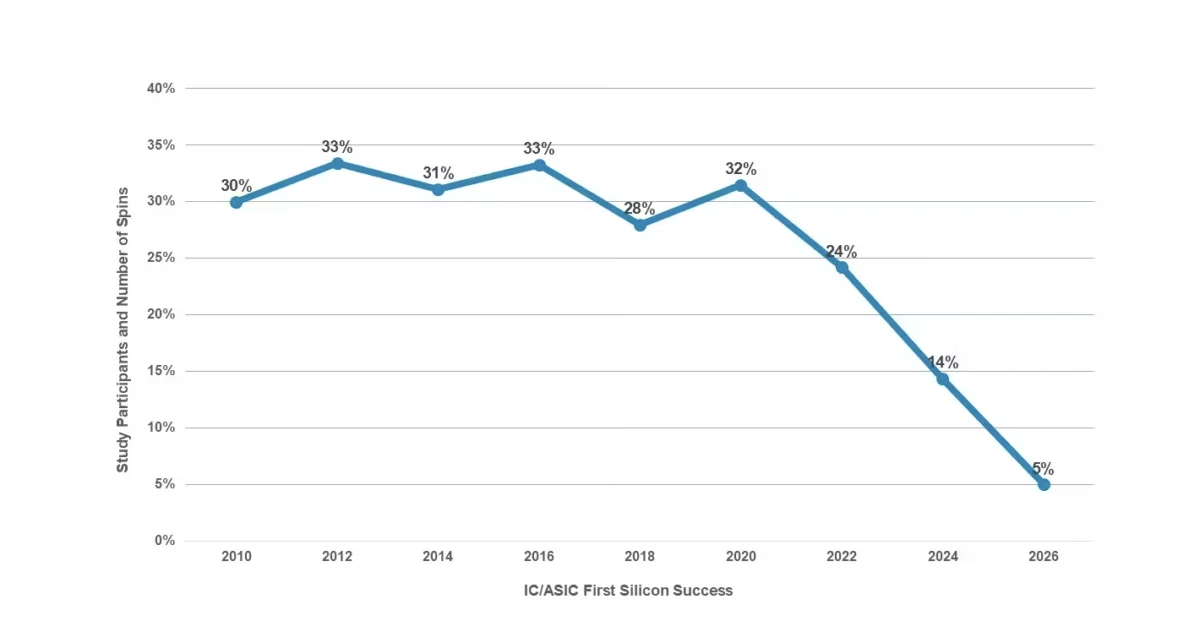

The semiconductor industry is currently navigating a critical inflection point where the traditional definition of functional verification is undergoing a fundamental transformation. According to the forthcoming 2026 Siemens EDA and Wilson Research Group Functional Verification Study, the primary challenge for chip architects is no longer restricted to closing a design to meet specification; rather, it has expanded to encompass the holistic validation of the entire system before a single piece of silicon is manufactured. This shift marks a departure from the historical focus on gate-level accuracy toward a software-driven mandate where silicon must perform reliably within complex, firmware-dependent environments from the moment it leaves the fabrication facility.
The Erosion of First-Silicon Success
For decades, the metric of "first-silicon success"—achieving a working chip on the first fabrication run—served as the gold standard of engineering proficiency. However, data from the 2026 study indicates a worrying trend: the historical equilibrium of high first-silicon success rates is declining. This reversal is not merely a byproduct of increased design density or node migration, but a direct consequence of the increasing disparity between hardware development and software readiness.
As the industry pushes into the era of specialized silicon, such as high-performance CPU, GPU, and AI accelerator architectures, the complexity of interactions between hardware and software has grown exponentially. The study suggests that companies are no longer just building processors; they are building entire platforms. When hardware reaches the lab, it is often already tasked with running complex operating systems, proprietary firmware, and security protocols, any one of which can trigger a catastrophic failure if not verified at the system level.
Chronology of a Changing Landscape
To understand the current state of verification, one must look at the evolution of the field over the last decade. During the early 2010s, the focus was primarily on UVM (Universal Verification Methodology) adoption and the standardization of testbenches. The goal was to eliminate logic bugs that could be caught via simulation.
By the late 2010s and early 2020s, the emergence of the "System-on-Chip" (SoC) era shifted the focus toward emulation and prototyping. Verification engineers were tasked with bridging the gap between RTL (Register Transfer Level) and the final physical implementation. However, the period between 2024 and 2026 has witnessed a radical acceleration in the integration of embedded processors across almost every category of silicon implementation. This ubiquity of software-controlled features has rendered traditional "block-level" verification insufficient. Today, a single bug in the firmware-to-hardware interface can necessitate a costly and time-consuming respin, a reality that is increasingly reflected in the declining first-silicon success rates observed in the latest industry reports.

Supporting Data and Verification Trends
The 2026 study highlights several key indicators that illustrate this systemic change. Beyond the drop in first-silicon success, there is a clear trend toward broader ecosystem participation. Verification teams are now frequently collaborating with firmware developers, security auditors, and functional safety engineers earlier in the development lifecycle than ever before.
Key data points from the study emphasize the following:
- Embedded Processor Integration: Nearly every category of IC development now reports the inclusion of multiple embedded processors, necessitating hardware-software co-verification as a baseline requirement.
- Safety and Security Visibility: A significant portion of reported respins is now attributed to firmware-related errors and security vulnerabilities, which were historically treated as post-silicon concerns.
- Complexity Growth: The sheer volume of verification data generated by modern AI-class accelerators requires advanced analytics, as manual inspection of verification results is no longer feasible.
These figures underscore a transition from "verification as a gate" to "verification as an ongoing process of system confidence." The study suggests that teams that rely on traditional methodologies without integrating system-level simulation are facing significantly higher risks of project failure.
Industry Perspectives and Reactions
While official responses to the study remain confidential until the full release, industry analysts familiar with the findings suggest that the results align with the broader "Shift-Left" philosophy. Leading semiconductor companies have begun to reorganize their engineering departments to merge hardware verification and software development teams into singular product validation units.
"The data confirms what we have been seeing on the ground," noted one industry observer familiar with the Siemens EDA reporting cycle. "The verification bottleneck is no longer the logic design itself; it is the confidence in the software stack that will execute on that design. If the software doesn’t behave as expected in the simulation environment, the hardware is functionally irrelevant."
This sentiment is echoed by the move toward greater adoption of virtual platforms and digital twins. By creating a high-fidelity software model of the hardware, teams are attempting to build "system confidence" years before the first physical prototype arrives.

The Broader Impact: From Verification to Confidence
The implications of this study are profound for the entire semiconductor supply chain. For chip designers, it means that the verification engineer’s role is evolving into that of a systems architect. They must understand the nuances of the compiler, the OS kernel, and the application-level security threats that the silicon will face in the field.
Furthermore, the rise of AI-driven design tools is expected to play a major role in closing the gap. As verification becomes more complex, the industry is increasingly turning to machine learning-based verification engines that can predict potential failure modes before they are even simulated. This predictive capability is seen as the next frontier in maintaining the feasibility of complex chip projects.
However, the cost of this shift is not negligible. The need for more robust simulation, larger emulation farms, and specialized personnel creates a barrier to entry that may consolidate the market. Smaller players may struggle to maintain the level of verification rigor required to succeed in this new environment, potentially leading to increased reliance on third-party verification services and IP-centric design flows.
Conclusion: A New Era of System Validation
As we look toward the remainder of the decade, the 2026 Siemens EDA and Wilson Research Group Functional Verification Study serves as a wake-up call. The era of focusing exclusively on functional correctness within a vacuum is over. The new imperative is to ensure that the hardware is robust enough to handle the software that will define its value.
For engineers, this requires a fundamental change in mindset. The metrics of success are no longer just code coverage and bug counts, but the ability to prove that the system will perform as intended in the hands of the end user. As silicon systems become more pervasive in critical infrastructure, automotive systems, and medical devices, the cost of failure will only increase. Therefore, the industry’s ability to pivot toward this model of "system confidence" will determine the next generation of semiconductor winners.
The findings of this study do not just point to a technical shift; they signal a maturation of the semiconductor industry. As it transitions from being a hardware-centric industry to a system-level solutions provider, the processes used to verify these systems must evolve in parallel. The decline in first-silicon success is not a permanent state of affairs, but rather the growing pains of an industry that is learning to master the complexities of the modern, software-driven world. Future success will belong to those who can effectively integrate hardware verification with the realities of the software-defined systems they support.
