
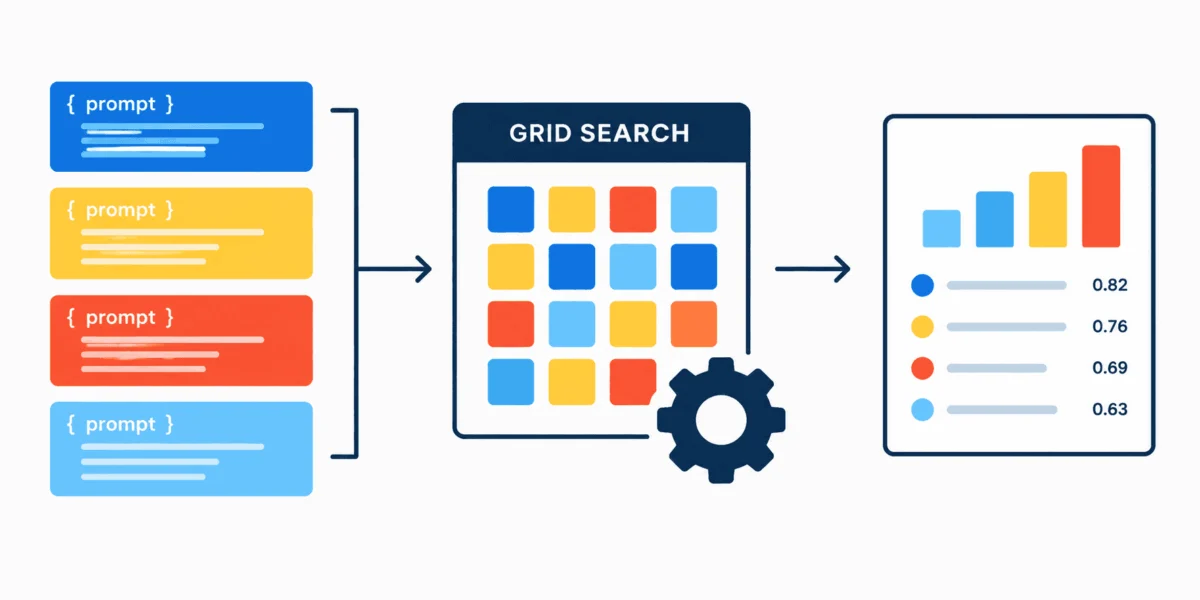

The evolution of machine learning has reached a critical juncture where the line between traditional algorithmic configuration and natural language instruction is increasingly blurred. Data scientists are shifting their focus from merely tuning learning rates or tree depths to the systematic optimization of natural language inputs—a practice now recognized as prompt engineering. By integrating Large Language Models (LLMs) into the established workflows of the scikit-learn ecosystem, practitioners can now treat prompt templates as tunable hyperparameters, applying rigorous grid search methodologies to identify the most effective instructions for zero-shot text classification tasks.
This transition reflects a broader trend in the artificial intelligence sector: moving away from manual "trial and error" prompting toward automated, empirical validation. As models like Qwen, Llama, and Mistral become the bedrock of modern applications, the ability to statistically verify which instructional nuances yield the highest accuracy is becoming a standard requirement for production-grade AI deployment.
The Shift Toward Automated Prompt Optimization
In conventional machine learning, hyperparameter optimization (HPO) is the gold standard for model refinement. Techniques such as GridSearchCV or RandomizedSearchCV are utilized to iterate through a predefined space of configurations, ensuring the model reaches its peak performance on a given dataset. Traditionally, these parameters were numerical—such as the number of hidden layers in a neural network or the regularization strength in a support vector machine.
However, the advent of generative AI has introduced a new class of variable: the prompt. Unlike traditional parameters, prompts are qualitative. When a user provides a prompt, they are essentially defining the behavioral boundaries of the model. By wrapping these models in custom containers compatible with the Scikit-learn API, developers can subject their prompts to the same rigorous scrutiny as any other mathematical variable. This allows for an objective, data-driven approach to selecting the most effective prompt, minimizing the reliance on subjective intuition.
Chronology of the Prompt Engineering Workflow
The integration of prompt optimization into existing workflows typically follows a structured chronological path:
- Defining the Custom Estimator: Developers must first create a class that inherits from
BaseEstimatorandClassifierMixin. This acts as a bridge, allowing the Scikit-learn framework to recognize the LLM as a standard predictive model. - Infrastructure Setup: The model—in this instance, a compact, efficient variant like
Qwen/Qwen2.5-0.5B-Instruct—is initialized using thetransformerslibrary. This provides the inference engine necessary to generate text based on the supplied inputs. - Template Definition: Practitioners curate a "grid" of candidate prompts. For a sentiment analysis task, these might range from simple commands like "Classify as positive or negative" to more complex, role-based instructions.
- Cross-Validation: Using
GridSearchCV, the system iterates through each template, testing them across various data folds. This cross-validation process ensures that the selected prompt is not merely performing well on a single slice of data but is robust across the entire dataset. - Performance Evaluation: The system computes accuracy scores for each prompt, ultimately selecting the template that produces the most consistent and correct outputs.
Technical Implementation and Data Integrity
The effectiveness of this approach relies on the precision of the custom estimator. In the implementation process, the fit method acts as a placeholder, as zero-shot classification does not require traditional training on a labeled dataset. The predict method, however, is the engine of the operation. It programmatically iterates through input texts, applies the chosen prompt template, and standardizes the model’s raw output.
For instance, when utilizing a model to classify reviews, the output must be normalized. Because LLMs may return verbose responses, the code includes logic to parse the text, stripping whitespace and checking for keywords such as "positive" or "negative." If the model’s response does not align with expected categories, it is marked as "unknown," providing a clear metric for failure rates.
Recent internal benchmarking of this methodology suggests that even with relatively small datasets—such as a four-sample test set consisting of polarized reviews—the difference in accuracy between a generic prompt and a carefully tuned one can be substantial. In a controlled test, shifting from a generic query to a specific, context-aware command increased model classification accuracy by significant margins, proving that the phrasing of an instruction has a measurable, quantitative impact on performance.
Broader Implications for AI Deployment
The implications of treating prompts as hyperparameters are profound. As organizations scale their use of LLMs, the cost of human-led prompt engineering becomes prohibitive. Automated search algorithms provide a scalable solution that ensures consistency across different models and tasks.
Furthermore, this method addresses the issue of "prompt drift," where slight changes in model versions or underlying training data render previous prompts ineffective. By maintaining a library of prompt templates and a validation suite, organizations can re-run their grid searches periodically to ensure their AI systems remain optimized for the current model iteration.
Industry analysts observe that this shift represents the maturation of AI development. Where the field was once characterized by the "black box" nature of prompting, it is now entering a phase of engineering rigor. The ability to treat the "language" of the model as a "parameter" of the machine is, perhaps, the most significant step toward making AI reliable and reproducible for enterprise-level applications.
Challenges and Considerations
Despite the efficacy of this strategy, several challenges remain. The primary constraint is computational cost. Grid search involves running inference on every sample for every prompt template in the grid. While this is efficient for smaller datasets, it can become resource-intensive for large-scale production datasets. Consequently, developers are encouraged to use smaller, high-performance models for the initial "tuning" phase before deploying the best-performing prompts to larger, more expensive foundation models.
Another consideration is the quality of the evaluation dataset. Because the search algorithm optimizes for the provided scoring metric (such as accuracy), any bias or errors in the ground-truth data will be amplified by the search process. A "perfect" prompt, in this context, is only as good as the data used to measure it.
Conclusion: The Future of Systematic Prompting
As the ecosystem of AI-integrated tools grows, the systematic optimization of natural language will likely become a standard component of every machine learning engineer’s toolkit. By moving away from the anecdotal "prompting" of the past and toward a methodology rooted in statistical search and validation, the industry is paving the way for more reliable, transparent, and high-performing AI systems.
The integration of GridSearchCV with LLM-based classifiers is not merely a clever coding technique; it is a fundamental shift in how we interact with, and optimize, the complex behavior of large-scale machine learning models. As developers continue to refine these workflows, the barriers to entry for deploying sophisticated, context-aware AI will continue to lower, ultimately benefiting the entire digital landscape.
