

When Jeff Barr published a modest blog post introducing the Amazon Elastic Compute Cloud (EC2) Beta twenty years ago, the technology industry viewed utility computing with a mixture of skepticism and curiosity. At its debut, the service offered a single virtual server instance type, designated as m1.small, hosted entirely within a single AWS Region in the United States. Billed strictly by the hour, these resizable Linux virtual servers gave developers the unprecedented ability to provision infrastructure programmatically, eliminating the capital-intensive and time-consuming process of procuring physical hardware.
That foundational release fundamentally altered global enterprise architecture. Over the subsequent twenty years, Amazon EC2 evolved from a minimalist utility into the bedrock of modern cloud computing, powering everything from straightforward web applications to massive, distributed artificial intelligence training clusters. As AWS celebrates this milestone, industry observers and enterprise leaders are reflecting on a two-decade trajectory that reshaped how software is built, scaled, and managed across the globe.
The Evolution of a Paradigm: Chronology and Key Milestones
The trajectory of Amazon EC2 is characterized by a relentless expansion of capabilities, addressing the complex demands of enterprise workloads through systematic innovation. The early years of the service were defined by the construction of core infrastructure components that transformed basic virtual servers into a comprehensive computing ecosystem.
In 2008, AWS launched Amazon Elastic Block Store (EBS), providing persistent, low-latency block storage volumes that could be attached to running EC2 instances, making it feasible to run stateful databases and enterprise applications in the cloud. The following year, 2009, marked a massive leap forward in application resilience and architecture. AWS introduced Elastic Load Balancing, Auto Scaling, and Amazon CloudWatch, equipping developers with the tools required to build highly available, fault-tolerant systems that could dynamically adjust capacity based on real-time demand.
Simultaneously, the introduction of Amazon Virtual Private Cloud (VPC) in 2009 addressed critical enterprise security and networking requirements by allowing organizations to provision logically isolated sections of the AWS cloud. This established a secure environment where traditional corporate data centers could safely extend into the public cloud.
As workloads diversified, hardware-level performance and cost efficiency became paramount. In 2017, AWS introduced the AWS Nitro System, an innovative combination of dedicated hardware and lightweight hypervisor software that offloaded virtualization functions, delivering near-bare-metal performance and enhanced security. A year later, in 2018, AWS released its first ARM-based custom silicon, AWS Graviton processors, engineered specifically to deliver optimal price-to-performance for scale-out workloads.
Scaling Globally: From Single Region to Edge and Telecommunications
While the initial iteration of EC2 was confined to a single geographic footprint, the service scaled in lockstep with the global enterprise demand for low-latency, localized data processing. Over twenty years, EC2 expanded from one original AWS Region to a vast global infrastructure spanning 39 geographic Regions worldwide.

Furthermore, AWS recognized that certain workloads required proximity beyond traditional data centers. This realization drove the development of specialized deployment models:
- AWS Outposts (2018): Brought native AWS infrastructure and operating models directly to on-premises data centers and local facilities.
- AWS Local Zones (2019): Placed compute, storage, and database services closer to large population and industry centers to support low-latency end-user applications.
- AWS Wavelength (2019): Embedded AWS compute and storage inside 5G telecommunications carrier networks, enabling ultra-low-latency mobile and edge applications.
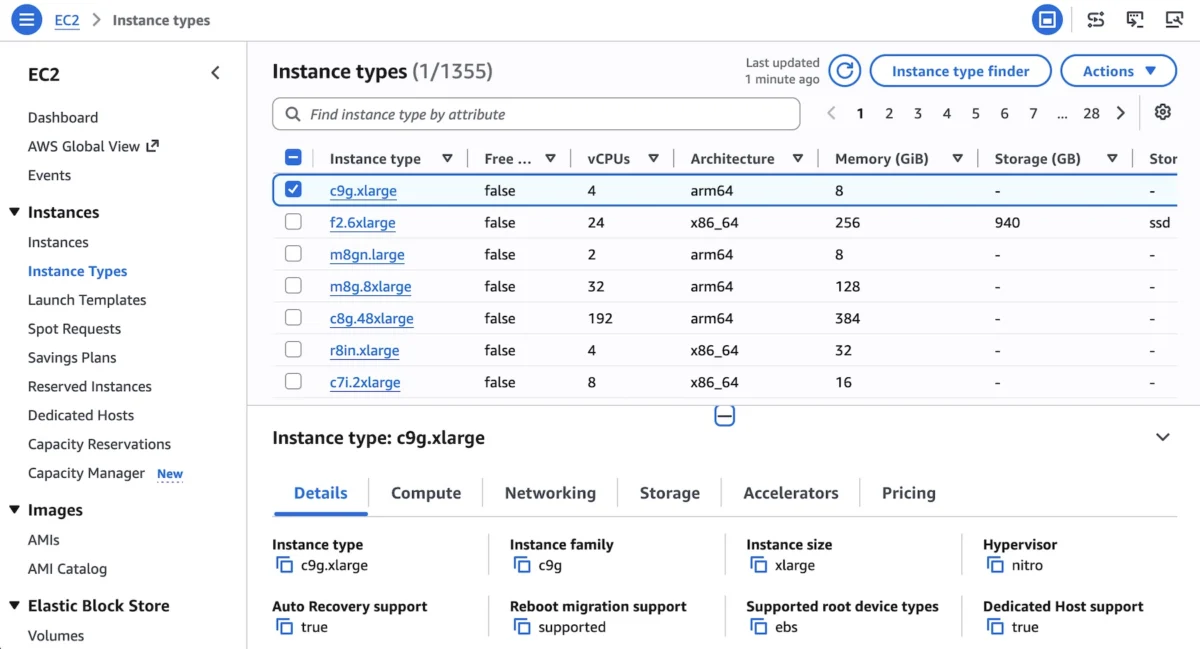
Today, the EC2 portfolio encompasses more than 1,200 distinct instance types. These are meticulously categorized into families optimized for general-purpose computing, compute-intensive operations, memory-heavy database workloads, high-performance storage, accelerated computing (featuring advanced GPUs), and high-performance computing (HPC) clusters.
The Foundation of Modern Cloud Ecosystems and AI Workloads
Despite the astronomical expansion in instance varieties and deployment form factors, the core value proposition of Amazon EC2 has remained steadfast: providing secure, resizable compute capacity on demand, with a pay-as-you-go pricing model that frees organizations from long-term financial commitments.
Crucially, EC2 serves as the underlying compute layer for nearly the entire AWS product portfolio. Higher-level services—including Amazon ECS, Amazon EKS, AWS Lambda, AWS Fargate, AWS Batch, Amazon EMR, and cutting-edge artificial intelligence platforms like Amazon SageMaker AI and Amazon Bedrock—ultimately rely on EC2 capacity to execute their operations. Every architectural paradigm conceived over the past two decades, from modest monolithic websites to trillion-parameter foundation model training runs, traces its operational roots back to the execution of an EC2 instance launch.
In recent years, the explosive growth of generative artificial intelligence has placed unprecedented demands on cloud infrastructure. AWS has responded by adapting EC2 to support massive, highly parallelized AI workloads, integrating advanced machine learning accelerators and custom silicon designed to train and deploy complex neural networks at scale—a requirement that was entirely unanticipated when the service debuted in 2006.
Strategic Implications and Future Outlook
The longevity and sustained market dominance of Amazon EC2 offer valuable lessons in technology strategy. By adhering to a philosophy of building minimal-yet-useful core services, launching rapidly, and iterating continuously based on direct customer feedback, AWS established a resilient platform capable of absorbing decades of technological disruption.
Industry analysts note that the success of EC2 fundamentally redefined enterprise IT budgets, shifting capital expenditure (CapEx) to operational expenditure (OpEx) and democratizing access to enterprise-grade computing power for startups and multinational corporations alike. As organizations increasingly migrate mission-critical systems and embrace generative AI transformation, the foundational reliability of virtualized compute remains non-negotiable.
Looking ahead, the next twenty years of cloud computing will undoubtedly demand architectural capabilities, performance thresholds, and security paradigms that are currently difficult to conceptualize. However, as the foundational engine of modern digital infrastructure, Amazon EC2 is positioned to remain the primary vehicle through which organizations run their most critical workloads, adapting to whatever technological shifts lie on the horizon.
