
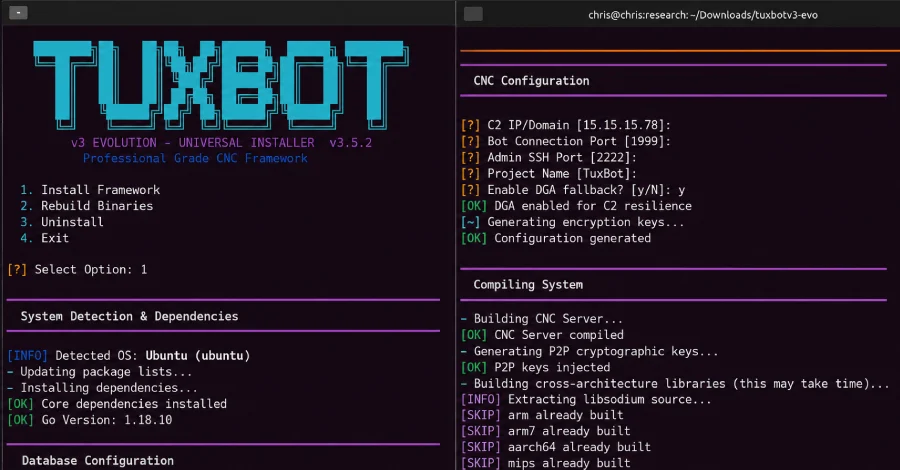

Cybersecurity researchers from Palo Alto Networks’ Unit 42 have uncovered and disclosed intricate details regarding a previously undocumented Internet-of-Things (IoT) botnet framework, christened TuxBot v3 Evolution. This new threat actor shows unsettling signs of having been developed with the assistance of a large language model (LLM), marking a significant, albeit imperfect, foray into AI-augmented cybercrime. The discovery serves as a stark warning about the evolving landscape of malicious software development, even as it highlights the current limitations of AI when unsupervised.
The research unveiled a peculiar anomaly within the botnet’s code: an embedded safety disclaimer generated by the assisting LLM, which the developer conspicuously failed to remove. This oversight provides a rare glimpse into the development process, indicating a reliance on AI that, at this stage, still requires substantial human oversight. "While the AI complied with their request to generate botnet code, it included a safety disclaimer that the developer failed to remove before shipping," stated the Palo Alto Networks Unit 42 report. The researchers further elaborated, "Although the LLM clearly aided in constructing the botnet, several functions in the analyzed samples failed to work correctly." This points to a nascent stage of AI integration in botnet creation, where the technology can accelerate certain aspects but has not yet perfected the art of robust, flawless malicious code generation. Cybersecurity experts generally concur that a thorough manual code review would have likely rectified these errors, raising concerns that more polished, fully functional iterations of this malware might already exist or are under development by more meticulous threat actors.
The Growing Shadow of AI in Cybercrime
The emergence of TuxBot v3 Evolution underscores a burgeoning concern within the cybersecurity community: the potential misuse of advanced AI, particularly large language models, by malicious actors. LLMs possess the capability to generate code, translate between programming languages, and even assist in complex problem-solving, skills that can be repurposed for nefarious ends. While initially lauded for their potential to democratize technology and enhance productivity, these same attributes make them attractive tools for cybercriminals looking to streamline their operations, accelerate development cycles, or even lower the technical barrier for entry into sophisticated cyberattacks.
The case of TuxBot v3 Evolution offers a concrete, albeit imperfect, example of this trend. The fact that an LLM was seemingly instrumental in constructing portions of the botnet suggests that threat actors are actively experimenting with these powerful tools. This development is particularly alarming because it hints at a future where even less-skilled individuals could potentially leverage AI to create complex and multi-faceted cyber threats that would traditionally require extensive programming expertise. The presence of the unremoved safety disclaimer, while a comedic oversight from a technical standpoint, provides critical forensic evidence, affirming the direct involvement of an LLM in the botnet’s genesis. It highlights the experimental nature of this specific project, yet simultaneously serves as a harbinger of more sophisticated, AI-enhanced attacks to come.

Deconstructing TuxBot v3 Evolution: A Modular and Ambitious Framework
TuxBot v3 Evolution is not merely a rudimentary piece of malware; it is a sophisticated, modular framework designed for comprehensive IoT device compromise and distributed denial-of-service (DDoS) attacks. Its architecture is indicative of a developer with significant ambition, aiming for a robust and resilient botnet.
The framework is composed of several distinct, yet interconnected, components:
- C-based Bot Agent: This core component is meticulously designed for cross-compilation across a wide array of architectures. This includes common IoT processor types such as ARM, MIPS, MIPSEL, MIPS64, x86_64, PowerPC, and RISC-V. This extensive compatibility ensures that the botnet can infect a diverse ecosystem of IoT devices, from routers and network-attached storage (NAS) to smart cameras and industrial control systems, maximizing its potential reach and impact. The choice of C for the bot agent suggests a focus on low-level control, efficiency, and a small footprint, critical for resource-constrained IoT devices.
- Go-based Command-and-Control (C2) Server with DDoS-for-Hire Panel: The C2 server, written in Go, provides a robust and scalable backend for managing compromised bots and orchestrating attacks. Go’s concurrency features and performance make it an ideal language for handling large numbers of connections from bot agents. The inclusion of a "DDoS-for-hire panel" signifies the botnet’s monetization strategy, allowing the developer or other affiliated cybercriminals to lease out the botnet’s attacking capabilities to third parties, a common model in the cybercrime underground.
- Custom Exploit Virtual Machine: This component is particularly intriguing, suggesting a sophisticated approach to vulnerability exploitation. A custom exploit VM could allow the botnet to dynamically adapt its attack vectors, test new exploits, or even emulate target environments to ensure exploit efficacy, making it a highly adaptable threat.
- Docker-based Test Infrastructure: The use of Docker containers for testing points to a modern, DevOps-like approach to malware development. This allows for rapid prototyping, consistent testing environments, and efficient deployment of different botnet modules, accelerating the development and refinement process.
- Automated Build System: An automated build system further supports this modern development paradigm, enabling the rapid compilation and deployment of botnet components for various architectures and functionalities, streamlining the entire development lifecycle.
Infection Vectors and Advanced Communication Mechanisms
The bot agent employs a dual-pronged approach to compromise target devices:
- Telnet Brute-Forcing: The botnet actively attempts to brute-force Telnet access on targeted devices using a predefined list of 1,496 credential pairs. This method exploits the widespread issue of weak or default credentials on many IoT devices, a persistent security vulnerability that manufacturers and users often neglect. Telnet, an unencrypted protocol, also makes credential sniffing easier for attackers.
- Exploitation of Known Vulnerabilities: Beyond brute-forcing, TuxBot v3 Evolution incorporates exploit code designed to target over 30 distinct IoT device families. This strategy leverages known vulnerabilities (N-day exploits) for which patches may exist but are often not applied by users or manufacturers. The vast number of unpatched IoT devices connected to the internet provides a fertile ground for such exploits, making them highly effective.
The botnet’s communication with its C2 server is designed for resilience and evasion, employing multiple sophisticated mechanisms:
- Encrypted TCP Channel: Primary communication occurs over an encrypted TCP channel, ensuring confidentiality and making it harder for network defenders to snoop on botnet commands and exfiltrated data.
- SHA512 Domain Generation Algorithm (DGA): As a fallback, the botnet utilizes a SHA512-based DGA. DGAs dynamically generate new C2 domain names, making it difficult for security services to block communication by simply blacklisting static IP addresses or domain names. The use of SHA512 suggests a robust and less predictable generation scheme.
- Peer-to-Peer (P2P) Gossip Protocol with Ed25519-signed Commands: This advanced P2P mechanism provides a highly resilient and decentralized communication layer. If direct C2 communication is disrupted, bots can communicate with each other to relay commands and maintain network cohesion. Ed25519 digital signatures ensure the authenticity and integrity of commands, preventing unauthorized parties from injecting malicious instructions.
- Internet Relay Chat (IRC), DNS TXT Queries, and HTTP Polling: These serve as additional fallback mechanisms, demonstrating the botnet’s layered approach to ensuring persistent communication. IRC channels are a classic, low-resource method for C2, while DNS TXT records can be used to covertly transmit small pieces of data or C2 addresses. HTTP polling, a common web communication method, helps blend C2 traffic with legitimate web traffic, aiding evasion.
Once launched on a compromised device, the botnet executes a predefined initialization sequence, which includes setting up persistence mechanisms such as systemd services, cron entries, and a watchdog keepalive process. These ensure that TuxBot remains operational even after device reboots or attempts to terminate its processes, maintaining its foothold on the compromised machine. The dedicated HTTP scanner, capable of managing up to 128 concurrent connections, further bolsters its capabilities by actively discovering vulnerable web interfaces, potentially expanding its reach within a compromised network or discovering new targets.

A Chronology of Development and Linkages
The history of TuxBot v3 Evolution, as pieced together by Unit 42, indicates a development trajectory rooted in existing botnet methodologies and open-source tools. The framework’s lineage has been traced back to three prominent botnets: Mirai, AISURU, and Wuhan. Mirai, infamous for its role in major DDoS attacks like the 2016 attack on Dyn, established the blueprint for leveraging vulnerable IoT devices. AISURU and Wuhan represent more recent evolutions, often incorporating new exploitation techniques and C2 resilience.
A significant point in TuxBot’s development timeline is the partial porting of functions from the open-source MHDDoS Python DDoS toolkit. MHDDoS is a widely available tool used for various types of DDoS attacks, and its integration suggests the TuxBot developer leveraged existing, proven codebases to accelerate their own project. Evidence suggests that the work on TuxBot v3 Evolution commenced approximately one year prior to January 2026, when the author was observed cloning the MHDDoS repository from GitHub. This establishes a clear starting point for its development. The first tangible evidence of the botnet’s operational status emerged on January 20, 2026, when at least one sample of the malware was uploaded to the VirusTotal platform. This upload indicates that TuxBot v3 Evolution had been actively developed and likely deployed or tested for over six months, signifying its presence in the wild and the ongoing threat it represents.
The framework’s own description, as uncovered by researchers Chris Navarrete, Asher Davila, and Doel Santos, paints a picture of ambitious intent: the developer aimed to build a "professional-grade C2 framework platform with a multi-user admin panel, automated deployment, and modular attack capabilities." This self-assessment, juxtaposed with the technical flaws discovered by Unit 42, highlights a disconnect between the developer’s aspiration and the current execution, perhaps due to the experimental nature of integrating AI in this context.
The Keksec Ecosystem and Broader Implications
Perhaps the most concerning aspect of TuxBot v3 Evolution is its connection to the notorious Keksec ecosystem. Unit 42’s analysis revealed shared infrastructure with Kaitori v3.9 and AISURU tooling, firmly placing the TuxBot operator within this established cybercriminal group. Keksec is widely recognized for its propensity to operate multiple IoT botnet variants concurrently, diversifying its attack capabilities and maximizing its illicit gains. TuxBot v3 Evolution appears to be another variant in Keksec’s expanding portfolio, signaling their continuous efforts to innovate and refine their malicious tools.
While this version of TuxBot may contain functional errors, its ambition to move beyond the typical Mirai fork is evident through its encrypted C2, advanced DGA, and a modular exploit system. The fact that this sophisticated framework, even with its current imperfections, was developed with apparent AI assistance carries profound implications for the future of cybersecurity. It foreshadows a landscape where AI tools, readily available and increasingly powerful, could dramatically lower the barrier to entry for developing complex malware, allowing individuals with less specialized knowledge to orchestrate sophisticated attacks.

The ongoing vulnerability of IoT devices exacerbates this threat. Despite repeated warnings, a vast number of IoT devices remain poorly secured, featuring weak default credentials, unpatched firmware, and inadequate network segmentation. This creates an ever-expanding attack surface that botnets like TuxBot v3 Evolution are designed to exploit. The continuous stream of new botnets, such as the recently disclosed RustDuck and AryStinger – which target routers, IP cameras, Android boxes, and poorly secured servers for reconnaissance and DDoS activities – underscores the pervasive and escalating nature of this threat.
Recommendations for a Safer IoT Future
The discovery of TuxBot v3 Evolution serves as a critical call to action for device manufacturers, service providers, and end-users alike. Manufacturers must prioritize security by design, implementing strong default security settings, providing regular firmware updates, and ensuring clear communication about security best practices. Service providers need to implement robust network monitoring and anomaly detection systems to identify and mitigate botnet activity. For end-users, vigilance is paramount: changing default passwords immediately, keeping device firmware updated, and segmenting IoT devices on a separate network can significantly reduce the risk of compromise.
Moreover, the cybersecurity industry must intensify its research into the defensive applications of AI, developing AI-powered tools that can detect, analyze, and predict AI-generated malware. Collaboration between researchers, law enforcement, and technology companies is essential to stay ahead of these rapidly evolving threats. The current flaws in TuxBot v3 Evolution offer a brief reprieve, but the underlying trend of AI-assisted cybercrime suggests that more potent and sophisticated botnets are on the horizon. The fight against AI-powered threats will require an equally advanced and adaptable defense strategy.
