

The landscape of modern enterprise technology underwent a permanent transformation two decades ago when Amazon Web Services introduced the public beta of Amazon Elastic Compute Cloud, universally known as Amazon EC2. Authored initially by Jeff Barr in a modest blog post, the launch offered a single virtual server type—the modest m1.small Linux instance—billed by the hour within a solitary region in the eastern United States. What began as a rudimentary utility tool has since evolved into the foundational bedrock of the global cloud computing economy, powering everything from garage startups to trillion-dollar enterprises, government agencies, and massive artificial intelligence training clusters.
As Amazon EC2 celebrates its twentieth anniversary, industry analysts and technologists are reflecting on a journey that fundamentally decoupled software development from physical hardware procurement. Before 2006, deploying a new application required weeks or months of capital expenditure, physical server provisioning, rack space leasing, and complex supply chain logistics. EC2 introduced elastic, on-demand compute capacity accessible via simple application programming interfaces, turning physical infrastructure into a fluid, software-defined resource.
The Evolution of an Industry Pioneer: A Chronological Milestone
The growth of Amazon EC2 did not happen overnight; it was forged through two decades of relentless architectural iteration, hardware innovation, and geographic expansion. Understanding the trajectory of cloud computing requires examining the key chronological milestones that built the modern digital world.
In 2006, the launch of the EC2 beta established the baseline concept of resizable cloud compute. However, the service quickly outgrew its experimental phase. By 2008, Amazon introduced Amazon Elastic Block Store (EBS), solving a critical limitation by providing persistent, low-latency block storage volumes designed specifically for EC2 instances. This allowed databases and stateful applications to run reliably in the cloud for the first time.

The following year, 2009, marked a massive leap in enterprise readiness. AWS rolled out Elastic Load Balancing, Auto Scaling, and Amazon CloudWatch, equipping developers with the tools needed to build highly available, fault-tolerant, and self-healing architectures. Concurrently, the introduction of Amazon Virtual Private Cloud (VPC) gave organizations the ability to provision logically isolated networks within the AWS cloud, satisfying strict corporate security and compliance requirements.
As workloads scaled globally, the underlying hardware infrastructure required a radical redesign. In 2017, AWS introduced the AWS Nitro System, a combination of dedicated hardware and lightweight hypervisor software that offloaded virtualization functions from the main CPU, resulting in enhanced security, increased performance, and faster delivery of new instance types. Building on this custom silicon strategy, AWS launched its proprietary Arm-based AWS Graviton processors in 2018, providing customers with exceptional price-performance ratios for scale-out workloads.
Geographic expansion mirrored this technological maturation. From a single region, EC2 has scaled to encompass 39 geographic regions worldwide. Furthermore, AWS broke the traditional boundary of centralized data centers by introducing AWS Outposts in 2018 for local on-premises execution, AWS Local Zones in 2019 for ultra-low-latency applications in major metropolitan areas, and AWS Wavelength in 2019 to embed compute power directly inside global 5G telecommunications networks.
From Simple Web Servers to Accelerated AI Supercomputing
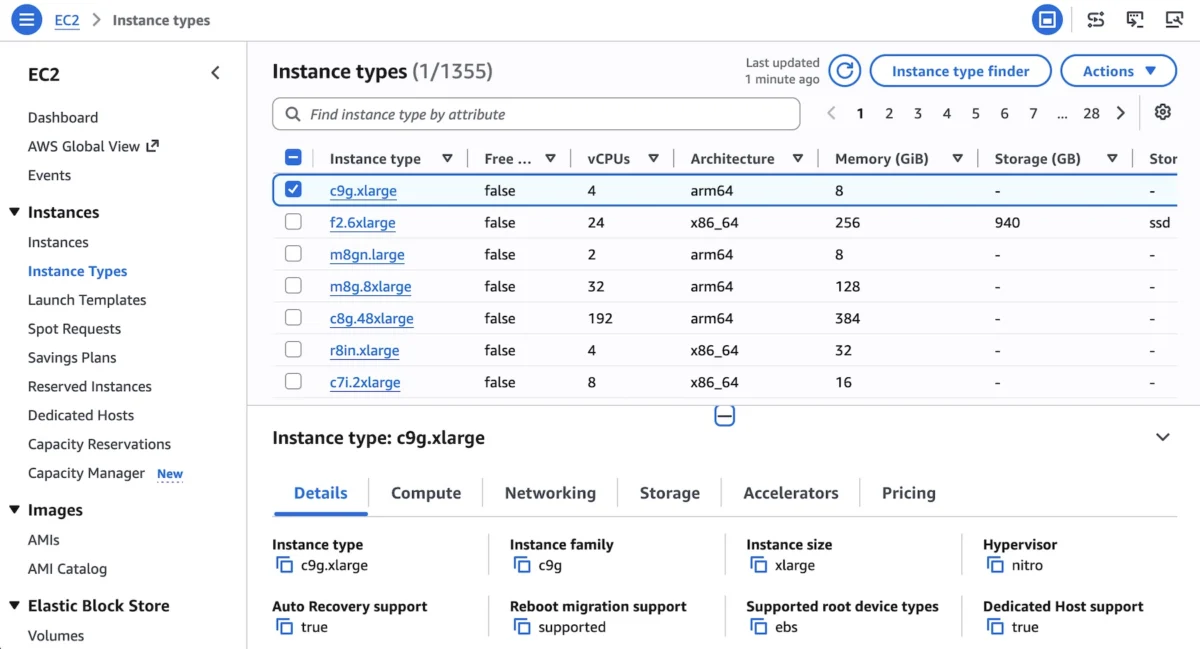
Today, the scale of Amazon EC2 defies the modest expectations of its creators. The service has expanded from a single instance type to a sprawling portfolio comprising more than 1,200 distinct instance types. These specialized configurations are tailored for general-purpose computing, memory-intensive databases, storage-optimized analytics, high-performance computing (HPC), and heavily accelerated machine learning workloads.
Over the past five years, the acceleration of generative artificial intelligence has pushed EC2 into uncharted territory. Modern enterprise AI models, featuring parameters scaling into the hundreds of billions, require massive clusters of specialized graphics processing units and custom neural network accelerators. EC2 has risen to this challenge, serving as the primary infrastructure layer for training and deploying state-of-the-art foundational models.

Industry observers and technical leadership at AWS frequently emphasize that EC2 is not merely a standalone product, but the hidden engine powering nearly every modern AWS service. Higher-level abstractions—including container orchestrators like Amazon ECS and Amazon EKS, serverless computing via AWS Lambda and AWS Fargate, managed data processing through Amazon EMR, and specialized machine learning platforms like Amazon SageMaker AI and Amazon Bedrock—all ultimately rely on underlying EC2 capacity to execute workloads.
Economic and Strategic Implications for the Enterprise
The widespread adoption of Amazon EC2 over the past twenty years has left an indelible mark on global economics, corporate IT budgeting strategies, and software development methodologies. By eliminating the high up-front capital expenditures historically associated with data center construction, EC2 democratized access to enterprise-grade computing power. Small startups with limited seed funding gained the ability to scale infrastructure dynamically to match viral user growth, leveling the playing field against established corporate legacy giants.
From a strategic standpoint, the architecture pioneered by EC2 forced legacy hardware vendors, enterprise software providers, and traditional telecommunications companies to completely overhaul their business models. The shift from perpetual software licensing and physical server ownership toward consumption-based, utility-style pricing models has become the definitive standard for the modern technology sector.
Furthermore, the environmental implications of cloud-scale computing have drawn significant scrutiny and praise. Concentrating millions of workloads into hyper-scale, highly optimized AWS data centers has historically yielded significantly higher energy efficiencies and lower carbon footprints per workload compared to thousands of underutilized, on-premises corporate server rooms.
Looking Ahead: The Next Decade of Cloud Infrastructure

As Amazon EC2 enters its third decade, leadership within AWS maintains that the core philosophy established in 2006 remains unchanged: providing secure, resizable compute capacity on demand, enabling customers to pay exclusively for what they consume without long-term commitments.
However, the operational environment of the next twenty years will present entirely new challenges. The explosive demand for real-time artificial intelligence inference, the rise of edge computing, and the integration of quantum computing capabilities will require infrastructure designs that are presently in their infancy.
Industry analysts project that the next era of cloud computing will be defined by hyper-specialized silicon, deeply distributed network fabrics, and automated, AI-driven infrastructure management. As these transformative paradigms take shape, Amazon EC2 is positioned to remain the central pillar upon which global digital transformation is constructed. Whether an enterprise is launching a basic web application or training a trillion-parameter artificial intelligence model, the architectural journey of modern computing will continue to begin with a single, foundational decision to launch an instance.
