

Modern enterprise environments face an escalating volume of sophisticated cyberthreats, making granular network access control and centralized identity management more critical than ever before. As organizations expand their digital perimeters to accommodate remote workforces, multi-cloud architectures, and a proliferation of Internet of Things (IoT) devices, the complexity of securing network infrastructure grows exponentially. Within the Windows Server ecosystem, Microsoft’s Network Policy Server (NPS) serves as a foundational tool designed to meet these security demands, functioning as a robust implementation of the Remote Authentication Dial-In User Service (RADIUS) protocol. By centralizing authentication, authorization, and accounting (AAA), NPS enables system administrators to enforce rigorous security policies across both wired and wireless enterprise networks, mitigating vulnerabilities before unauthorized entities can exploit them.
The evolution of remote access and authentication protocols dates back to the early days of widespread internet connectivity and dial-up networking. In 1991, the concept of a centralized authentication framework was formalized with the introduction of the RADIUS protocol, designed to streamline how network access servers verified user credentials without requiring localized databases on every piece of hardware. Over the subsequent decades, as enterprise architectures transitioned from simple local area networks to complex hybrid and distributed infrastructures, RADIUS remained an enduring standard. Microsoft integrated this protocol directly into its server operating systems, eventually evolving Internet Authentication Service (IAS) into the modern Network Policy Server beginning with Windows Server 2008. This historical trajectory highlights the enduring reliance of enterprise IT on standardized AAA frameworks to maintain operational continuity and data integrity.
At its core, NPS operates on the foundational principles of the AAA framework—Authentication, Authorization, and Accounting—each fulfilling a distinct and vital function in network security. Authentication represents the initial gatekeeping phase, wherein a user or device attempting to connect to the network presents credentials, such as a username, password, or digital certificate. The RADIUS server queries its internal database or integrates with Active Directory Domain Services (AD DS) to verify these credentials against authorized records. Once the identity of the user or device is successfully confirmed, the process shifts to Authorization. This second phase dictates precisely what network segments, applications, and resources the authenticated entity is permitted to access, ensuring that standard employees cannot access restricted administrative domains. Finally, the Accounting phase logs the lifecycle of the connection, tracking metrics such as session duration, data transfer volumes, and accessed services. These records are indispensable for internal auditing, regulatory compliance, and capacity planning.

Deploying NPS within an enterprise infrastructure provides distinct operational and security advantages that directly address the pain points of decentralized network management. By centralizing user policies, IT administrators eliminate the administrative overhead associated with configuring individual access rules on disparate wireless access points, virtual private network (VPN) gateways, and switches. Furthermore, NPS facilitates compliance with rigorous regulatory frameworks, such as the Health Insurance Portability and Accountability Act (HIPAA), the Payment Card Industry Data Security Standard (PCI-DSS), and the General Data Protection Regulation (GDPR). These regulations mandate strict auditing controls and restricted data access—capabilities that are inherently supported by the comprehensive logging and policy enforcement mechanisms native to NPS. Industry analysts frequently emphasize that centralized policy enforcement significantly reduces the attack surface of an enterprise, lowering the likelihood of human error during configuration updates.
To fully understand the versatility of NPS, system administrators must examine its three primary operational roles within an IT ecosystem: functioning as a RADIUS server, a RADIUS proxy, and a network policy server. In its capacity as a RADIUS server, NPS directly handles inbound authentication and authorization requests from network access servers, validating credentials against predefined security rules. When deployed as a RADIUS proxy, NPS acts as an intermediary, forwarding connection requests to external or remote RADIUS servers across different domains or administrative boundaries. This proxy functionality is particularly valuable for multi-tenant environments, federated networks, or large enterprises requiring load balancing and failover mechanisms to maintain high availability. Lastly, in its role as a network policy server, the software evaluates specific conditions—such as the time of day, group membership, and device compliance health—before granting network access, providing administrators with a granular level of control that static configurations cannot achieve.
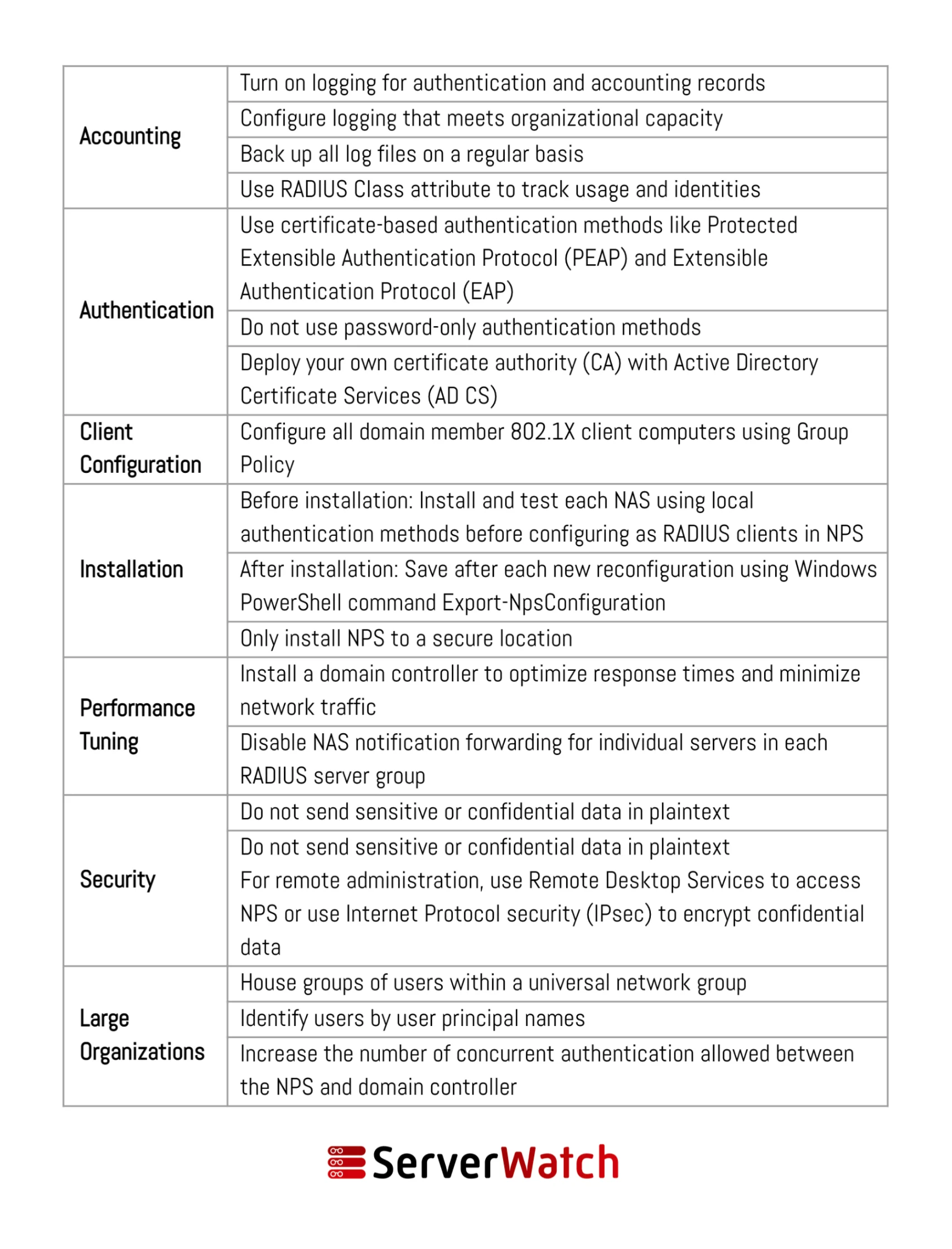
Despite the robust security framework provided by NPS, enterprise deployments require careful planning and adherence to established best practices to prevent misconfigurations that could compromise network integrity. Security professionals recommend several key guidelines when managing an NPS deployment. First, administrators should regularly back up NPS configuration settings and database policies to ensure rapid disaster recovery in the event of hardware or software failure. Second, strong cryptographic standards, such as Protected Extensible Authentication Protocol (PEAP) or Transport Layer Security (TLS), must be enforced for all RADIUS client-server communications to prevent credential interception or man-in-the-middle attacks. Additionally, organizations should implement redundant NPS servers to guarantee high availability, ensuring that authentication services remain operational even if a primary domain controller or server experiences downtime. Routine auditing of NPS event logs is also essential for identifying anomalous access attempts and potential security breaches early in their lifecycle.
As network architectures continue to evolve in response to zero-trust security models and cloud-first migrations, the role of centralized policy enforcement remains as critical as ever. While newer cloud-based identity and access management (IAM) solutions have emerged, traditional on-premises infrastructure heavily relies on tools like NPS to secure foundational network connectivity. By maintaining strict adherence to AAA principles, leveraging the multi-faceted roles of RADIUS servers and proxies, and following rigorous management best practices, organizations can fortify their defenses against modern cyber threats. Ultimately, the effective deployment of Network Policy Server transforms chaotic, decentralized access points into a cohesive, secure, and easily manageable enterprise network environment.
