

All digital data and systems, from the cloud platforms powering global applications to the personal accounts and company websites we interact with daily, ultimately reside on tangible hardware. The terms "virtual server" and "physical server" do not denote an abstract versus concrete existence, but rather describe distinct architectural approaches to how these machines are structured and utilized. This distinction is crucial for understanding the bedrock of modern computing infrastructure.
The Tangible Reality: Defining the Physical Server
A physical server, also known as a bare metal server, is a self-contained computing unit comprising all essential hardware components: a chassis, central processing unit (CPU), potentially a graphics processing unit (GPU), random-access memory (RAM), storage drives, a power supply unit, and a network interface. Beyond the hardware, it runs an operating system (OS) and server application software designed for continuous operation, typically 24/7. Unlike general-purpose computers, physical servers are engineered to perform specific tasks, serving requests from other computers, whether for hosting websites, managing databases, or running other critical server functions. The size of the machine, from a compact desktop form factor to a large rack-mounted unit, and its physical location, are irrelevant to its classification as a physical server.
Key Features of Physical Servers:
- Dedicated Resources: The primary advantage of a physical server is that it allocates all its hardware resources exclusively to the tasks it performs. This exclusivity translates to predictable and often superior performance, as there is no competition for CPU cycles, memory, or I/O bandwidth.
- Enhanced Security and Isolation: With all resources dedicated, physical servers offer a high degree of isolation from other systems. This is particularly important for sensitive data or applications with stringent security requirements, as there’s no risk of resource contention or "noisy neighbor" issues that can sometimes arise in shared virtualized environments.
- Direct Hardware Access: Administrators have direct, unmediated access to the underlying hardware. This can be critical for low-level system tuning, troubleshooting hardware-specific issues, or when specialized hardware accelerators are required.
- Raw Performance Potential: For workloads that demand maximum processing power, low latency, and high throughput, a well-configured physical server can often outperform its virtualized counterparts, especially when dealing with I/O-intensive operations or computationally heavy tasks.
Historical Context and Evolving Use Cases:
In the early 2000s, the vast majority of the world’s server infrastructure consisted of physical servers. Businesses typically owned and operated their own dedicated hardware to power their IT systems. This model, while robust, was often characterized by significant upfront capital expenditure, complex management, and underutilization of resources, as servers were often provisioned for peak loads that rarely materialized.
Today, while virtual machines (VMs) dominate global server workloads, physical servers retain a vital role in modern IT landscapes. They are indispensable for specific demanding applications where performance, security, and dedicated resource control are paramount.
Popular Use Cases for Physical Servers:
- High-Performance Computing (HPC): Complex simulations, scientific research, and advanced analytics often require the raw processing power and dedicated resources that only physical servers can reliably provide.
- Large-Scale Databases: Mission-critical, high-transaction databases that demand extreme I/O performance and low latency often benefit from the dedicated resources of a physical server.
- Game Servers: For massively multiplayer online games (MMOs) or competitive esports, the predictable low latency and consistent performance of physical servers are crucial for a smooth player experience.
- Video Rendering and Content Creation: Demanding media production workflows, such as 3D rendering and video editing, can leverage the full processing capabilities of physical machines for faster turnaround times.
- Legacy Systems: Some older applications may not be compatible with or perform optimally in virtualized environments, necessitating the use of physical hardware.
- Edge Computing: In scenarios where data needs to be processed very close to its source, and network latency is a critical factor, dedicated physical servers deployed at the "edge" are often employed.
Industries Relying on Physical Servers:
Sectors that place a premium on reliability, uncompromised performance, stringent security, and direct hardware control continue to utilize physical servers extensively. These include:
- Financial Services: High-frequency trading platforms, core banking systems, and fraud detection systems demand the lowest possible latency and highest levels of security.
- Healthcare: Patient record management systems, medical imaging processing, and specialized diagnostic software often require dedicated, secure, and high-performance hardware.
- Government and Defense: National security applications, classified data processing, and critical infrastructure management necessitate the highest levels of isolation and control.
- Aerospace: Complex simulations for flight dynamics, aircraft design, and mission planning rely on powerful, dedicated computing resources.
- Manufacturing: Industrial control systems, real-time production monitoring, and specialized robotics often require dedicated, low-latency physical hardware.
- Telecommunications: Core network infrastructure, real-time call processing, and high-throughput data handling are often managed on specialized physical servers.
The Abstract Power: Understanding the Virtual Server
A virtual server, or virtual machine (VM), is essentially a software-based emulation of a physical server. It is created using virtualization technology, which allows a single physical server to be divided into multiple isolated virtual environments. Each VM operates as an independent server, possessing its own operating system, applications, and allocated resources (CPU, RAM, storage, network interfaces) that are drawn from the underlying physical hardware. Virtualization is the cornerstone of cloud computing, enabling cloud providers to efficiently pool and allocate hardware resources to a vast number of customers, maximizing hardware utilization and offering scalable, on-demand computing power.
The concept can be illustrated by imagining a powerful, state-of-the-art physical server. Instead of dedicating this entire machine to a single user or application, virtualization software (a hypervisor) carves it up into smaller, distinct units. Each of these units acts as a standalone virtual server, capable of running its own OS and applications, completely isolated from other VMs sharing the same physical hardware.
Key Features of Virtual Servers:
- Resource Flexibility and Scalability: VMs can be easily scaled up or down by reallocating resources from the underlying physical server, or by migrating them to more powerful hardware. This agility is a hallmark of cloud computing.
- Cost-Effectiveness at Scale: While virtualization technology itself can be complex, the ability to host multiple VMs on a single physical server significantly reduces hardware acquisition costs, power consumption, and physical space requirements, especially when deployed in large numbers.
- Rapid Deployment and Provisioning: New virtual servers can be spun up in minutes, rather than the hours or days it might take to procure, install, and configure a physical server.
- Enhanced Disaster Recovery and Business Continuity: VMs can be easily backed up, replicated, and migrated to different physical hardware. This facilitates rapid recovery in the event of hardware failure or a disaster.
- Portability and Migration: Virtual servers are essentially software constructs that can be easily copied, moved, and restored across different physical hosts, simplifying maintenance, upgrades, and load balancing.
The Rise of Virtualization and Cloud Computing:
The widespread adoption of virtualization technology, particularly since the mid-2000s, has been a transformative force in the IT industry. It paved the way for the massive growth of cloud computing services offered by giants like Amazon Web Services (AWS), Microsoft Azure, and Google Cloud Platform (GCP). These providers leverage massive data centers filled with physical servers, which are then virtualized to offer a broad spectrum of services to businesses of all sizes.

Ubiquitous Use Cases for Virtual Servers:
The applications for virtual servers are virtually limitless, underpinning much of the digital world we interact with daily.
- Web Hosting: The vast majority of websites today are hosted on virtual servers, allowing for cost-effective and scalable solutions.
- Application Development and Testing: Developers frequently use VMs to create isolated environments for building, testing, and debugging applications without impacting production systems.
- Software as a Service (SaaS): Many SaaS applications run on virtualized infrastructure, providing users with access to powerful software without the need for local installation.
- Database Management: Virtual servers are commonly used to host databases, offering flexibility in scaling and management.
- Virtual Desktops (VDI): Users can access their desktop environments from any device, with the actual computing happening on virtual servers in a data center.
- Cloud Computing: As mentioned, VMs are the fundamental building blocks of public, private, and hybrid cloud environments.
- Big Data Analytics: While some big data workloads benefit from physical servers, many can be efficiently handled on virtualized clusters.
- Containerization (e.g., Docker, Kubernetes): While distinct from VMs, containerization technologies often run on top of virtual servers, offering even more granular resource allocation and application isolation.
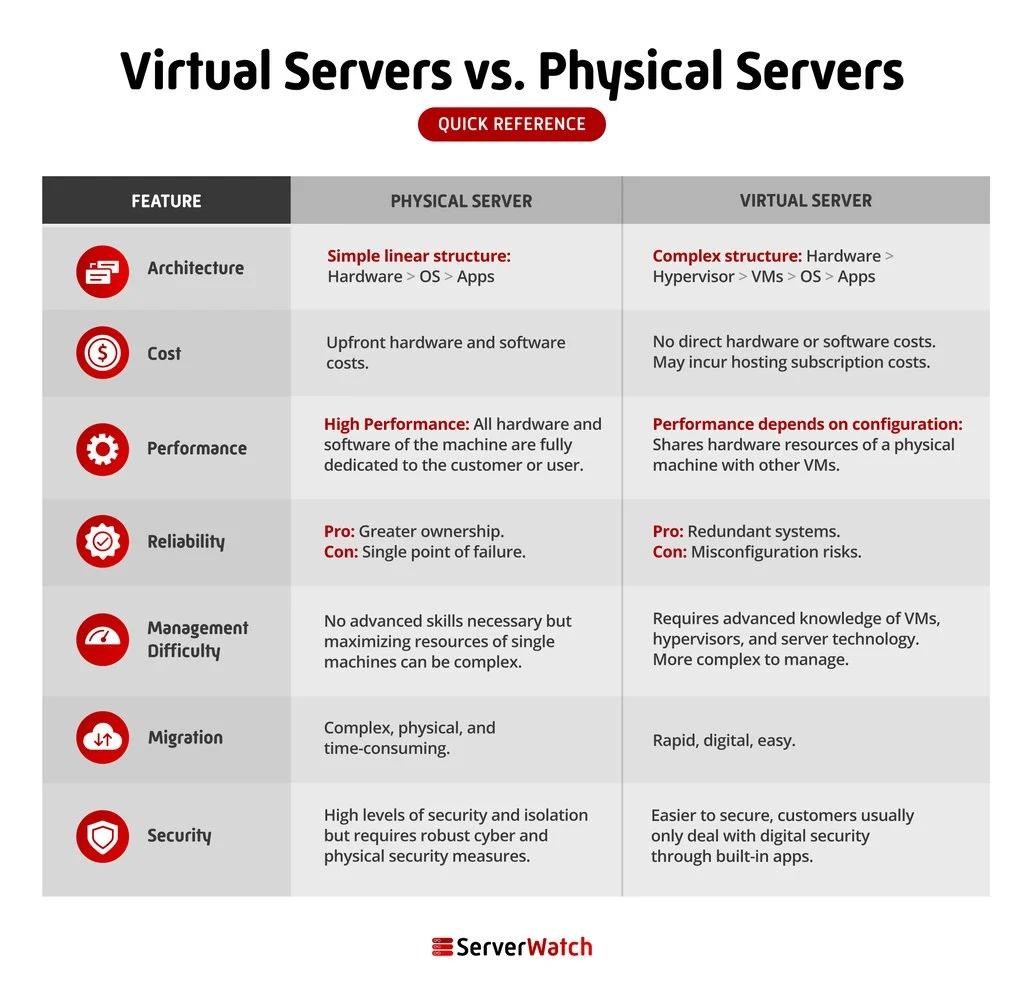
Virtual Servers vs. Physical Servers: A Comparative Analysis
The choice between a virtual and a physical server hinges on a nuanced understanding of their respective strengths and weaknesses across several critical dimensions.
Architecture
The fundamental difference lies in their architectural design. Physical servers are monolithic hardware units, while virtual servers are software abstractions built upon physical hardware. This distinction impacts everything from resource allocation to management.
Cost
When considered on a per-unit basis for small deployments, a physical server might seem simpler. However, the economics shift dramatically with scale. Virtualization offers significant cost efficiencies by allowing multiple workloads to share a single physical machine, reducing hardware acquisition, power consumption, cooling, and data center footprint costs. For businesses opting for cloud virtualization, the capital expenditure associated with hardware is entirely eliminated, replaced by an operational expense model. Furthermore, users of cloud-based virtual servers offload the responsibility and cost of physical hardware maintenance, repairs, and potential disaster-related damages.
Performance
The performance comparison between physical and virtual servers is often context-dependent. For highly specialized, I/O-intensive, or latency-sensitive workloads, a dedicated physical server can offer superior raw performance due to the absence of virtualization overhead and guaranteed access to all hardware resources. However, for many common business applications, the performance of a well-configured virtual server is more than adequate, and the ability to dynamically adjust resources can provide greater overall agility. Factors such as the quality of the hypervisor, the underlying hardware, network configuration, and software optimization all play significant roles in determining the actual performance of both types of servers.
Reliability
Both physical and virtual servers can be configured for high reliability. Physical servers, when properly maintained and with redundant components, can be extremely stable. Virtualization adds another layer of complexity, but also opportunities for enhanced reliability. Features like live migration (moving a running VM from one physical host to another without downtime), automatic failover, and distributed resource scheduling can make virtualized environments exceptionally resilient. The reliability of a virtual server is, to a degree, dependent on the reliability of the underlying physical hardware and the virtualization platform itself.
Management Difficulty
Managing physical servers can be complex, involving hardware maintenance, OS patching, and software updates. For virtual servers hosted by a third-party provider, much of this underlying management is handled by the vendor. However, managing the OS, applications, and configurations within the VM still falls to the user. The management tools provided by virtualization platforms and cloud providers often simplify many tasks, but a thorough understanding of the virtualization layer is still beneficial.
Migration
Migrating virtual servers is considerably simpler than migrating physical servers. A VM is essentially a set of files that can be easily copied, moved, or cloned to another physical host or even to a different cloud environment. This process can often be completed with a few clicks. Physical server migration, on the other hand, typically involves physically moving the hardware, reconfiguring network settings, and potentially reinstalling operating systems and applications, a far more time-consuming and labor-intensive undertaking.
Security
Both virtual and physical servers can be secured effectively, but they require different approaches. Physical servers offer inherent isolation, making them a strong choice for highly sensitive environments. However, they are susceptible to physical threats like theft or damage. Virtual servers, while sharing hardware, employ robust isolation mechanisms through the hypervisor to prevent cross-VM interference. Security in virtualized environments also involves securing the hypervisor itself, the management interfaces, and implementing strong network segmentation. Cloud providers invest heavily in physical and logical security for their data centers, offering a high level of protection for virtual servers hosted within their infrastructure.
The Strategic Imperative: Choosing the Right Server for Your Business
The decision between virtual and physical servers is not a one-size-fits-all scenario. It demands a thorough assessment of a business’s unique operational needs, budget constraints, performance requirements, and security mandates.
For many businesses, virtual servers represent the most pragmatic and cost-effective solution. Their inherent scalability, flexibility, rapid deployment capabilities, and cost efficiencies make them ideal for a wide range of applications, from web hosting and application development to general business computing and cloud-native services. The operational expenditure model associated with cloud-based virtual servers also appeals to businesses seeking to avoid large upfront capital investments.
However, physical servers remain indispensable for specific use cases where absolute performance, dedicated resources, low-latency, and stringent isolation are non-negotiable. Industries with extreme computational demands, such as high-frequency trading, complex scientific simulations, or demanding media production, will continue to rely on the raw power and predictable performance of bare metal. The direct control and enhanced security offered by physical servers also make them a preferred choice for highly regulated sectors or organizations handling exceptionally sensitive data.
Ultimately, a hybrid approach, leveraging both physical and virtual servers, often provides the optimal balance for modern enterprises, allowing them to capitalize on the strengths of each technology to meet diverse and evolving IT demands. Businesses are encouraged to explore the latest advancements in server virtualization software to unlock the full potential of their infrastructure.
