

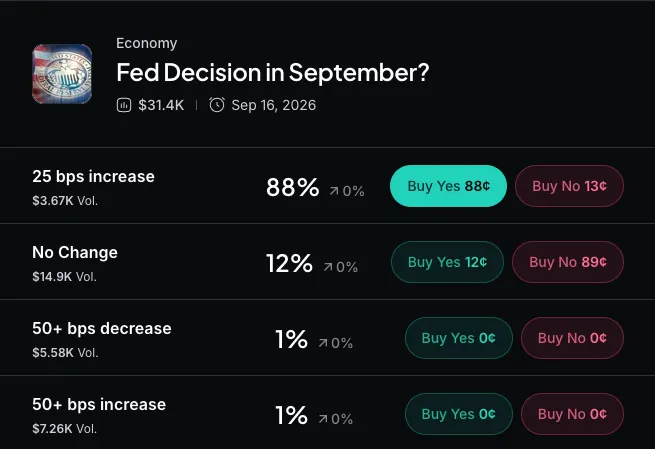
The Federal Reserve is poised to break its long-standing policy of interest rate stability, as financial markets across the globe prepare for what appears to be an inevitable quarter-point increase in borrowing costs. As the Federal Open Market Committee (FOMC) concludes its two-day policy summit this Wednesday, the consensus among economists, institutional investors, and market analysts has shifted toward a hawkish outlook. CME Group’s FedWatch tool, a primary indicator of market expectations, currently reflects a 94.5% probability of a 25-basis-point hike—a staggering shift in sentiment from the sub-50% probability recorded just one month ago.
This anticipated pivot comes at a critical juncture for the U.S. economy. Since 2023, the Fed has navigated a complex landscape of cooling growth and stubborn inflation. However, recent macroeconomic data has signaled that the cooling process may have reached an impasse, forcing policymakers to reconsider their trajectory.
A Chronology of the Current Tightening Cycle
The path to this week’s meeting has been marked by shifting expectations and recalibrated economic data. Following a period of aggressive rate hikes initiated in early 2022 to combat post-pandemic inflation, the Federal Reserve had entered a period of relative dormancy regarding interest rate adjustments.
- Mid-2026: The Fed held rates steady in a range of 3.50% to 3.75%, signaling confidence that inflation was trending toward the 2% target.
- August 2026: Headline Consumer Price Index (CPI) figures were released at 3.4% annually, with core inflation—which excludes volatile food and energy sectors—stuck at 2.5%. These figures exceeded market expectations and highlighted the persistence of inflationary pressure.
- Early September 2026: A wave of major financial institutions, including JPMorgan, Citigroup, and Morgan Stanley, published revised forecasts. Most analysts now anticipate a total of 50 basis points of tightening by the conclusion of the 2026 calendar year.
- Mid-September 2026: The failure of the "Clarity Act" to clear the U.S. Senate added further volatility to financial markets, impacting risk assets like Bitcoin and heightening sensitivity to the upcoming Fed announcement.
The Macroeconomic Drivers of Policy Shift
The primary catalyst for this shift is the "sticky" nature of inflation. Despite various cooling mechanisms, the 3.4% headline CPI reflects an economy that is struggling to return to the Federal Reserve’s mandated 2% stability target. Economists point to two primary drivers: geopolitical instability and supply-side constraints.
The ongoing conflict involving Iran has introduced significant volatility into global energy markets. Rising oil prices have served as a persistent inflationary force, one that monetary policy alone struggles to mitigate. Furthermore, recent trade policy rhetoric—specifically regarding tariffs—has created an environment of uncertainty. While tariffs are intended to protect domestic industry, they frequently result in higher costs for consumers, further complicating the Fed’s task.
Internally, the FOMC is not entirely aligned. At the July meeting, the decision to hold rates steady was finalized by a narrow 9-3 vote. The dissenters, who advocated for a hike even then, appear to have gained significant momentum following the release of the robust August jobs report. This report demonstrated that the labor market remains tighter than anticipated, giving the Fed the "cushion" required to raise rates without necessarily triggering an immediate recession.
The Political Tension: The Warsh-Trump Dynamic
The current rate hike cycle places Federal Reserve Chair Kevin Warsh in a politically delicate position. Appointed by President Donald Trump in January 2026 and inaugurated in May, Warsh is operating under an administration that has been overtly vocal about its preference for lower interest rates.
At his swearing-in ceremony, President Trump emphasized the necessity of the Fed’s "total independence," yet he simultaneously communicated clear expectations that the central bank should facilitate economic growth through easier monetary policy. This sentiment has been echoed by Vice President JD Vance and Treasury Secretary Scott Bessent, both of whom have lobbied publicly for rate cuts in recent weeks.
The pressure is further intensified by the proximity of the November midterms. Voter sentiment remains heavily influenced by the cost of living and the accessibility of credit. A rate hike, while technically a tool to lower inflation, will inevitably result in higher mortgage rates and increased borrowing costs for businesses and consumers alike. Warsh has maintained a stoic, non-committal stance, asserting in public briefings that the Fed’s decisions are strictly data-driven and insulated from the influence of the executive branch.
Market Implications: The Bond Market Rebound
The bond market has preempted the Federal Reserve’s official action, leading to a significant repricing of debt instruments. The yield on the 10-year Treasury note recently hit 5.04%, marking its highest level since July 2007. This surge suggests that investors are not merely pricing in a single quarter-point hike, but are also preparing for a "higher-for-longer" interest rate environment.
The two-year Treasury yield, which is traditionally more sensitive to near-term Fed policy, has similarly reached levels not seen since July 2024. These yields serve as a benchmark for borrowing costs across the economy, impacting everything from auto loans to corporate debt issuance. As yields rise, the opportunity cost of holding risk-on assets increases. Consequently, investors have begun rotating capital out of equities and digital assets, moving toward the relative safety and guaranteed returns offered by government-backed bonds.
The Crypto Sector: Navigating Volatility
Digital assets, particularly Bitcoin, are experiencing a period of significant price discovery. Following the rejection of the Clarity Act in the Senate, Bitcoin saw a retreat from its September highs of $82,000, sliding toward the $75,000 level. Technical analysts are watching the $73,200 threshold closely; a sustained close below this point could indicate a broader breakdown, potentially testing support levels at $71,000 and $66,900.
The broader crypto market is inherently sensitive to liquidity conditions. When the Federal Reserve tightens, the supply of "cheap money" that often flows into speculative assets dries up. However, there is a divergence of opinion among analysts. Some argue that a 25-basis-point hike is already "priced in," and that the market’s reaction will ultimately depend on the "dot plot"—the Fed’s internal projection of future rate movements.
If the Fed signals that this is the final hike of the cycle, the crypto market may find a bottom and stabilize. Conversely, if the central bank adopts the more aggressive stance suggested by Bank of America and Deutsche Bank—calling for 75 basis points of total tightening this year—the volatility in altcoins, which typically suffer from lower liquidity, could be severe.
Looking Ahead: The Wednesday Press Conference
All eyes are now turned toward 2:00 p.m. ET on Wednesday, when the Federal Reserve will release its official statement and the updated Summary of Economic Projections. The release of the "dot plot" will be the most scrutinized aspect of the report, as it will reveal the committee’s consensus on whether the terminal rate of this cycle has been reached.
Chair Warsh’s subsequent press conference at 2:30 p.m. ET will be equally pivotal. Traders will be listening for any nuance regarding the duration of the current policy. If the tone is overtly hawkish, markets will likely see a continuation of the current sell-off in equities and crypto. If the language remains balanced, highlighting the Fed’s readiness to pivot should the economy begin to contract, there may be a reprieve for risk-sensitive assets.
The complexity of this moment cannot be overstated. The Federal Reserve is attempting to thread the needle between cooling an overheating economy and avoiding a self-inflicted recession, all while navigating a high-stakes political environment. As the committee gathers, the global financial system waits to see if the Fed’s latest intervention will succeed in anchoring inflation or if it will trigger a broader economic recalibration. The outcome of this meeting will likely set the tone for the remainder of the fiscal year and the immediate future of the U.S. economy.
