


Beijing-based artificial intelligence lab Z.ai has officially launched its latest large language model, GLM-5.2, on June 16th, a development that promises to significantly elevate the performance benchmarks for open-source AI. This new iteration surpasses its already advanced predecessor, GLM 5.1, and is positioned to compete directly with top-tier proprietary models, marking a significant step forward in democratizing access to cutting-edge AI capabilities. The release comes at a critical juncture for the global AI industry, as geopolitical tensions and evolving regulatory landscapes create new opportunities and challenges for international AI development.
A New Contender Emerges Amidst Geopolitical Shifts
Z.ai’s emergence as a formidable player in the AI space is occurring against a backdrop of increasing scrutiny and restrictions placed on Chinese technology firms by the United States. The Beijing-based lab has been on the U.S. Entity List since January 2025, a designation that typically restricts access to U.S. technology and markets. However, this has not deterred Z.ai’s progress. Instead, it appears to have catalyzed a strategic pivot, potentially benefiting from growing concerns in some quarters regarding the dominant approach to AI development spearheaded by American companies.
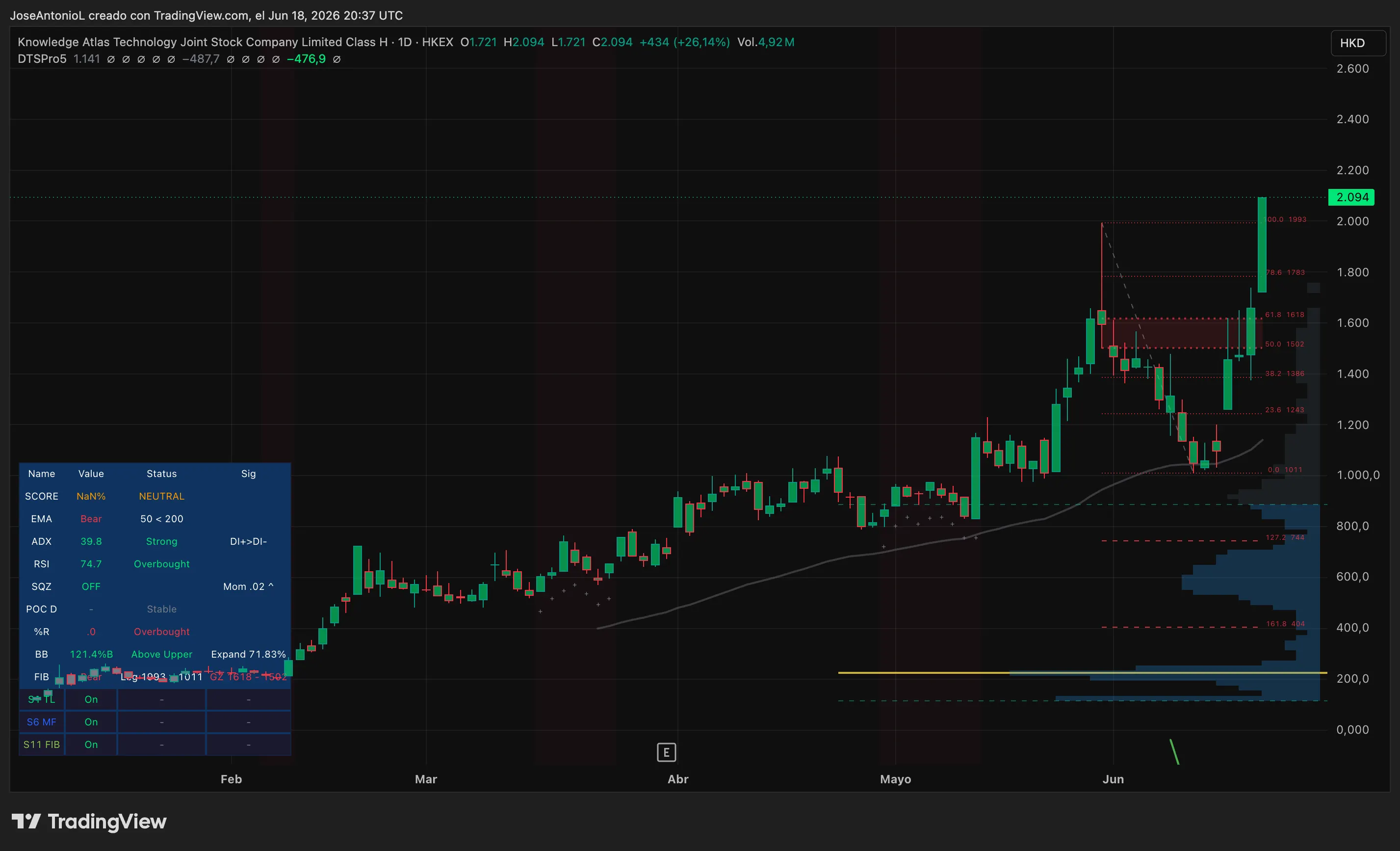
The impact of GLM-5.2’s release has been swift and substantial. In the week following its announcement, Z.ai’s stock has surged by an impressive 90%, reaching a new all-time high. This dramatic market reaction is likely fueled by a combination of factors, including the perceived strength of GLM-5.2, coupled with recent regulatory actions, such as the ban on Anthropic’s Fable model, which may have created a vacuum that Z.ai is poised to fill. Investors appear to be recognizing the potential for Z.ai to capture market share by offering powerful AI solutions that are less susceptible to the geopolitical headwinds affecting some of its competitors.
Benchmarking Excellence: GLM-5.2’s Performance Metrics
The hype surrounding GLM-5.2 is substantiated by robust performance data across several key benchmarks, indicating a significant leap in capabilities. On the FrontierSWE benchmark, which assesses an AI agent’s proficiency in completing open-ended technical projects—ranging from systems optimization and large-scale code construction to applied machine learning research—GLM-5.2 achieved a dominance rate of 74.4. This score places it remarkably close to Anthropic’s Claude Opus 4.8, which scored 75.1, and surpasses GPT-5.5’s score of 72.6.

Further validation comes from the SWE-bench Pro, a benchmark designed to evaluate the autonomous resolution of real-world GitHub issues. Here, GLM-5.2 demonstrated its prowess with a pass rate of 62.1, outperforming GPT-5.5’s 58.6. Crucially, it also significantly improved upon its predecessor, GLM-5.1, which achieved a score of 58.4, showcasing a substantial generational advancement.
These impressive results have earned GLM-5.2 the top spot among open-source models in the Artificial Analysis Intelligence Index, a comprehensive metric that aggregates nine different scores to gauge the overall quality of AI models. OpenRouter’s comparative benchmarks further position GLM-5.2 in the same league as the recently banned Claude Fable 5, underscoring its competitive standing in the AI ecosystem.
Innovative Hardware and Cost-Effective Training
A particularly noteworthy aspect of GLM-5.2’s development is the hardware used for its training. Z.ai exclusively utilized Huawei Ascend chips, conspicuously omitting any Nvidia components from the training pipeline. This strategic choice highlights a growing trend of leveraging alternative hardware ecosystems, particularly in regions facing U.S. technology export restrictions.
Emad Mostaque, the founder of Stability AI, has estimated the total training costs for GLM-5.2 to be around $25 million, with a significant 80% allocated to post-training optimization. This figure is notably cost-effective when compared to the multi-hundred-million-dollar price tags often associated with training comparable large-scale AI models by major Western labs. Such cost efficiency could be a significant advantage for Z.ai, enabling faster iteration and wider accessibility of its technology.
This reliance on non-American hardware is not new for Z.ai. As previously reported, the lab had already been training image generation models on Huawei’s Ascend Atlas servers without employing any U.S.-made chips. GLM-5.2 represents an escalation of this infrastructure strategy, featuring a 744-billion-parameter mixture-of-experts (MoE) architecture. A key feature is its genuine one-million-token context window, a fivefold increase from GLM-5.1’s 200,000-token limit. The model is released under an MIT license, a permissive open-source license that theoretically prevents any government directive from revoking access, thereby ensuring greater user autonomy. For clarity, tokens represent the discrete units of text that a model can process and generate, while parameters are the internal values and settings that dictate how a model interprets information and formulates responses.
Accessibility and Cost: Redefining Open-Source AI Economics
The expanded context window of GLM-5.2 represents a significant operational advantage for developers. Tasks that previously required intricate chunking of codebases or data, such as navigating entire code repositories, performing multi-file refactoring, or executing complex agentic pipelines, can now potentially be handled within a single API call. This simplification of workflows can lead to substantial gains in development efficiency and speed.
From a pricing perspective, Z.ai offers competitive rates for API access: $1.40 per million input tokens and $4.40 per million output tokens. These prices stand in stark contrast to those of leading proprietary models, such as Claude Opus 4.8, which charges $5 per input million tokens and $25 per output million tokens. For developers focused on coding tasks, Z.ai also provides a "Coding Plan" starting at approximately $18 per month, which integrates seamlessly with popular coding environments like Claude Code, Cline, and Kilo Code, as well as most agentic frameworks.
The potential for local deployment is another significant aspect of GLM-5.2’s release. Unsloth AI has successfully implemented 2-bit GGUF quantizations, compressing the model from its original 1.51 terabytes down to a more manageable 238 gigabytes while retaining approximately 82% of its accuracy. This level of compression significantly lowers the hardware barrier for local use.
However, even with quantization, running GLM-5.2 locally remains a demanding task. It requires a substantial 256 gigabytes of unified memory. This could necessitate high-end hardware such as a fully configured M4 Ultra Mac Studio or a powerful workstation equipped with a mid-range GPU and 256 gigabytes of system RAM, utilizing mixture-of-experts offloading techniques. While the cost remains considerable, it opens the door for dedicated individuals or organizations to run advanced AI models on their own infrastructure, offering greater control and privacy.
Practical Applications and Performance in Real-World Scenarios
To assess GLM-5.2’s practical capabilities, a test was conducted involving the development of a game that combines typing mechanics with shooter elements. While the user interface generated by GLM-5.2 was noted to be less polished compared to interfaces produced by other models, the gameplay experience itself was exceptionally diverse. The model demonstrated an ability to create varied scenarios across different waves, introduce shifting enemy types, and implement boss encounters later in the gameplay progression. This output variance was more pronounced than what was observed from other models tasked with the same objective in a zero-shot setup, highlighting GLM-5.2’s strength in generating complex and dynamic content.
For those interested in experiencing GLM-5.2 firsthand, a playable version of the game developed using the model is available on the Itch.io platform. This demonstration serves as a tangible example of the model’s generative potential.
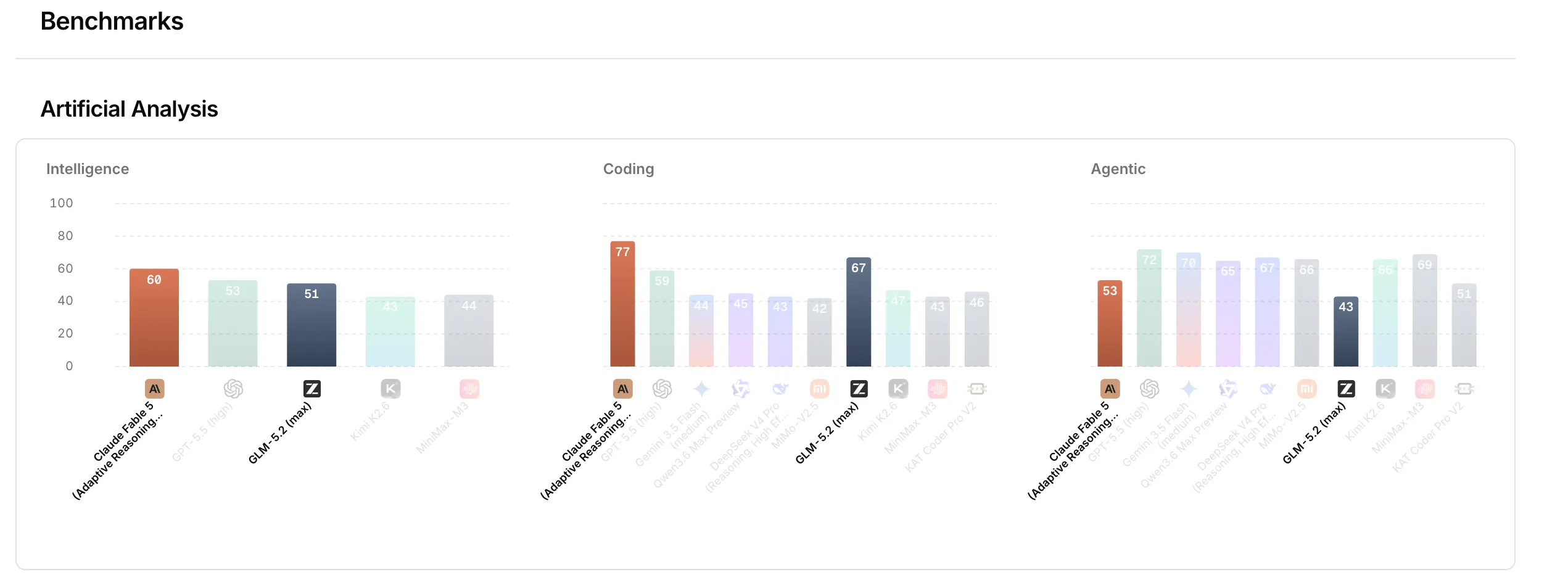
The diverse output from GLM-5.2 points to its economic viability in specific applications. For multi-stage generation workflows and agentic pipelines where output variability is a primary requirement over aesthetic polish, the pricing structure for open-source models makes GLM-5.2 a compelling choice. However, for highly demanding and sustained tasks, such as the SWE-Marathon benchmark where GLM-5.2 scored 13.0 against Claude Opus 4.8’s 26.0, a discernible performance gap to the most advanced proprietary models still exists.
Availability and Future Implications
The open-source weights for GLM-5.2 are now accessible on HuggingFace under the permissive MIT license. Quantized versions are also available on HuggingFace, catering to users with more constrained hardware. Existing subscribers to the GLM Coding Plan can immediately utilize GLM-5.2 by updating their model string. Furthermore, Z.ai is offering free testing of GLM-5.2 on its platform, albeit with certain usage limitations, allowing potential users to evaluate its capabilities before committing to a paid plan.
The release of GLM-5.2 by Z.ai signifies a pivotal moment in the evolution of AI. It not only demonstrates the remarkable progress being made by international AI labs operating under unique geopolitical conditions but also underscores the increasing accessibility of powerful AI tools. By leveraging alternative hardware and a cost-effective development approach, Z.ai is challenging the established order and pushing the boundaries of what is achievable in the open-source AI domain. The model’s robust performance, combined with its competitive pricing and licensing, positions it as a significant disruptor, potentially democratizing advanced AI capabilities for a broader range of developers and researchers worldwide. The long-term implications of this development will likely involve a more diverse and competitive AI landscape, fostering innovation and potentially altering the trajectory of global AI development.
