
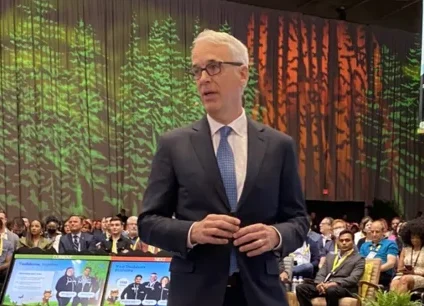

The recent unveiling of Salesforce’s Headless 360 initiative marks a pivotal transition in the enterprise software landscape, signaling a shift from traditional software-as-a-service (SaaS) interfaces toward a more flexible, AI-driven architecture. At the Evercore Global TMT Conference in San Francisco, Salesforce co-founder and current Slack CTO Parker Harris provided extensive clarity on the company’s vision for a "headless" future. His remarks come on the heels of a series of high-level communications from Salesforce leadership aimed at refining the market’s understanding of Headless 360, following initial comments by CEO Marc Benioff that suggested some customers and analysts had misinterpreted the scope of the launch.
The concept of "headless" software is not new to the broader IT industry—typically referring to the decoupling of the frontend user interface from the backend logic and data—but its application to the world’s leading Customer Relationship Management (CRM) platform represents a significant evolution. By removing the mandatory "head" or standard user interface (UI), Salesforce is enabling its core services, business logic, and metadata to be accessed and manipulated via APIs and AI agents across various platforms, including Slack, Microsoft Teams, and custom-built applications.
Chronology of the Headless 360 Launch
The trajectory of Headless 360 began in early April 2024, when Parker Harris first publicly discussed the concept of a more modular Salesforce experience. This initial disclosure set the stage for a more formal introduction at the TDX developer conference in May. However, the choice of venue created an immediate perception challenge for the company. Because TDX is primarily a developer-centric event, early market analysis framed Headless 360 as a tool exclusively for engineers and technical architects.
Recognizing this narrow interpretation, Salesforce CEO Marc Benioff later characterized Headless 360 as "probably the most exciting announcement" of the recent quarter, emphasizing its utility for the broader business user base. This was followed by a concerted effort from the executive leadership team—including Chief Marketing Officer Patrick Stokes, President of Enterprise and AI Technology Joe Inzerillo, and Chief Revenue Officer Miguel Milano—to reframe the technology as a solution for "knowledge workers" rather than just "builders."
By the time Harris appeared at the Evercore conference, the internal alignment was clear. Harris admitted that the company was surprised the announcement had not been the primary headline of the previous year’s Dreamforce, noting that the idea had matured rapidly in the months following the 2023 flagship event. The formalization of Headless 360 at TDX was intended to empower the developer community first, but the ultimate goal is to allow AI to generate user experiences on the fly for non-technical employees.
Technical Foundations: From APIs to Vibe Coding
The technical impetus for Headless 360 is rooted in the rapid advancement of Large Language Models (LLMs) and specialized AI tools. Harris pointed to the rise of "Claude Code"—an AI-driven coding tool from Anthropic—as a "tipping point" in February 2024. This development prompted Salesforce to rethink how its platform could be configured and implemented.
A central theme of Harris’s explanation was the concept of "vibe coding." This refers to a paradigm where users can describe a desired outcome or interface in natural language, and the AI interprets the underlying Salesforce metadata to build that experience instantly. Under this model, the "experience layer" is no longer a static set of pages within the Salesforce Lightning UI. Instead, the experience is generated dynamically. For example, a salesperson could ask an AI agent for a summary of the quarter’s top deals and a status update on pending trouble tickets. Rather than returning a wall of text, the system uses the headless architecture to "paint" a polished UI containing relevant data visualizations and interactive elements directly within the chat or interface the user is currently using.
This flexibility is supported by Salesforce’s long-standing API infrastructure. While the company has offered APIs for decades, Headless 360 optimizes these connections for AI consumption. By exposing the platform’s metadata—the underlying rules that define how a business operates—Salesforce allows external AI models like OpenAI’s ChatGPT or Anthropic’s Claude to understand the context of a business’s operations without requiring a manual UI setup.
The Role of Slack and Multi-Platform Flexibility
As the CTO of Slack, Harris highlighted the messaging platform’s role as the primary "engagement layer" for the headless enterprise. Slack is positioned not just as a communication tool, but as a surface where headless data from Salesforce and other enterprise systems can be converged and acted upon.
However, the "headless" strategy also acknowledges the reality of a fragmented enterprise software environment. Harris emphasized that Salesforce aims to "meet the customer where they are." If an organization relies heavily on Microsoft Teams, Headless 360 allows Salesforce services to be surfaced within that environment. This strategy addresses a common concern among Chief Information Officers (CIOs) who are wary of vendor lock-in during a period of rapid technological flux. By offering a headless architecture, Salesforce provides the flexibility for companies to choose their preferred user interface or AI model while keeping their core business logic and customer data within the Salesforce ecosystem.
Market Context and Data-Driven Defensibility
The pivot toward Headless 360 occurs against a backdrop of increasing competition in the CRM and AI sectors. Salesforce currently commands approximately 22% to 23% of the global CRM market share, significantly ahead of competitors like Microsoft, Oracle, and SAP. In the 2024 fiscal year, Salesforce reported total revenue of $34.9 billion, a reflects the scale of the "trusted relationships" Harris cited as a key competitive advantage.
The enterprise software industry is currently navigating what some analysts have termed the "SaaSpocalypse"—a theoretical shift where generative AI could render traditional seat-based software subscriptions obsolete by automating the tasks currently performed by human users. Harris pushed back against this narrative, arguing that Salesforce’s position is "highly differentiated and defensible."
His argument rests on two pillars: metadata and context. While general-purpose AI models are highly capable, they lack the specific business context of a particular corporation. Salesforce’s 27 years of accumulated business logic and customer data provide the "grounding" necessary for AI to be effective. Harris noted that putting too much raw data into an AI model is both expensive and inefficient. The headless architecture allows the system to provide the "exact right context" for a query without compromising security or performance.
Internal Strategy: The V2MOM and Innovation Culture
To manage this rapid transition, Salesforce relies on its "V2MOM" (Vision, Values, Methods, Obstacles, and Measures) management process. Originally developed by Marc Benioff at the company’s inception, the V2MOM serves as a living document that aligns the company’s thousands of employees. Harris noted that the current pace of AI development has required the company to rewrite its V2MOM frequently to stay aligned with market shifts.
This internal alignment is critical as the company moves toward "Agentforce"—Salesforce’s suite of autonomous AI agents. Harris indicated that the success of these initiatives will be measured by adoption metrics. He revealed that the company has already seen a "spike" in interest for the Model Context Protocol (MCP) interface within the Slack business unit. This protocol allows AI agents to access a broad corpus of information more easily, and the surge in demand suggests that customers are eager to move beyond simple chatbots toward more integrated, headless data access.
Implications for the Future of Enterprise Software
The shift to Headless 360 suggests a broader trend where the "UI" of enterprise software becomes secondary to the "Intelligence" of the underlying data. For Salesforce, this means doubling down on its identity as a CRM company while enhancing that core mission with autonomous AI capabilities.
The implications for customers are multi-faceted. On one hand, Headless 360 offers the potential for significantly reduced implementation times and more intuitive user experiences. On the other hand, it requires organizations to have a robust data strategy to ensure that the "headless" calls return accurate and useful information.
As the AI market continues to evolve, Salesforce’s strategy appears focused on maintaining its role as the "system of record" while abdicating its role as the exclusive "system of engagement." By allowing its services to flow into whatever surface the user prefers, Salesforce aims to remain indispensable in an era where the traditional software "desktop" is disappearing in favor of fluid, AI-orchestrated workflows.
In conclusion, Parker Harris’s insights at the Evercore conference reinforce the idea that Salesforce is not merely reacting to the AI boom but is actively re-architecting its platform to lead it. By embracing a headless model, the company is betting that its deep repository of business metadata will remain its most valuable asset, regardless of which AI model or user interface becomes the dominant "head" of the future. The transition is early, and widespread adoption remains the ultimate metric of success, but the strategic foundation is now firmly in place.
