

Amazon Web Services (AWS) has announced two significant updates to its widely used identity platform, Amazon Cognito: the introduction of multi-Region replication for improved resilience and the integration of customer-managed keys (CMK) for greater encryption control. These enhancements are designed to address the escalating demands for high availability, robust security, and compliance in modern web and mobile applications, as well as machine-to-machine (M2M) authentication flows that underpin today’s distributed architectures.
The Evolving Landscape of Digital Identity and the Imperative for Resilience
In an era defined by ubiquitous digital services, the reliability and security of user authentication and identity management have become paramount. Businesses globally rely on cloud infrastructure to host mission-critical applications, where even brief service interruptions can lead to substantial financial losses, reputational damage, and user dissatisfaction. The proliferation of microservices, serverless architectures, agentic AI systems, and sophisticated automation workflows has further amplified the need for seamless and resilient authentication mechanisms, not only for human users but also for automated services interacting across complex ecosystems.
Prior to these updates, organizations building highly available applications with Amazon Cognito faced considerable challenges in achieving consistent data across multiple AWS Regions. Engineering teams were frequently tasked with developing and maintaining intricate custom replication solutions. These bespoke systems were resource-intensive, often leading to significant operational overhead. Manual export and import procedures for user data between Regions introduced inherent security risks, increasing the potential for data exposure and creating opportunities for data inconsistencies. During regional outages or planned transitions, end-users often experienced disruptive events such as forced password resets and re-authentication prompts, severely impacting user experience. For machine-to-machine communications, developers had to manually create new application clients in secondary regions and reconfigure their applications, requiring updates to OAuth-protected resources to accept access tokens from new regional issuers. These complexities made maintaining uninterrupted operations across geographically dispersed Regions a formidable task.
Multi-Region Replication: A New Paradigm for Business Continuity

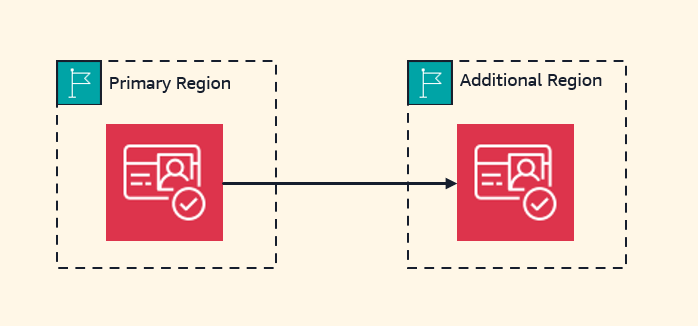
The newly launched multi-Region replication feature for Amazon Cognito directly addresses these longstanding challenges by automating the synchronization of user data and machine secrets across a primary and a chosen secondary AWS Region. This crucial capability ensures that authentication services remain operational even in the unlikely event of a regional service interruption, thereby bolstering application resilience and business continuity.
The replication process is unidirectional, flowing from the designated primary Region to the secondary Region. This comprehensive synchronization includes user profiles, credentials, and pool configurations, ensuring a consistent state across deployments. The secondary Region operates in a read-only mode, specifically configured to maintain authentication capabilities. A key advantage of this architecture is that existing user sessions can continue uninterrupted during a failover scenario. Both the primary and secondary regions are designed to recognize access tokens issued by either, allowing currently signed-in users to remain authenticated without disruption. This seamless transition is critical for maintaining a smooth user experience during regional events.
Multi-Region replication supports a wide array of authentication methods, encompassing federated sign-in through popular social providers such as Amazon, Google, Apple, and Facebook, as well as enterprise identity integrations via Security Assertion Markup Language (SAML) and OpenID Connect (OIDC). It also extends support to API authorization flows, ensuring robust availability for both customer-facing applications and the intricate machine-to-machine communications within backend services. While authentication continues without interruption, it is important to note that operations such as new user registration or profile updates are not available during an active failover event, as the secondary Region functions in a read-only capacity.

Enhanced Data Control with Customer-Managed Keys (CMK)
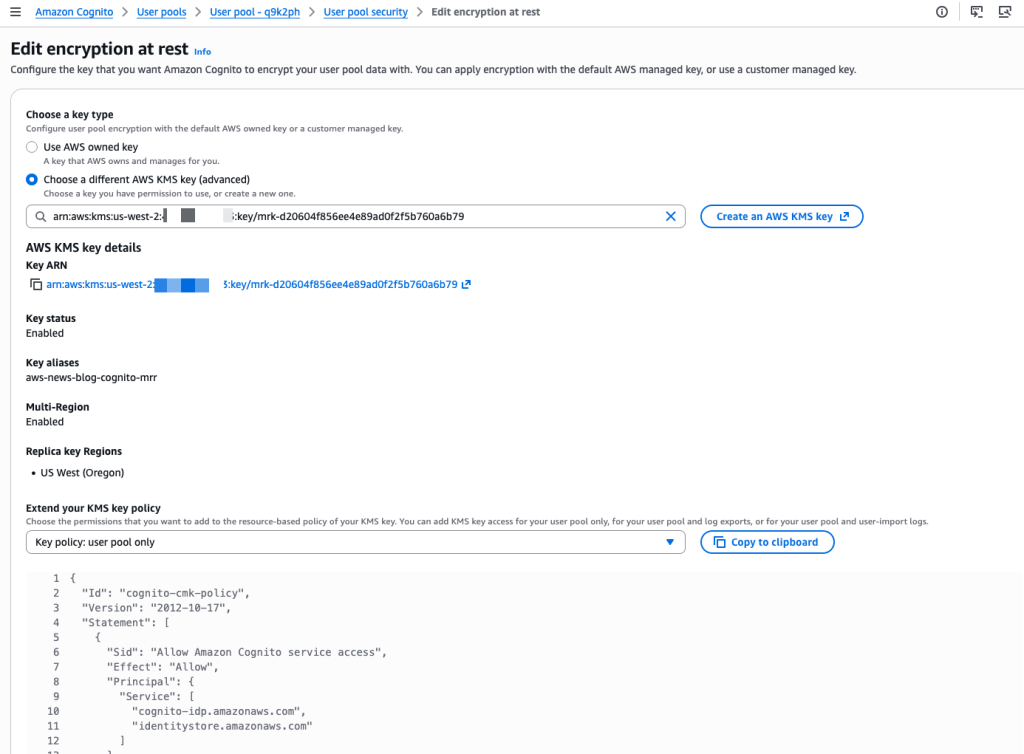
A prerequisite for configuring multi-Region replication and a significant enhancement in its own right is the support for customer-managed keys (CMK). Before enabling replication, customers must configure a multi-Region CMK stored in AWS Key Management Service (AWS KMS) to encrypt their user data at rest. This feature provides an additional layer of security and control, allowing organizations to manage the encryption keys used to protect sensitive identity data.
CMKs offer consistent encryption across Regions while empowering customers with granular control over their encryption strategy. This capability is particularly vital for organizations operating in highly regulated industries, such as healthcare, financial services, and government sectors, where stringent data sovereignty and compliance requirements mandate direct control over encryption keys. By leveraging AWS KMS, customers can define and enforce key policies, audit key usage, and rotate keys according to their specific security protocols, thereby meeting critical regulatory obligations and internal governance standards.
Implementation: A Streamlined Path to Resilience
Configuring multi-Region replication and CMK support within Amazon Cognito is a structured, console-guided process designed for ease of deployment. The journey typically begins with an existing Cognito user pool in a primary AWS Region, for instance, us-west-2 (Oregon), with the objective of replicating it to a secondary Region like us-east-1 (Northern Virginia). A prerequisite is the establishment of a customer-managed key, already replicated across these chosen Regions.
The setup process involves three core steps, meticulously guided by the AWS Management Console:
-
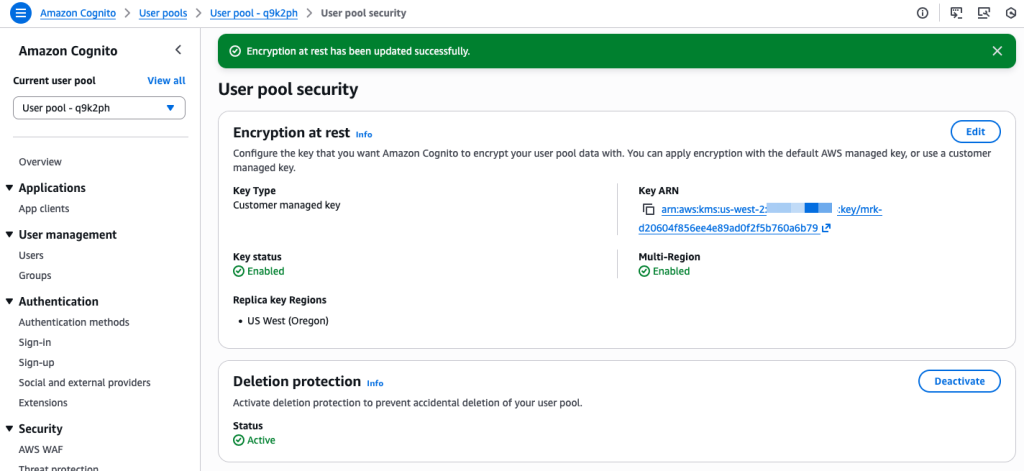
Custom Key Setup for Encryption: The first step involves selecting and configuring a custom AWS KMS key to encrypt user data at rest. This requires updating the key policy to grant Amazon Cognito the necessary permissions to access and utilize the key. The console provides clear instructions and the exact IAM policy statements needed for this crucial configuration. Once selected and policies are updated, the console confirms the successful setup.
-
Multi-Region OIDC Endpoints Configuration: This step is critical for ensuring seamless authentication across Regions. Users are guided to configure the OIDC issuer type to support multi-Region endpoints. A significant consideration here is the necessity for client applications to be updated with these new, multi-Region-aware endpoints. This often entails a redeployment for server-side applications and an update submission for mobile applications on respective app stores (e.g., Apple App Store, Google Play). Failure to update these endpoints will result in authentication disruptions, as requests directed to the old, single-Region endpoints will no longer be correctly routed. Upon confirmation of understanding and updating client applications, the changes to the issuer type are finalized.
-
Replication Configuration: The final step involves selecting the target secondary Region for replication. Only Regions where the custom encryption key has been replicated are available for selection, ensuring cryptographic consistency. Once the target Region is chosen, the replication process is initiated. The time required for this preparation phase is dependent on the volume of data within the user pool. Once the replicated user pool is prepared, it must be manually activated to transition its status to "Active," making it ready to serve authentication traffic.

Beyond Core Replication: Essential Ancillary Configurations
While multi-Region replication automates the core synchronization of user data and configurations, certain ancillary services and custom functionalities require manual deployment and configuration in the secondary Region. The AWS Management Console provides a helpful task list to guide users through these additional steps. For instance, if a Cognito user pool utilizes AWS Lambda functions for custom authentication flows or for sending SMS or email notifications, these Lambda functions must also be deployed and configured in the new secondary Region. Similarly, log streaming configurations (e.g., to Amazon CloudWatch or Amazon Kinesis) and AWS WAF (Web Application Firewall) rules designed to protect Cognito endpoints must be manually established in the target Region before directing authentication traffic to it. These manual steps ensure that the full suite of identity management functionalities and security postures are replicated across Regions.
Strategic Failover and Monitoring

With multi-Region replication enabled, both the primary and secondary regional endpoints remain active and continuously ready to serve traffic. The responsibility for monitoring system health and orchestrating failovers rests with the customer, allowing for a strategy tailored to specific application requirements and security postures. Organizations are encouraged to implement robust health checks that continuously monitor the status of authentication services in their primary Region. These checks can analyze metrics such as error rates, latency patterns, or specific service alerts to determine when to initiate a failover.
Upon detection of issues that meet predefined failover criteria, traffic can be seamlessly redirected to the secondary Region through DNS updates. This approach provides organizations with explicit control over the failover process, allowing for careful management of transitions while upholding security standards. It is strongly recommended to regularly test failover strategies, ideally during off-peak hours, by redirecting a small portion of traffic to verify that authentication continues to function as expected in the secondary Region. For users leveraging managed login and federation with custom domains, Amazon Route 53 offers a built-in traffic routing feature that can be integrated with Route 53 health check IDs, simplifying the automation of failover based on health status.
Pricing and Global Availability

Multi-Region replication is available today as an add-on feature for Amazon Cognito customers utilizing the Essentials and Plus tiers. For user authentication, the add-on is priced at $0.0045 per monthly active user (MAU) per replica Region for Essentials tier customers and $0.006 per MAU per replica Region for Plus tier customers. For machine-to-machine (M2M) authentication, the add-on incurs a 30% charge on top of the standard volume-based pricing for successfully issued tokens. Detailed pricing information is available on the Amazon Cognito pricing page.
The multi-Region replication feature is currently available in a wide array of AWS Regions, including US East (Ohio, N. Virginia), US West (N. California, Oregon), Asia Pacific (Mumbai, Seoul, Singapore, Sydney, Tokyo), Canada (Central), Europe (Frankfurt, Ireland, London, Paris, Stockholm), and South America (São Paulo). Any of these listed Regions can serve as either the source or the destination for the replication.
Support for customer-managed keys (CMK) is also available for both Essentials and Plus tiers across an even broader set of Regions: US East (Ohio, N. Virginia), US West (N. California, Oregon), Africa (Cape Town), Asia Pacific (Hong Kong, Hyderabad, Jakarta, Malaysia, Melbourne, Mumbai, New Zealand, Osaka, Seoul, Singapore, Sydney, Thailand, Tokyo), Canada (Central), Canada West (Calgary), Europe (Frankfurt, Ireland, London, Milan, Paris, Spain, Stockholm, Zurich), Israel (Tel Aviv), Mexico (Central), South America (São Paulo), and AWS GovCloud (US-East, US-West).

Industry Impact and Strategic Implications
The introduction of multi-Region replication and customer-managed keys for Amazon Cognito marks a pivotal advancement for enterprises seeking to build highly resilient and compliant applications on AWS. These features significantly elevate the standard for identity and access management in the cloud, addressing critical concerns for business continuity and data security.
For enterprises operating mission-critical applications, the automatic synchronization of user data and configurations across Regions substantially reduces the operational overhead traditionally associated with disaster recovery planning for identity services. Engineering teams can now redirect valuable resources from building and maintaining complex custom replication logic to focusing on core innovation and product development. This reduction in complexity also minimizes the risk of human error during manual data transfers or failover events, thereby enhancing overall system reliability.

Furthermore, the support for customer-managed keys provides a robust solution for organizations in regulated industries. By offering direct control over encryption keys used for user data at rest, AWS empowers customers to meet stringent regulatory requirements pertaining to data sovereignty, privacy, and cryptographic key management. This capability helps organizations demonstrate compliance with frameworks like GDPR, HIPAA, PCI DSS, and various national and industry-specific regulations, fostering greater trust and confidence in their cloud deployments.
These updates underscore AWS’s commitment to providing enterprise-grade services that are not only scalable and performant but also inherently resilient and secure. As the adoption of cloud-native architectures and advanced AI technologies continues to accelerate, robust and highly available identity management solutions will remain a foundational pillar for secure and uninterrupted digital operations. The new Amazon Cognito capabilities empower developers and security professionals to construct more robust, compliant, and user-friendly applications, ensuring that identity remains a strength, even in the face of regional challenges.
To leverage these new capabilities, customers are encouraged to visit the Amazon Cognito console or consult the comprehensive documentation for detailed setup instructions. These enhancements promise to strengthen application architectures and streamline the path to achieving superior resilience and data control.
