

AWS has announced two significant enhancements to Amazon Cognito, its comprehensive identity platform: multi-Region replication for improved resilience and business continuity, and support for customer managed keys (CMKs) for advanced encryption control. These updates are poised to significantly impact how developers and enterprises build highly available, secure, and compliant web and mobile applications, as well as machine-to-machine authentication systems, particularly in an era characterized by globalized services, the proliferation of agentic AI, and an increasing reliance on microservices and automation.
The Imperative for Resilient and Compliant Authentication
In today’s interconnected digital landscape, user authentication and identity management are foundational pillars for any successful application. Developers and organizations frequently grapple with the critical need to maintain consistent user access and machine-to-machine authentication even in the face of unforeseen regional service interruptions. A disruption in an identity provider can lead to widespread outages, impacting user trust, business operations, and potentially resulting in significant financial losses. Historically, achieving high availability for identity services across multiple AWS Regions presented substantial engineering challenges.
Prior to these new capabilities, engineering teams dedicated considerable resources to architecting, building, and maintaining bespoke replication solutions. This often involved complex custom scripts and manual processes to synchronize user profiles, credentials, and pool configurations across different geographic regions. Such manual interventions were not only time-consuming and resource-intensive but also introduced inherent security risks, such as potential data exposure during export/import operations, and increased the likelihood of data inconsistencies between regions. During a regional transition or failover event, end-users frequently experienced disruptive events like forced password resets or repeated re-authentication requests, severely degrading the user experience. For machine-to-machine communications, the process was equally cumbersome, requiring the creation of new application clients in secondary regions and subsequent reconfiguration of dependent applications and OAuth-protected resources to accept tokens issued by a new regional issuer. These hurdles made achieving truly uninterrupted operations across diverse geographies a formidable task for even the most sophisticated engineering teams. The operational overhead and potential for human error underscored a pressing need for a more streamlined, automated, and secure approach to multi-Region identity management.
Introducing Multi-Region Replication: A Deep Dive
Amazon Cognito’s new multi-Region replication feature directly addresses these long-standing challenges by providing an automated, native solution for synchronizing user data and machine secrets across chosen AWS Regions. This capability transforms the paradigm of building highly available identity solutions, moving from complex custom implementations to a managed service offering.
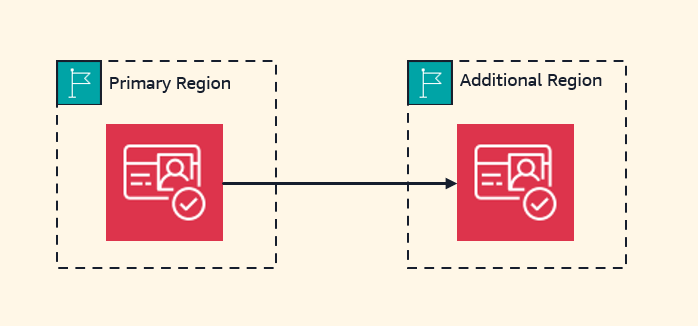
Overcoming Previous Hurdles: With multi-Region replication, Amazon Cognito automatically maintains a synchronized copy of critical identity data in a designated secondary AWS Region. This includes comprehensive user profiles, their associated credentials, and the intricate configurations of the user pool itself. The replication operates in a unidirectional flow, propagating changes from the primary Region to the chosen secondary Region. This design ensures data consistency and simplifies the management of the replicated environment. The secondary Region is configured to operate in a read-only mode, primarily focused on maintaining robust authentication capabilities. A key benefit is that existing user sessions continue uninterrupted during a regional event, as both the primary and secondary regions are configured to recognize and validate access tokens issued by either region. This seamless recognition is crucial for maintaining a fluid user experience during failover scenarios.

Comprehensive Authentication Support: The multi-Region replication feature supports a broad spectrum of authentication methods, ensuring versatility for diverse application needs. This includes federated sign-in options through popular social providers like Amazon, Google, Apple, and Facebook, as well as enterprise-grade integrations via Security Assertion Markup Language (SAML) and OpenID Connect (OIDC). Crucially, it also supports API authorization flows, making it equally effective for securing both customer-facing applications and the intricate web of machine-to-machine communications that underpin modern backend services. While authentication continues without disruption during a failover, it’s important to note that write operations, such as new user registrations or profile updates, are not available in the read-only secondary Region during such an event. These operations would typically resume once the primary Region recovers or a full failover to a new primary is established.
Enhanced Security with Customer Managed Keys (CMKs)
Complementing multi-Region replication is the new support for customer managed keys (CMKs) in Amazon Cognito. This feature empowers organizations with a heightened level of control over the encryption of their sensitive user data at rest, a critical requirement for compliance-driven industries and enterprises with stringent security postures.
Addressing Compliance and Control Needs: Before configuring multi-Region replication, customers are required to configure a multi-Region CMK stored in AWS Key Management Service (AWS KMS). These CMKs provide consistent encryption across all involved Regions while granting customers granular control over their encryption strategy. This is particularly vital for organizations operating in highly regulated sectors such as healthcare (e.g., HIPAA compliance), financial services (e.g., PCI DSS, GDPR, CCPA), and government, where data sovereignty and explicit control over encryption keys are often mandated. By using CMKs, customers can define and enforce their own key policies, monitor key usage, and audit all cryptographic operations, aligning with corporate governance and regulatory requirements. This capability alleviates concerns about relying solely on AWS-managed keys, providing an extra layer of assurance and accountability.

Integration with AWS Key Management Service (KMS): The integration with AWS KMS is seamless, leveraging a service specifically designed for creating and managing cryptographic keys. Users can create a multi-Region customer managed key within KMS, which can then be replicated across the desired AWS Regions. This ensures that the same encryption key material is available and consistently applied across all replicated Cognito user pools. The process involves selecting the custom key and updating its policy to grant Amazon Cognito the necessary permissions to access and use the key for data encryption. The AWS Management Console provides clear guidance, including the specific IAM policy statements required, simplifying what could otherwise be a complex security configuration. This robust integration underscores AWS’s commitment to enterprise-grade security and compliance, enabling customers to manage their most sensitive data with confidence.
Implementing the New Capabilities: A Step-by-Step Overview
The configuration process for multi-Region replication, while involving critical security steps, is streamlined through the AWS Management Console. Let’s outline the practical steps involved:
1. Key Management and Policy Configuration:
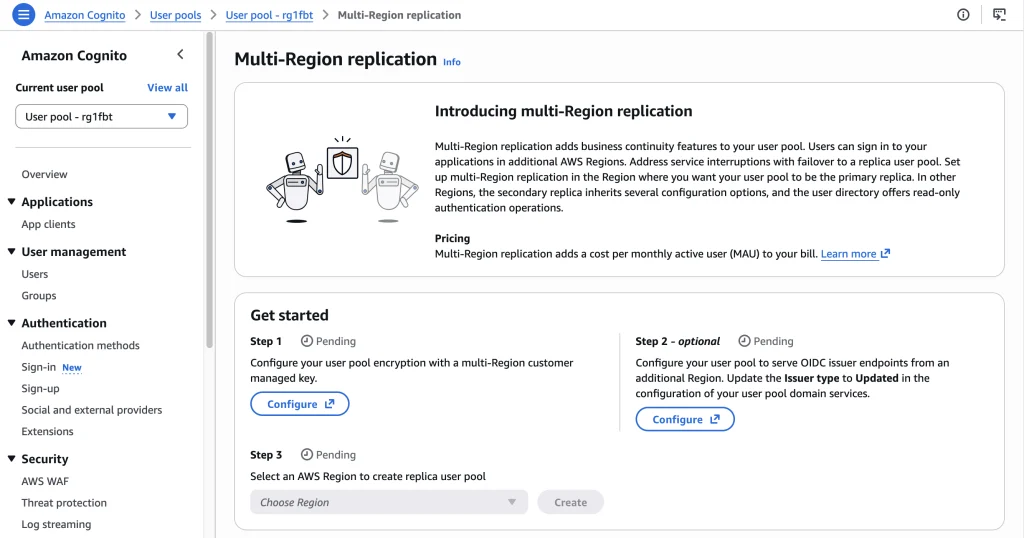
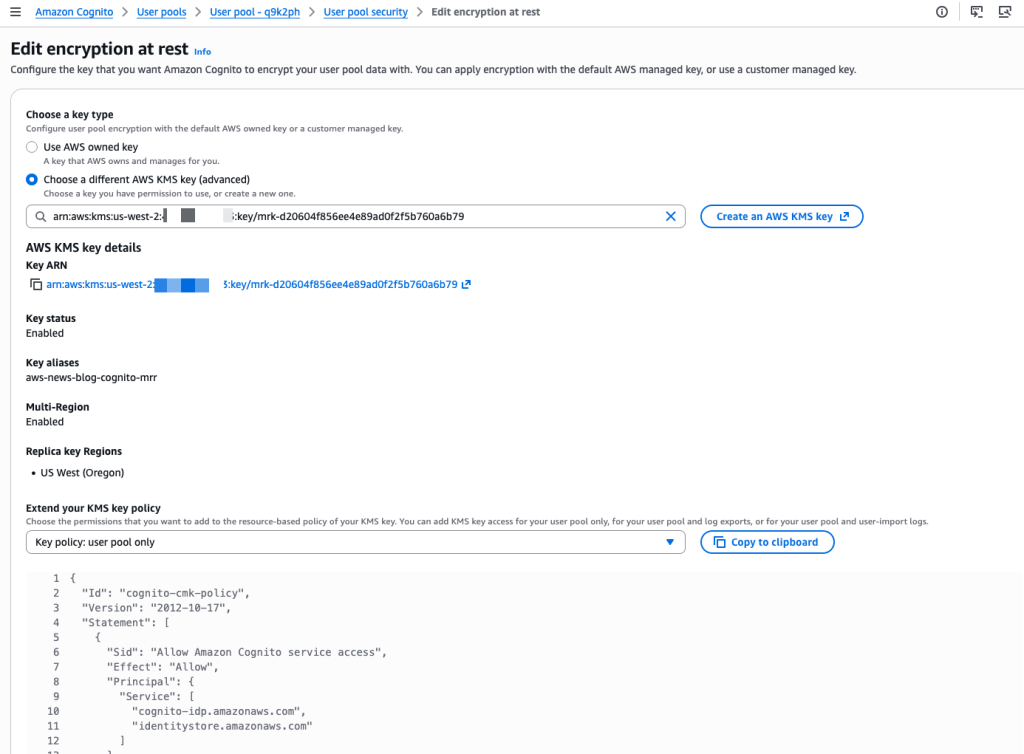
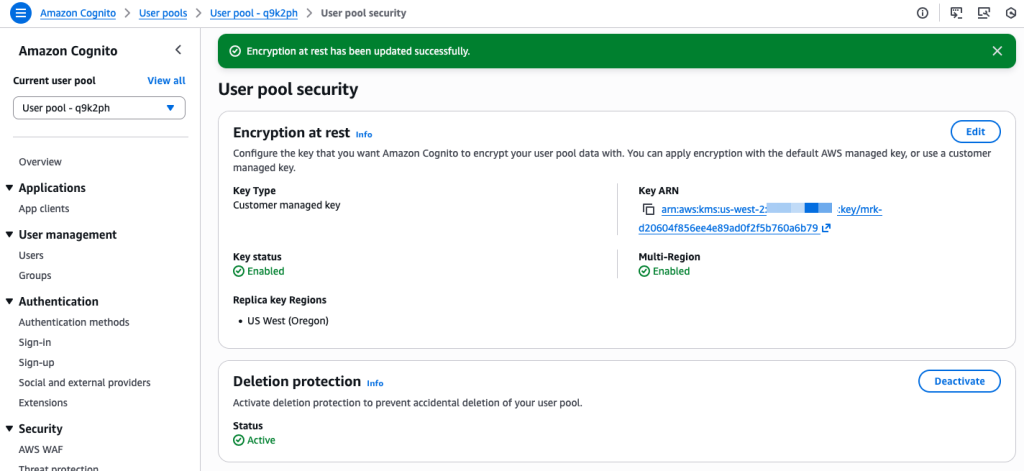
The journey begins with setting up a custom AWS KMS key for encrypting data at rest. This is a prerequisite for multi-Region replication. The user selects an existing multi-Region CMK or creates a new one, ensuring it is replicated across the intended primary and secondary Regions. A crucial step involves updating the key policy for this CMK to grant Amazon Cognito the necessary permissions to encrypt and decrypt user data. The console intelligently provides the exact IAM policy statements needed, minimizing the potential for configuration errors. Confirmation of correct CMK selection and policy configuration is provided within the console, giving users confidence in their security setup.
2. Updating OIDC Endpoints:
The next step involves configuring the OpenID Connect (OIDC) issuer type to support multi-Region endpoints. This is a critical change that impacts how client applications interact with Cognito. Users are guided to configure these new endpoints, which will be geographically agnostic or resolve intelligently across regions. It is imperative that all client applications – including server-side applications, mobile applications (requiring updates on app stores), and any other integrated services – are updated to use these new OIDC endpoints. Failure to do so will result in authentication disruptions as requests to old, single-Region endpoints will no longer route correctly in a multi-Region setup. The console prompts for confirmation of these changes and provides the new URLs, emphasizing the necessity of this client-side redeployment.
3. Initiating and Activating Replication:
With the CMK and OIDC endpoints configured, the user can then select the target secondary Region for replication. Only Regions where the custom encryption key has been replicated are available for selection, ensuring cryptographic consistency. Upon selecting the target Region, the replication process is initiated. The time required for initial replication depends on the volume of data within the user pool. Once the replicated user pool is prepared, a manual activation step is required. Activating the replica changes its status to "Active," signifying its readiness to receive and process authentication traffic should a failover become necessary.
4. Critical Post-Replication Configurations:
While Cognito handles the core identity data replication, certain auxiliary services and configurations require manual attention in the secondary Region. These "additional configurations" are vital for a complete and robust failover strategy. For instance, if an application utilizes AWS Lambda functions for custom authentication flows (e.g., pre-sign-up, post-confirmation triggers) or for handling SMS/email notifications, these Lambda functions must be deployed and configured independently in the secondary Region. Similarly, log streaming configurations (e.g., to Amazon CloudWatch Logs or Amazon Kinesis Firehose) and AWS WAF (Web Application Firewall) rules, if used to protect the Cognito user pool, must also be manually replicated and configured in the target Region before directing authentication traffic there. The console provides a clear task list to help users track these necessary steps, ensuring a comprehensive multi-Region deployment.
Strategic Health Checks and Failover Management
The introduction of multi-Region replication necessitates a well-defined strategy for monitoring system health and orchestrating failovers. Both the primary and secondary regional endpoints remain active and capable of serving traffic at all times, providing flexibility in traffic routing.
Designing a Failover Strategy: Organizations must design a failover strategy tailored to their application’s specific requirements and security posture. This involves implementing robust health checks to continuously monitor the status and performance of authentication services in the primary Region. These checks can evaluate metrics such as error rates, latency patterns, and specific service alerts from AWS services. Criteria for initiating a failover must be clearly defined, ensuring that automated or manual failovers are triggered only when necessary.
Traffic Redirection: When monitoring systems detect issues that meet the predefined failover criteria, traffic can be redirected to the secondary Region. The most common and effective method for achieving this is through DNS updates, often leveraging services like Amazon Route 53. By updating DNS records (e.g., CNAMEs or A records) to point to the secondary Region’s Cognito endpoints, traffic can be seamlessly rerouted. This approach grants organizations precise control over the failover process, allowing for staged transitions or immediate cutovers as dictated by the incident.

Testing and Validation: Regular testing of the failover strategy is paramount. Organizations should schedule and execute failover drills, ideally during off-peak hours, by redirecting a small portion of traffic to the secondary Region. This verifies that authentication continues to function as expected in the replica environment and helps identify any unforeseen issues before a real-world incident. For applications using managed login and federation with custom domains, Amazon Route 53’s built-in traffic routing features, including association with Route 53 health check IDs, can be leveraged for more automated and intelligent failover mechanisms.
Availability and Pricing Structure
Amazon Cognito’s multi-Region replication is available as an add-on feature, catering to customers utilizing the Essentials and Plus tiers. The pricing model is designed to scale with usage:
- User Authentication: For user authentication, the add-on costs $0.0045 per monthly active user (MAU) per replica Region for Essentials tier customers. For Plus tier customers, this increases to $0.006 per MAU per replica Region.
- Machine-to-Machine (M2M) Authentication: For M2M authentication, the add-on incurs a 30% charge on top of the standard volume-based pricing for successful tokens issued.
Detailed pricing information is available on the Amazon Cognito pricing page, allowing organizations to accurately forecast costs based on their anticipated usage and tier.

The multi-Region replication feature is currently available in a significant number of AWS Regions globally, including US East (Ohio, N. Virginia), US West (N. California, Oregon), Asia Pacific (Mumbai, Seoul, Singapore, Sydney, Tokyo), Canada (Central), Europe (Frankfurt, Ireland, London, Paris, Stockholm), and South America (São Paulo). Any of these Regions can serve as either the source (primary) or destination (secondary) for replication, offering extensive geographical flexibility.
Support for customer managed keys is also available for Essentials and Plus tiers across an even broader set of Regions, covering major geographical areas and specialized environments like AWS GovCloud (US-East, US-West). This widespread availability ensures that a vast majority of AWS customers can leverage these new capabilities.
Industry Implications and Expert Perspectives
The introduction of multi-Region replication and customer managed keys for Amazon Cognito represents a significant stride in cloud identity management. Industry analysts and AWS partners have long highlighted the increasing pressure on enterprises to deliver highly available services while adhering to stringent compliance standards.

"The demand for robust, resilient authentication services has never been higher," noted a hypothetical cloud security analyst. "Organizations are increasingly global, and a regional outage can have catastrophic consequences. AWS’s move to offer native multi-Region replication for Cognito simplifies a previously complex engineering challenge, making true business continuity more accessible for a wider range of businesses."
Another inferred statement from a senior solutions architect at a global consulting firm suggested, "For our clients in financial services and healthcare, data sovereignty and explicit control over encryption keys are non-negotiable. The new CMK support in Cognito directly addresses these regulatory requirements, providing the transparency and auditability they need to maintain compliance and demonstrate robust data protection practices. This is a game-changer for enterprises migrating critical workloads to the cloud."
These features collectively enhance Amazon Cognito’s position as a leading identity platform, particularly for enterprises with global footprints or those operating in highly regulated sectors. By automating complex replication tasks, AWS empowers developers to focus on core application logic rather than undifferentiated heavy lifting. The added control over encryption keys reinforces AWS’s shared responsibility model, allowing customers to meet their security and compliance obligations more effectively. This strategic update is expected to accelerate cloud adoption for sensitive workloads and enable the deployment of even more resilient and secure applications across the AWS ecosystem.

Conclusion: A New Era for Identity Management on AWS
Amazon Cognito’s new multi-Region replication and customer managed keys are transformative additions to the service, addressing long-standing needs for enhanced resilience, security, and compliance in identity management. By providing automatic synchronization of user data and configurations across regions, AWS significantly reduces the operational overhead and inherent risks associated with custom replication solutions. Concurrently, the support for customer managed keys offers an unprecedented level of control over data encryption, empowering organizations to meet stringent regulatory requirements and bolster their security posture. These capabilities are crucial for building modern, high-availability applications that can withstand regional incidents and maintain seamless user experiences, while also providing the necessary governance for sensitive data. Developers and enterprises are encouraged to explore these new features via the Amazon Cognito console or through the detailed documentation to strengthen their application architectures and elevate their identity management strategies.
