
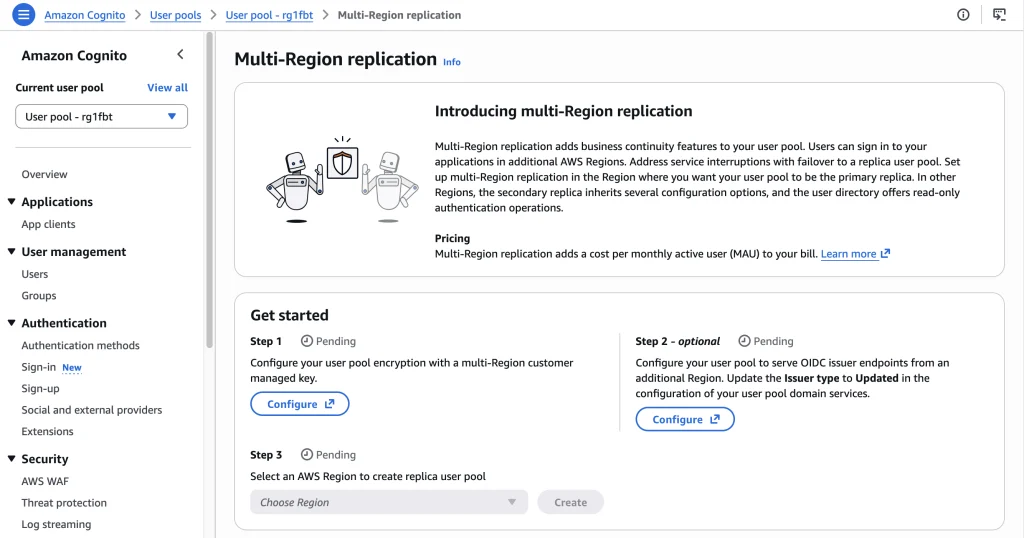

Amazon Web Services (AWS) has announced significant enhancements to Amazon Cognito, its fully managed identity platform, introducing multi-Region replication for improved resilience and support for customer managed keys (CMKs) for advanced encryption control. These updates directly address the evolving demands of modern cloud applications, which require consistent user authentication, robust machine-to-machine security, and unwavering availability, even in the face of regional service interruptions. The increasing prevalence of agentic AI, intricate microservices architectures, extensive automation, and dedicated service accounts has amplified the critical need for sophisticated and reliable machine-to-machine authentication mechanisms, paralleling the long-standing requirement for seamless user experiences.
Addressing Historical Challenges: The Imperative for Resilience
For years, organizations building high-availability applications on AWS have grappled with the complexities of maintaining consistent user authentication and identity data across different AWS Regions. Amazon Cognito has served as a cornerstone for managing user and machine-to-machine authentication, alongside user profiles, for countless applications. However, achieving true multi-Region consistency for identity data presented considerable engineering hurdles. Development teams often dedicated substantial resources to building and maintaining bespoke replication solutions, involving intricate scripting and operational overhead, to synchronize configurations and user data across geographically dispersed AWS Regions.
These custom approaches were fraught with challenges. Manual export and import processes for user data between Regions introduced inherent security risks, increasing the potential for data exposure during transit or storage. Furthermore, such manual interventions were prone to human error, leading to data inconsistencies that could compromise security or user experience. During regional transitions or failover events, end users frequently encountered disruptive experiences, such as being forced to reset passwords or re-authenticate, undermining the perceived reliability of the application. For machine-to-machine communications, the absence of native multi-Region support meant that new application clients had to be created in secondary regions. This necessitated extensive reconfigurations of backend applications and updates to OAuth-protected resources to accept access tokens issued by the new regional issuer, adding complexity and delaying recovery. These significant operational and security challenges made it exceedingly difficult for businesses to maintain uninterrupted operations and a seamless user experience across different AWS Regions. The new multi-Region replication feature is a direct response to these long-standing pain points, offering a managed, automated solution to a previously labor-intensive problem.
Deep Dive into Multi-Region Replication: A New Era of Availability
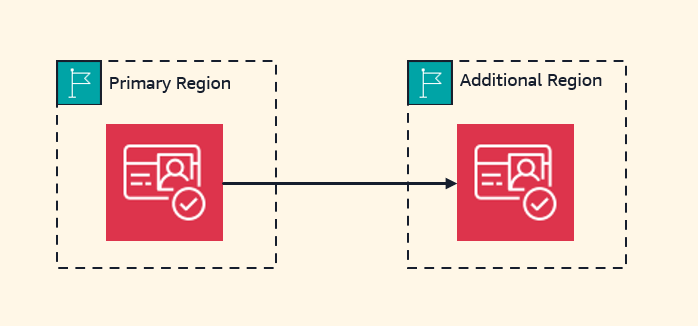
The introduction of multi-Region replication fundamentally transforms how Amazon Cognito handles high availability and disaster recovery. This feature enables Amazon Cognito to automatically maintain a synchronized, read-only copy of user data and machine secrets in a secondary AWS Region chosen by the customer. The replication process flows unidirectionally, from a designated primary Region to the secondary Region, ensuring data consistency while maintaining operational simplicity. This comprehensive replication includes critical identity components such as user profiles, credentials, and user pool configurations, ensuring that all necessary information is available in the secondary location.

During normal operations, the primary Region handles all read and write operations, including new user registrations and profile updates. The secondary Region, operating in a read-only mode, primarily focuses on maintaining authentication capabilities. A key benefit of this design is that existing user sessions continue uninterrupted, even in the event of a primary Region outage. When a need arises to direct traffic to the secondary Region—typically during a failover scenario—existing users can continue signing in seamlessly with their existing credentials. This is made possible because both the primary and secondary regions are configured to recognize and validate access tokens issued by either region, ensuring a smooth transition for currently authenticated users.
Multi-Region replication supports a comprehensive array of authentication methods, catering to diverse application requirements. This includes federated sign-in through popular social providers like Amazon, Google, Apple, and Facebook, as well as enterprise identity integrations via Security Assertion Markup Language (SAML) and OpenID Connect (OIDC). Furthermore, it seamlessly supports API authorization flows for machine-to-machine communications. This comprehensive support ensures that both customer-facing applications and critical backend services relying on machine-to-machine authentication can maintain high availability. It is important to note, however, that while authentication continues without interruption during a failover to the secondary Region, operations requiring write access, such as new user registration or profile updates, are not available. These operations would resume once the primary Region is restored or a new primary is designated and fully operational. This design prioritizes authentication continuity during critical events, minimizing user impact.
Enhancing Security and Control with Customer Managed Keys (CMKs)

Parallel to the resilience improvements, Amazon Cognito has also rolled out support for customer managed keys (CMKs) via AWS Key Management Service (AWS KMS). This feature provides organizations with significantly greater control over the encryption of their user data at rest within Cognito user pools. Before configuring multi-Region replication, customers are required to configure a multi-Region CMK stored in AWS KMS. This ensures consistent encryption across all replicated Regions while empowering customers to define and manage their encryption strategy.
CMKs are cryptographic keys that customers can create, manage, and control within AWS KMS. Unlike AWS-managed keys, CMKs offer enhanced control over key policies, access permissions, and audit trails. This level of granular control is particularly crucial for organizations operating in highly regulated industries, such as healthcare, financial services, and government, where strict compliance mandates often require customers to manage their own encryption keys. By allowing customers to use their own CMKs, Amazon Cognito helps these organizations meet stringent regulatory requirements, including data sovereignty, data residency, and specific audit controls. It also provides an additional layer of security assurance, as the customer maintains direct control over the cryptographic material used to protect their sensitive user data. The integration of CMKs with multi-Region replication ensures that this elevated level of security is maintained consistently across all replicated data, regardless of its physical location, thus strengthening the overall security posture of the identity solution.
Implementing High Availability: A Step-by-Step Guide
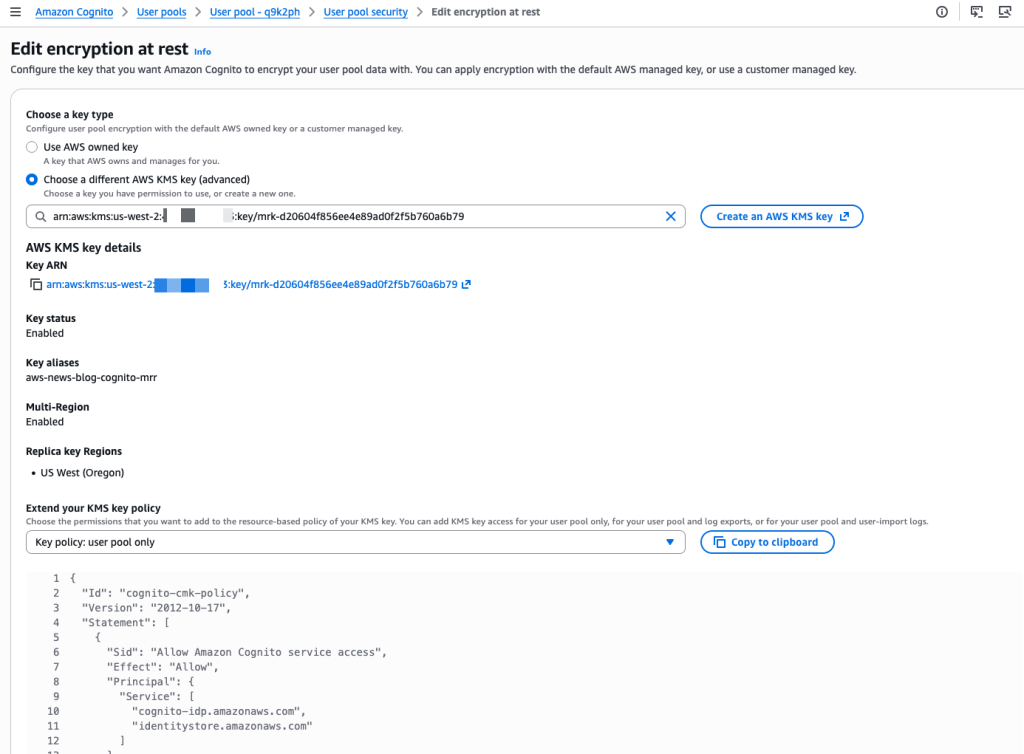
Configuring multi-Region replication and CMKs in Amazon Cognito is a streamlined process, guided by the AWS Management Console. The initial setup requires a pre-existing Cognito user pool and a customer managed key replicated across the desired primary and secondary AWS Regions. For instance, a user pool in us-west-2 (Oregon) can be replicated to us-east-1 (Northern Virginia), provided the CMK is also replicated in both regions.
The configuration typically involves three main steps:
-
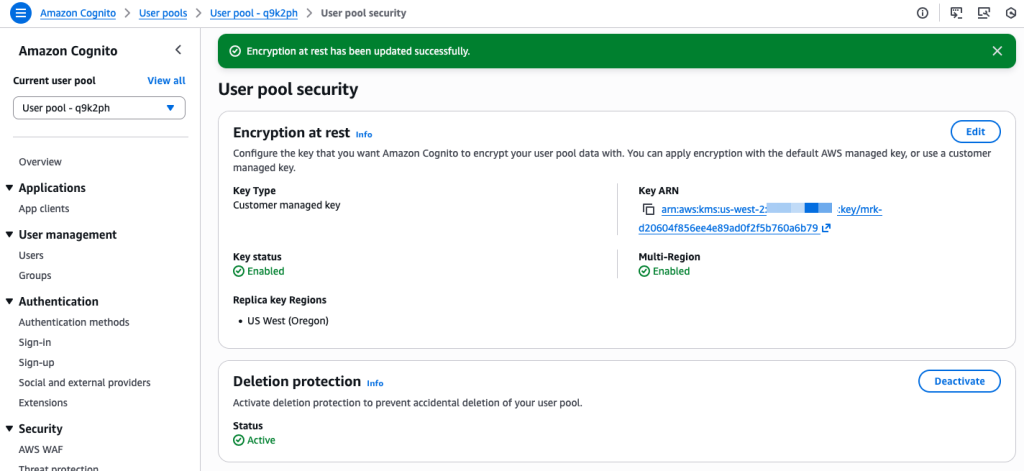
Setting up a Custom Key for Encryption: The first crucial step is to designate and configure a custom AWS KMS key for encrypting user data at rest. Within the Cognito console, users select their pre-created multi-Region CMK. This process also involves updating the key policy for the chosen CMK to explicitly grant Amazon Cognito the necessary permissions to access and utilize the key for encryption and decryption operations. The console provides the precise IAM policy statements required, simplifying this critical security configuration. Confirmation within the console validates that the custom key is correctly selected and configured, ensuring secure data handling from the outset.
-
Configuring Multi-Region OIDC Endpoints: The next step involves configuring the OpenID Connect (OIDC) issuer type for the user pool. This transition generates new, multi-region OIDC endpoints that client applications must use for authentication. This is a mandatory update; client applications, whether server-side or mobile, must be redeployed or updated to incorporate these new endpoints. Failure to update client applications will result in authentication disruptions, as requests directed to old, single-region endpoints will no longer be routed correctly, leading to failed sign-in attempts for users. The console provides the new URLs, and users must confirm they have updated their applications before proceeding. This step is vital for ensuring that applications can correctly route authentication requests to the appropriate region, especially during failover events.
-
Initiating and Activating Replication: Finally, the user selects the target secondary Region for replication. The console intelligently displays only those Regions where the custom encryption key is also replicated, ensuring cryptographic consistency. Once the target Region is chosen, the replication process is initiated. The time required for initial data synchronization depends on the volume of data within the user pool. Upon completion of the initial sync, the replicated user pool in the secondary Region is marked as ready, and the user must manually activate it. Once activated, the replication status changes to "Active," signifying that the secondary user pool is ready to serve authentication traffic as a replica.
Additional Configurations for Comprehensive Failover

While Amazon Cognito automates the replication of core identity data, a complete multi-Region failover strategy requires careful consideration of other application components. The AWS console provides helpful guidance on these additional configurations. For instance, if an application utilizes AWS Lambda functions for custom authentication flows (e.g., pre-authentication, post-confirmation triggers) or for sending SMS or email notifications, these Lambda functions and their associated resources must also be deployed and configured in the secondary Region. Similarly, any log streaming configurations (e.g., to Amazon CloudWatch or Kinesis) and AWS WAF (Web Application Firewall) rules protecting Cognito endpoints must be manually replicated and configured in the target Region before directing authentication traffic to it. These steps are crucial to ensure that the entire authentication pipeline, including custom logic and security protections, functions seamlessly in the secondary Region during a failover.
Strategic Health Checks and Failover Management
The multi-Region replication feature provides the underlying infrastructure for resilience, but the responsibility for monitoring system health and initiating failover remains with the customer. Both the primary and secondary regional endpoints for Cognito remain active and capable of serving traffic at all times. Organizations must design a comprehensive strategy for monitoring their primary Region’s authentication services. This strategy should include defining clear criteria for initiating a failover, based on metrics such as elevated error rates, increased latency patterns, or specific service alerts indicating degraded performance or unavailability.

Upon detection of issues that meet the predefined failover criteria, customers can redirect authentication traffic to the secondary Region. The most common and recommended approach for this is through DNS updates, specifically by changing the CNAME record for the Cognito domain to point to the secondary Region’s endpoint. This method provides organizations with granular control over the failover process, allowing for staged transitions or immediate cutovers as required by their application’s specific recovery time objectives (RTOs) and recovery point objectives (RPOs). It also maintains security by ensuring that traffic is routed through managed DNS services like Amazon Route 53. Regularly testing the failover strategy, perhaps during off-peak hours by redirecting a small portion of traffic, is a critical best practice to verify that authentication continues to function as expected in the secondary Region. For applications utilizing managed login and federation with custom domains, Amazon Route 53’s built-in traffic routing features, including health check IDs, can be leveraged to automate failover based on predefined health checks.
Impact and Implications for Businesses and Developers
The introduction of multi-Region replication and CMK support for Amazon Cognito represents a significant leap forward in cloud identity management, offering profound implications for businesses and developers alike.

- Enhanced Business Continuity: Businesses can now achieve higher levels of availability for their identity infrastructure, drastically reducing the impact of regional outages. This translates directly into improved customer trust, adherence to stringent Service Level Agreements (SLAs), and minimized financial losses associated with downtime.
- Operational Efficiency: The automation of identity data replication eliminates the need for complex, error-prone custom solutions, freeing up valuable engineering resources. Developers can focus on building innovative features rather than managing intricate disaster recovery mechanisms for identity.
- Global Expansion and Performance: For global applications, these features simplify expansion into new geographies by providing a consistent and highly available authentication experience closer to end-users, potentially reducing latency and improving user satisfaction.
- Strengthened Security Posture: CMK support empowers organizations with greater control over their data encryption strategy, bolstering their overall security posture. This is especially vital in an era of escalating cyber threats and increasingly complex data protection regulations.
- Simplified Compliance: The ability to use CMKs directly addresses critical compliance requirements in regulated industries, helping organizations meet obligations related to data residency, sovereignty, and key management.
- Developer Empowerment: Developers gain a powerful toolset to design and implement highly resilient and secure applications with greater ease, fostering innovation and reducing time-to-market for applications with demanding uptime requirements.
- Strategic Advantage for AWS: These enhancements reinforce Amazon Cognito’s position as a robust and comprehensive identity platform, further integrating it into AWS’s broader ecosystem of highly available and secure cloud services.
Regulatory Compliance and Data Governance
For organizations navigating complex regulatory landscapes, the CMK support is particularly impactful. Regulations such as GDPR, HIPAA, PCI DSS, and various national data protection acts often mandate specific controls over encryption keys and data residency. By enabling customers to manage their own encryption keys through AWS KMS, Amazon Cognito facilitates compliance with these stringent requirements. Customers can demonstrate direct control over the cryptographic material protecting sensitive user data, satisfy auditing requirements related to key usage, and better address data sovereignty concerns by knowing where their keys are managed and how access is controlled. This capability significantly lowers the barrier for regulated industries to leverage the scalability and resilience of cloud-based identity solutions.
Pricing and Availability: Key Details for Adoption

Multi-Region replication is available as an add-on feature for Amazon Cognito customers utilizing the Essentials and Plus tiers. For user authentication, the add-on is priced at $0.0045 per monthly active user (MAU) per replica Region for Essentials tier customers, and $0.006 per MAU per replica Region for Plus tier customers. For machine-to-machine (M2M) authentication, the add-on incurs a 30% charge on top of the standard volume-based pricing for successfully issued tokens. Comprehensive pricing details are available on the Amazon Cognito pricing page.
The multi-Region replication feature is currently available in a wide array of AWS Regions, including US East (Ohio, N. Virginia), US West (N. California, Oregon), Asia Pacific (Mumbai, Seoul, Singapore, Sydney, Tokyo), Canada (Central), Europe (Frankfurt, Ireland, London, Paris, Stockholm), and South America (São Paulo). Any of these listed Regions can serve as either the source or the destination for replication, providing extensive geographical flexibility.
Support for customer managed keys is also available for both the Essentials and Plus tiers and is offered in an even broader set of Regions, encompassing US East (Ohio, N. Virginia), US West (N. California, Oregon), Africa (Cape Town), Asia Pacific (Hong Kong, Hyderabad, Jakarta, Malaysia, Melbourne, Mumbai, New Zealand, Osaka, Seoul, Singapore, Sydney, Thailand, Tokyo), Canada (Central), Canada West (Calgary), Europe (Frankfurt, Ireland, London, Milan, Paris, Spain, Stockholm, Zurich), Israel (Tel Aviv), Mexico (Central), South America (São Paulo), and AWS GovCloud (US-East, US-West). This widespread availability ensures that a vast majority of AWS customers can leverage these critical security and resilience features.

Conclusion: A Leap Forward in Cloud Identity Management
These latest updates to Amazon Cognito underscore AWS’s unwavering commitment to providing highly available, secure, and compliant cloud identity solutions. By introducing multi-Region replication and customer managed keys, AWS directly addresses critical customer needs for business continuity during regional incidents and enhanced control over data encryption, particularly for organizations in regulated industries. The automatic synchronization of user data and configurations dramatically reduces operational overhead, allowing engineering teams to focus on core application development rather than managing complex replication logic. Simultaneously, the ability to use customer managed keys provides an additional layer of data protection and helps organizations meet stringent regulatory requirements. These features collectively empower developers to build more resilient, secure, and scalable applications with greater ease, solidifying Amazon Cognito’s role as an essential component in modern cloud architectures. Organizations are encouraged to explore these new capabilities via the Amazon Cognito console or detailed documentation to strengthen their application architecture and enhance their overall security posture.
