
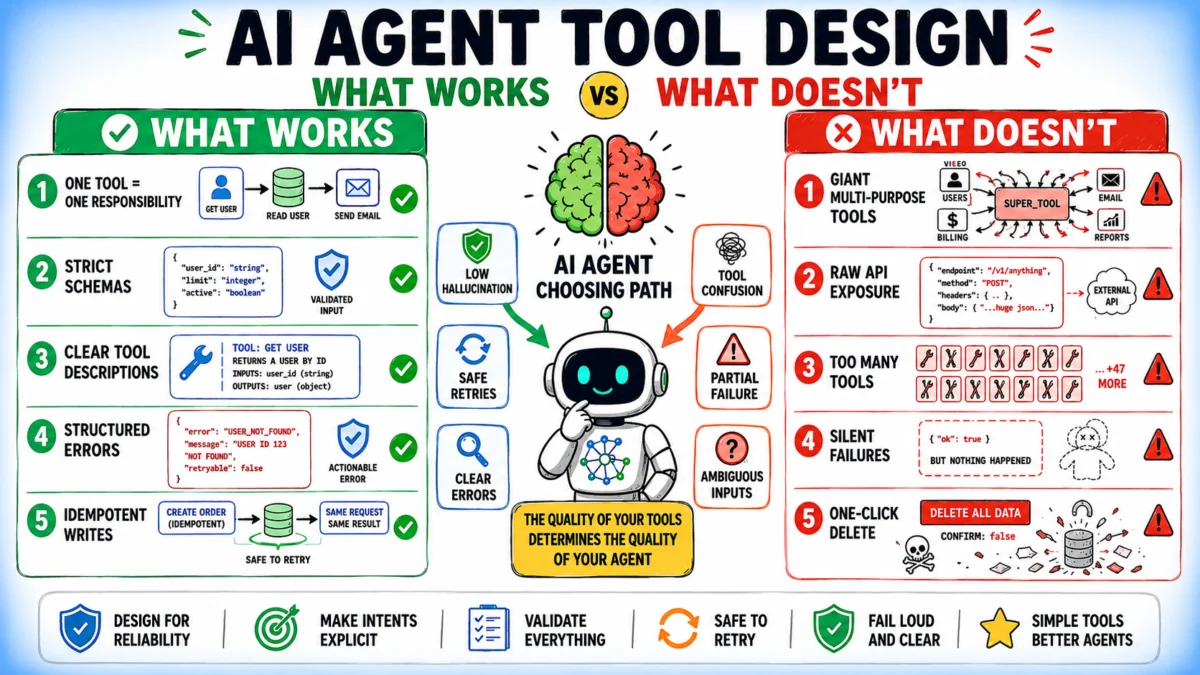

The escalating deployment of artificial intelligence agents across various industries has brought a critical insight to the forefront: the majority of agent failures, often mistakenly attributed to limitations in model capability, are in fact stemming from flawed tool design. This revelation underscores a significant paradigm shift in how developers and organizations should approach the integration of AI agents, emphasizing robust and meticulously crafted tool interfaces as the bedrock of reliable autonomous systems.
The Rise of AI Agents and Initial Challenges
The last few years have witnessed an explosive growth in AI agents, from sophisticated virtual assistants and automated customer service bots to complex systems managing financial transactions, logistics, and scientific research. These agents differentiate themselves from simpler AI models by their ability to not only process information but also to interact with the external world through a suite of specialized tools. Whether it’s querying a database, sending an email, or manipulating a filesystem, these tools are the agent’s "hands and eyes" in a digital environment.
Initially, many developers focused heavily on enhancing the underlying large language models (LLMs), believing that more powerful models would inherently lead to more robust agent performance. However, real-world deployment quickly exposed a different reality. Agents would frequently choose the wrong tool, pass incorrect arguments, or mishandle error responses, leading to operational inefficiencies, user frustration, and even significant financial or data integrity risks. A 2024 industry report by "AI Solutions Review" indicated that over 60% of observed agent failures in enterprise settings could be traced back to issues in tool interaction rather than core reasoning deficits within the LLM itself. This data catalyzed a deeper examination of the interfaces connecting agents to their capabilities.
Understanding the Core Problem: The Interface Illusion
The fundamental issue lies in how an AI model interprets and interacts with the tools it is given. An agent’s understanding is entirely predicated on the information exposed through the tool interface: the tool’s name, its detailed description, the schema of its parameters, and the descriptions for each parameter. These seemingly minor details are, in essence, the model’s instruction manual for interacting with the world. When this "manual" is unclear, incomplete, or poorly structured, the model’s ability to interpret user intent, formulate a coherent plan, and execute tasks reliably is severely compromised.
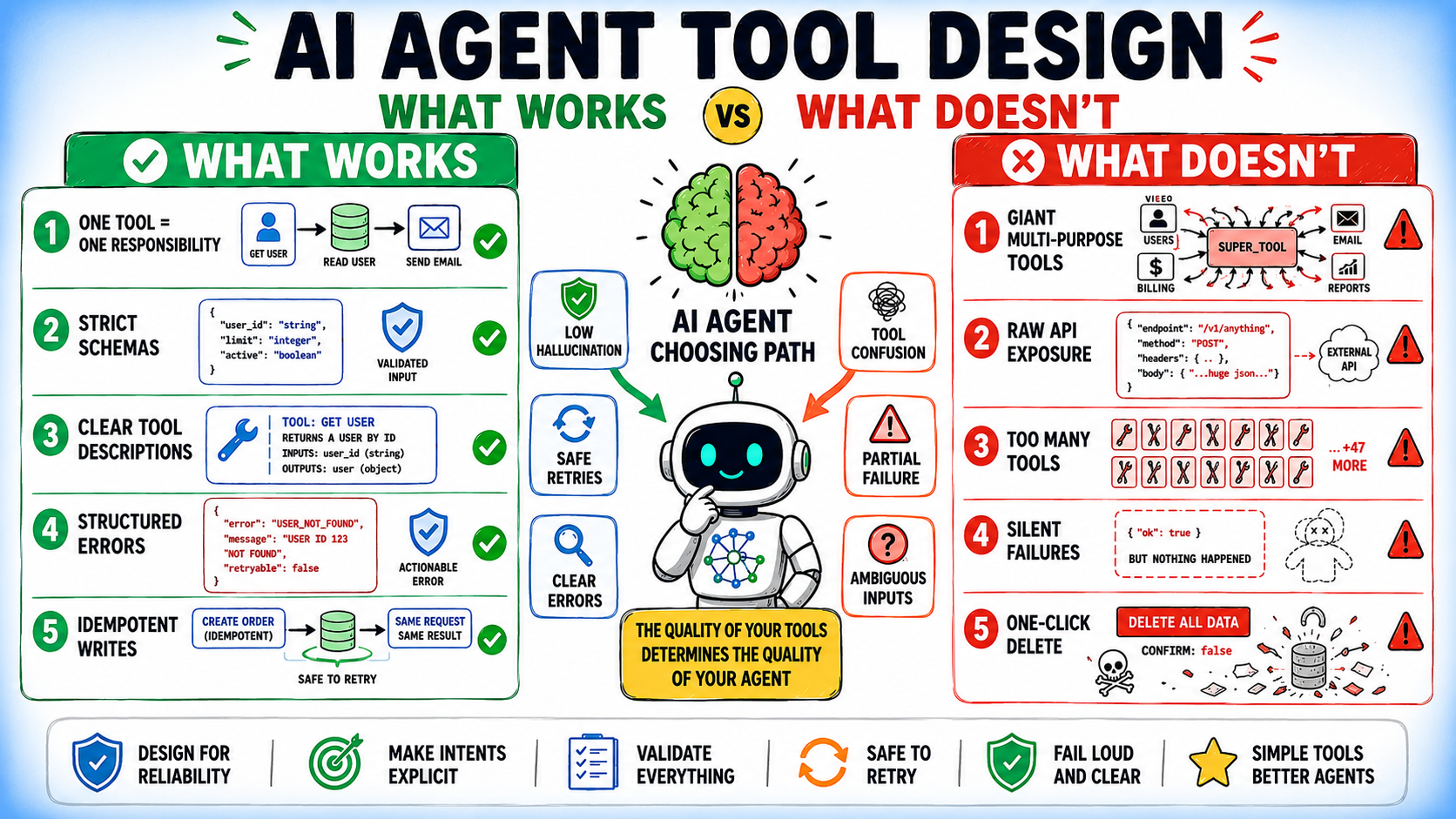
For instance, a vague tool name might lead to inappropriate selection, while an ambiguous parameter description could result in the agent supplying malformed inputs. Inconsistent schemas across tools or weak parameter definitions exacerbate these issues, making failures not accidental occurrences but predictable outcomes of suboptimal design. While more advanced LLMs can mitigate some of these mistakes through improved reasoning, they cannot reliably compensate for a fundamentally flawed interface that misrepresents or obscures a tool’s true function and operational boundaries.
Pillars of Effective AI Agent Tool Design
Leading AI development teams are now converging on several best practices to mitigate these challenges, transforming how tools are conceived and implemented:
-
The Single Responsibility Principle (SRP) for Tools: A cornerstone of good software engineering, SRP dictates that each module, or in this case, each tool, should have one, and only one, reason to change. Applied to AI agents, this means a tool should represent a single, clear operation. The common anti-pattern of a multi-action tool (e.g.,
manage_customer(action="create" | "get" | "update")) forces the model to first decide which mode to invoke before addressing the actual task. This introduces an unnecessary layer of reasoning complexity and a higher chance of error. Dedicated tools likecreate_customer,get_customer, andsuspend_customerprovide unambiguous functions, simplifying the agent’s decision-making and improving observability. A recent internal study by "Tech Innovations Lab" found that agents using single-responsibility tools achieved a 15-20% higher task success rate compared to those using multi-action tools for similar operations. -
Rigorous Schemas for Input Validation: In tool-calling agents, the model constructs tool arguments based on the provided schema. Therefore, robust schemas that make invalid states impossible are paramount. Utilizing enums for fields with a finite set of values (e.g.,
Priority.LOW | MEDIUM | HIGH) eliminates a whole class of plausible-but-invalid outputs. Similarly, employing data types,min_length,max_length, and regex patterns for string formats (e.g., ISO 8601 dates) ensures that validation failures surface at the tool boundary, preventing cryptic downstream errors. This "fail-fast" approach is crucial for debugging and agent self-correction. -
Comprehensive Descriptions Defining Scope and Boundaries: Tool descriptions are the agent’s documentation. Beyond merely explaining what a tool does, effective descriptions must explicitly define when to use it and, crucially, when not to. A weak description like "Search for documents in the knowledge base" leaves too much to inference. A strong description clarifies: "Search the internal knowledge base for documents, policies, and reference material. Use this when the user asks about company procedures, product specs, or documented workflows. Do NOT use this for real-time data (prices, availability, current status) – use
get_live_data()instead." As Dr. Anya Sharma, lead AI architect at Synapse Corp., stated in a recent interview, "Ambiguity in tool descriptions is a silent killer of agent reliability. Explicitly delineating boundaries prevents costly selection errors and improves the agent’s ability to differentiate between similar-sounding tools."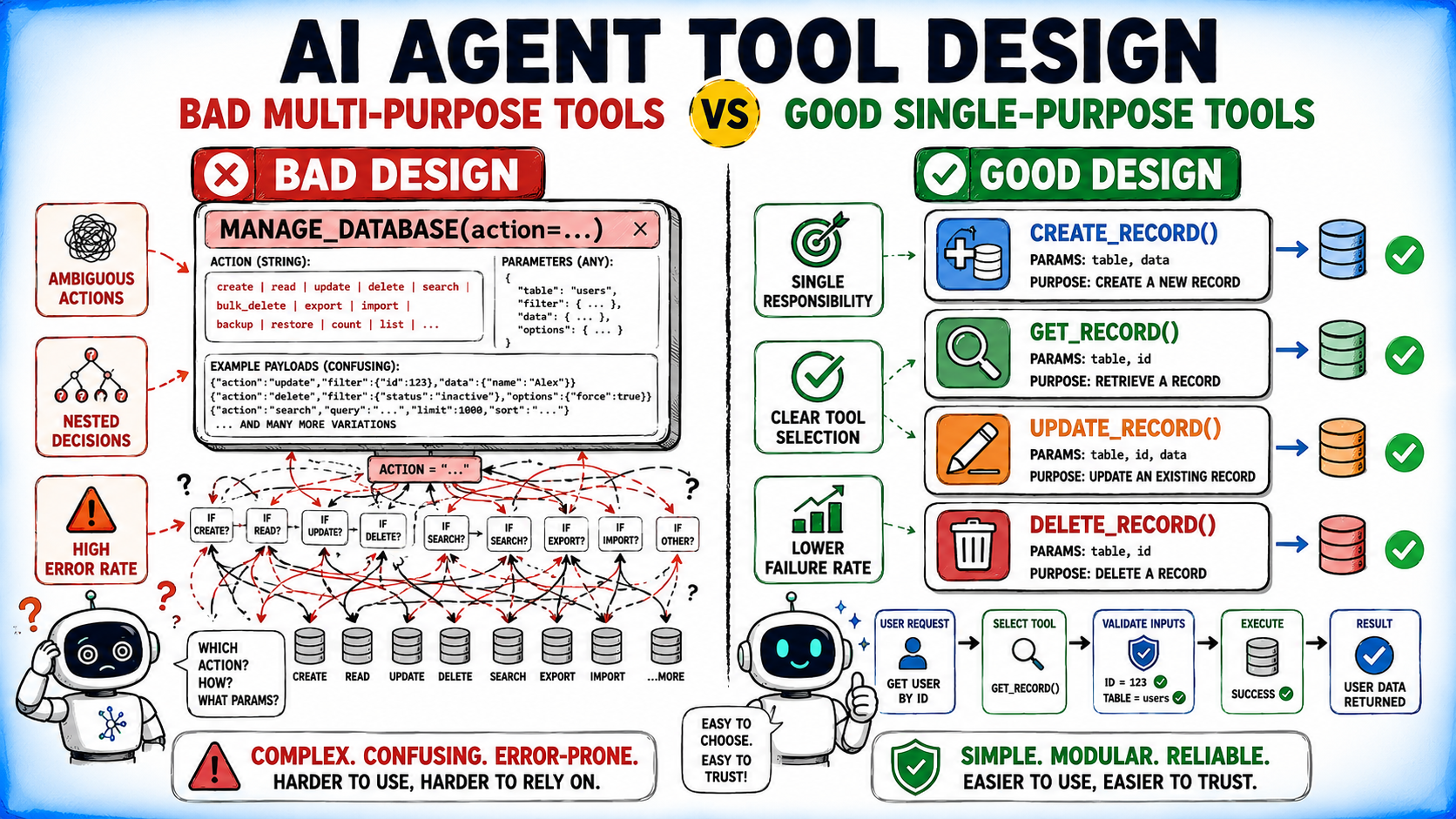
-
Structured, Actionable Error Returns: When a tool fails, the agent needs clear guidance on what to do next. An unhandled exception or a raw stack trace is noise; a structured error is actionable information. A robust error format should include a machine-readable
error_code, a human-readablemessage, arecoverableboolean flag, and asuggested_actionfield. For example, an error like"error_code": "RECORD_NOT_FOUND", "recoverable": True, "suggested_action": "Use list_users() to get valid user IDs before calling get_user()."provides the agent with a clear recovery path, preventing it from retrying non-retryable errors or abandoning recoverable ones. -
Idempotent State-Changing Operations: Any tool that alters the system’s state (e.g., creating a record, sending a message, transferring funds) must be designed to be safely called multiple times without producing unintended side effects. Agents may retry operations due to transient network failures or because the LLM loop issues a duplicate call if confirmation is delayed. Implementing an idempotency key for every write operation ensures that subsequent calls with the same key return the original result without re-executing the action. This is a critical safeguard against duplicate actions and ensures data consistency in dynamic AI agent environments.
Common Pitfalls and Their Systemic Impact
Alongside best practices, the industry has identified several recurring anti-patterns that consistently lead to agent failures:
-
Thin Wrappers Around Unfiltered APIs: A common shortcut is to simply wrap existing REST APIs as agent tools. However, APIs built for human developers often expose excessive detail, rely on pagination, use opaque internal IDs, and return error codes requiring deep domain knowledge. Agents struggle with this verbosity and complexity. A purpose-built wrapper, on the other hand, handles pagination internally, projects only relevant fields, and maps complex API errors into the structured
ToolErrorformat. While over-wrapping can lead to fragmentation, the goal is an agent-friendly abstraction layer, not raw exposure. -
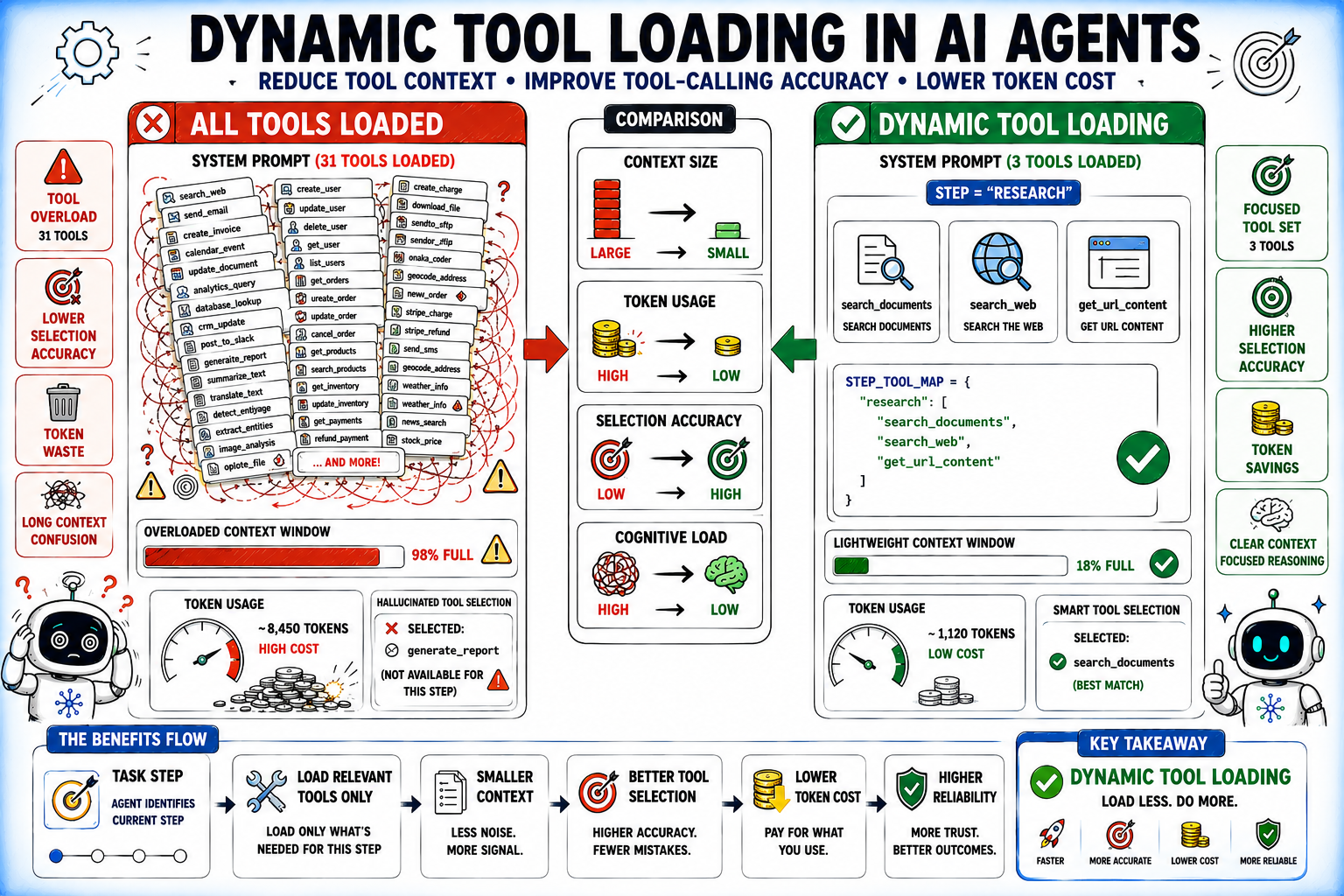
Loading All Tools Into Every Context: The performance of LLMs, especially in tool-calling scenarios, degrades significantly as the size of the tool catalog increases. A 2025 study, "LongFuncEval," demonstrated substantial performance drops even in models with large context windows (128K tokens) when faced with an overly broad set of tools. Loading every available tool into every system prompt consumes valuable token budget and introduces noise, making it harder for the model to identify the most relevant tool. Dynamic tool loading, where only a contextually relevant subset of tools is exposed at each step of an agent’s workflow, addresses both performance and cost issues, improving selection accuracy.
-
Silent Partial Success: A particularly insidious problem arises when a tool completes only part of its requested work but returns a response that falsely indicates full success. For example, a
bulk_create_taskstool that silently swallows exceptions for failed individual tasks will mislead the agent, which then proceeds with an incomplete or erroneous view of the system state. Explicitly reportingcreated_ids,failed_items, and apartial_successflag in the return object empowers the agent to branch its logic: retry failed items, report partial results to the user, or halt the workflow. -
Overlapping Tool Names and Descriptions: When tools perform similar functions or have ambiguous names and descriptions, the agent is forced to engage in costly and error-prone reasoning on every call to differentiate them. Examples include
search_documentsandquery_knowledge_base, orsend_messageanddispatch_notification. Each tool must have a semantically distinct purpose that can be described without reference to other tools. Tool sprawl, characterized by too many tools with overlapping scope, is a major source of unreliable agent behavior in large-scale deployments. -
Destructive Actions Without a Confirmation Gate: Tools that perform irreversible actions—deleting records, messaging real users, executing financial transactions—represent high-risk operations. A single-step execution for such actions, even with an in-prompt "are you sure?" query, is insufficient. The safest pattern involves a two-step confirmation process: a
stage_deletiontool that generates a short-lived confirmation token, followed by aconfirm_deletiontool that requires this token for execution. This explicit confirmation boundary prevents accidental or unauthorized execution. Cybersecurity experts stress that while crucial, such two-step flows must be augmented with additional safeguards like single-use tokens, strict session binding, and replay protection to prevent token leakage or bypass attempts.
Implications for the Future of AI Development
The growing understanding of tool design’s paramount importance has profound implications for the future of AI development and adoption. As AI agents become more autonomous and integrate into mission-critical systems, the reliability and safety of their interactions with external tools will be non-negotiable. Organizations like Anthropic are actively publishing guidelines and best practices for writing effective tools, signaling a broader industry commitment to this area. It is plausible that future regulatory frameworks for AI systems will include provisions or certifications related to the design and validation of agent tools, particularly for applications in sensitive sectors.
Ultimately, investing in robust, well-defined tool design is not merely an optimization; it is a fundamental requirement for unlocking the full potential of AI agents. By shifting focus from solely enhancing model capabilities to meticulously crafting the interfaces through which these models operate, developers can build more reliable, trustworthy, and scalable AI systems, paving the way for their responsible and widespread deployment across the global economy.
