

Amazon Web Services (AWS) today announced the launch of AWS Lambda MicroVMs, a groundbreaking serverless compute primitive designed to revolutionize how developers run user-generated or AI-generated code in highly isolated, stateful execution environments. This new offering provides the robust security of virtual machine-level isolation, combined with the agility of near-instant launch and resume capabilities, all while abstracting away the complexities of infrastructure management and virtualization technologies. Powering this innovation is Firecracker, the same lightweight virtualization technology that has proven its mettle by underpinning over 15 trillion monthly AWS Lambda function invocations, ensuring a foundation of unparalleled operational maturity and scale.
Addressing a Critical Industry Gap in Multi-Tenant Applications
The evolution of modern software architecture has, over the past few years, given rise to a distinct class of multi-tenant applications that present unique computational demands. These applications inherently require the ability to provision each end user or session with a dedicated, secure execution environment where potentially untrusted code, written by the user or an AI, can be run safely. Prominent examples include sophisticated AI coding assistants, interactive code editors and learning platforms, advanced data analytics environments, comprehensive vulnerability scanners, and dynamic game servers that execute user-supplied scripts.
Historically, developers building such capabilities have been confronted with a difficult compromise. Traditional virtual machines (VMs) offer strong isolation, making them a secure choice for untrusted workloads, but their startup times, often measured in minutes, render them unsuitable for interactive, low-latency user experiences. Containers, while launching in seconds and offering improved resource utilization, operate on a shared-kernel architecture. This design necessitates significant custom hardening and continuous security vigilance to safely contain untrusted code, diverting valuable engineering resources. Functions-as-a-Service (FaaS) models, such as existing AWS Lambda Functions, are optimized for event-driven, request-response workloads, designed for rapid, stateless execution. They are not inherently built for long-running, interactive sessions that demand the retention of environment state across multiple user interactions.
This predicament has forced developers to either accept inherent tradeoffs between performance and isolation, or embark on the arduous and resource-intensive journey of building and operating custom virtualization infrastructure. Such an undertaking demands deep expertise in complex systems engineering, drawing engineering talent away from core product development and innovation. AWS Lambda MicroVMs has been purpose-built to precisely fill this critical gap, providing a solution that delivers both stringent isolation and rapid, stateful execution without the operational burden.

The Power of Firecracker: A Proven Foundation for Isolation and Performance
At the heart of AWS Lambda MicroVMs lies Firecracker, an open-source virtualization technology developed by AWS. Firecracker is a virtual machine monitor (VMM) that uses KVM to create lightweight virtual machines, known as microVMs. These microVMs provide the security and isolation properties of traditional virtual machines but with significantly reduced overhead, enabling incredibly fast startup times and efficient resource utilization. Its design prioritizes security, minimal footprint, and rapid instantiation, making it ideal for serverless workloads.
The decision to leverage Firecracker for Lambda MicroVMs is a testament to its proven reliability and performance at massive scale. As the foundational technology behind AWS Lambda Functions, Firecracker has successfully isolated and managed trillions of invocations monthly for years. This extensive operational history means that Lambda MicroVMs inherits a battle-tested, robust, and highly scalable infrastructure. Developers benefit from this mature stack without needing to understand the intricacies of low-level virtualization, allowing them to focus entirely on their application logic. The isolation model ensures that each user’s code runs in its own dedicated microVM, preventing any shared kernel or resources that could potentially lead to security vulnerabilities or performance interference between tenants.
Unpacking the Core Capabilities: Isolation, Speed, and Statefulness
AWS Lambda MicroVMs introduces three distinct capabilities that, until now, were not simultaneously available in a single AWS compute service, addressing the critical needs of modern multi-tenant applications.
Virtual Machine-Level Isolation for Untrusted Code
The paramount feature of Lambda MicroVMs is its commitment to virtual machine-level isolation. By providing each user session with its own dedicated microVM, Firecracker ensures there is no shared kernel or shared resources between different users. This architectural design is crucial for applications that execute untrusted code. It means that code supplied by one end-user is securely contained within their specific execution environment, preventing unauthorized access to other users’ environments or the underlying system infrastructure. This robust security model significantly reduces the risk of multi-tenancy vulnerabilities, offering peace of mind to developers and enhancing the trust of end-users.
Rapid Launch and Resume from Pre-Initialized Snapshots
Lambda MicroVMs pioneers an innovative "image-then-launch" model that drastically reduces startup latencies. The process begins when a developer creates a MicroVM Image by supplying a Dockerfile and their application code packaged as a zip artifact in Amazon S3. AWS Lambda then retrieves the code, executes the Dockerfile, initializes the application, and critically, takes a Firecracker snapshot of the running environment’s memory and disk state.

Every subsequent MicroVM launched from this pre-initialized image resumes directly from this snapshot rather than performing a cold boot. This means that applications are not just starting, but resuming from an already running state, complete with loaded libraries, cached data, and active processes. The result is near-instant startup latency for both initial launches and subsequent idle resumes. Even interactive sessions involving multi-gigabyte application states can come back online quickly enough to provide a seamless, responsive experience to the end-user, eliminating the frustration of waiting for environments to boot.
Stateful Execution for Persistent User Experiences
A significant departure from traditional FaaS models, Lambda MicroVMs offers fully stateful execution. A running MicroVM retains its entire memory, disk state, and running processes throughout the duration of a user’s session. This persistence is vital for interactive applications where users expect their work and environment to be exactly as they left it.
Furthermore, during periods of user inactivity, a MicroVM can be suspended – with its complete memory and disk state preserved – and then rapidly resumed when new traffic arrives. This suspension capability is a game-changer for cost efficiency. Installed packages, pre-loaded machine learning models, and working filesets are immediately available upon resumption, eliminating the need for re-initialization. From the client’s perspective, the pause is virtually imperceptible. Lambda MicroVMs supports up to 8 hours of total runtime for a single session and can be suspended automatically after a configurable idle window. This flexibility makes it straightforward to build a diverse range of products, from software vulnerability scans that complete in minutes, to complex data analytics applications running for hours, and interactive coding sessions with extended periods of user inactivity. Developers should note that applications generating unique content, establishing network connections, or loading ephemeral data during initialization may require integration with service-provided hooks to ensure compatibility with the snapshot-based resume mechanism.
Real-World Applications and Use Cases
The introduction of AWS Lambda MicroVMs unlocks new possibilities for a wide array of applications that were previously constrained by the limitations of existing compute options.
- AI Coding Assistants and Interactive Development Environments (IDEs): These platforms can now offer each user a truly isolated and stateful environment where they can safely run and test AI-generated code or their own scripts without impacting other users. The rapid resume ensures a fluid, responsive coding experience, crucial for developer productivity.
- Interactive Data Analytics Platforms: Data scientists can be provided with dedicated, persistent environments to run complex queries, process large datasets, and build models. The ability to retain memory and disk state across sessions means long-running computations can be paused and resumed, saving cost during idle periods without losing progress.
- Software Vulnerability Scanners and Sandboxes: Security tools often need to execute potentially malicious or untrusted code in a highly isolated environment to detect vulnerabilities. Lambda MicroVMs provides the ideal secure sandbox, preventing any escape or impact on the host system or other tenants.
- Custom Game Servers and Modding Platforms: Game developers can empower players to run custom scripts or mods in a secure, isolated environment. This fosters creativity and community engagement without compromising the stability or security of the core game infrastructure.
- Educational Platforms with Code Execution: Online learning environments can offer students individual, sandboxed environments to practice coding, complete assignments, and experiment with different programming languages, ensuring fair resource allocation and security.
Simplified Developer Experience and Complementary Architecture
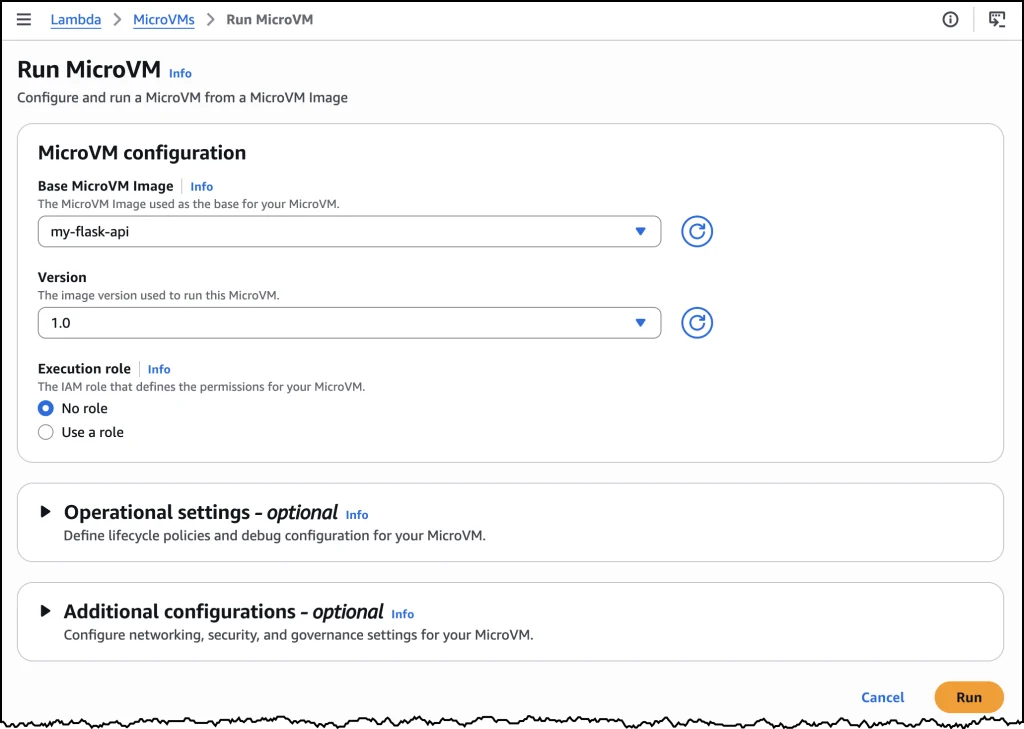
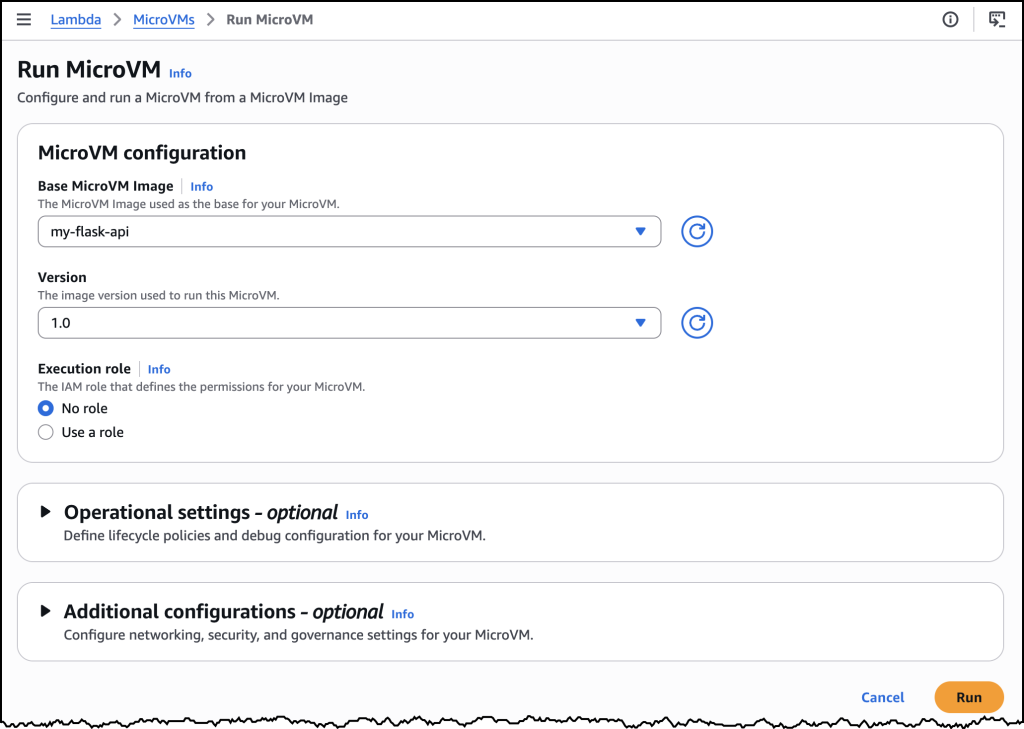
Getting started with AWS Lambda MicroVMs is designed to be intuitive for developers already familiar with the AWS ecosystem. The new service appears directly in the AWS Lambda console, alongside the existing Lambda Functions. Developers can create a MicroVM Image by uploading a zipped application (containing a Dockerfile and their code) to an Amazon S3 bucket. AWS Lambda handles the build process, streaming real-time logs to Amazon CloudWatch, and providing an Amazon Resource Name (ARN) upon completion.

For execution, developers simply use the AWS Console or CLI to run a MicroVM, specifying the image ARN and an idle policy. This policy dictates how long the MicroVM remains active before automatically suspending to a low idle cost, with the option to auto-resume on the next incoming request. No complex networking setup is required; Lambda assigns a unique ID and a dedicated endpoint URL.
It’s important to clarify the distinction between Lambda MicroVMs and existing Lambda Functions. Lambda Functions remain the optimal choice for event-driven, request-response workloads that are inherently stateless or can manage state externally. Lambda MicroVMs, conversely, is purpose-built for multi-tenant applications demanding isolated, stateful, and long-running execution environments for user- or AI-generated code. The two services are complementary; an application utilizing Lambda Functions for its event-driven backend can seamlessly invoke Lambda MicroVMs for specific steps that require running untrusted code in isolation, thus leveraging the strengths of both primitives.
Availability and Technical Specifications
AWS Lambda MicroVMs is now generally available in key AWS Regions: US East (N. Virginia), US East (Ohio), US West (Oregon), Europe (Ireland), and Asia Pacific (Tokyo). The service supports the ARM64 architecture, offering significant performance and cost benefits. Each MicroVM can be provisioned with substantial resources, supporting up to 16 vCPUs, 32 GB of memory, and 32 GB of disk space, accommodating a wide range of computational needs.
Idle MicroVMs can be suspended explicitly via an API call or automatically through a configured lifecycle policy. This intelligent suspension mechanism drastically reduces running costs during periods of inactivity while preserving the full application state for a rapid and seamless resume. Detailed pricing information, reflecting the compute, memory, and storage costs, including the reduced cost for suspended states, can be found on the AWS Lambda pricing page.
Industry Reactions and Future Outlook
The launch of AWS Lambda MicroVMs is poised to be a significant development in the serverless computing landscape. Industry analysts are likely to view this as a strategic move by AWS to capture a growing segment of the market focused on interactive, multi-tenant applications and the burgeoning field of AI-generated code execution.
"This is a game-changer for a specific class of applications that have long struggled with the tradeoffs between isolation, performance, and operational complexity," commented a hypothetical industry analyst. "By providing VM-level security with near-instant startup and statefulness, AWS is effectively removing a major barrier to innovation for AI platforms, educational technology, and collaborative development tools. Developers will no longer need to compromise on security or user experience when running untrusted code."
Developers are expected to welcome the simplified approach to secure, stateful environments. The abstraction of virtualization complexities means more time can be dedicated to feature development and less to infrastructure plumbing. This innovation could accelerate the adoption of serverless architectures for workloads previously considered unsuitable, fostering a new wave of highly interactive and secure multi-tenant SaaS offerings. The cost-effectiveness offered by the idle suspend feature will also be a major draw, allowing businesses to optimize their operational expenditures without sacrificing performance or state.
Conclusion
AWS Lambda MicroVMs represents a pivotal advancement in serverless technology, delivering a purpose-built solution for the intricate demands of multi-tenant applications that execute user- or AI-generated code. By combining the robust isolation of virtual machines with the agility of serverless and the critical capability of stateful execution, AWS has empowered developers to build more secure, responsive, and cost-effective applications without the burden of managing complex underlying infrastructure. This new primitive is set to redefine how developers approach interactive and sandboxed computing, paving the way for a new generation of innovative cloud services.
To begin exploring the capabilities of this new service, visit the AWS Lambda console, or find more detailed information on the Lambda MicroVMs product page. Comprehensive documentation is available in the Lambda MicroVMs Developer Guide.
