
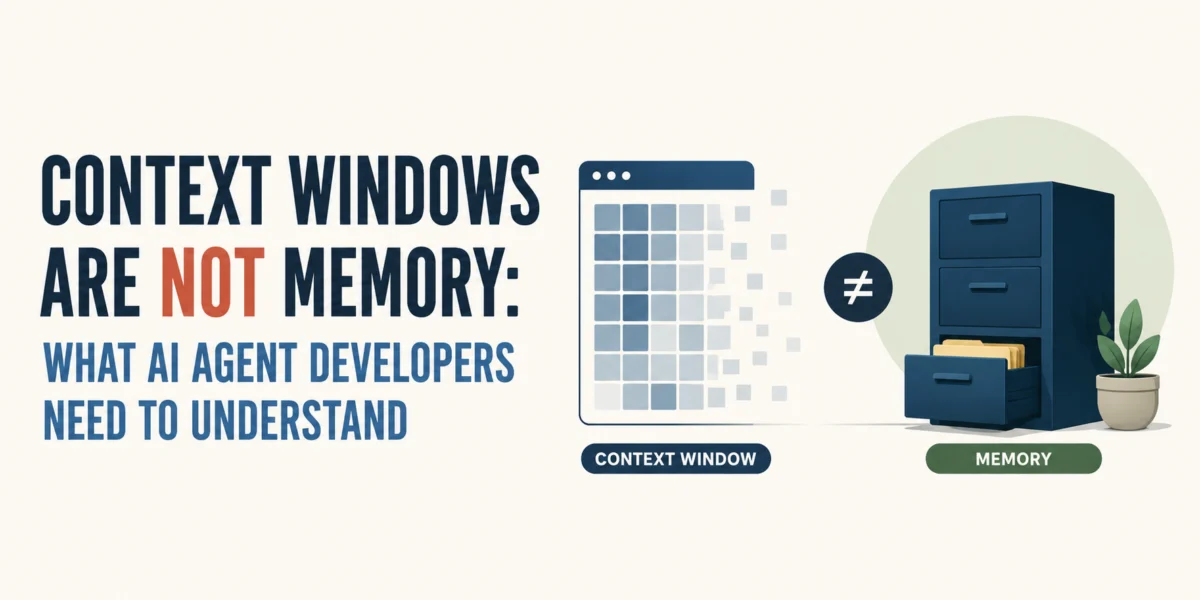

The proliferation of large language models (LLMs) boasting expansive context windows has led to a critical misconception among some AI developers: that a massive context window inherently equates to robust agent memory. This architectural misunderstanding, akin to purchasing an oversized office desk to avoid a filing cabinet, risks fundamental flaws in the design and scalability of AI agents. While a vast context window allows an LLM to process a significant amount of information at once, it fundamentally operates as a stateless scratchpad, requiring a far more sophisticated cognitive stack to achieve genuine, persistent memory.
The Stateless Nature of Large Language Models: A Fundamental Principle
At its core, a large language model is inherently stateless. Each interaction with an LLM via an API call begins at "step zero," meaning the model has no inherent recollection of prior turns or conversations unless that history is explicitly re-fed into its context window with every subsequent prompt. This design stems from the transformer architecture, which processes input sequences in parallel, using self-attention mechanisms to weigh the importance of different tokens within that current window. It doesn’t "remember" past sessions; it "re-reads" its entire provided "universe" for each new request, performing this re-reading in milliseconds.
For example, if an AI agent is engaged in a 50-turn conversation, and on turn 47, the user asks about a detail mentioned in turn 1, the entire transcript of all 46 previous turns, plus the current query, must be resent to the model. This constant re-feeding of information, while enabling impressive conversational capabilities, is not memory. It’s akin to a human repeatedly reviewing an entire document from start to finish before answering each new question, rather than recalling information from long-term memory. This approach, while functional for short interactions, introduces several critical challenges for agent-based systems.
The Illusion of Infinite Context: Challenges and Pitfalls
While models like Anthropic’s Claude 3.5 Sonnet boast a 200K token context window, and Google’s Gemini 1.5 Pro reaches 1 million tokens (with experimental 2 million token contexts), the practical application of these colossal windows in a purely "shove everything in" manner presents significant hurdles:
- Snowballing Costs: Token usage directly correlates with API costs. Resending entire conversation histories, documents, or codebases repeatedly leads to rapidly escalating operational expenses. As an interaction lengthens, the cost per turn can become prohibitive, making long-running or complex agentic tasks economically unfeasible for many applications.
- Increased Latency: While modern GPUs can process large contexts quickly, there’s still a physical limit. Extremely long prompts take longer to process, increasing the response time of the agent. In real-time applications or user-facing interfaces, even small increases in latency can degrade user experience.
- Diminished Performance and "Lost in the Middle" Syndrome: Counterintuitively, a larger context window does not always mean better performance. Research, notably from organizations like Google and Anthropic, has shown that LLMs can suffer from a "lost in the middle" problem. Key information embedded within a very long context might be overlooked or less effectively utilized by the model compared to information presented at the beginning or end of the prompt. The model’s attention mechanism might struggle to discern truly critical details amidst a sea of less relevant data, leading to factual errors or inconsistent responses.
- Security and Privacy Risks: Placing vast amounts of potentially sensitive data (user information, proprietary code, confidential documents) directly into the prompt for every API call increases the attack surface. If prompts are logged or inadvertently exposed, it could lead to data breaches. Furthermore, managing data retention and compliance (e.g., GDPR, CCPA) becomes significantly more complex when sensitive information is constantly flowing in and out of a third-party API.
- Difficulty in Control and Debugging: When an agent’s "memory" is simply its entire context window, it becomes challenging to control what information it prioritizes or how it interprets contradictory statements. Debugging why an agent made a particular decision or forgot a piece of information can be arduous, as the issue might stem from the sheer volume of input rather than a logical flaw in the agent’s reasoning.
These challenges underscore the necessity for a more structured approach to agent memory, moving beyond the simple expansion of the context window.
True Agentic Memory: A Multi-Layered Cognitive Stack
Industry experts and leading AI labs are increasingly emphasizing that effective AI agents require a sophisticated "cognitive stack" that intelligently manages information beyond the immediate context window. This stack integrates various techniques, each serving a distinct purpose in facilitating genuine memory and efficient operation.
Retrieval-Augmented Generation (RAG): Beyond Simple Lookup
Retrieval-Augmented Generation (RAG) systems act as an external "bookshelf" or knowledge base for an agent, enabling it to fetch static, existing data relevant to the current task in a "Just-In-Time" fashion. When a user asks a question, a RAG system queries a document store (often using vector embeddings for semantic similarity), retrieves the top-K relevant chunks, and injects them into the LLM’s context window. This dramatically reduces the need to cram all possible information into the prompt, making the system more efficient and cost-effective.
However, RAG is not without its nuances, especially in dynamic agentic environments. Vector similarity, while powerful for identifying semantically related content, does not inherently equate to "semantic truth" or temporal accuracy. Consider a scenario where a user tells a scheduling agent: "Move my meeting to Friday." Later, they say: "Cancel Thursday’s meeting, Alice is sick." A naive RAG pipeline might retrieve both statements based on semantic similarity to a query about "meeting schedules," presenting contradictory information to the LLM. The agent, therefore, needs to act as a discerning "accountant," capable of resolving conflicts before generation.
Advanced RAG pipelines incorporate reconciliation logic. For instance, they might prioritize the most recently recorded statement by timestamp, or apply domain-specific rules to determine which piece of information overrides another. This pre-processing ensures that the LLM receives a coherent and accurate set of facts, preventing the agent from confidently restating stale or conflicting instructions. This approach transforms RAG from a simple lookup mechanism into an intelligent data curation layer, providing reliable, up-to-date information to the agent’s scratchpad.
Strategic Compression: Optimizing Bandwidth for Efficiency
Compression, in the context of AI agents and LLMs, is an algorithmic token reduction technique that maintains the key underlying data while shrinking its physical footprint within a prompt. This is analogous to zipping large files to reduce storage or transmission size. The goal is bandwidth optimization: to squeeze a large payload (e.g., a 15,000-token API response) down to a manageable size (e.g., 5,000 tokens) to conserve context window space for the model’s core reasoning tasks.
Various techniques fall under this umbrella:
- Stop-word stripping: Removing common words that carry little semantic weight.
- Payload reduction: Carefully selecting the most critical fields from a structured data payload.
- Specialized compression models: Models like LLMLingua are designed specifically to compress text while preserving core meaning, allowing for significant token savings.
- Prompt Caching: Storing and reusing parts of prompts that remain constant across multiple turns.
The key distinction from summarization is that compression aims to preserve the original data intact, albeit in a more compact form. If needed, the compressed data could theoretically be "uncompressed" or fully reconstructed. This ensures that the underlying facts survive the journey to the LLM’s context window, only their representation is optimized. Developers strategically route large data structures through these compression layers before they ever reach the main LLM prompt, effectively maximizing the utility of the available context window.
Intelligent Summarization: Abstracting for Long-Term Understanding
Unlike compression, summarization is a one-way trip: it removes the original data and replaces it with an abstraction or a high-level overview. This process is inherently irreversible; the original detail cannot be perfectly reconstructed from the summary alone. Therefore, a crucial best practice when implementing context summarization is to employ "forked storage."
This pattern involves dumping raw transcripts or detailed interaction logs into cheap, cold storage solutions like Amazon S3 buckets, Google Cloud Storage, or basic SQL tables. Only a synthesized, compact summary of the interaction is then passed into the active prompt for the LLM. This ensures that the agent has access to a concise overview of past events, while the full, granular detail remains archived and accessible should a later step require it for deeper analysis, auditing, or human review.
For example, after a complex user interaction involving multiple steps, the raw conversation might be saved to an S3 bucket with a unique session ID and turn ID. Concurrently, a summarizer model generates a brief synopsis (e.g., "User requested to reschedule meeting X, then inquired about Y’s status.") which is then fed into the LLM’s context for subsequent turns. This approach mitigates the "lost in the middle" problem by presenting only the most salient points, prevents context window bloat, and manages costs effectively. It represents a deliberate trade-off between detail and conciseness, optimized for long-running agentic tasks.
Memory Persistence: Agents as Database Administrators
For an AI agent to possess genuine, long-term memory, it must not act as the database itself (by simply holding everything in its context window), but rather as a "database administrator." This means the agent must be explicitly taught to interact with external, persistent data stores. This paradigm shift enables the agent to maintain state across sessions, remember user preferences, track evolving entities, and manage complex workflows.
This "database administrator" role is typically implemented through a "state machine" or knowledge graph architecture. When a user provides information – for instance, "My dog’s name is Goofy, but we might rename him Pluto" – the agent should not just passively include this in its context. Instead, it should trigger an explicit tool-call or function invocation to update an external database. This tool-call might look like:
  "tool": "update_entity_graph",
  "params":
    "subject": "User_Dog",
    "attribute": "Name",
    "value": "Goofy",
    "notes": "Considering Pluto"
The underlying data store could be a standard relational SQL database, a flexible NoSQL database like MongoDB or Redis, or a sophisticated knowledge graph (e.g., Neo4j, Amazon Neptune) that captures relationships between entities. The choice of database depends on the complexity and structure of the information needing to be stored.
The operational discipline for such an agent involves a consistent "query-then-commit" loop:
- Query at the start of every turn: Before processing a new user message, the agent queries its external memory to retrieve all relevant, current state information. This information (e.g., user preferences, ongoing tasks, known entities) is then injected into the LLM’s context window.
- Commit at the end of every turn: After the LLM processes the user message and generates a response, the agent identifies any new or updated pieces of information that need to be persisted. It then executes tool-calls to update the external database, ensuring that its long-term memory is consistently current.
This explicit management of state transforms the agent from a purely reactive conversational model into a proactive, intelligent system capable of sustained interaction and informed decision-making over extended periods. It is the cornerstone of building truly persistent and reliable AI agents.
The Evolving Landscape of AI Agent Development and Broader Implications
The distinction between context windows and agent memory is not merely an academic point; it has profound implications for the future of AI development. As the industry moves from simple conversational chatbots to sophisticated, autonomous AI agents capable of complex tasks (e.g., automating workflows, personalized assistants, scientific discovery), the architectural design of memory becomes paramount.
Industry Perspectives: Leading AI frameworks like LangChain, LlamaIndex, and AutoGen are explicitly designed to facilitate the construction of these multi-layered cognitive stacks. They provide abstractions and tools for integrating RAG, summarization, and external memory stores, guiding developers away from the "stuff everything in the prompt" mentality. AI researchers and practitioners increasingly emphasize the importance of external tools and structured data management as foundational for robust agentic AI. As Dr. Andrew Ng, a prominent figure in AI, frequently highlights, the future of AI applications lies in orchestrating multiple AI components and tools, rather than relying solely on monolithic, ever-larger foundation models.
Economic Impact: A proper memory architecture leads to more cost-effective AI solutions. By selectively retrieving, compressing, or summarizing information, developers can minimize token usage, thereby reducing API costs significantly over the lifetime of an agent. This makes deploying complex agents at scale a more viable economic proposition.
Reliability and Trust: Agents with true memory persistence are inherently more reliable. They can maintain consistent behavior, retrieve accurate historical context, and avoid repetitive queries or contradictory actions. This builds user trust and enables the deployment of AI in critical applications where accuracy and consistency are non-negotiable.
Scalability and Complexity: A well-designed memory system allows agents to handle more complex tasks and longer interactions without degrading performance. It enables the creation of sophisticated AI systems that can manage vast amounts of information and execute multi-step plans, moving beyond the limitations of single-turn interactions.
Conclusion
The notion that a large context window alone constitutes agent memory is a seductive but ultimately misleading simplification. While impressive in their ability to process vast amounts of data at once, context windows serve as temporary scratchpads. Genuine AI agent memory demands a meticulously designed cognitive stack that integrates retrieval for dynamic information access, compression for bandwidth optimization, summarization for long-term abstraction, and, most critically, external memory persistence managed by the agent itself acting as a database administrator.
The lesson for AI agent developers is clear: stop trying to buy a huge, multi-million-token desk. Instead, equip your agent with a normal, efficient workspace, provide it with sharp tools, and, crucially, teach it how to intelligently access, process, and store information in a structured "filing cabinet" system. This architectural maturity is not just about efficiency; it’s about building reliable, scalable, and truly intelligent AI agents capable of understanding and interacting with the world in a meaningful, persistent way. The future of AI agents lies not in the sheer size of their immediate attention span, but in the sophistication of their ability to learn, remember, and reason over time.
