
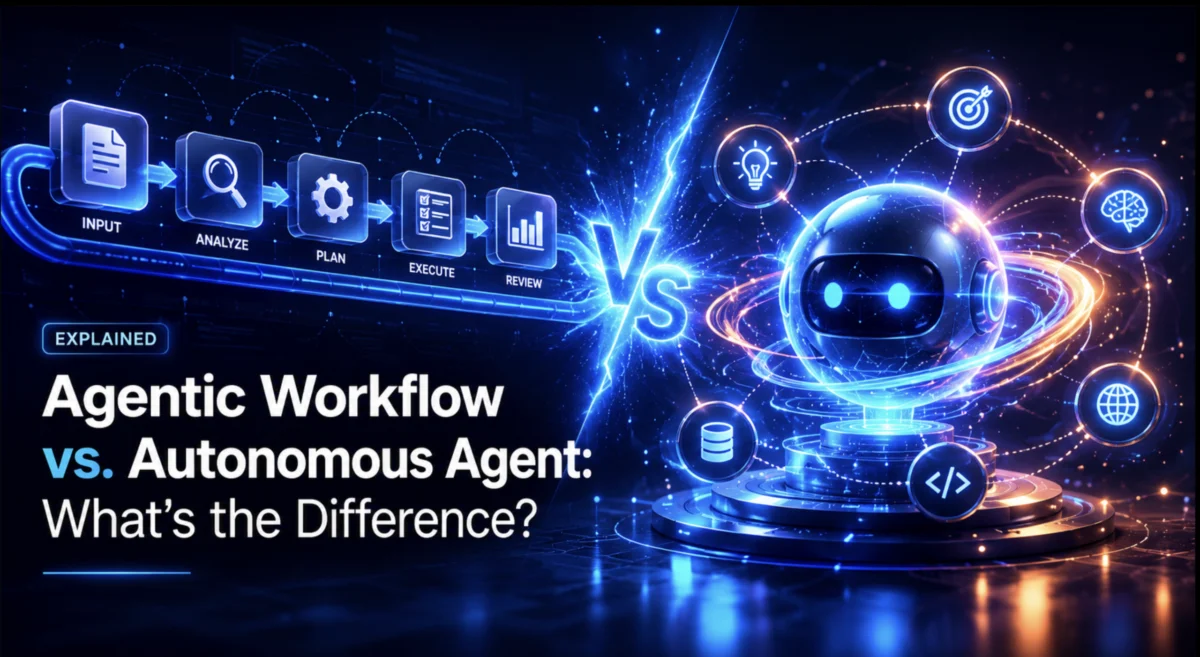

The rapid acceleration of artificial intelligence, particularly with the advent of large language models (LLMs), has introduced a lexicon of terms that, while exciting, often blur critical distinctions in system design and operational capabilities. Among these, "agentic workflows" and "autonomous agents" are frequently used interchangeably, yet they represent fundamentally different paradigms of AI control and decision-making. This article aims to clarify these differences by focusing on the crucial element of control flow: whether a human pre-defines the execution path through code, or an AI model dynamically reasons and determines its own sequence of actions at runtime. Understanding this distinction is not merely an academic exercise; it has profound implications for the design, deployment, auditability, and overall success of AI systems in production environments.
The current landscape sees a significant surge in AI adoption across industries. A 2025 projection by Deloitte, a leading global professional services firm, anticipates that by 2027, as many as 50% of companies utilizing generative AI will have launched agentic AI pilots or proofs of concept. This projected wave of adoption underscores the urgency of precise terminology, as the umbrella term "agentic" has begun to encompass everything from simple, fixed-step pipelines that incorporate an LLM call for a specific task (like summarization) to complex, self-directing systems that plan and execute their own paths with minimal human intervention. Treating these diverse architectures as equivalent can lead to critical missteps: either over-engineering straightforward tasks with unnecessary and potentially risky autonomy, or, conversely, under-engineering genuinely open-ended problems by forcing them into rigid, predefined structures that fail when confronted with unforeseen real-world variability.
The Foundational Distinction: Human Pre-coding vs. Model Runtime Reasoning
At its core, the differentiation hinges on the origin of the control flow. As succinctly articulated by AI research firm Anthropic in their influential "Building Effective Agents" discourse, workflows are characterized by systems where LLMs and associated tools are orchestrated through predefined, human-coded paths. In contrast, agents are systems where LLMs dynamically direct their own processes and tool usage, maintaining intrinsic control over how a given task is accomplished. This fundamental line informs all subsequent architectural variations.
The evolution of AI system design can be viewed along a spectrum, moving from absolute predictability to increasing autonomy. This spectrum encompasses deterministic workflows, orchestrated workflows, reactive single agents, and highly autonomous multi-agent systems. The critical axis for this comparison is not simply "AI vs. no AI"—as almost every modern system now incorporates some form of AI—but rather predictability versus autonomy. Key questions for system architects include: Does this process absolutely require step-by-step repeatability, auditability, and explainability? And, is the optimal path to task completion known in advance, or must the system discover it dynamically at runtime?
A system can extensively utilize an LLM and still maintain a fully deterministic structure. Consider a fixed pipeline where an LLM generates text at one stage, but the subsequent steps are hardcoded regardless of the LLM’s output. Conversely, a system might be labeled "agentic" yet possess limited true autonomy, operating within a tightly scripted loop with a constrained set of actions and a strict step limit. The presence of an LLM call is not the definitive signal; the ownership of the control flow is. Google Cloud’s design-pattern documentation reinforces this operational distinction: deterministic workflows are suited for tasks with a clearly defined, unchanging path, while dynamic orchestration is required for problems where the agent must determine the best course of action without a predefined script. This distinction serves as the guiding principle for understanding the different stages of AI system autonomy.
Deterministic Workflows: The Bedrock of Predictability
At the most predictable end of the spectrum lie deterministic workflows. In these systems, a human explicitly defines the entire sequence of steps during the design phase, embedding it directly into the code. An LLM might be integrated into any of these steps—perhaps for generating a report, classifying incoming data, or drafting a summary. However, the LLM’s output does not dictate the subsequent action. The overarching, human-written code maintains full control, irrespective of what the model returns.
Consider a customer support pipeline. A raw input is first extracted, then classified by an LLM (e.g., "billing," "general," "technical"), then summarized, and finally, a notification is sent. In a deterministic workflow, even if the LLM classifies two different inputs as "billing" and "general" respectively, both inputs will proceed through the exact same sequence of extraction, classification, summarization, and notification. The LLM’s classification is merely data flowing through a fixed pipe; it does not alter the pipe’s structure or the order of operations. This inherent predictability is invaluable for applications demanding high levels of auditability, regulatory compliance, and consistent output, such as financial transaction processing or medical record management, where every step must be explainable and repeatable.
Orchestrated Workflows: Dynamic Routing within Human-Defined Boundaries
The next step on the autonomy spectrum is orchestrated workflows, a category often mistakenly labeled as fully "agentic." These systems introduce a layer of dynamic decision-making, typically powered by an LLM, but crucially, the entire graph of possible paths is still defined in advance by a human. The LLM’s role is to select which predefined path to take at runtime, essentially choosing from a menu of options that a human has meticulously prepared. It does not invent new paths or actions.
Imagine an enhanced customer support system. After extracting the input, an LLM classifies the query (e.g., "billing," "technical," "general"). Based on this classification, the system then routes the query to a specific, pre-programmed handler (e.g., handle_billing, handle_technical, handle_general). Each handler represents a distinct branch in the workflow, all of which were anticipated and coded by a human. The LLM’s decision determines which branch executes, but it cannot create a new branch that wasn’t already hardcoded. This approach offers greater flexibility than purely deterministic workflows, allowing for more nuanced responses to varying inputs, yet retains a high degree of control and predictability because all possible outcomes and paths are known and managed by human developers. This "dynamic orchestration" is widely used in applications like intelligent routing in call centers, document processing pipelines that branch based on content type, or automated email responses that adapt to query intent within a known set of responses.
Reactive Agents: The Dawn of True Autonomy with the ReAct Loop
True autonomy begins with reactive agents, a paradigm fundamentally enabled by the Reasoning plus Acting (ReAct) pattern, introduced by Yao et al. in 2022. Here, the AI model itself decides, at each step, what action to take next, based on its observations from previous actions. Unlike orchestrated workflows, there is no pre-written branch covering every conceivable case. The agent operates within an iterative loop of "Thought → Action → Observation" until a defined exit condition is met. The sequence of actions, their number, and the specific tools used are not known in advance; they are dynamically determined by the model’s reasoning at runtime. Only the available tools are fixed; the path through them is not.
Consider a sophisticated customer service agent tasked with resolving complex queries. It might have access to tools like search_knowledge_base and escalate_to_human. If a user asks, "What is the refund policy?", the agent might think, "I need to look up the policy," then act by calling search_knowledge_base with the query. Upon observing the result (e.g., "Refunds are available within 30 days"), it might think, "I found the answer," and then finish by providing the information.
Now, if a user asks, "Can you process my international tax refund in crypto?", the agent might initially think the same, act by calling search_knowledge_base. However, the observation might be, "No matching information found in knowledge base." At this point, the agent dynamically reasons, "The knowledge base has no answer. I should escalate this," and then acts by calling escalate_to_human. This demonstrates a genuinely open path: the system’s behavior adapts not just to the initial input, but to the consequences of its own actions, leading to different step counts and sequences based on runtime observations. This capability is vital for tasks that are genuinely open-ended, require exploration, or involve navigating complex, unpredictable environments, such as code generation, scientific discovery, or complex problem-solving where the solution path is not predefined. Production implementations often manage the accumulated thought/observation history in a "scratchpad" and summarize tool outputs to prevent context overload.
Autonomous Multi-Agent Systems: Collaborative Intelligence and Unbounded Potential
At the very cutting edge of the autonomy spectrum reside autonomous multi-agent systems. These architectures build upon the ReAct loop, but in a nested fashion. A central orchestrator agent runs its own ReAct loop, but some of its "actions" are calls to other specialized agents. Each of these sub-agents, in turn, operates its own complete ReAct loop. The orchestrator reasons about what tasks to delegate, delegates them, observes the results from its sub-agents, and continues its own planning.
Imagine the AVAILABLE_TOOLS of our reactive agent now including research_agent, finance_agent, and coding_agent. Calling research_agent doesn’t return a simple string; it initiates that sub-agent’s independent Thought-Action-Observation loop, which might run for multiple steps, interact with its own specialized tools, and then return a comprehensive result to the orchestrator. No human has pre-defined which sub-agent gets called, in what order, or how many times any of them execute. The system dynamically assembles a "team" of AI specialists to tackle a complex problem.
Google Cloud’s documentation refers to the most extreme version of this as the "swarm" pattern—a collaborative team of agents operating without a single central orchestrator. Such systems hold immense promise for generating exceptionally high-quality, creative solutions to problems of unprecedented complexity, precisely because they are not constrained by predefined interaction patterns. However, this lack of structure also introduces significant risks: swarms can fall into unproductive loops, fail to converge on a solution, or incur substantial computational costs due to extensive, multi-turn interactions. This represents the extreme end of autonomy, where predictability is largely sacrificed for maximum flexibility in handling truly novel problems.
Why This Distinction Matters in Production: Navigating the Real-World Trade-offs
The difference between agentic workflows and autonomous agents is far from theoretical; it has tangible, measurable impacts on the viability and success of AI deployments in the real world. Despite the substantial hype surrounding fully autonomous agents, production realities in 2025 indicate that AI workflows—both deterministic and orchestrated—remain the dominant pattern behind successful generative AI deployments. Fully autonomous multi-agent systems, while promising, are still largely in exploratory phases or confined to narrow, specialized domains.
The primary reason for this lies directly in the predictability axis discussed earlier. Agentic systems, by their very nature, are non-deterministic; identical inputs can yield different outputs across separate runs. This inherent variability is a significant liability in environments that demand high stakes, regulated processes, or strict auditability. If a process must be explainable, step-by-step, to a compliance team, a regulator, or for legal accountability, a purely autonomous agent without robust guardrails and human-in-the-loop checkpoints is generally not suitable. The challenges of debugging, monitoring, and ensuring consistent, auditable behavior in highly autonomous systems are substantial.
The emerging pattern in mature AI systems is, therefore, hybrid. This approach strategically combines elements from across the spectrum. A higher-level agent might be employed to set overarching goals and orchestrate the general task, leveraging its autonomy to interpret ambiguous situations and dynamically adapt. Simultaneously, critical, well-understood computations—where a known correct path exists and repeatability is paramount—are delegated to deterministic modules or orchestrated workflows. For instance, a medical diagnostics system might use an autonomous agent to interpret a patient’s complex, ambiguous symptoms and dynamically decide the optimal sequence of diagnostic tests to order. This is genuine autonomy, as the precise testing sequence is not knowable in advance. However, the execution and interpretation of each individual test would likely run through a validated, deterministic pipeline, ensuring accuracy, consistency, and regulatory compliance for that specific, well-defined sub-task.
Conclusion: Choosing the Right Tool for the Right Problem
The terms "agentic workflow" and "autonomous agent" are not mutually exclusive or indicative of a hierarchy from "worse" to "better." Instead, they describe different points along a continuous spectrum of AI autonomy, each optimized for different problem characteristics and operational requirements. The four stages—deterministic, orchestrated, reactive, and autonomous multi-agent—represent distinct answers to the fundamental question of who owns the control flow: a human writing code in advance, or an AI model reasoning at runtime.
Deterministic workflows offer unparalleled auditability, repeatability, and predictability by design; the same input guarantees the same path every time. Reactive and multi-agent systems willingly forgo this absolute guarantee in exchange for the profound ability to tackle problems whose structure, solution path, or intermediate steps cannot be anticipated ahead of time. Neither property is without its trade-offs, and no single architecture is inherently "correct" for all applications.
The most robust and successful AI systems in production do not commit to one extreme of this spectrum uniformly. Instead, they intelligently segment a problem, applying the appropriate level of autonomy to each component. Fixed structures are implemented where a known, correct path exists and consistency is paramount, while genuine autonomy is reserved for those facets of a problem that truly lack a predefined solution path. Mastering this nuanced understanding of AI control flow is not just an architectural preference; it is a strategic imperative for organizations seeking to responsibly and effectively harness the transformative power of artificial intelligence.
