

The United States has officially entered a new era of strategic technological development with the launch of America’s Quantum Space Initiative, a multi-sector coalition designed to accelerate the integration of quantum technologies into the space domain. This landmark partnership brings together a powerful consortium of industry leaders and academic heavyweights, including Infleqtion, Voyager Technologies, Monarch Quantum, Armada, and the University of Colorado Boulder. The initiative aims to unify disparate research efforts into a cohesive national strategy, ensuring that the U.S. maintains a competitive edge in what is increasingly being termed the "quantum space race."
The primary vehicle for this collaboration is the newly established Quantum Space Hub. This collaborative network is structured to connect innovators from across the quantum and space communities, facilitating the transition of theoretical breakthroughs into mission-ready hardware. By fostering an environment where government policy, academic research, and commercial scalability intersect, the initiative seeks to solve the unique challenges of operating sensitive quantum systems in the harsh environment of Earth orbit and beyond.
The Strategic Imperative for Quantum in Space
The decision to form this initiative comes at a critical juncture in global aerospace development. While classical computing and communication systems have reached a high level of maturity, they are approaching physical limits in terms of precision, security, and processing power. Quantum technologies—leveraging the principles of superposition and entanglement—offer the potential for exponential leaps in capability. However, terrestrial quantum systems face significant hurdles, such as signal loss in fiber optic cables and environmental noise.
Space provides a unique vantage point and environment that can overcome these limitations. Vacuum conditions and the ability to establish line-of-sight laser links over thousands of kilometers make space the ideal medium for a global quantum internet. Furthermore, the microgravity environment offers a pristine laboratory for cold-atom experiments that are difficult to replicate on Earth. The America’s Quantum Space Initiative recognizes that leadership in space is no longer just about launch capacity or satellite volume, but about the sophistication of the payloads those satellites carry.
A Chronology of U.S. Quantum Policy and Development
The formation of this initiative is the latest milestone in a decade-long effort to formalize U.S. quantum strategy. To understand the context of this week’s announcement, it is necessary to look at the legislative and research timeline that preceded it:
- 2018: The National Quantum Initiative Act (NQI): Signed into law to provide a coordinated federal program to accelerate quantum research and development for the economic and national security of the United States. It established several research centers and authorized over $1.2 billion in funding.
- 2020: The Quantum Internet Blueprint: The Department of Energy (DOE) unveiled a strategy for the development of a national quantum internet, highlighting the role of satellite-to-ground links.
- 2022: The CHIPS and Science Act: This legislation significantly boosted funding for "frontier technologies," including quantum information science, and emphasized the need for domestic manufacturing of quantum-related hardware.
- 2023: Early Orbital Demonstrations: Several small-scale experiments, including Infleqtion’s work with cold atom systems on the International Space Station (ISS), proved that quantum hardware could survive the rigors of launch and operate in microgravity.
- 2024: Launch of America’s Quantum Space Initiative: The current coalition was formed to bridge the "valley of death" between laboratory research and commercial deployment, specifically targeting space-based applications.
Technical Foundations: From Cold Atoms to Precision Timing
The initiative focuses on three core pillars of quantum technology: sensing, timing, and computing. Each of these areas has profound implications for how the U.S. operates in space and protects its domestic infrastructure.
Quantum Positioning, Navigation, and Timing (PNT)
Current global navigation satellite systems (GNSS), such as GPS, rely on highly accurate atomic clocks. However, these signals are weak and susceptible to jamming or spoofing. Quantum sensors, specifically those using cold atom interferometry, can provide "GPS-denied" navigation. These sensors are so precise they can detect minute changes in gravity and acceleration, allowing a spacecraft or aircraft to calculate its position with extreme accuracy without needing an external signal.
Quantum Communications and Cryptography
As quantum computers become more powerful, they threaten to break traditional encryption methods. The Quantum Space Initiative is prioritizing the development of Quantum Key Distribution (QKD). By using entangled photons sent via satellite, two parties can create a secure encryption key. Because of the "observer effect" in quantum mechanics, any attempt to intercept the key would be immediately detectable, providing a level of security that is mathematically unbreakable.
Neutral Atom Quantum Computing
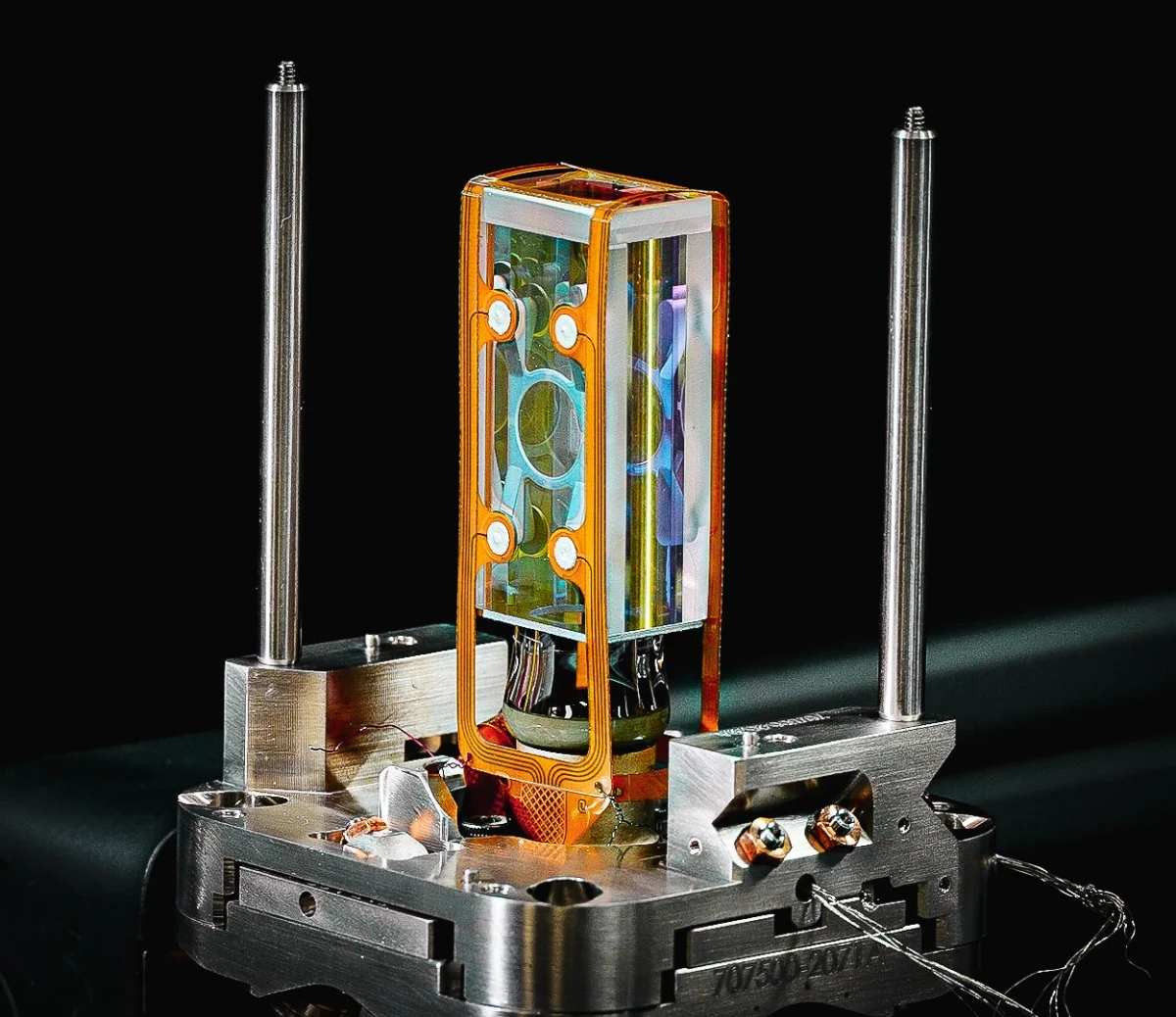
Infleqtion, a founding member of the initiative, specializes in neutral atom quantum computing. Unlike superconducting qubits that require massive dilution refrigerators to stay near absolute zero, neutral atoms can be trapped using lasers in a glass cell. This technology is significantly more portable and energy-efficient, making it a prime candidate for deployment on space stations or large satellite buses where size, weight, and power (SWaP) are at a premium.
Profiles of the Founding Partners
The diversity of the coalition reflects the multifaceted nature of the quantum industry. Each member brings a specific set of capabilities to the Quantum Space Hub:
- Infleqtion: Formerly known as ColdQuanta, the company is a leader in cold atom technology. Their "quantum-on-a-chip" approach is essential for miniaturizing quantum devices for space flight.
- Voyager Technologies (Voyager Space): Known for its work on the Starlab commercial space station, Voyager provides the orbital infrastructure and mission integration expertise. They understand the logistical requirements of getting hardware into space and maintaining it.
- Monarch Quantum: This firm focuses on the networking layer, developing the interfaces required to connect quantum processors and sensors into a functional, distributed network.
- Armada: Specializing in edge computing and ruggedized infrastructure, Armada ensures that quantum data can be processed and utilized in remote or "disconnected" environments, which is a standard condition for deep-space missions.
- University of Colorado Boulder: A perennial leader in physics and aerospace engineering, CU Boulder serves as the academic anchor. The university’s long history with JILA (formerly the Joint Institute for Laboratory Astrophysics) has produced multiple Nobel laureates in the field of Bose-Einstein condensates and atomic physics.
Official Responses and Strategic Vision
The leadership of the initiative has emphasized that this is not merely a research project, but a strategic necessity. Dylan Taylor, Chairman and CEO of Voyager Technologies, highlighted the importance of translating innovation into "enduring capabilities." His statement reflects a broader sentiment in Washington and the private sector: that the U.S. must move beyond "one-off" experiments and toward a permanent quantum presence in orbit.
"American leadership in space depends on turning breakthrough technologies into enduring capabilities," Taylor noted. "Quantum technologies represent an exciting frontier, and we look forward to helping advance the infrastructure, partnerships, and innovations that will support the next generation of space missions."
Dr. Scott Morrison, a lead researcher at the University of Colorado Boulder, added that the initiative provides students and faculty with a direct pipeline to real-world applications. "The Quantum Space Hub will act as a bridge, ensuring that the theoretical work being done in our labs today becomes the mission-critical hardware of tomorrow," Morrison said in an internal briefing following the announcement.
Global Competition and Geopolitical Analysis
The urgency behind America’s Quantum Space Initiative is fueled by intense global competition. China has made significant strides in this field, notably with the 2016 launch of the Micius satellite, which successfully demonstrated long-distance QKD. The European Union has also launched the EuroQCI (European Quantum Communication Infrastructure) to build a secure quantum network across the continent.
For the United States, the stakes are both economic and military. The global quantum technology market is projected to reach over $100 billion by the 2030s, with space-based services making up a significant portion of that valuation. From a defense perspective, the ability to maintain secure communications and precise navigation in a contested space environment is paramount. By leveraging a public-private partnership model, the U.S. hopes to move faster and more efficiently than the state-led programs of its adversaries.
Broader Impact and Future Implications
The long-term implications of the Quantum Space Initiative extend far beyond the aerospace sector. The technologies developed for space are likely to "spin back" to Earth, much like the integrated circuit and GPS did in previous decades.
- Climate Monitoring: Quantum gravity sensors in orbit will allow for unprecedented monitoring of Earth’s water tables, ice sheet thickness, and volcanic activity, providing climate scientists with data that is orders of magnitude more accurate than current satellite imagery.
- Resource Exploration: Space-based quantum sensors could identify mineral deposits and oil reserves by detecting subtle gravitational anomalies from orbit.
- Deep Space Exploration: As NASA looks toward Mars, quantum clocks will be essential for autonomous navigation in the deep solar system, where signal delays to Earth make real-time control impossible.
The launch of America’s Quantum Space Initiative marks the beginning of a coordinated effort to master the quantum domain. By combining the agility of startups like Monarch and Armada with the established expertise of Infleqtion and Voyager, and the intellectual rigor of CU Boulder, the coalition is positioned to transform the "quantum frontier" into a stable and productive component of the U.S. space economy. As the Quantum Space Hub begins its operations, the focus will now shift to the first round of technology demonstrations, which are expected to reach orbit within the next 24 to 36 months.
