
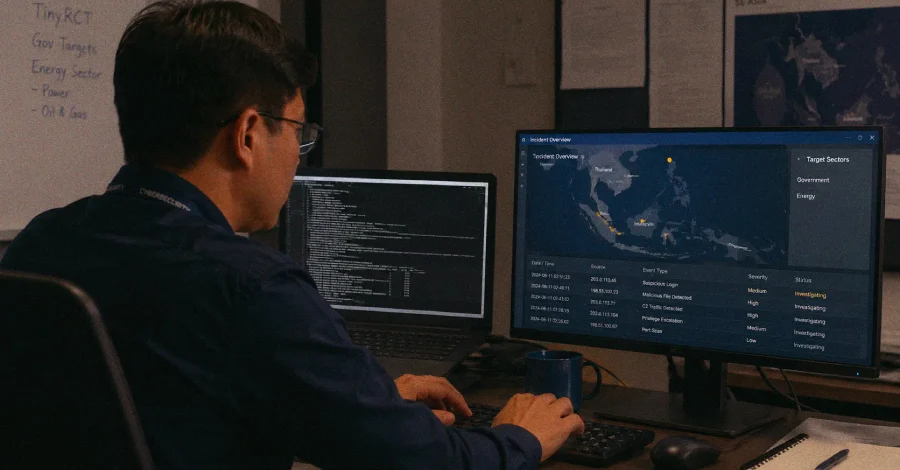

A sophisticated Chinese-speaking Advanced Persistent Threat (APT) actor has been definitively linked to a previously undocumented custom backdoor, dubbed TinyRCT, as part of a persistent and strategic campaign targeting government entities and critical infrastructure sectors across Southeast Asia. The ongoing activity, meticulously documented by cybersecurity researchers, underscores a calculated effort to compromise sensitive networks and exfiltrate vital information from state-owned enterprises in the energy and governmental domains, signaling a significant escalation in regional cyber espionage.
Unmasking CL-STA-1062: A Persistent Regional Threat
The threat actor at the center of these operations has been identified by Palo Alto Networks Unit 42 as CL-STA-1062. This designation signifies a dedicated and well-resourced group with a sustained focus on strategic targets within East and Southeast Asia. Crucially, Unit 42’s analysis revealed significant overlaps between CL-STA-1062 and UAT-7237, a hacking group first brought to public attention by Cisco Talos in August 2025. UAT-7237 was initially observed conducting targeted campaigns against web infrastructure entities in Taiwan, indicating a broader regional remit and a consistent interest in high-value information assets.
The attribution to a "Chinese-speaking" APT actor is a critical detail, often implying state sponsorship or alignment with national strategic interests. Such groups typically engage in cyber espionage for long-term intelligence gathering, intellectual property theft, or to gain geopolitical advantage. Their targets are rarely chosen at random, instead reflecting a methodical approach to data acquisition that supports national objectives. CL-STA-1062’s operational history extends well beyond the recent Southeast Asian breaches, with Unit 42 tracing their campaigns targeting strategic sectors in East Asia back to at least March 2022. This extensive timeline suggests a well-established and highly capable group with a clear mandate for regional cyber operations, evolving its tactics and tools to maintain stealth and effectiveness.
TinyRCT: A Custom-Built Espionage Tool
At the heart of CL-STA-1062’s recent toolkit is TinyRCT, a bespoke and previously undocumented backdoor designed for covert operations within compromised networks. The development and deployment of custom malware like TinyRCT highlight the sophistication of CL-STA-1062, as it allows them to tailor functionalities precisely to their needs, evade generic antivirus signatures, and maintain a lower profile than readily available off-the-shelf tools.
TinyRCT is a lightweight remote access trojan (RAT) equipped with a formidable array of capabilities, enabling comprehensive control over an infected host. Its functionalities include the ability to execute arbitrary commands, providing the attackers with direct operational control over the compromised system. This allows them to manipulate system processes, deploy additional malware, or modify configurations as needed. Furthermore, the backdoor can enumerate files and directories, meticulously mapping the victim’s data landscape to identify valuable information. Once identified, these files can be exfiltrated, meaning they are secretly copied and transferred to the attacker’s command-and-control (C2) infrastructure.

Beyond data theft, TinyRCT also boasts screen capture capabilities, allowing the attackers to visually monitor user activities and sensitive operations in real-time. This is particularly valuable for understanding proprietary systems, observing manual data handling processes, or capturing information that might not be easily accessible via file system enumeration. The malware also incorporates a self-deletion mechanism, a common feature in sophisticated malware designed to wipe traces of its presence after completing its mission or if detection is imminent, thereby hindering forensic analysis and attribution efforts.
A key technical detail in TinyRCT’s design is its evasion of sandboxed environments. This feature indicates that the malware is programmed to detect whether it is running in a controlled analysis environment, such as those used by security researchers. If a sandbox is detected, TinyRCT may alter its behavior, remain dormant, or self-terminate to avoid revealing its full capabilities, thus making it harder for security analysts to study and develop effective countermeasures.
Communication between TinyRCT and its C2 server (identified as "45.32.113[.]172") is established over HTTP, but with an added layer of security: all exchanged data is encrypted using AES-128 encryption in CBC mode. This strong encryption protects the stolen data and command instructions from eavesdropping, making it challenging for network defenders to decipher the traffic. The malware operates on a beaconing model, characterized by a default 10-second sleep interval between requests. This means TinyRCT periodically "calls home" to the C2 server for instructions using GET requests and sends exfiltrated data via POST requests, a common technique for maintaining covert communication channels that can blend with legitimate network traffic.
A Hybrid Arsenal: Blending Custom Tools with Open-Source Utilities
CL-STA-1062’s operational methodology relies on a hybrid toolkit, combining the stealth and tailored functionality of custom malware like TinyRCT with the widespread availability and plausible deniability of common open-source tools. This pragmatic approach allows the threat actor to leverage established utilities for routine tasks while reserving their bespoke tools for critical stages of an attack.
Among the frequently used open-source tools identified are SoftEther VPN, Mimikatz, VNT, and Yuze. SoftEther VPN is a powerful, multi-protocol VPN software often abused by threat actors to establish encrypted tunnels and maintain anonymous access to compromised networks. Mimikatz is a well-known post-exploitation tool used to extract plaintext passwords, hash, PIN codes, and Kerberos tickets from memory, facilitating privilege escalation and lateral movement. VNT (Virtual Network Tunnel) is another open-source VPN solution, while Yuze is a SOCKS5 proxy, both used to anonymize traffic and route communications through various network points to obscure the origin of their attacks.
The threat actor demonstrates an additional layer of sophistication by disguising these open-source utilities. They are often repackaged or renamed to appear as legitimate software, such as VMware executables (e.g., "vmtools.exe," "vmwared.exe") or an XDR agent (e.g., "XDRAgent.exe"). This masquerading technique helps them blend into typical network environments, making it harder for security personnel to distinguish malicious binaries from benign system processes or legitimate endpoint security tools. The use of RAR archives containing these toolsets further aids in packaging and deployment, often delivered after initial network compromise.
TinyRCT’s Delivery Mechanism: A Sophisticated Injection

The deployment of TinyRCT itself is a multi-stage, sophisticated process designed to leverage a legitimate Windows feature for malicious purposes. The primary delivery vector observed involves a malicious archive named "chrome_setup.zip." This archive is carefully crafted to appear innocuous, containing what seems to be a legitimate executable, "chrome_setup.exe," along with a configuration file, "chrome_setup.exe.config," and a rogue DLL, "MyAppDomainManager.dll."
The critical element of this delivery mechanism is the abuse of the AppDomainManager injection technique (MITRE ATT&CK T1574.014). This technique involves manipulating the .NET framework’s application domain management. When "chrome_setup.exe" is executed, the malicious "MyAppDomainManager.dll" is loaded. This rogue DLL does not directly contain TinyRCT; instead, it acts as a downloader. It contacts an attacker-controlled infrastructure, specifically "139.180.134[.]221," to retrieve the final payload, "PerfWatson2.exe," which is TinyRCT itself. This staged approach adds complexity, making initial detection harder as the first malicious component (the DLL) might only be a downloader, with the full malicious functionality downloaded later, potentially bypassing some initial security checks.
Chronology of Targeted Operations and Breaches
CL-STA-1062’s campaigns exhibit a clear chronological progression and an expanding scope of targets:
- March 2022 Onwards: Initial East Asian Focus: Unit 42 first observed CL-STA-1062 campaigns targeting strategic sectors in East Asia. While specific targets are not detailed, "strategic sectors" often encompass government, defense contractors, advanced technology firms, and critical infrastructure related to energy or telecommunications, indicating an early focus on high-value intelligence gathering.
- Mid-2025: Shift to Critical Infrastructure: A significant pivot in CL-STA-1062’s targeting strategy occurred around mid-2025, when the adversary began actively scanning multiple critical infrastructure entities in the region for vulnerabilities. This shift highlights an interest beyond pure espionage, potentially extending to reconnaissance for future disruptive or destructive capabilities. Gaining a foothold in critical infrastructure provides significant leverage and access to highly sensitive operational technology (OT) environments.
- August 2025: UAT-7237 and Taiwan: Cisco Talos publicly reported on UAT-7237’s activities, specifically targeting web infrastructure entities in Taiwan. This aligns with the broader regional focus and the identified overlaps between UAT-7237 and CL-STA-1062, reinforcing the notion of a persistent actor with varied but interconnected objectives across East and Southeast Asia. Compromising web infrastructure can lead to defacement, data theft from databases, or use of compromised servers as launchpads for further attacks.
- September 2025: Southeast Asian Government Entity Infiltration: A notable incident involved the infiltration of a Southeast Asian government entity. During this breach, the threat actor deployed a web shell, a malicious script used to gain remote administrative access to a web server, to exfiltrate data from an MS SQL server. The choice of an MS SQL server suggests an aim for structured, potentially sensitive database information. Simultaneously, the attackers conducted network reconnaissance on a separate government entity within the same country, strongly indicating an attempt to identify lateral movement opportunities and broaden their access within the national infrastructure. In one specific instance, the attackers were observed staging and exfiltrating an entire directory of web server source code from the compromised government entity, a trove of information that could reveal vulnerabilities, proprietary logic, or sensitive configurations.
- October-December 2025: Widespread Breaches: The scale of CL-STA-1062’s operations became even clearer with the detection of breaches at no fewer than 10 distinct organizations across Southeast Asia within a short three-month period. This high volume of successful compromises points to an efficient and systematic approach to target exploitation, likely leveraging automated scanning and exploitation techniques combined with manual follow-up for high-value targets.
Broader Impact and Geopolitical Implications
The activities of CL-STA-1062, particularly their sustained targeting of government entities and critical infrastructure in Southeast Asia, carry significant geopolitical and economic implications. Southeast Asia is a strategically vital region, characterized by rapid economic growth, crucial maritime trade routes, and a complex web of international relationships. Nations in this region are often rich in natural resources, hold significant geopolitical sway, and are increasingly digitalizing their public and private sectors, making them attractive targets for state-sponsored cyber espionage.
National Security and Governance: Compromising government entities can lead to the theft of national security secrets, foreign policy documents, sensitive diplomatic communications, and intelligence on defense capabilities. Such information can provide a foreign adversary with a significant advantage in international negotiations, regional influence, or even military planning. The exfiltration of web server source code, as observed in the September 2025 incident, could expose intellectual property, reveal proprietary government applications, or uncover further vulnerabilities for future attacks.
Economic Espionage: State-owned enterprises in the energy sector are prime targets for economic espionage. Information regarding energy production, distribution networks, future energy policies, and resource exploration can be invaluable for competing nations, allowing them to gain an unfair economic advantage, disrupt markets, or pre-empt strategic decisions. The theft of intellectual property or trade secrets from these entities can undermine economic competitiveness and technological advancements.

Critical Infrastructure Risk: The persistent targeting of critical infrastructure poses a direct threat to the stability and functionality of nations. Successful breaches could lead to service disruptions, power outages, communication failures, or even physical damage through sophisticated cyber-physical attacks. The mere reconnaissance of these systems, as performed by CL-STA-1062, allows for mapping vulnerabilities and potential attack vectors, laying the groundwork for future disruptive operations. This could have cascading effects on public safety, economic activity, and national morale.
Cybersecurity Landscape Challenges: The blend of custom malware and sophisticated injection techniques (like AppDomainManager injection) with readily available open-source tools presents a complex challenge for defenders. Custom malware like TinyRCT is harder to detect with traditional signature-based security tools, requiring advanced behavioral analysis and threat intelligence. Meanwhile, the use of open-source tools, often disguised as legitimate software, allows the attackers to operate with a lower "signal-to-noise" ratio, blending their malicious activities with legitimate network traffic and software usage. This requires organizations to implement robust endpoint detection and response (EDR) solutions, conduct continuous monitoring, and foster a strong security culture.
Official Responses and Forward Path
While specific statements from affected governments are often withheld for national security reasons or to avoid alerting adversaries, the detailed reporting by cybersecurity firms like Palo Alto Networks Unit 42 and Cisco Talos serves as a crucial public warning. These reports are vital for raising awareness within the cybersecurity community and among potential target organizations. They enable intelligence sharing, allowing other security vendors and national Computer Emergency Response Teams (CERTs) to update their defenses, develop new detection rules, and proactively hunt for signs of compromise.
Affected organizations are expected to initiate comprehensive incident response procedures, including forensic analysis, containment, eradication, and recovery. This would involve patching identified vulnerabilities, enhancing network segmentation, deploying advanced threat detection technologies, and educating employees on phishing and social engineering tactics, as these are often initial access vectors. The ongoing nature of CL-STA-1062’s activities underscores the need for continuous vigilance, proactive threat hunting, and international collaboration to counter such persistent and sophisticated cyber threats. The development of TinyRCT signals that CL-STA-1062 is not only active but also continually refining its capabilities, ensuring that it remains a formidable and evolving threat to the strategic interests of nations in the region.
