
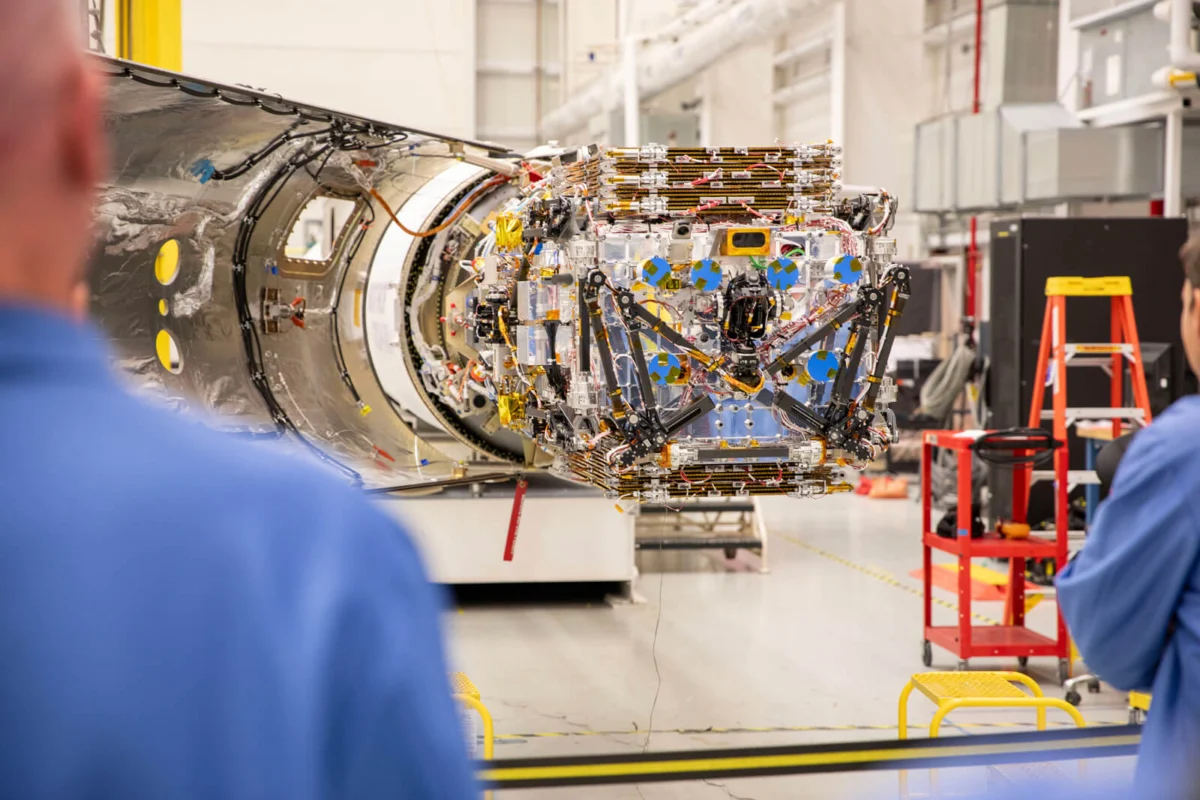

In a high-stakes endeavor to preserve one of the most productive astronomical tools in the federal inventory, Northrop Grumman’s Pegasus XL rocket is scheduled to depart from the Kwajalein Atoll this June. The mission represents a critical intervention for the NASA Neil Gehrels Swift Observatory, a venerable satellite that has spent two decades deciphering the most violent phenomena in the universe. Faced with a rapidly decaying orbit brought on by heightened solar activity, NASA has turned to the commercial sector for a rapid-response solution. The mission will deploy Katalyst Space’s LINK robotic servicing spacecraft, marking a milestone in the burgeoning field of On-orbit Servicing, Assembly, and Manufacturing (OSAM). If successful, this operation will be the first time a commercial robotic vehicle has successfully captured and serviced a government-owned satellite that was not originally designed for docking or external maintenance.
The Swift Observatory: A Legacy Under Threat
The Neil Gehrels Swift Observatory, launched in November 2004, is a cornerstone of NASA’s High Energy Astrophysics program. For over 20 years, it has served as the world’s premier "first responder" to gamma-ray bursts (GRBs)—the most powerful explosions in the cosmos since the Big Bang. Equipped with three distinct telescopes—the Burst Alert Telescope (BAT), the X-ray Telescope (XRT), and the Ultraviolet/Optical Telescope (UVOT)—Swift is capable of detecting a burst and autonomously reorienting its entire chassis to begin observation within seconds.
Since its deployment, Swift has detected more than 1,500 gamma-ray bursts and provided critical data on supernovae, black hole outbursts, and the electromagnetic counterparts to gravitational wave events. However, the observatory lacks a significant propulsion system to maintain its altitude over long periods. Under normal conditions, Swift’s orbit would have remained stable for several more years. However, the current solar cycle—Solar Cycle 25—has proven significantly more intense than initial projections.
Solar activity, characterized by sunspots and solar flares, increases the density of Earth’s upper atmosphere. This increased density creates additional drag on satellites in Low Earth Orbit (LEO), causing their orbits to decay faster than predicted. For Swift, this atmospheric drag has placed the observatory on a terminal trajectory toward re-entry. Without a manual reboost, NASA’s most agile telescope would be lost to the atmosphere, ending two decades of scientific discovery.
The LINK Mission: Commercial Innovation at Warp Speed
To prevent the loss of the observatory, NASA awarded a $30 million contract to Katalyst Space in September 2025. The mandate was clear but daunting: design and build a spacecraft capable of intercepting, capturing, and boosting a non-cooperative satellite within an extremely tight timeframe. The resulting spacecraft, named LINK, is a robotic servicing vehicle designed specifically for high-precision proximity operations.
The development of LINK has been described by industry analysts as a "sprint." In just eight months, the Katalyst Space team moved from conceptual design to a fully integrated, flight-ready spacecraft. Ghonhee Lee, CEO of Katalyst Space, noted that the accomplishment reflects a paradigm shift in how space hardware is developed. According to Lee, the team designed, built, and tested a robotic platform capable of performing one of the most ambitious commercial servicing missions ever attempted in a fraction of the time typically required for government-led projects.
The LINK spacecraft utilizes advanced computer vision and robotic grappling mechanisms. Unlike modern satellites designed with "servicing-friendly" ports or magnetic docking plates, Swift was launched in an era when on-orbit servicing was considered science fiction for anything other than the Hubble Space Telescope. LINK must therefore perform a "non-cooperative" capture, likely involving the use of robotic arms to secure the observatory’s existing structural components, such as its launch adapter ring, before using its own thrusters to push Swift into a higher, safer orbit.
The Pegasus XL: A Final Salute to an Aviation Icon
The launch vehicle selected for this mission is as unique as the payload itself. The Northrop Grumman Pegasus XL is the world’s first air-launched space vehicle. Rather than taking off from a traditional vertical pad, the Pegasus is carried to an altitude of approximately 39,000 feet by the "Stargazer" L-1011, a modified Lockheed commercial tri-jet.
The use of an air-launch platform provides unparalleled flexibility. Because the rocket does not require a fixed launch pad, it can be deployed from various locations around the globe to reach specific orbital inclinations with maximum efficiency. For the Swift reboost mission, the Stargazer aircraft has been staged at the NASA Wallops Flight Facility in Virginia for final integration before transiting to the Reagan Test Site at Kwajalein Atoll in the Marshall Islands.
This mission marks the first flight of the Pegasus vehicle since 2021 and is expected to be the final flight for the storied rocket. Since its debut in 1990, Pegasus has completed more than 45 missions, playing a vital role in launching small scientific satellites. Despite its historical significance, the rise of low-cost vertical-launch providers like SpaceX and Rocket Lab has reduced the demand for the Pegasus. However, Northrop Grumman officials emphasized that for this specific mission—where timing, orbital requirements, and budget were non-negotiable—Pegasus was the only system capable of meeting the criteria.
Steve Hollo, Northrop Grumman’s chief engineer for Pegasus, highlighted that this final mission is not merely a swan song but a demonstration of modern capability. The rocket has undergone a complete avionics upgrade to modernize its systems, ensuring that its final flight utilizes 21st-century guidance and control technology while leveraging decades of flight heritage.
Chronology of the Swift Reboost Mission
The timeline for the LINK mission underscores the "rapid response" nature of the operation:
- September 2025: NASA identifies the critical decay of Swift’s orbit and awards a $30 million emergency contract to Katalyst Space.
- October 2025 – May 2026: Katalyst Space undergoes rapid prototyping, software development for autonomous docking, and environmental testing of the LINK spacecraft.
- Early June 2026: The LINK spacecraft is transported to NASA’s Wallops Flight Facility.
- June 12, 2026: The LINK robotic spacecraft is encapsulated within the Pegasus XL fairing and attached to the belly of the Stargazer L-1011 carrier aircraft.
- June 15-20, 2026: The Stargazer aircraft departs Wallops for the Marshall Islands, making necessary stopovers for refueling and crew rest.
- June 27, 2026: Targeted launch date. The Stargazer will drop the Pegasus XL over the Pacific Ocean. After a five-second freefall, the rocket’s first-stage motor will ignite, beginning the journey to Low Earth Orbit.
Once in orbit, the LINK spacecraft will begin a multi-day phasing maneuver to synchronize its orbit with that of the Swift Observatory. The final approach will be conducted with extreme caution, utilizing LIDAR and optical sensors to ensure a soft capture that does not damage the observatory’s sensitive scientific instruments.
Strategic Implications for On-Orbit Servicing
The success of the LINK mission would have profound implications for both NASA and the global space economy. For decades, satellites have been treated as "disposable" assets; once they ran out of fuel or their orbits decayed, they were left to burn up or become space debris. The ability to commercially reboost and service existing government assets changes the fiscal calculus of space exploration.
If Katalyst Space proves that it can capture an "unprepared" satellite, it opens the door for a massive market in life extension for hundreds of existing satellites. This includes not only scientific missions like Swift but also aging weather satellites and national security assets.
Furthermore, this mission reinforces NASA’s strategic shift toward being a "customer" of space services rather than a primary operator. By utilizing a commercial provider for the reboost, NASA saves the hundreds of millions of dollars that would be required to build and launch a replacement for Swift. This "commercial-first" approach is a key pillar of the Artemis era, where the government focuses on deep-space exploration while the private sector manages LEO logistics and maintenance.
Conclusion: A Race Against the Atmosphere
As the June 27 launch date approaches, the eyes of the global space community are on Kwajalein Atoll. The mission represents a convergence of three distinct eras of spaceflight: the legacy of the 20-year-old Swift Observatory, the 35-year history of the Pegasus XL rocket, and the futuristic promise of Katalyst Space’s robotic servicing.
The "race against the clock" described by NASA officials is not just about saving a single telescope; it is a test of whether humanity has reached a level of orbital maturity where we can actively maintain and repair the infrastructure we have placed among the stars. Should LINK succeed in its rendezvous and reboost, the Neil Gehrels Swift Observatory will continue to peer into the high-energy universe for years to come, and the final flight of the Pegasus will be remembered as the dawn of a new age in orbital sustainability.
