
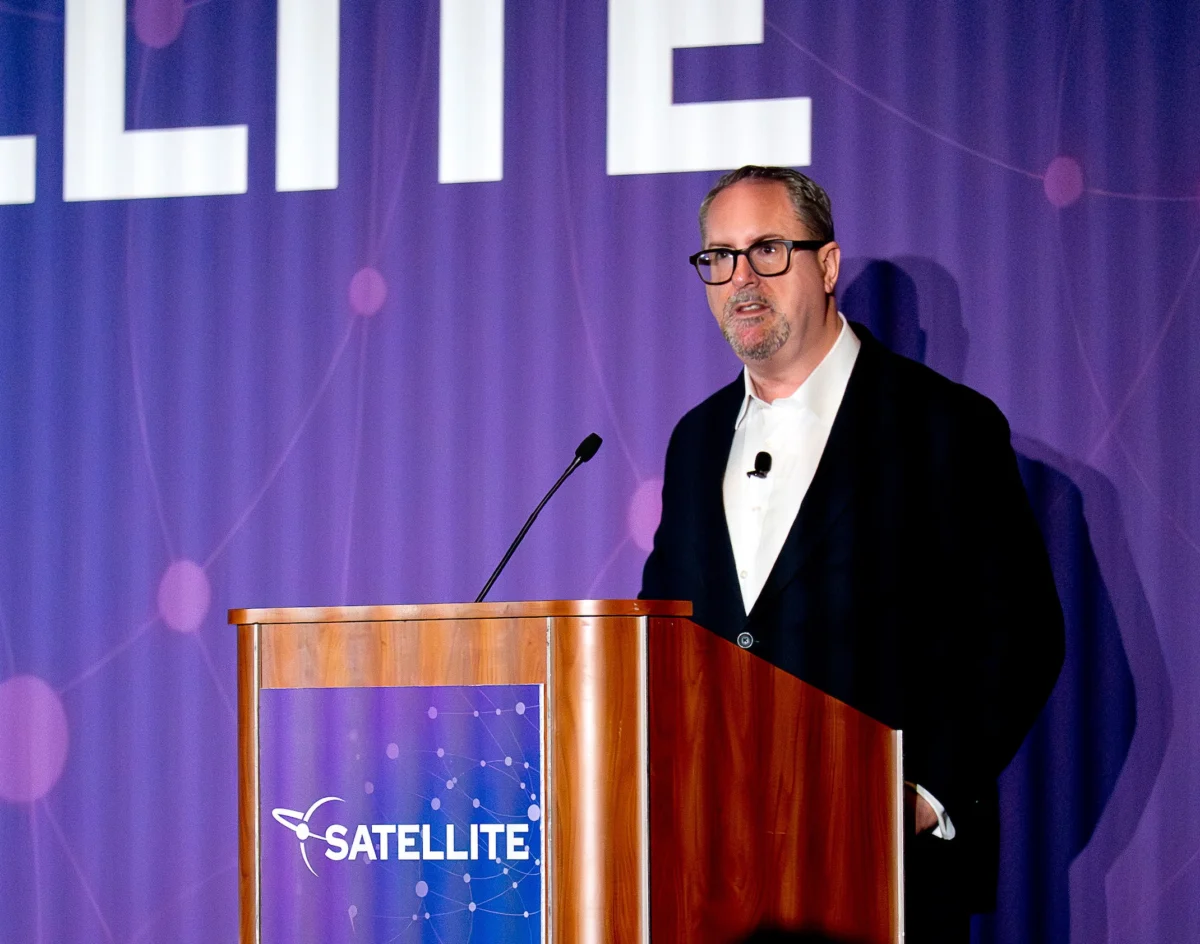

Mark Boggett, the Chief Executive Officer of Seraphim Space, opened the SATELLITE 2026 conference in Washington, D.C., with a comprehensive keynote address that signaled a definitive shift in the global space economy. Addressing a packed hall of industry leaders, investors, and policymakers, Boggett characterized the current period as a "pivotal time" for the sector, asserting that the industry has moved beyond speculative growth into a mature phase where space is unequivocally "open for business." His presentation, backed by a series of robust financial metrics from the 2025 fiscal year, painted a picture of an ecosystem that has not only recovered from the post-2021 market correction but has fundamentally restructured itself to become a cornerstone of national and global infrastructure.
The data presented by Boggett underscored a remarkable resurgence in capital flow. In the 12-month period ending in December 2025, total investment into space technology reached a record-breaking $12 billion. This figure represents a nearly 50% increase compared to the previous year, signaling a sharp acceleration in investor confidence. Perhaps more significant than the raw total was the composition of this capital. Boggett noted that the industry is attracting a more diverse mix of investors, moving away from a reliance on niche venture capital toward broader participation from institutional investors, sovereign wealth funds, and private equity firms looking for long-term infrastructure plays.
A Decoupling from the General Technology Sector
One of the most striking revelations of the keynote was the assertion that space technology has successfully "decoupled" from the broader technology asset class. Since 2023, the global space venture capital market has consistently outperformed the general venture capital market. While general tech faced headwinds due to fluctuating interest rates and a cooling of the artificial intelligence hype cycle, the space sector found stability in its dual-use applications and essential service delivery.
Boggett explained that while the "dealflow"—the number of individual funding rounds—remained relatively consistent with previous years, the volume of capital per deal has increased significantly. This suggests that investors are concentrating larger sums of money into proven winners and "category leaders," rather than spreading smaller bets across a wide array of unproven startups. This maturation of the market is further evidenced by the balance of funding across different stages of company growth. In 2025, capital was distributed almost equally across Seed, Series A, Series B, Series C, and Series D rounds. According to Seraphim Space, this equilibrium is a hallmark of a healthy investment ecosystem, ensuring a steady pipeline of new innovation while simultaneously supporting the scaling of established players.
Public Market Success and the IPO Resurgence
The keynote highlighted 2025 as a banner year for public space companies, providing the "exit" opportunities that private investors have long sought. Boggett pointed to the successful initial public offerings (IPOs) of Firefly Aerospace, Karman Holdings, and Voyager Technologies as evidence that the public markets are once again receptive to space-based business models. Unlike the SPAC-led (Special Purpose Acquisition Company) boom of 2021, these recent listings were characterized by more traditional rigorous vetting and a focus on operational readiness.
The performance of existing public stocks in 2025 provided additional tailwinds for the sector. Boggett noted that Planet Labs saw its stock price surge by 390%, AST SpaceMobile rose by 245%, and Rocket Lab climbed by 175% over the course of the year. Analysts suggest these gains are a result of these companies transitioning from "story stocks" to "revenue stocks," as they begin to deliver on multi-year government contracts and commercial service-level agreements. The massive growth in AST SpaceMobile, in particular, reflects the market’s high expectations for the direct-to-device satellite market, while Rocket Lab’s performance underscores its status as a reliable, high-frequency launch provider.
The Next Generation of Space Unicorns
Seraphim Space, which has already backed nine "space unicorns" (companies valued at over $1 billion), including Iceye and HawkEye 360, remains bullish on the next wave of industry leaders. During his address, Boggett identified two companies currently "under the radar" that he believes are poised for unicorn status: Xona Space Systems and All.Space.
Xona Space Systems is targeting the Global Navigation Satellite System (GNSS) market, which Boggett described as ripe for disruption. As reliance on GPS grows for autonomous vehicles, precision agriculture, and critical infrastructure, the vulnerabilities of legacy systems—such as signal jamming and spoofing—have become a national security concern. Xona’s tech aims to provide a more secure, high-accuracy alternative that could redefine global positioning. Similarly, Boggett praised All.Space for its revolutionary antenna technology. By enabling terminals to connect to multiple satellites across different orbits (LEO, MEO, and GEO) simultaneously, All.Space is solving a critical bottleneck in the ground segment of the satellite industry, allowing for seamless, high-bandwidth connectivity for defense and commercial users alike.
The SpaceX Factor and Market Repricing
No discussion of space finance in 2026 would be complete without addressing the potential for a SpaceX IPO. Boggett suggested that the rumored public offering of Elon Musk’s aerospace giant would be the defining event of the year. He argued that a SpaceX IPO would do more than just raise capital; it would "reprice the entire ecosystem."
The logic behind this "repricing" is that SpaceX serves as the industry’s primary benchmark. A public valuation for SpaceX would provide a concrete multiple for launch services, satellite internet (Starlink), and deep-space exploration. This clarity would likely lift the valuations of other companies in the sector by providing a transparent framework for how space assets should be valued on the open market. "SpaceX going public wouldn’t just raise capital; it could revalidate the entire investment thesis for the sector," Boggett remarked.
Europe’s Strategic Pivot and the Rise of Sovereign Space
A significant portion of the keynote was dedicated to the shifting geopolitical landscape, particularly in Europe. Boggett observed that European nations are acting with a new sense of urgency regarding space and defense capabilities. This shift is driven by a realization that strategic autonomy requires a robust, indigenous space-based competency.
Germany has emerged as a key leader in this European ramp-up. The German government is expected to invest hundreds of billions of euros into defense, with a substantial portion earmarked for space-based capabilities. Boggett highlighted Germany’s ability to mobilize its traditional industrial strengths—such as its world-class automotive supply chain—to build a resilient defense and space infrastructure. This "neo-prime" approach involves established industrial giants collaborating with agile NewSpace startups to accelerate the development of sovereign assets.
This trend toward "Sovereign Space" is not limited to Europe. Boggett cited India as a prime example of this global shift. Pixxel, a leading Indian Earth Observation (EO) startup, recently secured a landmark contract from the Indian government to build a specialized EO platform. This move reflects a broader global trend where nations are increasingly viewing space not just as a scientific endeavor, but as a permanent national infrastructure allocation, akin to energy, defense, and digital networks.
The Emergence of the "Golden Dome" and Multi-Domain Defense
Looking toward the remainder of 2026 and beyond, Boggett predicted the rise of "Golden Dome" type projects. These are large-scale, integrated public-private partnerships designed to create comprehensive space-based defense shields. Such systems would integrate missile defense, persistent surveillance, and secure communications into a single, cohesive architecture.
"We will see more of this," Boggett stated. "Other regions will want their own Golden Domes. You are starting to see a neo-prime approach developing where the lines between traditional defense contractors and innovative space tech companies are blurring."
This integration is expected to drive further consolidation in the industry. Boggett predicted that 2026 would see an acceleration in mergers and acquisitions (M&A) as larger entities seek to vertically integrate their supply chains and acquire specialized technologies to compete for massive government "Sovereign Space" contracts.
Analysis of Implications for the Global Economy
The shift of space from a "venture niche" to a "permanent infrastructure allocation" has profound implications for global finance. For decades, space was viewed as a high-risk, high-reward frontier suitable only for specialized investors. However, as space-based data becomes essential for everything from climate monitoring to financial transaction timing and global logistics, the sector’s "defensibility" as an investment has increased.
The 50% year-over-year growth in investment suggests that capital is flowing toward the "utilitarian" side of space—services that provide tangible value to Earth-based industries. This transition is likely to insulate the space sector from the volatility of the broader tech market. If Boggett’s predictions hold true, the "IPO window" will remain open for category leaders who can demonstrate clear paths to profitability and secure long-term government or enterprise contracts.
Furthermore, the emphasis on sovereign capabilities suggests a move away from a globalized space supply chain toward more localized, secure ecosystems. While this may increase costs in the short term, it is expected to foster innovation at a national level and create a more resilient global space economy.
As SATELLITE 2026 continues, the themes of sovereign autonomy, public market stability, and the "repricing" of the industry will likely dominate the discourse. Mark Boggett’s keynote has set a high bar for optimism, suggesting that the "pivotal time" he described is not just a moment of growth, but the beginning of a new era where space is a fundamental pillar of the global economic and security architecture.
