
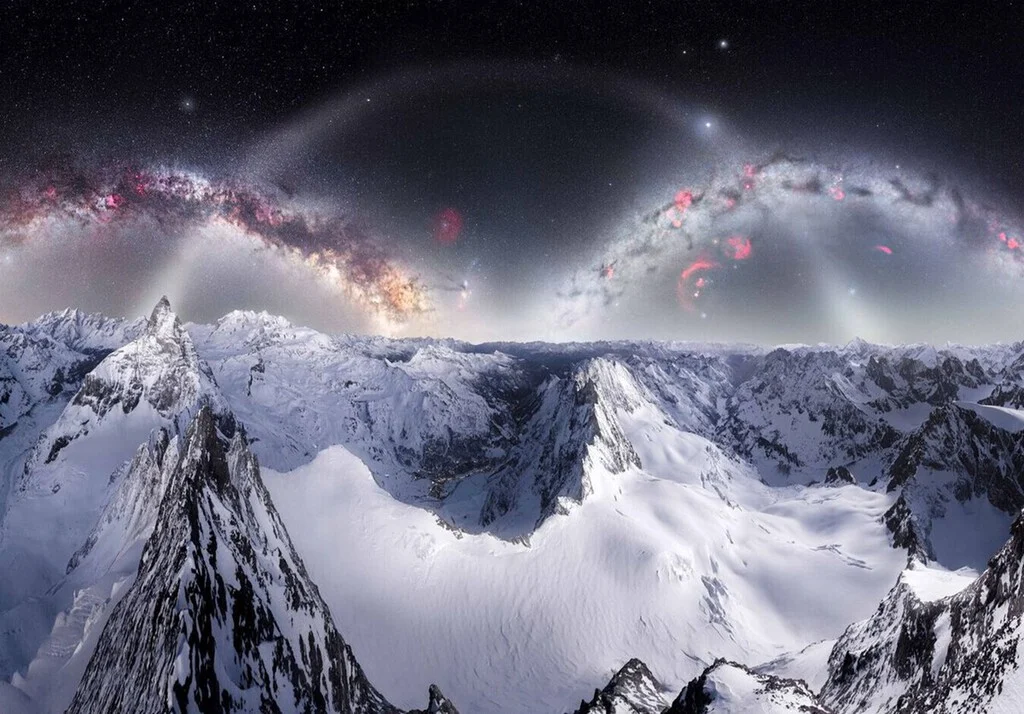

Angel Fux, an acclaimed astrophotographer renowned for her breathtaking celestial landscapes and night sky portraits, has etched her name into the annals of photographic history by becoming the first individual to successfully capture the elusive double arch of the Milky Way from the formidable heights of the Alps. This monumental achievement transcends mere photographic skill, representing an unparalleled fusion of technical prowess, meticulous planning, and sheer human endurance against some of Earth’s most challenging environmental conditions. Her remarkable feat, which saw her ascend to an astonishing 4,200 meters, has garnered international attention, including a notable feature by NASA on its prestigious Astronomy Picture of the Day (APOD) program, underscoring the scientific and artistic significance of her work.
An Expedition into the Extreme: Battling Nature’s Fury
The endeavor to photograph the double arch was far from a simple point-and-shoot exercise; it was an odyssey into an environment designed to push the limits of human and technological resilience. Fux meticulously prepared for months, undergoing rigorous training to withstand the brutal conditions she knew awaited her in the high Alps. These included navigating treacherous, ice-laden cornices, enduring relentless, powerful gusts of wind, and operating in temperatures plummeting to an unforgiving -28°C. This sector of the Alps, known for its extreme inaccessibility and inherent dangers, is a realm few dare to tread, especially not in winter and certainly not at night, making Fux’s success all the more extraordinary.
Beyond the pursuit of an unprecedented image, Fux was also driven by a personal ambition to surpass her previous records. Her target was to ascend 1,000 meters higher than her 2025 expedition, where she had reached the 3,100-meter peak of the Gornergrat, a notable Swiss vantage point. This continuous quest for higher altitudes and darker skies is a testament to her unwavering dedication to her craft and her profound connection with the cosmos.
The Chosen Battlefield: Dent d’Hérens
For this ambitious undertaking, Fux selected the majestic Dent d’Hérens, a towering summit situated directly behind the iconic Matterhorn, straddling the border between Italy and Switzerland. As Fux herself articulated in her blog, "Photographers don’t go there, even less in winter, and even less at night." This statement encapsulates the unique difficulty and isolation of her chosen location. A primary deterrent for most, particularly astrophotographers, is the inherent incompatibility between the specialized, often delicate equipment required for capturing deep-sky phenomena and the robust, minimalist gear essential for high-altitude mountaineering. The logistical challenges of transporting and operating sensitive cameras, lenses, and tracking devices in such a harsh, remote environment are immense.
Recognizing the extreme risks, Fux enlisted the expertise of professional mountain guide Richard Lehner and his son, Arnaud. For a painstaking six months, this trio engaged in exhaustive planning, meticulously mapping out every logistical detail, preparing their specialized equipment, and strategizing how to confront the myriad perils of the mountain. Their discussions were dominated by a healthy respect for the dangers lurking on the mountain’s flanks, from the ever-present threat of a fall on icy slopes to the severe risk of frostbite and hypothermia in the relentless cold. This extensive preparatory phase was not merely about logistics; it was about forging a cohesive team capable of facing the unknown with calculated precision and mutual trust.
A Clear Vision Amidst Uncertainty: The Double Arch Phenomenon
Fux’s motivation for undertaking such an arduous journey is rooted in a deep-seated passion for capturing the profound beauty of the night sky. On her website, she elaborates on her relentless pursuit of dark skies, explaining, "My search for dark skies has intensified over the years in a way I didn’t understand until recently." This lifelong quest has previously led her to remote corners of the globe, including the Pyrenees, the Andes, and the Dolomites, each expedition building upon her experience and refining her unique approach to astrophotography.
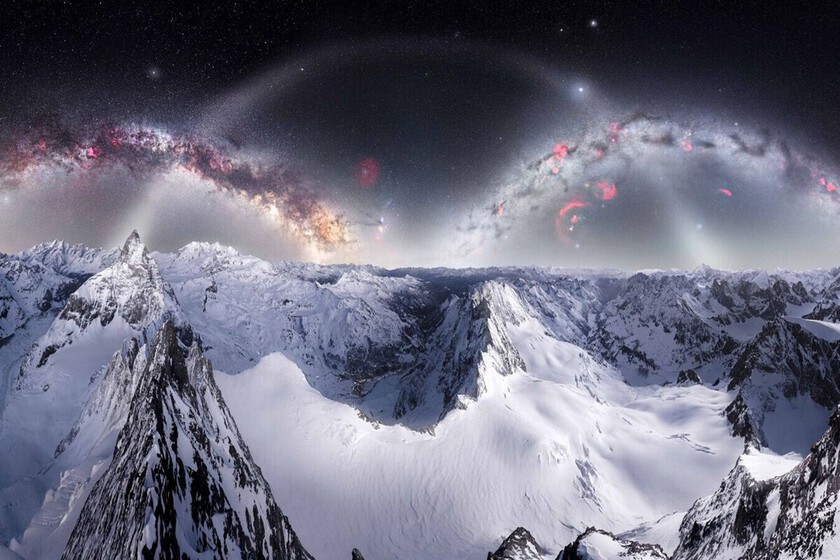
For her Dent d’Hérens adventure, Fux harbored a very specific, yet incredibly fleeting, objective: to immortalize the double arch of the Milky Way. This rare celestial event, she explains, occurs "once a year, in the Northern Hemisphere, something simply extraordinary happens in the night sky. For a few days each March, it is possible to contemplate both arms of the Milky Way above the horizon on the same night, not simultaneously, but over the course of the same terrestrial rotation."
She further describes this breathtaking phenomenon: "The winter arch, a quieter, less dense band of stars, rises during the first half of the night. Then, as the Earth rotates, the summer arch ascends from the other direction, bringing with it the galactic core, that unmistakable and dense river of light. Together, they form what is known as the double arch of the Milky Way." This intricate dance of galactic arms requires precise timing and specific astronomical alignment, making its successful capture a monumental achievement. Fux had previously documented this magical moment during her 2025 Gornergrat expedition, but photographing it consistently is a challenge due to a confluence of factors. Optimal conditions demand a new moon phase, a completely unobstructed 360-degree horizon, perfect positioning, and, critically, favorable meteorological conditions – a rare alignment that often eludes even the most seasoned astrophotographers.
The Indispensable Role of Specialized Equipment
After months of meticulous planning and preparation, Fux’s perseverance culminated in the capture of her spectacular photograph. Her success was inextricably linked to the specialized equipment she employed, a sophisticated arsenal designed to perform in the most extreme conditions. Her primary tools included a Nikon Z6 II camera, specifically adapted for astrophotography to enhance its sensitivity to nebulae and star fields. This was paired with a high-performance Nikon NIKKOR Z 20mm f/1.8 lens, known for its wide aperture and excellent optical clarity, crucial for gathering maximum light in dark environments. A Benro Polaris star tracker completed her setup, a device indispensable for compensating for Earth’s rotation, allowing for longer exposures without star trails and thus capturing fainter celestial details.
Even with such cutting-edge technology, Fux encountered technical difficulties directly attributable to the extreme cold. Batteries drained rapidly, LCD screens became sluggish, and mechanical components risked freezing. Operating at -28°C with biting wind chill meant every adjustment was a struggle, often requiring the removal of thick gloves, exposing bare skin to frostbite. This stark reality underscores a critical point: not even the most advanced mobile phone camera on Earth could have immortalized this magical moment.
The Unbridgeable Gap: Why Mobile Phones Fall Short
The limitations of commercial mobile phones in such extreme environments are profound and multi-faceted. Standard smartphones are engineered to function within a specific ambient temperature range. For instance, the latest iPhone 17 Pro models are specified for operational temperatures between 0°C and 35°C, with non-operational temperatures ranging from -20°C to 45°C. The -28°C Fux faced falls well outside this operational range and even pushes the limits of the non-operational threshold. While ruggedized phones with military certifications might offer a more generous temperature envelope, their camera quality, particularly for deep-sky astrophotography requiring large sensors, wide apertures, and precise manual controls, would be woefully inadequate.
Beyond temperature, altitude poses another significant challenge for mobile devices. The iPhone 17 Pro, for example, has a tested operating altitude of up to 3,000 meters. While commendable for general use, this falls significantly short of the 4,200 meters Fux ascended for her expedition. At such extreme altitudes, reduced atmospheric pressure can affect battery performance, screen responsiveness, and the integrity of internal components. Furthermore, the specialized processing power and algorithms required to stack multiple long-exposure images, calibrate for noise, and meticulously process the vast amounts of data inherent in professional astrophotography are simply beyond the capabilities of even the most advanced smartphone processors. The ability to capture faint light from distant galaxies requires sensor size, lens quality, and raw data output that consumer phones cannot match.
The Night Unfolds: A Celestial Spectacle
When the long-awaited night finally arrived, Fux executed her plan with precision honed by months of preparation. She first focused on capturing the winter arch of the Milky Way, working diligently between 8:30 PM and 11:30 PM. As the Earth continued its rotation into the early hours of the morning, she shifted her attention to the summer arch, commencing her photographic efforts around 2:30 AM. Each segment required multiple long exposures, careful adjustments for tracking, and constant battle against the cold and fatigue.
What Fux did not anticipate, however, was an additional, serendipitous reward for her immense effort. As she reviewed the panoramic shots of the winter arch, an unexpected celestial phenomenon revealed itself. "There was a surprise," she recounted. "As I reviewed the winter arch panoramic, I noticed a faint, oval arc extending opposite the sun, traversing the frame with a subtle but unmistakable gradient."
This ethereal glow was identified as the ‘Gegenschein,’ or counterglow – a diffuse, faint patch of light in the night sky caused by sunlight reflecting off interplanetary dust particles concentrated in the anti-solar point. It is notoriously difficult to observe with the naked eye and even rarer to capture photographically due to its extreme faintness and the requirement for exceptionally dark skies and precise camera settings. Its appearance in Fux’s image not only added a layer of scientific intrigue to her already groundbreaking photograph but also served as a powerful testament to the purity of the skies above Dent d’Hérens and the exquisite sensitivity of her equipment.
The Art of Post-Processing: Crafting the Masterpiece
The physical and technical challenges of the expedition were only half the battle. Upon her descent back to "the real world," Fux faced another arduous task: the meticulous post-processing of her vast collection of raw images. This phase alone consumed 40 intensive hours, a testament to the complexity and precision required to transform raw data into a publishable masterpiece. Astrophotography post-processing involves numerous intricate steps: stacking dozens, sometimes hundreds, of individual exposures to reduce noise and enhance signal, calibrating images for dark frames, flat frames, and bias frames to remove sensor artifacts, and then carefully stretching, blending, and color-grading the combined data to reveal the subtle structures and vibrant colors of the Milky Way. This rigorous digital darkroom work is as much an art as it is a science, demanding a deep understanding of image manipulation software and a keen artistic eye. Forty hours for a single photograph might seem excessive to the uninitiated, but for an image of this caliber and scientific importance, it is an essential and non-negotiable part of the creative process.
Implications and Future Horizons
Angel Fux’s capture of the double arch of the Milky Way from the extreme altitude of Dent d’Hérens represents more than just a stunning photograph; it is a significant milestone in astrophotography and extreme environment photography. It pushes the boundaries of what is considered achievable, inspiring a new generation of photographers and adventurers to seek out and document the hidden wonders of our universe. The feat highlights the critical interplay between advanced technology, meticulous preparation, and unwavering human spirit. It serves as a powerful reminder of the irreplaceable value of specialized professional equipment in fields where consumer-grade devices simply cannot compete.
Moreover, this achievement underscores the importance of preserving dark skies, as such phenomena become increasingly difficult to observe and photograph due to escalating light pollution. Fux’s work not only provides scientific data on atmospheric conditions and celestial phenomena but also serves as a poignant artistic statement, reconnecting humanity with the profound beauty of our cosmic home. Her journey from months of planning to the final, painstaking hours of post-processing, culminating in an image that captivates the imagination, solidifies her status as a pioneer in the field, forever changing our perception of what is possible at the intersection of art, science, and adventure.
