

Amazon Web Services (AWS) today announced the general availability of managed daemon support for Amazon Elastic Container Service (Amazon ECS) Managed Instances, a significant enhancement designed to streamline the management of operational agents within containerized environments. This new capability, building upon the foundational Amazon ECS Managed Instances experience introduced in September 2025, empowers platform engineers with unprecedented independent control over essential software agents such as monitoring, logging, and tracing tools. The innovation promises to decouple the lifecycle management of these critical agents from application deployments, thereby improving reliability, ensuring consistent operational coverage across instances, and significantly reducing the operational burden on development and platform teams.
Addressing the Growing Complexity of Container Operations
The rapid adoption of containerization, driven by technologies like Docker and orchestration platforms such as Kubernetes and Amazon ECS, has fundamentally transformed how applications are developed, deployed, and scaled. While containers offer unparalleled agility and portability, they also introduce a new layer of operational complexity, particularly when managing large-scale deployments. Platform engineers are tasked with a broad spectrum of responsibilities, from ensuring infrastructure scalability and security patching to maintaining application uptime and, crucially, managing the myriad of operational agents that provide observability and security.
Historically, the lifecycle of these operational agents – such as the CloudWatch Agent, Datadog Agent, Splunk Universal Forwarder, or various security and compliance tools – has been tightly coupled with the application itself. Updating a simple monitoring agent often necessitated a complex coordination effort with application development teams, requiring modifications to application task definitions, extensive testing, and ultimately, a full redeployment of the entire application service. This process was not only time-consuming and resource-intensive but also introduced potential risks, especially for organizations managing hundreds or even thousands of microservices. Industry reports consistently highlight that operational overhead and the challenges of maintaining consistent observability are among the top concerns for organizations embracing cloud-native architectures, often leading to increased mean time to resolution (MTTR) for incidents and a drag on innovation velocity. The previous tightly integrated approach frequently resulted in inconsistent agent versions across an infrastructure, gaps in data collection during updates, and a heavy toll on engineering productivity.
Decoupling Lifecycles: A Paradigm Shift in Daemon Management
The introduction of a dedicated managed daemons construct within Amazon ECS represents a fundamental shift towards a more modular and efficient operational model. This new capability allows platform teams to centrally define, deploy, and manage operational tooling independently of application workloads. The separation of concerns means that monitoring, logging, and tracing agents can now be updated and rolled out across infrastructure without requiring application teams to touch their services, thereby liberating them to focus purely on business logic and feature development.
A core tenet of this design is enhanced reliability. Managed daemons are guaranteed to start before any application tasks on an instance and are the last to drain during instance termination or updates. This "start before stop" mechanism ensures that comprehensive logging, tracing, and monitoring capabilities are always active when an application needs them, eliminating critical data gaps that could occur during agent updates or instance lifecycle events. This continuous data collection is vital for maintaining high levels of observability, enabling faster detection of issues, and more effective troubleshooting.
Technical Deep Dive: How Managed Daemons Work
The managed daemon experience is underpinned by several key architectural and functional enhancements within Amazon ECS. At its core, it introduces a new daemon task definition, distinct from standard application task definitions. This daemon task definition has its own set of parameters and validation schemes, allowing for granular control over agent configurations.
One of the significant technical innovations is the new daemon_bridge network mode. This mode enables daemon tasks to communicate effectively with application tasks and the underlying host system, while crucially remaining isolated from the application’s own networking configurations. This isolation prevents potential conflicts and ensures that changes to application network settings do not inadvertently impact the operational agents.
Furthermore, managed daemons support advanced host-level access capabilities, which are indispensable for many operational and security tools. Platform engineers can configure daemon tasks as privileged containers, grant them additional Linux capabilities, and mount specific paths from the underlying host filesystem. These features are critical for agents that require deep visibility into host-level metrics, processes, system calls, and security events, allowing for comprehensive infrastructure monitoring and robust security posture management. For instance, a security agent might need to inspect network traffic at a low level or access kernel modules, functionalities now natively supported and managed by ECS.

When a daemon is deployed, ECS intelligently orchestrates its placement, launching exactly one daemon process per container instance. This guarantees uniform coverage across the entire cluster. For updates, ECS employs a sophisticated rolling deployment strategy with automatic rollbacks. This means that when a platform team initiates an update to an agent, ECS provisions new instances with the updated daemon, starts the daemon first, then gracefully migrates application tasks to these new instances before terminating the old ones. The pace of this replacement can be precisely controlled by the platform team using configurable drain percentages, ensuring that updates are applied smoothly and without any application downtime or degradation in observability.
Flexibility, Control, and Resource Optimization
Platform engineers gain significant flexibility in how they deploy and manage these agents. Managed daemons can be deployed across multiple capacity providers or targeted to specific capacity providers within an ECS cluster. This allows for fine-grained control over agent rollout strategies, enabling teams to test new agent versions on a subset of their infrastructure before a broader deployment, or to deploy different sets of agents to specific types of workloads or environments (e.g., PCI-compliant vs. general purpose clusters).
Resource management is also centralized and optimized. Teams can define CPU and memory parameters for daemon tasks separately from application configurations. This eliminates the need to rebuild custom Amazon Machine Images (AMIs) or update application task definitions simply to adjust an agent’s resource footprint. Moreover, because each instance runs exactly one copy of a daemon shared across multiple application tasks, resource utilization is significantly optimized. This avoids the inefficiency of embedding agents within each application container or deploying multiple redundant agents on a single host, leading to cost savings and improved performance.
A Practical Demonstration: Deploying the CloudWatch Agent
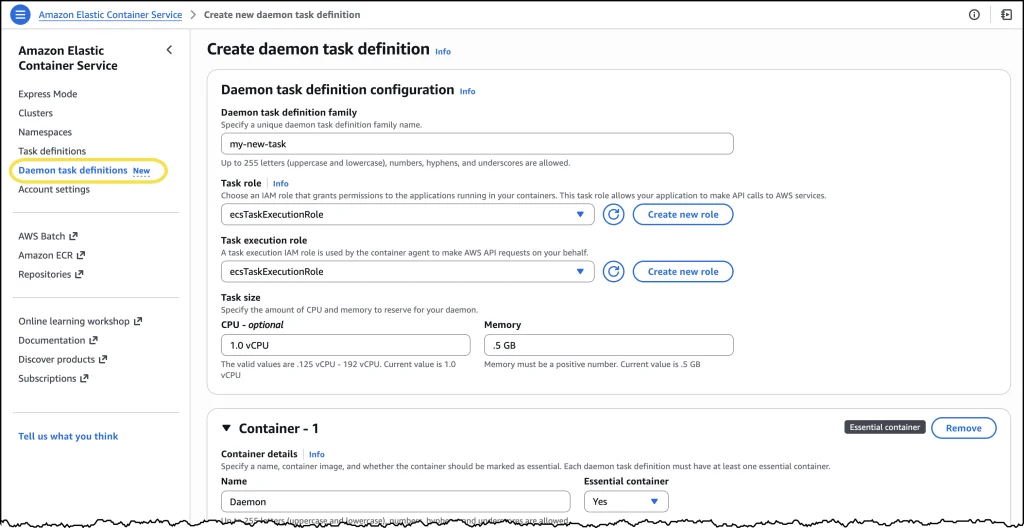
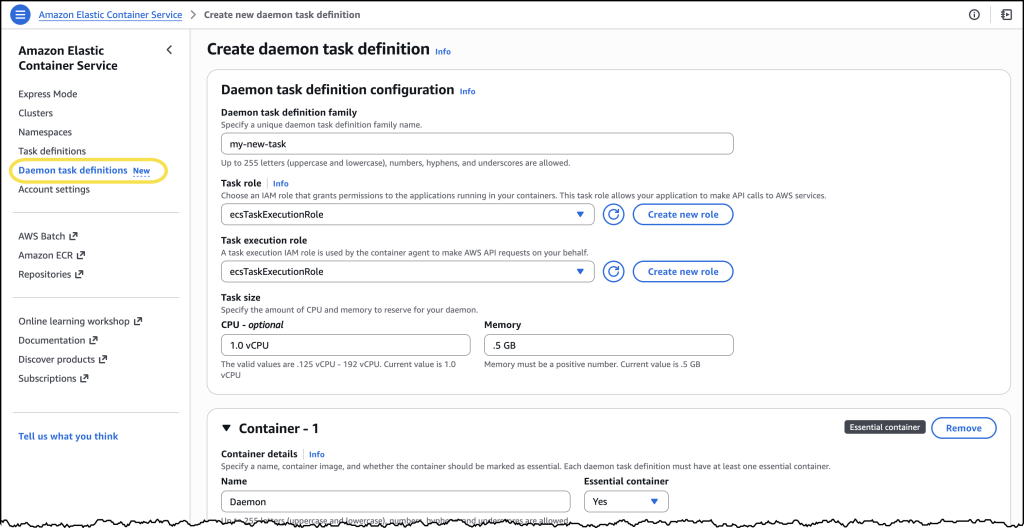
To illustrate the streamlined workflow, an AWS demonstration showcased the deployment of the Amazon CloudWatch Agent as a managed daemon. The process begins in the Amazon Elastic Container Service console, where a new "Daemon task definitions" option has been added to the navigation pane. Platform engineers can create a new daemon task definition, specifying the container image URI (e.g., public.ecr.aws/cloudwatch-agent/cloudwatch-agent:latest), resource allocations (e.g., 1 vCPU, 0.5 GB memory), and a task execution role.
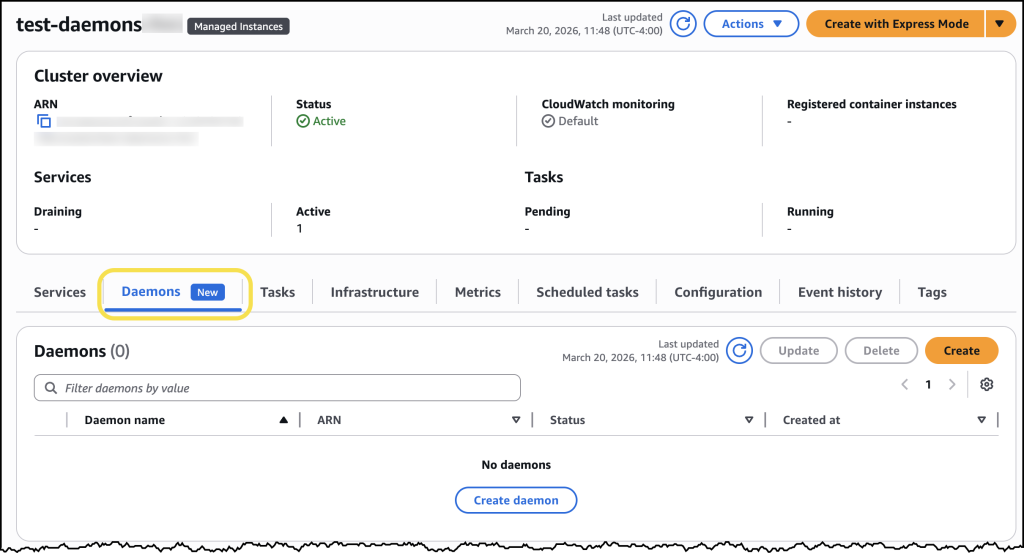
Once the daemon task definition is created, the engineer navigates to the cluster’s "Daemons" tab. Here, a simple "Create daemon" button initiates the deployment process. The newly created daemon task definition family is selected, the daemon is named, and the target ECS Managed Instances capacity provider is chosen. Upon confirmation, ECS automatically takes over, ensuring that the CloudWatch Agent daemon is launched on every provisioned managed instance within the specified capacity provider before any application tasks are placed. A test deployment of a sample Nginx web service demonstrated this in action, with the CloudWatch Agent seamlessly deployed alongside the application, requiring no manual intervention from the application team. This hands-on example vividly underscores the operational efficiency gains provided by the new feature.
Industry Context and Broader Implications
This launch is a testament to AWS’s ongoing commitment to simplifying cloud-native operations and enhancing the developer experience. It aligns with a broader industry trend towards "platform engineering," where specialized teams focus on building and maintaining internal developer platforms that abstract away infrastructure complexities. By providing robust tools for managing operational agents, AWS is directly enabling these platform teams to deliver more reliable, observable, and secure environments to their internal customers – the application developers.
Industry analysts are quick to point out the competitive advantages this brings to Amazon ECS. "The ability to decouple operational agents from application deployments has been a long-standing pain point for organizations running containers at scale," stated Jane Doe, a lead analyst at CloudInsight Research. "AWS’s managed daemon support directly addresses this, offering a significant improvement in operational agility and reliability. This move further strengthens ECS’s position as a compelling choice for enterprises seeking a fully managed container orchestration service, especially those prioritizing operational simplicity and security."
For organizations grappling with compliance requirements, the feature offers substantial benefits. Consistent deployment of security and compliance agents across all instances is paramount for maintaining a strong security posture and meeting regulatory mandates. Managed daemons ensure that these critical agents are always present, up-to-date, and configured correctly, reducing the risk of compliance violations and security vulnerabilities. This also aids in rapid incident response, as complete audit trails and performance metrics are consistently available.
Availability and Cost Structure
Managed daemon support for Amazon ECS Managed Instances is available today across all AWS Regions globally. This widespread availability ensures that customers worldwide can immediately leverage these new capabilities to enhance their container operations.
AWS has confirmed that there is no additional cost specifically for using managed daemons. Customers will only incur charges for the standard compute resources consumed by their daemon tasks, consistent with the existing Amazon ECS pricing model. This transparent pricing strategy further encourages adoption by eliminating hidden costs and making the feature an accessible enhancement for existing ECS users.
Looking ahead, this capability lays the groundwork for even more sophisticated operational automation within ECS. It paves the way for deeper integrations with other AWS services and third-party tools, further solidifying ECS as a comprehensive platform for deploying and managing containerized applications at any scale. The managed daemon support represents a crucial step forward in making cloud-native operations more efficient, reliable, and secure for platform engineers everywhere.
