

The evolution of Broadcom’s VMware Cloud Foundation (VCF) is transitioning it from a comprehensive infrastructure solution to a sophisticated application substrate, navigating the complex terrain between offering an "easy button" for cloud infrastructure and fostering an open, adaptable platform that aligns with the rapid advancements in Kubernetes. This strategic pivot was a central theme during discussions at KubeCon + CloudNativeCon Europe 2026, where industry leaders explored the resurgence of private cloud, the deep integration of Kubernetes into enterprise core systems, and the critical role VCF plays in supporting large-scale operations and platform engineering teams.
At the heart of VCF’s ongoing development lies the imperative to strike a delicate balance. On one hand, Broadcom aims to simplify cloud infrastructure deployment and management, making it accessible and efficient for organizations. On the other, it is committed to maintaining an open and flexible ecosystem, ensuring VCF remains at the forefront of cloud-native innovation, particularly as Kubernetes continues its dominance. The inherent strengths of open source and private cloud remain foundational to VCF’s architecture, with Broadcom, a significant contributor to the Kubernetes community, reinforcing its commitment to aligning VCF with open standards and collaborative development.
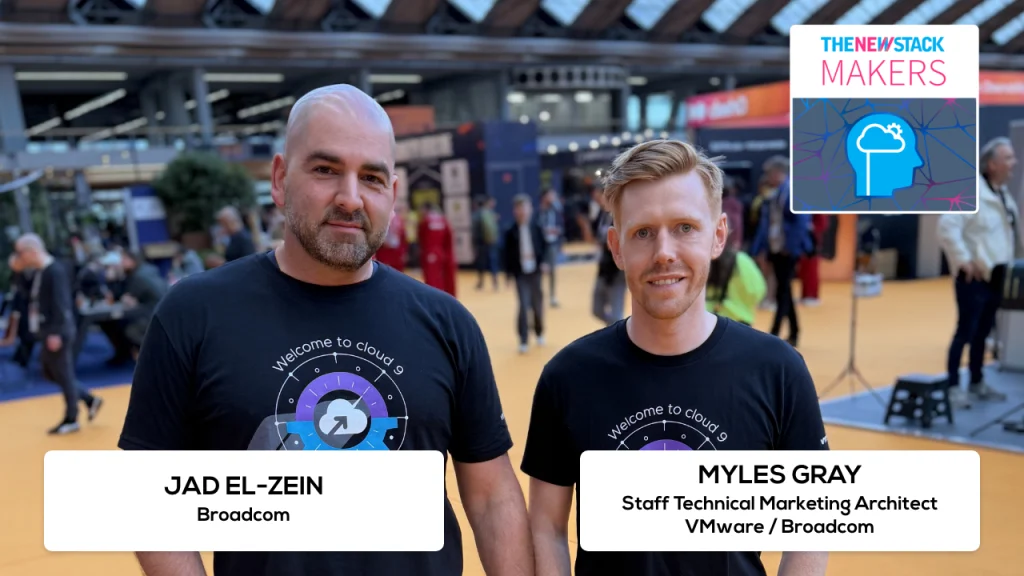
During the KubeCon + CloudNativeCon Europe 2026 event held in Amsterdam, Jad El-Zein, a technologist at Broadcom, and Myles Gray, a senior technical marketing architect at VMware/Broadcom, offered valuable insights into these evolving dynamics on The New Stack podcast. Their conversation delved into the shifting landscape of cloud-native technology, the surprising comeback of private cloud environments, and the seamless integration of Kubernetes as a cornerstone for modern enterprise infrastructure. They highlighted how VCF is specifically engineered to empower platform engineering teams and facilitate operations at scale, addressing the multifaceted needs of today’s businesses.
The interview, recorded live amidst the vibrant atmosphere of Europe’s premier cloud-native conference, underscored a significant industry trend: the deliberate migration of workloads back to private clouds. This movement is largely propelled by mounting concerns surrounding data sovereignty, particularly with the burgeoning adoption of Artificial Intelligence (AI), and a growing preference for native open-source stacks. Broadcom’s strategy appears to be directly responding to this shift, prioritizing on-premises stability and control over a purely SaaS-centric model.
Private Cloud’s Full-Circle Return: A Strategic Realignment
"And what we’re seeing is that stack that has now become cloud native, and the enterprise fully adopted it is now coming back on-prem," Jad El-Zein articulated during the podcast. "But we’re bringing the community in with us more than I’ve seen it in the past." This statement encapsulates a significant industry recalibration. The principles and practices of cloud-native development, once predominantly associated with public cloud environments, are now being re-implemented within the controlled confines of private data centers. This return is not a regression, but rather a sophisticated adaptation, leveraging the maturity of cloud-native technologies to build robust and secure on-premises platforms.
This resurgence of private cloud is underpinned by several key factors. For many enterprises, the perceived benefits of enhanced control over data, stricter security postures, and the ability to optimize costs for predictable workloads are compelling reasons to bring infrastructure back in-house. Furthermore, the increasing complexity and regulatory scrutiny surrounding data residency requirements, especially for sensitive information and AI training data, make on-premises solutions more attractive. Broadcom’s emphasis on VCF as a platform that bridges these needs signals a strategic alignment with market demands, ensuring that enterprises can harness the agility of cloud-native architectures without compromising on control.
AI Fuels Sovereignty Concerns: The Data Imperative
The rise of Artificial Intelligence (AI) has emerged as a primary catalyst for the renewed interest in private cloud infrastructure, directly fueling data sovereignty concerns. As organizations increasingly rely on AI for data analysis, machine learning, and predictive modeling, the implications of where this data resides and how it is processed become paramount. El-Zein noted that the emergence of AI is a key driver behind this trend, compelling businesses to re-evaluate their cloud strategies.
The need to keep AI training data and sensitive intellectual property within the organization’s direct control is a significant factor. Public cloud environments, while offering scalability and flexibility, can present challenges in fully satisfying stringent data sovereignty mandates. This is particularly true for industries with strict regulatory oversight, such as finance, healthcare, and government. By bringing these AI-driven workloads back to private clouds, enterprises can ensure compliance with data residency laws, maintain greater control over data access, and mitigate potential risks associated with cross-border data transfers. This "full circle" trend, as El-Zein described it, is a testament to the maturing cloud-native landscape and the evolving needs of businesses leveraging advanced technologies like AI.
Open Source Replaces Proprietary Defaults: A Quality Revolution
A fundamental shift in the technology landscape is the ascent of open-source projects to a level of quality and sophistication that often rivals, and sometimes surpasses, proprietary solutions. This has led to a scenario where open source is no longer a secondary consideration but a primary choice, even for demanding, high-end features. El-Zein highlighted VMware by Broadcom’s historical commitment to the open-source community, underscoring its position as a top-five contributor to Kubernetes. This deep involvement is not merely symbolic; it translates into tangible contributions, with Broadcom actively donating crucial projects like Velero, Contour, and Harbor to the Cloud Native Computing Foundation (CNCF).
"Open source is of such high quality nowadays that you don’t necessarily need something completely proprietary to do that," El-Zein stated. This sentiment reflects a broader industry maturation, where the collaborative nature of open source development has fostered innovation at an unprecedented pace. Projects incubated and maintained by large, active communities often benefit from rigorous testing, rapid bug fixes, and continuous feature development, making them highly reliable and performant.
VMware by Broadcom has moved beyond treating Kubernetes as an add-on component. Instead, it has been elevated to the status of the fundamental control plane for the entire VCF platform. This strategic integration enables a "public cloud operating model" to be effectively replicated on-premises. As Myles Gray explained, this means that core infrastructure elements such as storage, networking, and compute are all managed through declarative Kubernetes APIs. This unified approach simplifies management, enhances automation, and provides a consistent experience for developers and operators alike.
"Kubernetes is fundamental to how we are building our platform, too," Gray emphasized. This signifies a deep architectural commitment, where the principles of Kubernetes – declarative configuration, extensibility, and resilience – are woven into the fabric of VCF. This allows organizations to leverage the power of Kubernetes for managing diverse workloads, including traditional virtual machines and modern containerized applications, within a cohesive and integrated environment.
The Application-Centric Future: Unifying Developer Experience
The evolving landscape of cloud-native development is increasingly characterized by a focus on the application itself, rather than the underlying infrastructure. This perspective is driving a push towards a unified developer experience, where the distinction between containers and virtual machines becomes less relevant. The ultimate goal, as articulated by El-Zein, is to provide a singular pipeline through which developers can consume resources and deploy applications, irrespective of their underlying instantiation method.
"It’s all about apps, right? And why should developers ever have to think about pivoting across two platforms?" El-Zein queried. This question highlights a key challenge for platform engineering teams: enabling developers to be productive without forcing them to become experts in disparate infrastructure technologies. By abstracting away the complexities of the underlying hardware and orchestration layers, VCF aims to empower developers to focus on building and delivering business value.
The concept of a "standard contract," such as a Kubernetes pod specification, serves as a crucial enabler for this unified approach. Regardless of whether a workload is deployed as a container or within a virtual machine, the developer interacts with it through a familiar and consistent interface. This abstraction layer allows the infrastructure to dynamically provision and manage resources, ensuring that the application receives the necessary compute, storage, and network capabilities without the developer needing to manage these details directly. This is particularly relevant as platform engineering teams mature, focusing on creating self-service portals and automated workflows that streamline the application lifecycle from development to production.
The implications of this shift are far-reaching. For enterprises, it promises increased agility, faster time-to-market for new applications, and improved developer productivity. For Broadcom, it represents a strategic imperative to position VCF as the de facto platform for modern, cloud-native enterprise IT, capable of supporting both existing and emerging workloads. The continued integration of open-source principles and the strategic embrace of Kubernetes as a foundational element are critical to VCF’s success in this dynamic and rapidly evolving market. The conversations at KubeCon + CloudNativeCon Europe 2026 clearly indicated that the future of enterprise infrastructure is intertwined with the continued evolution of cloud-native technologies, and VCF is poised to play a pivotal role in this transformation.
