
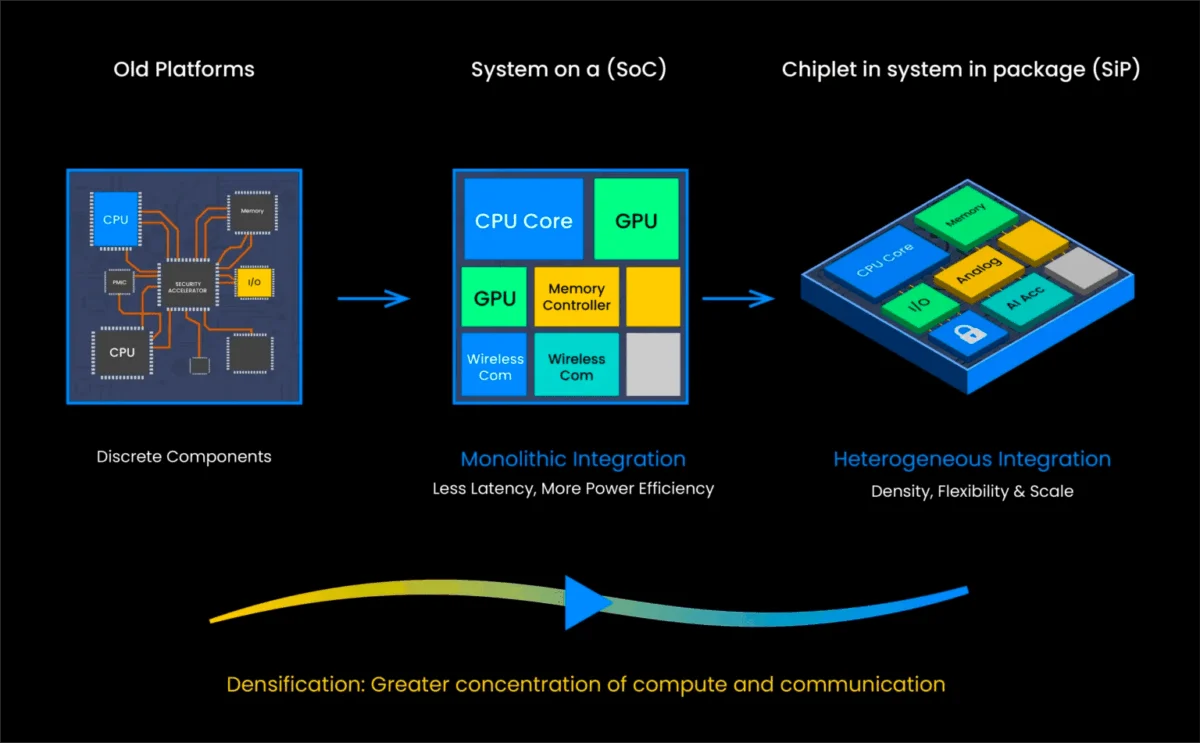

For three decades, Arm has functioned as a central architect of the global semiconductor industry, moving from the foundational designs of mobile computing to the sophisticated demands of cloud infrastructure and autonomous automotive systems. Through the proliferation of its architecture and the Advanced Microcontroller Bus Architecture (AMBA) ecosystem, Arm has established the technical backbone for scalable compute. However, the industry is currently navigating a significant structural transition as the era of monolithic System-on-Chip (SoC) designs begins to taper, making way for the emergence of multi-die chiplet systems. This shift is driven by physical limitations, economic imperatives, and the escalating demands of artificial intelligence (AI) and high-performance computing (HPC).
While complex SoCs remain a necessity for various applications, the industry has reached a critical juncture where the capacity for a single die—constrained by the reticle limit of approximately 858mm²—is no longer sufficient to meet the performance, latency, and power requirements of modern workloads. As a result, semiconductor architects are increasingly turning to chiplet-based architectures. These systems allow for the integration of multiple specialized dies into a single package, enabling scalability that far exceeds the boundaries of traditional monolithic silicon. In response to this trend, Arm is fostering an ecosystem centered on the Arm Chiplet Specification Architecture (ACSA) and the Open Compute Project (OCP) Foundation’s Chiplet System Architecture (FCSA). The recent announcement that Baya Systems has officially joined the Arm ecosystem marks a pivotal moment in this transition, signaling a move from simple connectivity toward intelligent, system-wide orchestration.
The Physical and Economic Drivers of the Chiplet Era
The transition toward chiplets is not merely a design preference but a response to the slowing of Moore’s Law and the rising costs of advanced process nodes. As transistors shrink to 3nm, 2nm, and beyond, the cost per millimeter of silicon increases exponentially. Furthermore, the yield of large monolithic dies decreases as the die size approaches the reticle limit; a single defect on a massive chip renders the entire unit useless. Chiplets mitigate this risk by breaking the system into smaller, high-yield dies that can be manufactured on the most appropriate process node for their specific function. For instance, a high-performance CPU might use a 3nm node, while an I/O controller or power management unit might remain on a more cost-effective 7nm or 12nm node.
However, the shift to chiplets introduces a new layer of complexity: the "data movement bottleneck." In a monolithic SoC, data travels across the silicon with minimal latency. In a multi-die system, the data must cross physical boundaries between chiplets. Without sophisticated orchestration, these chiplets become "disconnected islands of silicon," where the potential performance of high-frequency CPUs or powerful Neural Processing Units (NPUs) is neutralized by the inability to move data efficiently. This challenge has necessitated a new architectural imperative focused on coherent connectivity and deterministic data movement.
A Chronology of Standards and Ecosystem Development
The path to the current chiplet-centric landscape has been defined by a series of standardizations and collaborative efforts. For years, Arm’s AMBA protocol served as the de facto standard for on-chip communication, allowing diverse third-party intellectual property (IP) blocks to interoperate within a single SoC. As the industry looked toward multi-die solutions, the need for an "off-chip" version of these standards became apparent.
- The Rise of AMBA CHI: The Coherent Hub Interface (CHI) was developed to provide the high-frequency, non-blocking communication required for many-core systems.
- The Introduction of AMBA CHI C2C: To address chiplet-to-chiplet (C2C) communication, Arm extended the CHI protocol to maintain coherency across die boundaries. This allowed multiple chiplets to share memory and cache resources as if they were on a single piece of silicon.
- The Launch of ACSA and FCSA: Recognizing that hardware standards alone were insufficient, the industry collaborated on the Arm Chiplet Specification Architecture and the OCP’s Chiplet System Architecture. These frameworks provided the blueprints for how different vendors could build interoperable chiplets.
- The Integration of Baya Systems: Most recently, Baya Systems joined the Arm ecosystem to provide the "system intelligence" layer. While Arm provides the compute subsystem (CSS), Baya offers a software-defined fabric that orchestrates data movement across the entire heterogeneous system.
Supporting Data: The Scale of the Chiplet Market
Market analysis highlights the rapid acceleration of this sector. According to industry projections, the global chiplet market is expected to grow at a compound annual growth rate (CAGR) of over 30% through 2030. This growth is largely fueled by the data center and AI sectors, where the demand for "XPU" (CPU, GPU, NPU, and FPGA) integration is at an all-time high. In AI training and inference, the ability to pool memory across multiple chiplets can lead to a 2x to 3x improvement in effective bandwidth compared to traditional non-coherent architectures.
Furthermore, power efficiency has become a primary metric. Data centers now account for nearly 2% of global electricity consumption, with AI workloads contributing a growing share. Chiplet systems that utilize intelligent data orchestration can reduce "data tax"—the energy expended simply to move bits from memory to processor—by optimizing the pathing and reducing unnecessary cache misses.

Technical Analysis: From Standards to System Intelligence
The partnership between Arm and Baya Systems addresses the limitation that standards, while necessary, are not sufficient for peak performance. Arm’s AMBA CHI C2C provides the foundational "language" for chiplets to speak to one another. Baya Systems builds upon this by providing the "logic" for the conversation.
Baya’s software-defined fabric architecture enables several critical capabilities:
- Unified Transport: It allows for AMBA-compliant communication while simultaneously supporting proprietary protocols on the same transport layer.
- System-Wide Coherency: It extends the reach of Arm’s Compute Subsystems, integrating specialized accelerators like GPUs and NPUs into a single coherent domain.
- Deterministic Movement: In safety-critical applications such as automotive and industrial robotics, data must arrive at its destination within a guaranteed timeframe. Baya’s orchestration ensures that "safety islands"—traditionally isolated to prevent interference—can now be integrated into the larger system without compromising functional partitioning.
This represents a seismic shift in design philosophy. In the monolithic era, system capability was often defined by CPU frequency. In the chiplet era, capability is defined by how fast and predictably data moves. If a CPU cannot access the right data at the right time, its potential performance remains unrealized, leading to increased latency and inefficient memory pooling.
Official Responses and Industry Implications
While formal statements from all ecosystem partners are typically issued during major industry events like Arm TechCon or OCP Summits, the industry consensus is clear: the "Lego-like" assembly of semiconductors is the only viable path forward for high-end compute. Industry analysts suggest that the integration of Baya Systems into the Arm ecosystem will likely prompt other IP providers to accelerate their own chiplet-compatible designs.
"The chiplet era will not be won by those who simply connect dies," noted industry observers following the announcement. "It will be won by those who orchestrate them." This sentiment reflects a broader realization that hardware connectivity is now a commodity, whereas intelligent orchestration is the new high-ground for competitive advantage.
The implications for specific sectors are profound:
- Automotive: Manufacturers can now design central vehicle computers that combine high-performance infotainment with safety-critical ADAS (Advanced Driver Assistance Systems) on separate chiplets, maintaining isolation while sharing a unified, high-speed fabric.
- Hyperscale Data Centers: Cloud providers can create custom silicon "platforms" by mixing their own proprietary accelerators with off-the-shelf Arm CPUs, reducing time-to-market and development costs.
- AI Hardware Startups: Smaller firms can focus on designing a single, high-performance NPU chiplet rather than an entire SoC, relying on the Arm/Baya ecosystem to provide the necessary compute and connectivity infrastructure.
Conclusion: The Structural Shift Toward Intelligent Silicon
The integration of Baya Systems into the Arm ecosystem is not an incremental update; it is a structural shift in how intelligent silicon is designed. By aligning Arm-based platforms with Baya’s software-defined fabric, the industry is moving toward a future where compute and data movement are treated as a singular, integrated challenge.
As the industry moves beyond the reticle limit, the focus of innovation is shifting from the transistor to the system. The success of the next decade of compute will depend on the ability to manage complexity through standardization and to unlock performance through intelligent orchestration. With the foundations of ACSA, FCSA, and AMBA CHI C2C firmly in place, and the addition of system-level intelligence from partners like Baya, the chiplet era has officially transitioned from a theoretical necessity to a practical reality. This new paradigm ensures that the next generation of AI, automotive, and cloud technologies will be built on platforms that are not only scalable but inherently intelligent in how they handle the lifeblood of modern computing: data.
