


OpenAI has officially rolled out a groundbreaking personal finance feature within ChatGPT, a significant leap from its previously generic financial guidance. This new capability allows Pro subscribers in the U.S. to securely connect their bank accounts, enabling ChatGPT to analyze actual spending habits and provide highly personalized financial advice. This development signifies a strategic push by OpenAI into the burgeoning fintech AI sector, building on recent acquisitions and a clear trend of integrating AI into specialized, data-rich domains.
The feature, initially available on web and iOS for ChatGPT Pro users at a $200 monthly subscription, leverages Plaid, a leading financial data infrastructure provider. Plaid’s secure API grants ChatGPT read-only access to a user’s financial data, including account balances, transaction history, investment portfolios, and liabilities, spanning over 12,000 financial institutions. This includes major players such as Chase, Fidelity, Schwab, American Express, and Capital One, offering a comprehensive view of an individual’s financial landscape.
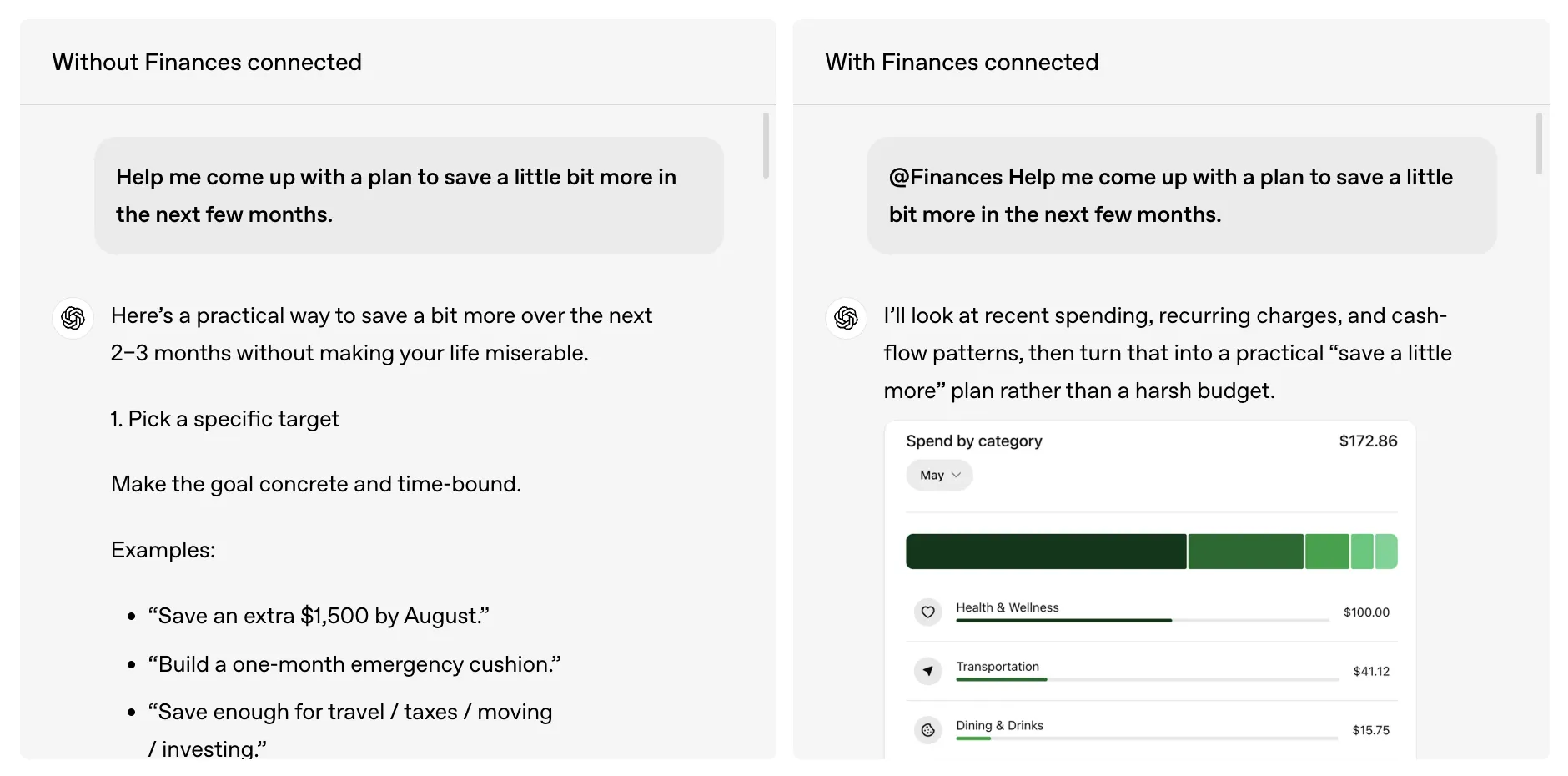
Previously, ChatGPT’s financial advice was limited to general recommendations like tracking subscriptions, automating savings, and reducing discretionary spending. While these tips are sound, they lacked the actionable specificity that users often crave. The new personal finance feature aims to bridge this gap by moving beyond hypothetical scenarios to data-driven insights. For instance, instead of suggesting a generic target for dining out, ChatGPT can now analyze a user’s actual spending over the past 90 days in that category and propose a realistic, personalized monthly budget based on their established patterns. This marks a stark contrast to previous methods, where users would have to manually download and input extensive financial statements to achieve a similar level of personalized analysis.
A Strategic Expansion into Fintech
This move is not an isolated event but rather a culmination of OpenAI’s increasing interest and investment in the financial technology sector. Just last month, OpenAI acquired Hiro Finance, a startup that positioned itself as an "AI personal CFO." This acquisition was largely an "acqui-hire," bringing the expertise of the Hiro team into OpenAI to bolster its capabilities in this domain. The integration of Hiro’s technology and talent is directly reflected in the new personal finance feature. This follows OpenAI’s prior acquisition of Roi, an app focused on personalized investing, underscoring a deliberate strategy to build out its financial AI offerings.
To ensure the accuracy and reliability of its financial advice, OpenAI collaborated with over 50 finance professionals. These experts helped establish a rigorous benchmark to evaluate the performance of its AI models on complex personal finance tasks. The default model powering the Finances feature, GPT-5.5 Thinking, achieved a score of 79 out of 100 on this benchmark. For Pro subscribers, an enhanced version, GPT-5.5 Pro, demonstrated even greater proficiency, scoring 82.5. This extensive testing and validation process aims to instill confidence in the system’s analytical capabilities.

The "Why" Behind the Feature: Addressing User Demand and Market Trends
The question of safety and privacy is paramount when dealing with sensitive financial data. OpenAI addresses these concerns by emphasizing the role of Plaid as the secure intermediary. Plaid employs bank-level encryption, does not store users’ bank credentials, and has a strong track record of security, having facilitated over 150 million connections without a major breach. The critical consideration for users, therefore, shifts to OpenAI’s data handling policies once the information is accessed.
OpenAI’s policy states that conversations involving connected financial accounts are subject to the user’s existing model training settings. This means that if a user has opted out of contributing their data to model training in other ChatGPT interactions, this preference will extend to their financial data as well. Furthermore, users retain the ability to disconnect their accounts at any time. OpenAI asserts that synced financial data is deleted from its systems within 30 days of disconnection.
It is crucial to note that OpenAI explicitly clarifies that ChatGPT is not a financial advisor. While it can identify spending patterns, suggest savings targets, and offer personalized insights, it lacks a fiduciary duty. This means it has no legal obligation to act in the user’s best financial interest. Consequently, any financial decisions or their outcomes remain solely the responsibility of the user. This distinction is significant and will likely be a focal point for scrutiny by financial regulators as the product evolves and potentially expands to a wider user base.
This approach mirrors OpenAI’s strategy in other specialized sectors. Earlier this year, the company launched a dedicated ChatGPT for clinicians, providing a powerful AI tool for medical professionals. However, as with the personal finance feature, OpenAI did not claim responsibility for the clinical advice generated by the AI. This pattern suggests a deliberate strategy of empowering AI in complex domains by providing access to structured data, while maintaining a clear demarcation of responsibility.
OpenAI has stated that over 200 million people already engage with ChatGPT on financial topics monthly. The introduction of this feature is, therefore, a direct response to and an enhancement of existing user behavior. By integrating direct access to financial data, OpenAI is formalizing and optimizing how users are already seeking financial guidance from its platform.
Competitive Landscape and Future Implications
OpenAI is not alone in this rapidly developing space. Perplexity AI has also launched a personal finance product integrated with Plaid, offering users a comprehensive view of their finances within its AI search engine. Moreover, Intuit, the parent company of financial software giants like TurboTax and QuickBooks, is slated to integrate with ChatGPT. This partnership is expected to unlock functionalities such as estimating the tax implications of stock sales or assessing the likelihood of credit card approvals, all directly within the chat interface.
The personal finance feature’s rollout to Plus users, following a preview phase for Pro subscribers, indicates a phased approach to market penetration. This allows OpenAI to gather user feedback and refine the product before a broader release. For users who do not opt for paid subscriptions, alternative methods exist. Advanced users can potentially achieve similar results by utilizing powerful local AI models or privacy-focused providers, combined with manual data input. While less convenient, this DIY approach offers greater control over personal data.
The implications of this development are far-reaching. For individuals, it promises more accessible, personalized, and potentially effective financial planning. The ability to get real-time, data-backed insights directly from a conversational AI could democratize financial advice, making it more granular and responsive to individual circumstances.
For the financial industry, this represents both an opportunity and a challenge. Traditional financial advisors may face increased competition from AI-driven platforms that offer a more immediate and cost-effective alternative for certain services. However, it also presents opportunities for collaboration, with established financial institutions potentially integrating AI capabilities into their own customer offerings.
From a regulatory perspective, the integration of AI with sensitive financial data will undoubtedly prompt increased scrutiny. Ensuring robust data privacy, security, and transparency will be paramount. The absence of fiduciary duty for AI financial tools is a critical point that will require clear communication to users and careful consideration by regulatory bodies as these technologies become more sophisticated and widespread.
The success of OpenAI’s personal finance feature will hinge on its ability to balance advanced functionality with user trust and data security. As AI continues to permeate various aspects of our lives, its application in personal finance marks a significant milestone, blurring the lines between artificial intelligence and personal well-being. The coming years will likely see further innovation and integration, reshaping how individuals manage and understand their financial futures. The benchmark scores achieved by GPT-5.5 models in finance-specific tasks suggest a strong foundation, but the real-world impact and user adoption will ultimately determine the long-term success of this ambitious endeavor.
