
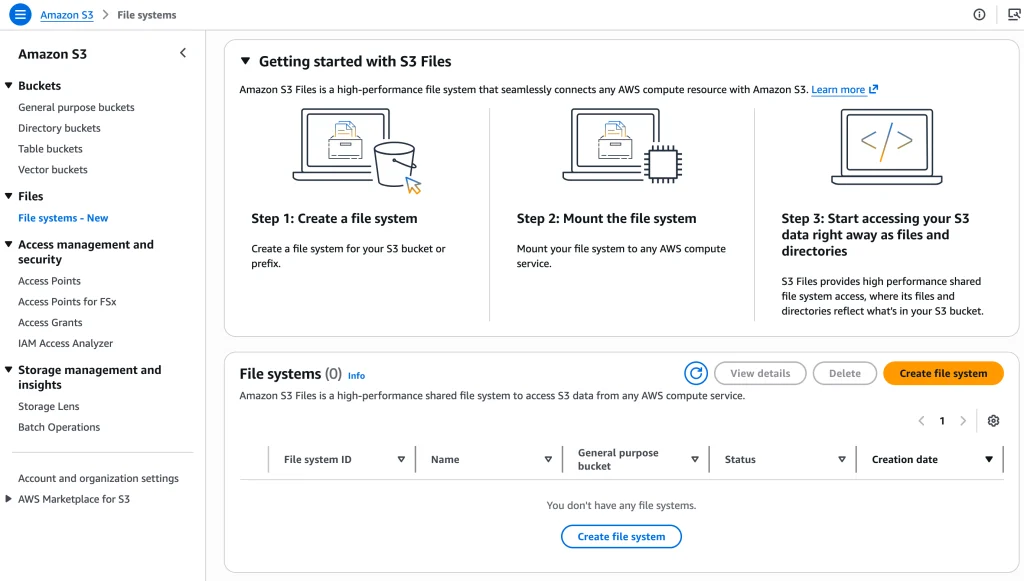

Amazon Web Services (AWS) has announced the general availability of Amazon S3 Files, a groundbreaking new file system designed to seamlessly connect any AWS compute resource with Amazon Simple Storage Service (Amazon S3), effectively unifying the previously distinct paradigms of object storage and traditional file systems. This significant innovation promises to simplify cloud architectures, eliminate data silos, and accelerate a wide array of workloads, from machine learning training to agentic AI systems and enterprise applications.
A Decades-Old Distinction Redefined
For over a decade, cloud architects and developers have grappled with the fundamental differences between object storage and file systems. Amazon S3, launched in 2006, revolutionized data storage with its unparalleled scalability, durability, and cost-effectiveness, treating data as immutable objects. This model, often likened to books in a library where an entire volume must be replaced to change a single page, proved ideal for massive data lakes, backups, and static content. In contrast, traditional file systems, like those found on local computers, offer hierarchical organization, directory structures, and the ability to modify data in-place, page by page. This interactive, granular control has been indispensable for operating systems, application data, and shared collaboration.
The necessity of choosing between S3’s economic benefits and a file system’s interactive capabilities often led to complex data management strategies, including manual data transfers, custom connectors, or the use of file system abstraction layers that sometimes introduced performance bottlenecks or consistency challenges. These workarounds created operational overhead and prevented organizations from fully leveraging S3 as a central data hub for all their diverse workloads. The introduction of Amazon S3 Files directly addresses this long-standing architectural challenge, making S3 the first and only cloud object store to offer fully-featured, high-performance file system access to data.
Core Functionality and Technical Architecture

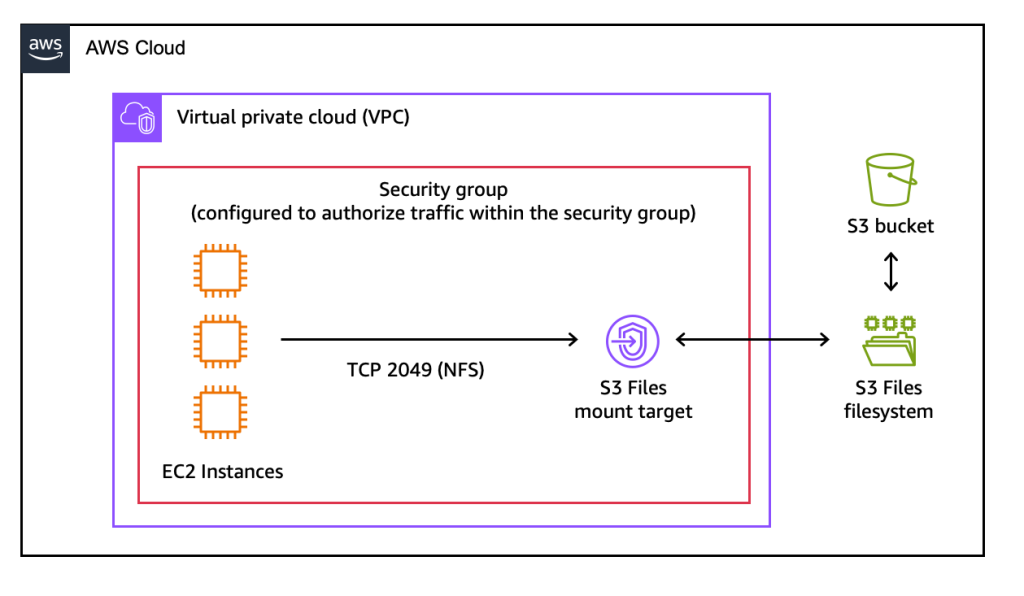
At its heart, S3 Files transforms S3 buckets into accessible file systems, supporting standard Network File System (NFS) v4.1+ operations, including creating, reading, updating, and deleting files and directories. This means that applications and users can interact with S3 data using familiar file system commands and APIs, eliminating the need for application refactoring or specialized S3 integration code.
The underlying architecture of S3 Files leverages Amazon Elastic File System (Amazon EFS), a managed NFS service, to deliver low-latency access to actively used data. When data is accessed through the S3 Files interface, relevant file metadata and contents are intelligently placed onto a high-performance storage layer managed by EFS, ensuring sub-millisecond latencies (approximately 1ms) for active data. This hybrid approach optimizes performance for interactive workloads while retaining the cost benefits and scalability of S3 for the vast majority of data.
Crucially, S3 Files incorporates intelligent data management strategies. For files requiring low-latency access, data is cached and served from the high-performance EFS tier. However, for files that benefit from large sequential reads or byte-range reads (e.g., streaming video, large scientific datasets), S3 Files automatically serves these directly from Amazon S3 to maximize throughput and minimize data transfer costs, only fetching the requested bytes. This intelligent pre-fetching capability further anticipates data access needs, enhancing overall efficiency.
Data synchronization between the S3 file system and the underlying S3 bucket is automatic and finely controlled. Changes made on the file system are reflected in the S3 bucket as new objects or new versions of existing objects, typically within minutes. Conversely, changes to objects directly in the S3 bucket are visible in the file system within seconds, though occasional delays up to a minute or longer can occur. This near real-time synchronization, combined with NFS close-to-open consistency, ensures data integrity across environments and supports concurrent access from multiple compute resources, making it ideal for collaborative, data-mutating workloads.
Expanding the Reach of S3 Across AWS Compute
One of the most significant implications of S3 Files is its broad compatibility across the AWS compute ecosystem. It can be attached to Amazon Elastic Compute Cloud (Amazon EC2) instances, containers running on Amazon Elastic Container Service (Amazon ECS) or Amazon Elastic Kubernetes Service (Amazon EKS), and even AWS Lambda functions. This universal accessibility means that applications traditionally reliant on local or network file systems can now directly leverage the vast and durable storage capabilities of S3 without modification.

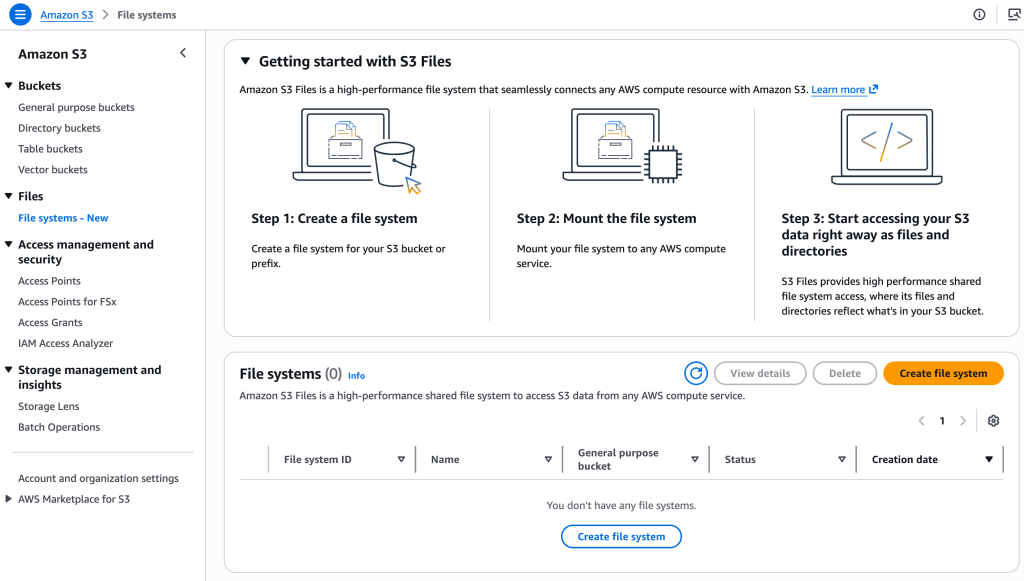
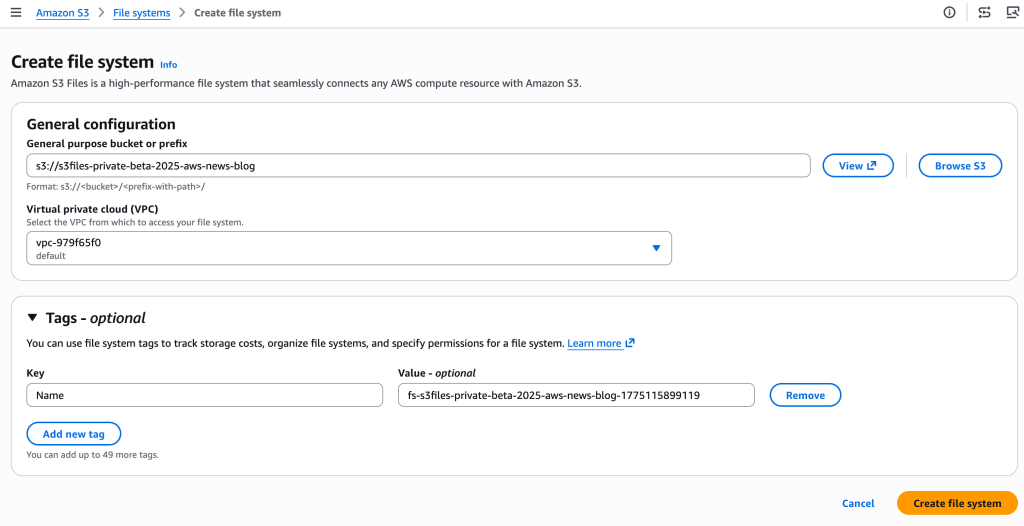
For instance, an EC2 instance can mount an S3 file system using standard Linux commands, treating an S3 bucket as if it were a local directory. This simplifies operations for developers and system administrators, who can use familiar tools like ls, cp, mv, and echo to interact with S3 data. The setup process, demonstrated through the AWS Management Console, AWS Command Line Interface (AWS CLI), or Infrastructure as Code (IaC), is straightforward, involving the creation of an S3 file system and its associated mount targets within a Virtual Private Cloud (VPC).
Transformative Use Cases and Industry Impact
The introduction of S3 Files unlocks new possibilities and simplifies existing architectures across several critical domains:
-
Artificial Intelligence and Machine Learning (AI/ML): AI and ML workloads often involve massive datasets, iterative model training, and shared access among multiple compute instances. S3 Files enables ML pipelines to directly access and mutate datasets stored in S3, eliminating the need for costly and complex data movement to specialized file systems. Agentic AI systems, which frequently rely on file-based Python libraries, shell scripts, and collaborative tools, can now seamlessly operate on S3 data with file system semantics and high performance. This is particularly beneficial for distributed training scenarios where multiple GPUs or instances need to read and write to shared datasets.
-
DevOps and Containerized Applications: Modern containerized applications, orchestrated by services like ECS and EKS, often require shared persistent storage. S3 Files provides a high-performance, scalable solution for these applications, allowing containers to read and write to shared data in S3 using standard file system interfaces. This simplifies deployment and management for microservices that need shared configuration, logs, or intermediate processing results.
-
Big Data Analytics: While many big data tools can directly access S3 objects, some legacy or specialized analytics applications expect a file system interface. S3 Files bridges this gap, allowing these tools to run directly on S3 data without requiring complex data ingestion or transformation pipelines, accelerating insights and reducing operational complexity.
-
Content Management and Media Processing: Industries dealing with large volumes of media files, such as video editing, image processing, or content delivery networks, can benefit from S3 Files. It allows creative professionals and automated workflows to interact with media assets stored in S3 with the responsiveness of a local file system, while still leveraging S3’s scalability and durability for archiving and distribution.
-
Lift-and-Shift Migrations: Enterprises migrating on-premises applications that have strong dependencies on network-attached storage (NAS) can now consider S3 Files as a viable target, especially if those applications can tolerate the slight eventual consistency for S3 object changes. This reduces the friction and refactoring effort often associated with cloud migration.
Comparison with Other AWS File Services
AWS offers a comprehensive suite of storage services, and understanding where S3 Files fits alongside existing offerings like Amazon Elastic File System (EFS) and Amazon FSx is crucial for optimal architectural design.
-
Amazon EFS: EFS is a fully managed NFS file system primarily designed for general-purpose workloads that require shared, elastic file storage for EC2 instances, containers, and serverless functions. It offers higher IOPS and lower latency than S3 Files for all data, but typically at a higher cost per GB for cold data. EFS is ideal when applications require consistently high performance across all files and full POSIX compliance for every operation, regardless of access patterns. S3 Files uses EFS under the hood for its high-performance tier but focuses on bringing file semantics to S3 data.
-
Amazon FSx: FSx provides fully managed file systems for specific enterprise workloads with deep compatibility requirements.
- FSx for Lustre: Optimized for high-performance computing (HPC) and GPU clusters, delivering sub-millisecond latencies and hundreds of gigabytes per second of throughput. It’s designed for bursty, high-throughput, parallel workloads.
- FSx for NetApp ONTAP: Offers rich data management features, including snapshots, replication, and data deduplication, with broad enterprise application compatibility.
- FSx for OpenZFS: Provides a high-performance, open-source file system with ZFS features like data integrity, snapshots, and compression.
- FSx for Windows File Server: Provides a fully managed, highly available Windows native shared file system, ideal for Windows-based applications and user home directories.
S3 Files differentiates itself by providing interactive, shared access to data that originates and primarily resides in Amazon S3, leveraging S3’s cost-effectiveness and durability as the foundational storage layer. It is the go-to solution when the objective is to bring file system capabilities to vast S3 data lakes, especially for workloads that involve mutating data collaboratively across compute clusters without data duplication. The decision between these services often hinges on performance requirements, cost considerations, application compatibility, and the primary location/type of data.
Pricing and Global Availability
Amazon S3 Files is now generally available in all commercial AWS Regions, ensuring broad accessibility for global organizations. The pricing model is designed to be transparent and aligns with the value proposition of the service. Customers pay for several components:
- The portion of data actively stored in the S3 file system’s high-performance tier (utilizing EFS).
- Charges for small file read operations and all write operations performed on the file system.
- Standard S3 requests incurred during the automatic data synchronization between the file system and the S3 bucket.
This tiered pricing structure encourages efficient use of the high-performance layer while benefiting from S3’s cost-effectiveness for the bulk of the data. Detailed pricing information is available on the Amazon S3 pricing page, allowing organizations to accurately estimate costs based on their specific usage patterns.
A New Era for Cloud Data Architectures
The launch of Amazon S3 Files marks a pivotal moment in cloud storage, effectively dissolving the historical barrier between object storage and file systems. By enabling direct, high-performance file system access to data residing in Amazon S3, AWS empowers organizations to simplify their cloud architectures, eliminate complex data movement and synchronization processes, and unlock new levels of agility and efficiency.
This innovation is poised to accelerate the development and deployment of next-generation applications, particularly in the burgeoning fields of AI and ML, where interactive and collaborative data access is paramount. S3 Files reinforces Amazon S3’s position as the central hub for all organizational data, providing an accessible and robust foundation for diverse workloads across the entire AWS ecosystem. As cloud adoption continues to grow, solutions like S3 Files will be instrumental in helping businesses build more flexible, scalable, and cost-effective data strategies.
