

AWS has announced the general availability of managed daemon support for Amazon Elastic Container Service (Amazon ECS) Managed Instances, a significant enhancement designed to empower platform engineers with independent control over essential operational software agents. This new capability extends the existing managed instances experience, initially rolled out in September 2025, by decoupling the lifecycle management of tools such as monitoring, logging, and tracing agents from application deployments. The move promises to enhance operational reliability, ensure consistent agent deployment across instances, and significantly reduce the coordination burden between platform and application development teams, thereby fostering more agile and robust containerized environments.
The proliferation of containerized workloads and microservices architectures has fundamentally transformed how organizations develop and deploy applications. Services like Amazon ECS have played a pivotal role in abstracting away much of the underlying infrastructure complexity, allowing developers to focus on application logic. However, as organizations scale, the operational overhead associated with managing the supporting ecosystem—specifically, the critical daemons responsible for observability and security—has continued to grow. Platform engineers, tasked with maintaining the health, performance, and security of these environments, have traditionally faced a complex challenge: ensuring that every container instance consistently runs the necessary operational agents without disrupting application development cycles.
The Evolving Landscape of Container Operations
Before this announcement, managing operational agents within large-scale ECS deployments presented a unique set of challenges. In many scenarios, monitoring, logging, and tracing tools, often deployed as sidecar containers or integrated into application task definitions, were tightly coupled with the application’s lifecycle. This coupling meant that any update to a monitoring agent, for example, necessitated coordination with application teams, modifications to existing task definitions, and a complete redeployment of the affected applications. For organizations managing hundreds or even thousands of distinct services, this process translated into a significant operational burden, consuming valuable engineering resources, increasing the risk of human error, and potentially introducing delays in rolling out critical updates or security patches.
The initial introduction of Amazon ECS Managed Instances in September 2025 marked a step towards simplifying infrastructure management for containerized applications. Managed Instances automate tasks like instance provisioning, scaling, and patching, allowing platform teams to focus on higher-value activities. However, the need for a dedicated mechanism to manage the agents running on these instances, independently of the applications they support, remained a crucial gap. The latest announcement directly addresses this, providing a granular level of control previously unavailable.
Decoupled Lifecycle Management: A Paradigm Shift
The core innovation of managed daemon support lies in its ability to introduce a dedicated "managed daemons construct." This construct allows platform teams to centrally define, deploy, and update operational tooling, completely separate from application task definitions. This separation of concerns is a game-changer for several reasons:
- Independent Deployment and Updates: Platform engineers can now deploy new versions of monitoring, logging, or tracing agents directly to their infrastructure without requiring application teams to modify their code or redeploy their services. This dramatically accelerates the rollout of critical updates and ensures that the operational environment remains current.
- Consistent Enforcement: The new system enforces the consistent use of required tools across all designated instances. This means that every managed instance within a specified capacity provider will automatically run the defined daemons, eliminating manual configuration inconsistencies and ensuring comprehensive host-level monitoring and observability from the moment an instance comes online.
- Guaranteed Execution Order: Managed daemons are guaranteed to start before application tasks on an instance and drain last when an instance is being decommissioned or updated. This "start before stop" approach ensures that logging, tracing, and monitoring capabilities are always available when an application needs them, providing continuous data collection and minimizing blind spots during critical operational phases, including instance provisioning and decommissioning.
- Optimized Resource Utilization: Each managed instance runs exactly one copy of a defined daemon, which is shared across multiple application tasks running on that instance. This contrasts with scenarios where multiple application tasks might each include their own sidecar agents, leading to redundant resource consumption. By centralizing daemon management, resource allocation for these agents can be optimized, contributing to better cost efficiency.
Deep Dive into Technical Mechanics and Operational Benefits
The implementation of managed daemon support leverages several key technical advancements within the ECS ecosystem. A new daemon_bridge network mode has been introduced, enabling daemons to communicate effectively with application tasks while maintaining isolation from application networking configurations. This ensures that operational agents can gather necessary data without interfering with the primary application’s network setup.

Furthermore, managed daemons support advanced host-level access capabilities, which are crucial for the effectiveness of operational tooling. Platform engineers can configure daemon tasks as privileged containers, add specific Linux capabilities, and mount paths directly from the underlying host filesystem. These capabilities are indispensable for monitoring and security agents that require deep visibility into host-level metrics, processes, and system calls to function effectively. For instance, a security agent might need to mount the host’s /var/log directory to collect system logs, or a performance monitoring agent might require privileged access to kernel statistics.
The operational benefits extend beyond mere technical features:
- Enhanced Observability: By ensuring that monitoring, logging, and tracing agents are always deployed consistently and start before applications, organizations gain superior observability into their entire containerized stack. This translates to faster root cause analysis, proactive issue detection, and improved system reliability.
- Improved Security Posture: Security agents can be consistently deployed and updated across all instances, providing uniform threat detection and vulnerability management capabilities. The decoupled lifecycle means security patches for agents can be rolled out swiftly without impacting application availability.
- Streamlined Compliance: For industries with stringent compliance requirements, the ability to guarantee the presence and consistent configuration of specific auditing and logging agents across the entire infrastructure simplifies compliance audits and reporting.
- Reduced Operational Friction: The primary benefit for platform engineers is the significant reduction in operational friction. The ability to manage agents independently reduces the need for constant coordination with application teams, allowing both groups to operate more autonomously and efficiently. This accelerates development and deployment cycles for both applications and operational tools.
- Cost Efficiency: Beyond optimized resource utilization, the automation inherent in managed daemons reduces the manual effort required for agent deployment and updates, freeing up skilled engineers for more strategic initiatives.
A Practical Implementation: Deploying the CloudWatch Agent
To illustrate the ease of use, an example deployment of the Amazon CloudWatch Agent as a managed daemon highlights the streamlined process. Assuming an existing Amazon ECS cluster with a Managed Instance capacity provider is in place, the steps are intuitive:
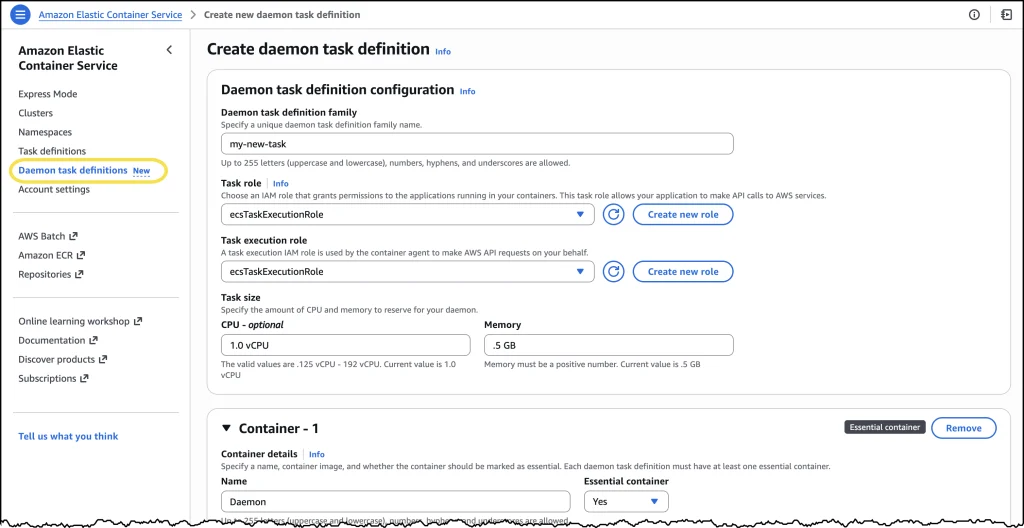
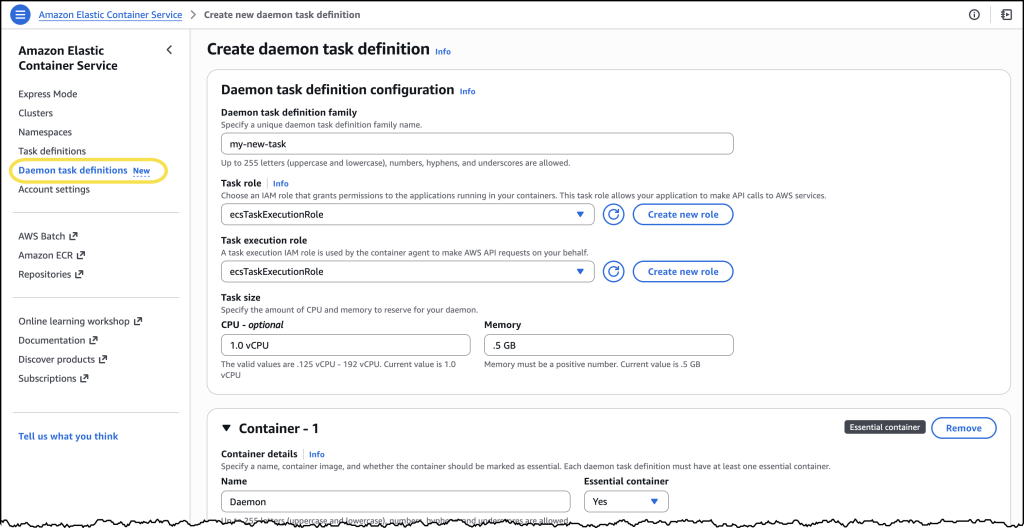
- Daemon Task Definition Creation: Within the Amazon Elastic Container Service console, a new "Daemon task definitions" option appears in the navigation pane. Platform engineers can create a new daemon task definition, specifying resources like vCPU and memory (e.g., 1 vCPU, 0.5 GB memory) and providing the container image URI (e.g.,
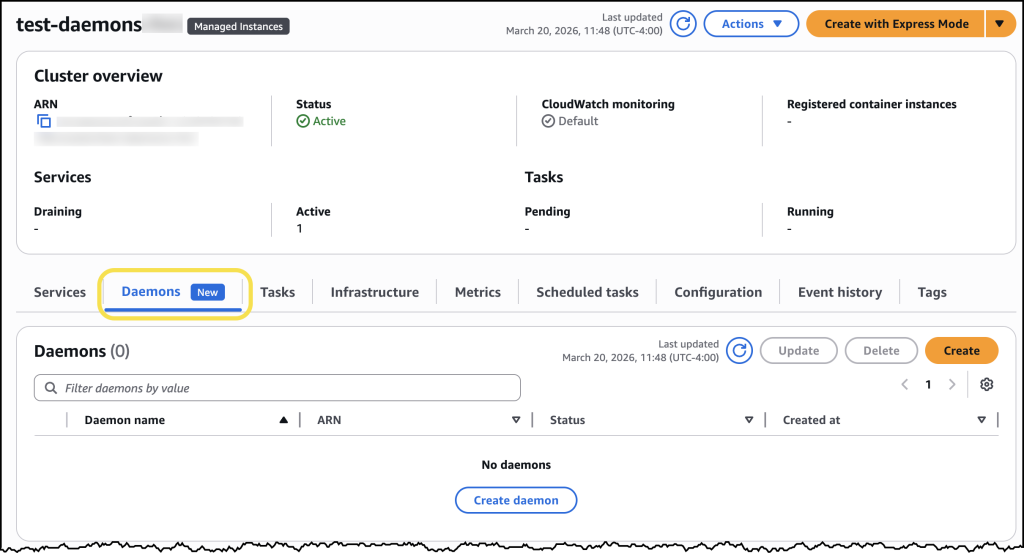
public.ecr.aws/cloudwatch-agent/cloudwatch-agent:latest). This process is similar to creating a standard task definition but is specifically tailored for daemons. - Daemon Deployment: Navigating to the "Clusters" page and selecting the target cluster reveals a new "Daemons" tab. Here, a "Create daemon" button allows engineers to select their newly created daemon task definition, assign a name, and specify the ECS Managed Instances capacity provider where the daemon should be deployed.
- Automatic Provisioning and Updates: Once configured, ECS automatically ensures the daemon task launches first on every provisioned ECS managed instance within the selected capacity provider. When updates to the daemon are required, ECS handles the rolling deployment automatically. This involves provisioning new instances with the updated daemon, starting the daemon first, then gracefully migrating application tasks to the new instances before terminating the old ones. The "start before stop" approach ensures continuous daemon coverage throughout the update process, preventing any gaps in data collection. Configurable drain percentages provide granular control over the pace of these updates, minimizing potential impact.
Statements and Industry Implications
"This new managed daemon support represents a crucial step forward in operationalizing containerized workloads at scale," stated an AWS spokesperson, who emphasized the company’s commitment to addressing customer pain points. "We heard from platform engineers about the complexities of managing the lifecycle of essential operational agents, and this feature directly empowers them to maintain consistent observability and security without the overhead of coordinating with every application team. It’s about giving control back to the teams responsible for infrastructure reliability."
Industry analysts concur, viewing this announcement as a significant evolution in the cloud-native ecosystem. "The move towards platform engineering demands tools that abstract away infrastructure complexities while providing granular control where it matters," noted a senior analyst at a leading tech research firm. "AWS’s managed daemon support for ECS is a prime example of this trend. It simplifies a notoriously difficult aspect of cloud operations, allowing organizations to scale their container deployments with greater confidence in their observability and security postures. This will undoubtedly free up engineering talent to focus on innovation rather than operational toil."
The implications for DevOps practices are substantial. By clearly separating the concerns of application development and operational tooling, this feature encourages a more efficient division of labor. Application teams can maintain their focus on delivering business value through code, while platform teams can independently ensure the robust health and monitoring of the underlying infrastructure. This fosters a more mature and scalable DevOps culture within organizations.
Availability and Cost
Managed daemon support for Amazon ECS Managed Instances is available today across all AWS Regions where Amazon ECS is offered. This broad availability ensures that organizations worldwide can immediately benefit from these enhanced capabilities.
Crucially, there is no additional cost associated with using managed daemons. Customers only pay for the standard compute resources consumed by their daemon tasks, aligning with AWS’s pay-as-you-go pricing model. This transparent cost structure further encourages adoption, as organizations can enhance their operational posture without incurring new licensing or feature-specific fees.
To get started, platform engineers can visit the Amazon ECS console or refer to the comprehensive Amazon ECS documentation for detailed guides and tutorials. The new managed daemons Application Programming Interface (APIs) are also available for those looking to integrate this functionality into automated workflows or custom management tools. This feature is poised to become an indispensable tool for platform engineers navigating the complexities of modern containerized environments, driving greater efficiency, reliability, and control across their AWS deployments.
