
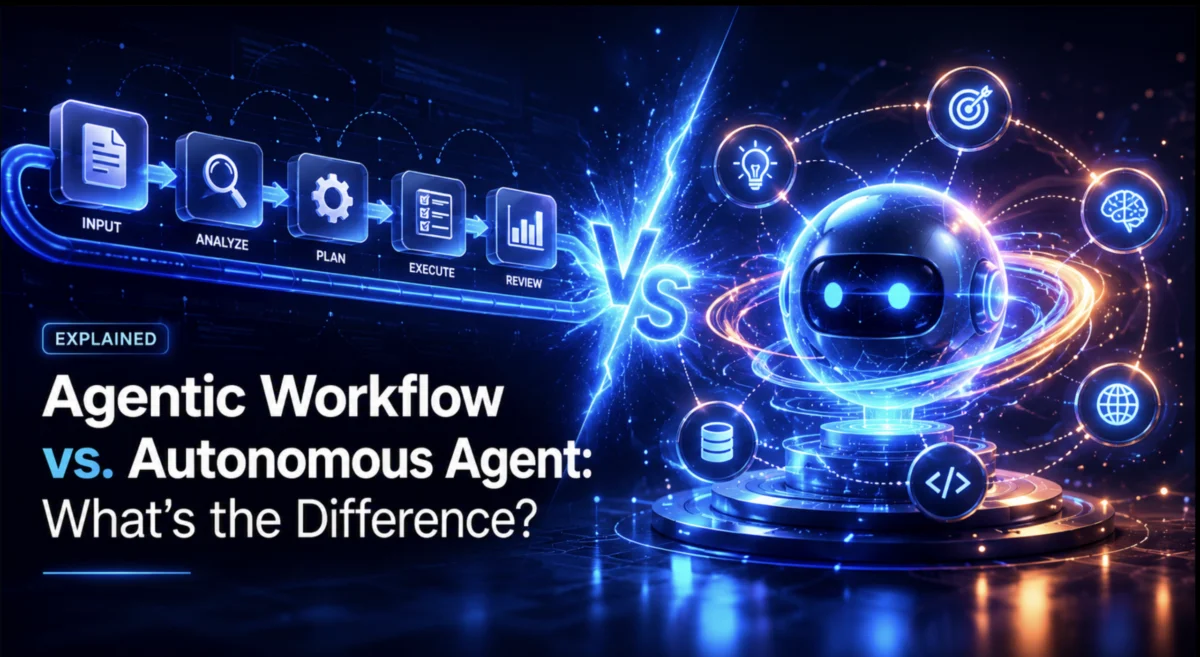

The current surge in AI adoption has led to a semantic ambiguity, particularly around the term "agentic." What began as a precise descriptor for systems exhibiting a degree of self-direction has broadened to encompass almost any application incorporating a Large Language Model (LLM) call. From a straightforward five-step process where an LLM merely summarizes text in one stage, to a sophisticated system that independently plans its entire execution path, the label "agentic" is frequently applied. This conflation, industry experts caution, risks two significant pitfalls: over-engineering simple, predictable tasks with unnecessary layers of autonomy, or conversely, under-engineering complex, open-ended problems by forcing them into rigid, predefined structures that inevitably fail when faced with novel situations.
The foundational distinction, as articulated by leading AI research institutions like Anthropic, posits that workflows are systems where LLMs and associated tools are orchestrated through predefined, human-coded paths. Agents, on the other hand, are characterized by LLMs that dynamically direct their own processes and tool utilization, maintaining control over how a task is accomplished. This nuanced differentiation forms the bedrock for understanding the spectrum of AI system architectures, moving from entirely deterministic operations to fully autonomous, multi-agent collaborations. The journey through this spectrum reveals how control flow evolves from explicit human scripting to implicit, real-time model reasoning, impacting everything from system predictability to cost and ethical oversight.
The Foundational Axis: Predictability Versus Autonomy
In the contemporary AI ecosystem, the pertinent question is no longer merely "does this system utilize an LLM?" as LLMs have become ubiquitous. Instead, architects and developers are increasingly focusing on two critical axes: "Does this process require step-by-step repeatability, auditability, and explainability?" and "Is the optimal execution path known in advance, or must the system discover it dynamically at runtime?" These questions fundamentally reframe the discussion from a binary "AI or no AI" to a spectrum of predictability versus autonomy.
A system can extensively leverage an LLM and still maintain a fully deterministic structure. Consider a fixed pipeline where an LLM generates text for one step, but the subsequent action is hardcoded irrespective of the generated output. Conversely, a system might be labeled "agentic" with minimal genuine autonomy, operating within a tightly scripted loop with a limited set of allowed actions and strict step constraints. The mere presence of an LLM call is not the defining characteristic; rather, it is the ownership of the control flow that serves as the decisive signal. This operational distinction is echoed in architectural guidelines, such as those from Google Cloud, which delineate between deterministic workflows (tasks with a clearly defined, unchanging path) and dynamic orchestration (problems where an agent must determine the best course of action without a predefined script). This framework provides a clear lens through which to examine the various stages of AI system design.
Deterministic Workflows: The Blueprint of Predictability
At the most fundamental level are deterministic workflows. In these systems, a human designs and codes a precise, known sequence of steps at the outset. An LLM can be integrated into any of these steps—for tasks like generating content, classifying inputs, or drafting summaries—but its output does not influence the progression to the next step. The overarching code, written by a human, dictates the flow, irrespective of what the model returns. This architecture guarantees consistency: the same input will always traverse the exact same path, yielding predictable outcomes.
For example, imagine a customer support pipeline. A raw user query first undergoes an extract function to clean it. Next, a classify function uses an LLM to categorize the query (e.g., "billing," "general"). Following this, a summarize function generates a concise overview, and finally, a notify function dispatches the summary. In a deterministic setup, even if the LLM classifies one query as "billing" and another as "general," both will proceed through summarize and notify in the same order. The LLM’s output is data, not a decision-maker for the workflow’s trajectory. The primary advantage of this approach lies in its auditability, repeatability, and ease of debugging, making it ideal for tasks in regulated environments or where strict adherence to predefined processes is paramount. The control flow is entirely human-authored, ensuring transparency and control.
Orchestrated Workflows: Conditional Execution within Defined Boundaries
Moving slightly along the spectrum, orchestrated workflows represent a common intermediate stage, often mistakenly equated with full autonomy. Here, a human still defines a complete graph of all possible execution paths in advance. However, unlike deterministic workflows, an LLM’s runtime decision does determine which of these predefined paths is taken. The LLM acts as a router, selecting from a menu of options that a human has already crafted; it does not possess the ability to invent new options or fundamentally alter the menu itself.
Consider the customer support example again. In an orchestrated workflow, after the extract step, the LLM-driven classify function might return a label like "billing," "technical," or "general." This label then dynamically dispatches the query to a corresponding pre-written handler function—handle_billing, handle_technical, or handle_general. Each handler represents a distinct, human-designed branch of the workflow. For instance, a "billing" query might be routed to a specific billing team’s queue, while a "technical" query goes to tech support. While different inputs now lead to different sequences of actions, every possible destination and action sequence was explicitly coded by a human beforehand. This approach offers greater flexibility than purely deterministic pipelines by allowing for conditional logic driven by LLM intelligence, but it strictly confines the LLM’s influence within the boundaries of a human-designed decision space. Google Cloud accurately terms this "dynamic orchestration," distinguishing it from true agentic behavior where the system plans its own route without a fully predefined script.
Reactive Agents: Embracing Real-time Decision-Making (The ReAct Loop)
The threshold for genuine autonomy is crossed with reactive agents, notably exemplified by the ReAct pattern (Reasoning + Acting), introduced by Yao et al. in 2022. Here, the AI model itself determines, at each step, what action to take next, based on its ongoing observations and internal reasoning. There is no exhaustive, human-written branch for every conceivable scenario. Instead, the agent operates within an iterative loop of "thought, action, and observation" until a specified exit condition is met. Critically, the sequence of actions, the number of steps, and the specific tools to be used are not knowable in advance; they are decided by the model at runtime. While the set of available tools is fixed, the path through them is entirely dynamic.
Imagine a customer interaction agent equipped with tools like search_knowledge_base and escalate_to_human. Upon receiving a query like "What is the refund policy?", the agent might think: "I need to look up the policy." It then acts by calling search_knowledge_base with the query. If the observation from this tool is "Refunds are available within 30 days," the agent might then think: "I found the answer. Task complete," and provide the final response. However, if the query is "Can you process my international tax refund in crypto?" and the search_knowledge_base returns "No matching information found," the agent might reason: "The knowledge base has no answer. I should escalate this." It then acts by calling escalate_to_human. The key here is that the decision to escalate, and the number of steps taken, are not hardcoded conditional statements but emergent properties of the model’s real-time reasoning based on its observations. This represents a significant shift in control flow, empowering the model to dynamically adapt its strategy, even if its toolkit remains constrained. Production implementations often augment this by maintaining a "scratchpad" of accumulated thought and observation history, often summarizing tool outputs to prevent context overload and improve the quality of subsequent reasoning steps.
Autonomous Multi-Agent Systems: Collaborative Intelligence at Scale
At the farthest end of the autonomy spectrum reside autonomous multi-agent systems, which build directly upon the principles of the ReAct loop but in a nested, collaborative fashion. In this architecture, an overarching orchestrator agent runs its own ReAct loop, but some of its "actions" involve delegating tasks to other specialized agents. These sub-agents (e.g., a research_agent, finance_agent, or coding_agent) each execute their own complete ReAct loops. The orchestrator reasons about what to delegate, dispatches the task, observes the result from the sub-agent, and continues its own reasoning process—just like a single-agent loop, but with "tools" that are themselves complex, independent agents.
In such a setup, the orchestrator’s AVAILABLE_TOOLS dictionary wouldn’t just contain simple functions; it would list other agents. Calling a research_agent, for instance, doesn’t return a simple string; it initiates that sub-agent’s independent Thought-Action-Observation cycle, which could involve multiple steps and tool calls before it returns a consolidated result to the orchestrator. Crucially, no human pre-scripts which sub-agent gets called, in what order, or how many times any of them run. This dynamic delegation allows for highly complex problem-solving. Google Cloud’s documentation even describes the "swarm" pattern—a collaborative team of agents operating without a central orchestrator—as the most extreme manifestation, capable of generating exceptionally creative and high-quality solutions precisely because interactions are unconstrained.
However, this profound flexibility comes with significant challenges. The very lack of human-designed structure that fosters creativity also introduces substantial risks. Swarms can fall into unproductive loops, fail to converge on a solution, or incur prohibitive computational costs due to extensive, unpredictable interactions. This architecture swings the predictability axis dramatically in favor of autonomy, offering unparalleled adaptability for unanticipated problems, but at the cost of granular control, auditability, and predictable resource consumption.
The Production Reality: Why This Distinction Matters for Enterprise AI
The differentiation between agentic workflows and autonomous agents is far from an academic exercise; it carries direct, measurable implications for the successful deployment of AI in production environments. Despite the considerable hype surrounding fully autonomous agents, industry trends indicate that AI workflows – particularly those involving sophisticated orchestration – have largely dominated successful generative AI deployments through 2025. Fully autonomous multi-agent systems, while promising, remain largely exploratory or confined to narrow, specialized domains.
The core reason for this disparity ties directly back to the predictability axis. Truly autonomous agentic systems are inherently non-deterministic. Identical inputs can yield varied outputs across different runs due to the dynamic, real-time reasoning involved. This characteristic poses a significant liability in contexts demanding strict regulation, auditability, or high stakes, such as finance, healthcare, or legal sectors. If a process must be explainable step-by-step to a compliance team or a regulatory body, a purely autonomous agent without significant guardrails and human-in-the-loop checkpoints cannot be reliably trusted with critical consequences. The debugging process for non-deterministic systems is also considerably more complex, often requiring sophisticated observational tools and post-hoc analysis rather than straightforward code tracing.
The emerging pattern in mature, production-grade AI systems is not one of exclusive choice but rather a hybrid approach. A higher-level agent might be employed to define broad goals, interpret ambiguous inputs, and orchestrate the overall task flow, leveraging its autonomy where flexibility is essential. Concurrently, critical, well-understood computations—those requiring absolute reliability and auditability—are still executed within deterministic modules that have been thoroughly specified and validated by humans. For example, in a medical diagnostics system, an agent might autonomously interpret a patient’s complex symptoms and decide the optimal sequence of diagnostic tests to order—a task requiring genuine autonomy as the "correct" path is not known in advance. However, each individual diagnostic test itself would run through a rigorously validated, deterministic pipeline, ensuring consistency and accuracy in a life-critical application. This hybrid model strategically places each component of the problem at the appropriate point on the predictability-autonomy spectrum, balancing innovation with control, and emergent intelligence with reliability.
Conclusion: A Spectrum, Not a Hierarchy
"Agentic workflow" and "autonomous agent" are not competing technologies but rather represent two ends of a continuous spectrum of AI system design. The four stages outlined—deterministic, orchestrated, reactive, and autonomous multi-agent—do not constitute a ranking from inferior to superior. Instead, they offer distinct answers to a fundamental question: who owns the control flow, and was that decision made by a human writing code in advance, or by a model reasoning dynamically at runtime?
Deterministic workflows inherently provide auditability and repeatability, ensuring that the same input consistently follows the same path. This makes them invaluable for processes where predictability, compliance, and debugging ease are paramount. Conversely, reactive and multi-agent systems willingly trade some of that predictability for the unparalleled ability to tackle problems whose precise shape and optimal solution cannot be anticipated beforehand. Neither characteristic is without its trade-offs, and neither architectural pattern is universally correct.
The most robust and effective AI systems in production today rarely commit to one extreme. Instead, they adopt a nuanced, pragmatic approach, assigning each segment of a problem to the point on the spectrum that best suits its requirements. Fixed structures are implemented where known correct paths exist and repeatability is crucial, while true autonomy is reserved for the complex, open-ended aspects of a problem where no predefined solution path can possibly account for all eventualities. This intelligent allocation of control flow is key to harnessing the full potential of AI while mitigating its inherent risks.
