

Amazon Web Services (AWS), a subsidiary of Amazon.com Inc., has announced a significant expansion of its Amazon Elastic Block Store (Amazon EBS) portfolio by introducing cross-account volume cloning capabilities. This new feature allows cloud architects and database administrators to securely generate and transfer instant point-in-time copies of EBS volumes across distinct AWS accounts. By bridging isolated account environments, the capability facilitates streamlined workflows for software development, automated testing, quality assurance, and security auditing without compromising the structural integrity or isolation of live production systems. Furthermore, the capability integrates native re-encryption tools using AWS Key Management Service (AWS KMS) keys housed within the destination account, aligning with strict corporate data governance and compliance mandates.
The rollout builds upon the foundation established the previous year when AWS launched EBS Volume Clones within single Availability Zones. While the initial release successfully solved the challenge of rapidly provisioning block storage volumes for intra-account workloads, enterprise users frequently voiced a need for inter-account sharing mechanisms. Modern enterprise architectures commonly rely on strict multi-account strategies governed by AWS Organizations to compartmentalize billing, resource ownership, and access boundaries. Consequently, replicating production states into isolated staging, development, or sandbox accounts previously required complex snapshot creation, data transfer, and manual restoration workflows. The newly deployed cross-account volume clone feature eliminates these operational friction points, establishing a native, high-speed pathway for data replication.
Operational Mechanics and Step-by-Step Implementation
The technical workflow for executing a cross-account volume clone leverages AWS Resource Access Manager (AWS RAM), a service engineered to securely share AWS resources across multiple accounts or within an organization. The process requires coordination between the source account owner and the target account administrator.
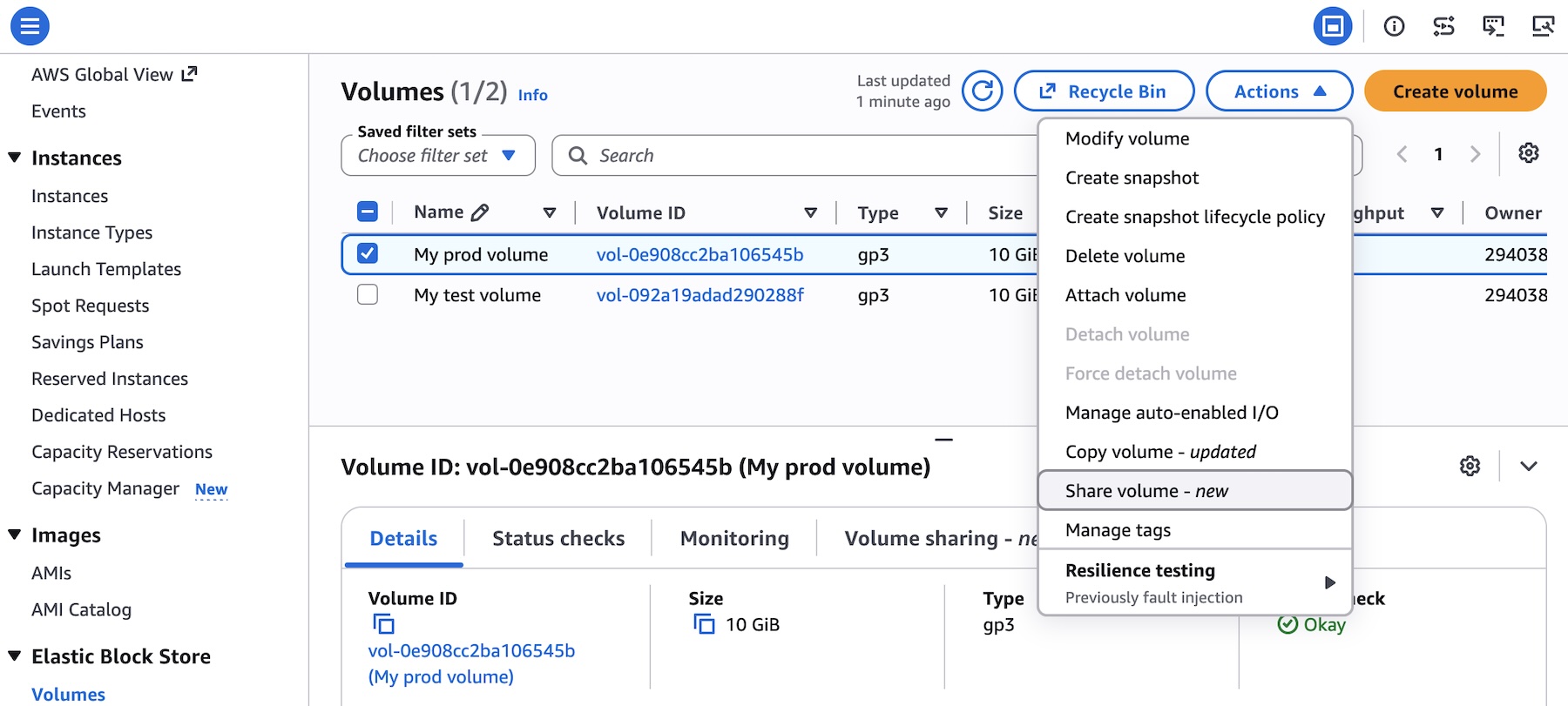
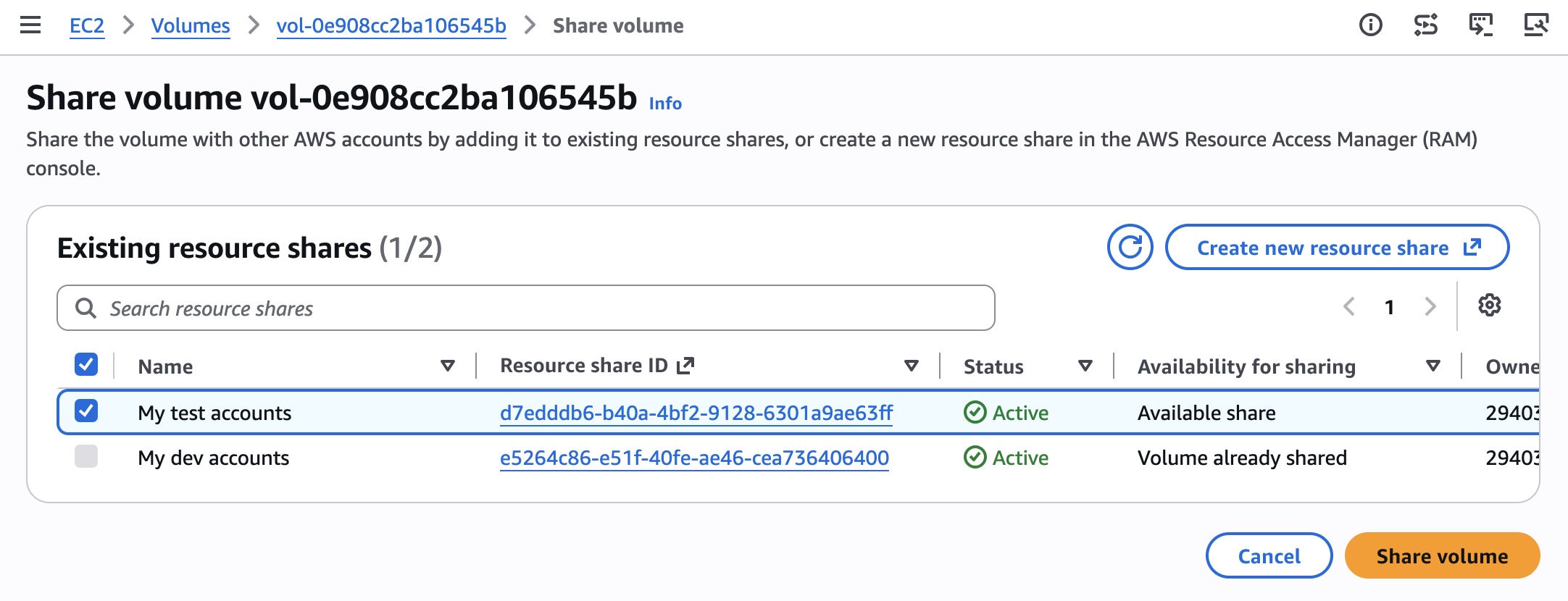
The procedure begins within the Amazon EBS console, where the volume owner selects the designated storage volume and initiates the sharing protocol via the volume detail page. The user then designates target AWS accounts by incorporating the volume into an existing resource share or by establishing a brand-new resource share through the AWS RAM console. Once configured, the system generates a resource share invitation.
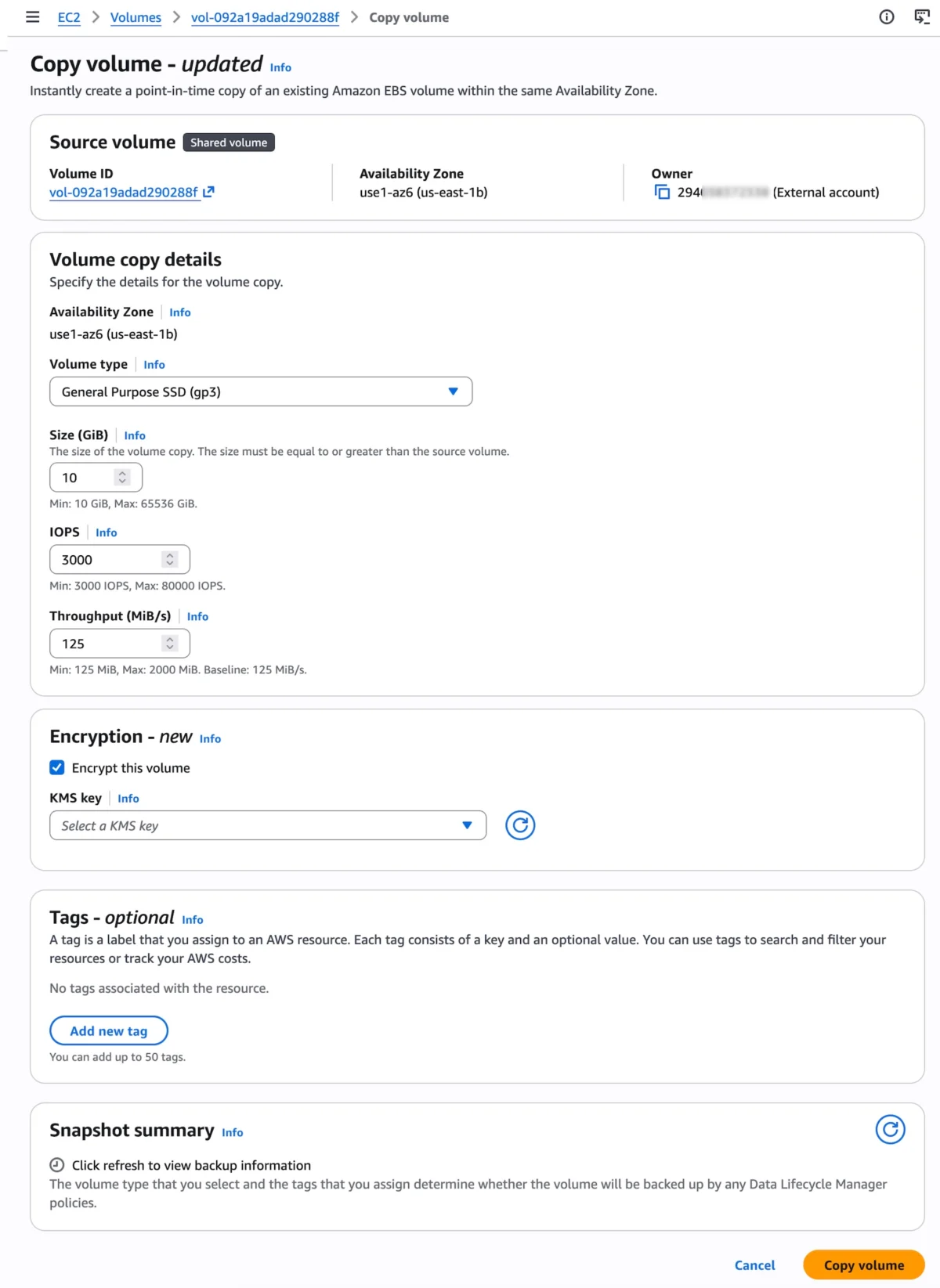
Upon receiving the resource share invitation, the administrator of the target AWS account must navigate to the AWS RAM console to formally accept the shared resource. Once accepted, the shared EBS volume automatically appears within the EBS volume management interface of the target account. The target administrator then selects the "Copy volume" action. During this staging phase, the administrator can optionally specify a target AWS KMS key to re-encrypt the data, ensuring that the cloned asset adheres entirely to the cryptographic security protocols of the secondary account.

For development teams aiming to automate these pipelines, AWS has integrated support for the AWS MCP Server and associated plugins. These tools allow engineers to interact with APIs programmatically and query technical documentation through preferred AI coding assistants, thereby accelerating the integration of cross-account cloning into continuous integration and continuous deployment (CI/CD) automation scripts.
Strategic Background and Evolution of Amazon EBS
Amazon Elastic Block Store has served as a foundational block storage service for Amazon Elastic Compute Cloud (EC2) instances since its inception in 2008. Over nearly two decades of cloud computing evolution, EBS has transformed from a basic persistent storage utility into a high-performance, highly reliable subsystem capable of supporting mission-critical relational databases, enterprise resource planning (ERP) systems, and latency-sensitive transactional workloads.
The introduction of Volume Clones last year represented a major paradigm shift in how storage copies were generated. Traditional EBS backups relied heavily on Amazon EBS snapshots, which capture incremental block-level changes and store them in Amazon Simple Storage Service (Amazon S3). While snapshots remain vital for long-term data archiving and disaster recovery, restoring a snapshot to a new volume involves data hydration overhead. EBS Volume Clones circumvented this limitation by utilizing metadata-level pointer copying within the storage architecture, generating instantaneous clones that reflect the exact state of the source volume at a precise moment in time without physical data duplication at creation.
Extending this cloning methodology across account boundaries addresses a critical operational bottleneck in enterprise DevOps pipelines. In traditional software engineering lifecycles, maintaining synchronization between production data realities and non-production testing environments is notoriously difficult. Outdated test data frequently fails to uncover edge cases, race conditions, or performance degradations that manifest under real-world loads. Conversely, utilizing live production data in unmanaged test environments introduces severe security vulnerabilities and compliance risks regarding Personally Identifiable Information (PII) and financial records.
Security, Governance, and Compliance Implications
The integration of AWS KMS re-encryption directly into the cross-account cloning process highlights the heightened focus on data sovereignty and zero-trust architectures in modern cloud infrastructures. Under standard cloud security frameworks, organizations must enforce strict boundaries to prevent unauthorized data exfiltration or accidental exposure of sensitive datasets.
By allowing target accounts to apply distinct encryption keys during the cloning process, AWS ensures that the principle of least privilege is maintained. The owner of the production volume retains absolute control over whether the data can leave the account boundary via AWS RAM policies, while the recipient account maintains autonomous control over the cryptographic keys protecting the newly minted clone. This decoupling of data access from cryptographic ownership ensures that security teams in non-production environments cannot inadvertently decrypt production-tier assets unless explicitly granted authorization through proper KMS key policies.
Industry analysts note that capabilities of this nature significantly reduce the administrative overhead associated with regulatory compliance frameworks such as the Health Insurance Portability and Accountability Act (HIPAA), the Payment Card Industry Data Security Standard (PCI-DSS), and the General Data Protection Regulation (GDPR). By establishing auditable, native pathways for data replication rather than relying on custom scripts or third-party utilities, enterprises maintain a clean, transparent provenance trail for all data movements across organizational units.
Industry Response and Economic Impact
Enterprise feedback from early adopters across financial services, healthcare, and software-as-a-service (SaaS) sectors indicates that cross-account volume cloning will yield measurable efficiencies in infrastructure management and engineering productivity. Software development teams frequently spend considerable hours provisioning, sanitizing, and refreshing test environments. By reducing the time required to populate staging databases with production-grade data volumes from hours or days down to mere seconds, organizations can accelerate release cycles and improve software resilience.
Furthermore, the architectural reliance on existing AWS native services—specifically Amazon EBS, AWS RAM, and AWS KMS—means that organizations do not need to invest in supplementary licensing or external data management software to achieve cross-account synchronization. This native integration reduces total cost of ownership (TCO) for cloud operations teams tasked with managing complex, multi-account enterprise estates.

Availability and Future Roadmap
AWS has confirmed that cross-account volume clones for Amazon EBS are generally available immediately across all global AWS Regions that currently support standard Amazon EBS Volume Clones. Organizations wishing to evaluate the feature can access the functionality directly through the Amazon EC2 and Amazon EBS management consoles.
As cloud environments scale to accommodate increasingly complex multi-account topologies, AWS continues to refine its underlying storage fabric to meet enterprise demands for agility, security, and performance. Technical documentation, API specifications, and detailed user guides are available through the official Amazon EBS User Guide, while regional expansion roadmaps can be tracked via the AWS Capabilities by Region portal. Feedback and feature requests regarding the new functionality are being channeled through AWS re:Post for Amazon EBS and standard AWS Support communication channels.
