
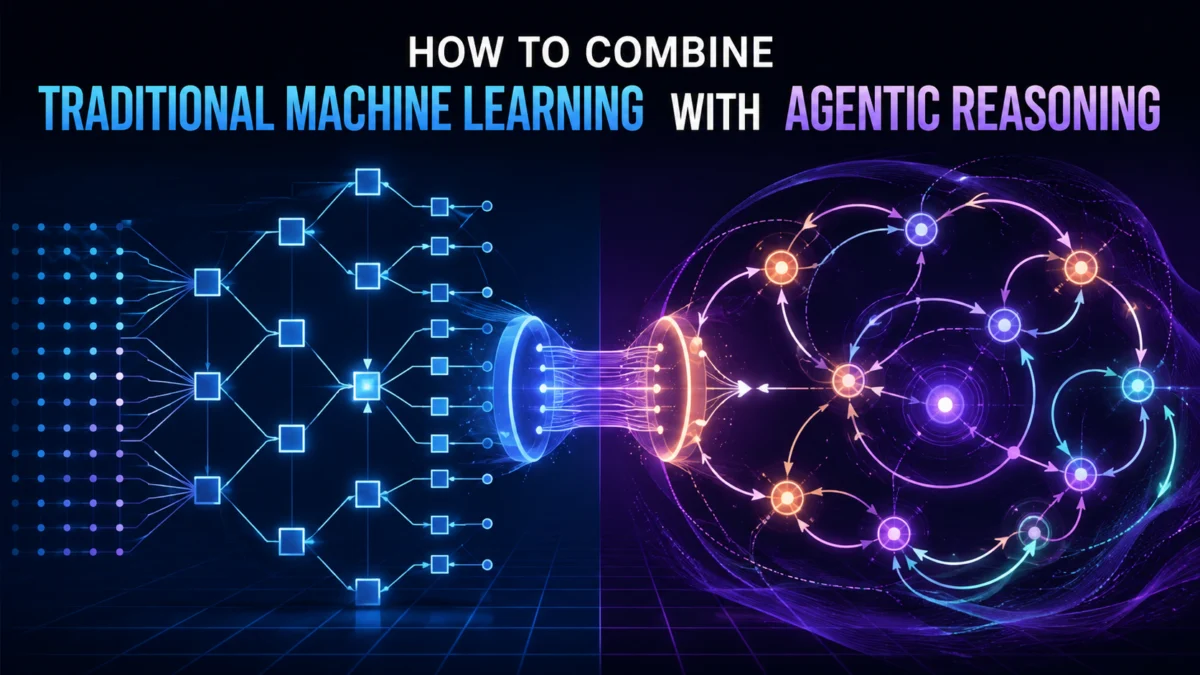

The landscape of artificial intelligence is undergoing a significant architectural shift as organizations move beyond static predictive models toward dynamic, agentic workflows. For over a decade, the industry has relied on traditional machine learning (ML)—supervised learning algorithms designed to map specific inputs to probability scores or categorical outputs. While these systems have achieved remarkable accuracy in fraud detection, churn prediction, and demand forecasting, their inherent limitations regarding multi-step reasoning and real-world execution have prompted the development of "agentic" systems. By integrating large language model (LLM) reasoning engines with established ML pipelines, developers are creating hybrid architectures that possess both the granular pattern recognition of traditional models and the adaptability of autonomous agents.
The Historical Context and Limitations of Predictive AI
The trajectory of machine learning began in earnest with the maturation of deep learning and ensemble methods in the 2010s. During this era, the primary objective was the refinement of statistical inference. Companies invested heavily in training models that could parse structured data—such as tabular transaction logs or pixel-level image data—to provide high-confidence predictions. According to industry data from the 2023 State of AI report, over 70% of enterprise-grade AI implementations were focused on classification and regression tasks.
However, these models operate within a closed-loop environment. They are "input-dependent" and "static." A model trained on 2022 financial data, for example, cannot inherently account for a 2024 regulatory shift unless it is retrained or fine-tuned. This rigidity creates a "last-mile" problem: while the model can identify a high-risk transaction, it cannot decide whether to pause the account, notify the customer, or trigger a manual audit. Historically, this gap was bridged by brittle, hard-coded software scripts or human intervention, both of which introduce latency and operational costs.
The Rise of Agentic Reasoning
The emergence of transformer-based architectures has provided a new capability: reasoning. Unlike traditional ML, which processes data through fixed mathematical weights, agentic systems utilize LLMs as "orchestrators." These systems operate as a loop: Perception, Reasoning, Planning, and Execution.
In a landmark paper presented at the 2024 AI Systems Summit, researchers highlighted that agentic frameworks allow for "dynamic task decomposition." Instead of a single inference step, the system breaks a complex request into a sequence of sub-tasks. If an agent is tasked with a supply chain optimization problem, it does not merely output a prediction; it queries an inventory database, compares current logistics costs, checks weather reports via external APIs, and drafts a rerouting request. This capacity to interact with the environment—utilizing tools and adapting to feedback—represents a fundamental departure from the passive nature of earlier predictive models.
Chronology of Integration
The convergence of these technologies has occurred in three distinct phases over the last 24 months:
- The Era of Siloed Models (Pre-2022): Predictive models were deployed as stand-alone assets. Data was cleaned, features were engineered, and the model output was consumed by legacy dashboards or human analysts.
- The LLM Integration Phase (2023): Organizations began "wrapping" predictive models in LLM interfaces. This allowed users to query models using natural language, but the underlying models remained static and incapable of autonomous tool use.
- The Agentic Hybrid Era (2024–Present): The current shift involves deep architectural integration. Agents act as the "brain," delegating specific, high-precision tasks to specialized ML models while managing the broader, unstructured workflow.
Supporting Data and Performance Metrics
Evidence suggests that hybrid architectures significantly outperform either approach in isolation. A recent study by a leading enterprise research firm demonstrated that when a financial institution utilized a hybrid "Agent + Classifier" model for loan processing, the time to resolution decreased by 64%. While the classifier was responsible for the risk scoring (achieving 98% precision), the agent managed the document verification and customer notification workflows, which had previously accounted for 80% of the processing time.
Furthermore, empirical testing indicates that agentic systems exhibit a "self-correction" mechanism. In scenarios where a tool returns a null value or an error, an agentic system can retry the query or pivot to an alternative data source, a feat impossible for a standard regression model. This capability is critical in high-stakes environments like healthcare diagnostics, where the ability to pull updated patient history before finalizing a recommendation can be the difference between a successful intervention and a misdiagnosis.
Broader Implications and Institutional Impact
The transition toward agentic reasoning carries significant implications for the future of enterprise software. First, it renders many "brittle" business rules obsolete. Rather than maintaining thousands of lines of if-then code to handle every possible edge case in a workflow, developers can define a goal and a set of tools, allowing the agent to navigate the logic autonomously.
However, this shift also introduces new requirements for observability and governance. Unlike a static model, which produces consistent outputs for identical inputs, an agentic system’s path may vary depending on the information it discovers. This creates a need for "reasoning traces"—logs that record not just the final output, but the logic and data retrieval steps taken by the agent. Legal and compliance departments are currently developing frameworks to audit these traces, ensuring that agentic decisions remain transparent and traceable.
Expert Perspectives on the Hybrid Model
Industry analysts note that this evolution is not a replacement of traditional machine learning but a maturation of the AI stack. "We are moving away from the idea that a single model can solve an entire business problem," says a lead architect at a global AI infrastructure firm. "The future is modular. We need the precision of a trained classifier for the narrow tasks, and we need the reasoning capacity of an agent to connect those tasks into a coherent business process."
This sentiment is echoed by developers who observe that the most successful implementations are those that maintain a "Human-in-the-Loop" for critical decision points. The agent acts as a sophisticated assistant that handles the information gathering and synthesis, allowing humans to focus on final validation. By offloading the "connective tissue" of business processes to agentic systems, organizations can achieve a level of operational efficiency that was previously constrained by the limits of linear, input-output models.
Future Outlook
As the industry looks toward the next phase of deployment, the focus is shifting toward "multi-agent systems." In this configuration, multiple specialized agents—each capable of invoking different ML models—collaborate to solve complex, cross-functional problems. For example, in a modern retail setting, a procurement agent might coordinate with a demand-forecasting model, a warehouse logistics agent, and a customer service agent to optimize the entire lifecycle of a product, from acquisition to sale.
This systemic approach marks a shift from AI as a tool to AI as a collaborator. By combining the reliability of statistical prediction with the agency of reasoning engines, the industry is effectively moving toward a future where AI systems are capable of executing complex strategies with minimal human oversight, thereby transforming the underlying mechanics of modern enterprise operations. The challenge ahead lies not in improving the raw accuracy of models, but in refining the orchestration, security, and predictability of the agents that manage them.
