
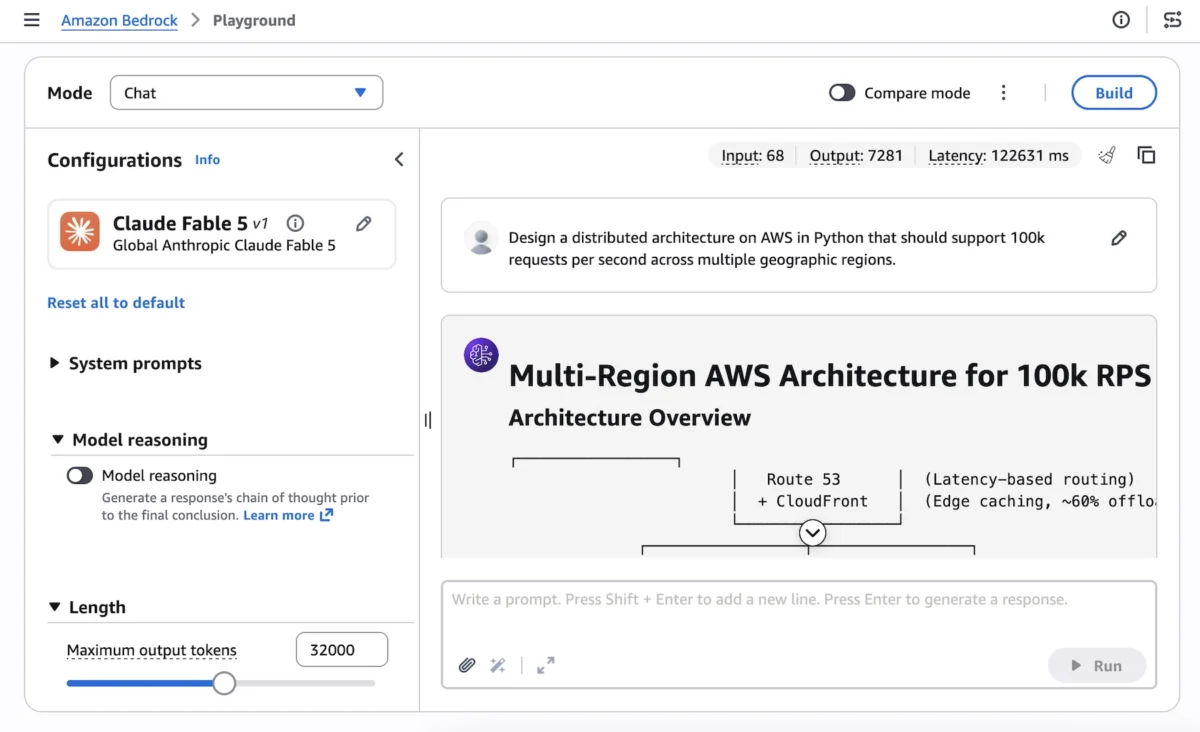

San Francisco, CA & Seattle, WA – June 12, 2026 – In a significant development impacting the burgeoning field of artificial intelligence, Anthropic’s highly anticipated Claude Fable 5 and Claude Mythos 5 large language models (LLMs) have been abruptly made unavailable on Amazon Bedrock and the Claude Platform on AWS. The revocation, announced on June 12, 2026, stems directly from a request by Anthropic to AWS to comply with a US Government export control directive, highlighting the growing intersection of advanced AI technology and national security regulations. While these two advanced models are no longer accessible, other Anthropic offerings, including Opus 4.8, remain fully operational and available to users on Amazon Bedrock.
The announcement sent ripples through the developer community and AI industry, coming swiftly after the initial excitement surrounding the models’ launch. Claude Fable 5, in particular, was touted as a breakthrough, offering "Mythos-level capabilities" to a broader customer base with integrated safeguards designed for responsible deployment. Its sibling, Claude Mythos 5, was intended for a select group of vetted customers due to its unrestricted capabilities. The sudden withdrawal underscores the complex and rapidly evolving regulatory landscape that governs cutting-edge AI, especially as these technologies gain strategic importance globally.
A Swift Reversal: The Chronology of Events
The journey of Claude Fable 5 and Mythos 5 on AWS platforms was remarkably brief. The initial announcement of their availability on Amazon Bedrock and the Claude Platform on AWS was met with considerable anticipation from enterprises and developers eager to leverage their advanced capabilities.
- Early June 2026 (Implicit): Anthropic and AWS prepare for the launch of Claude Fable 5 and Mythos 5, with technical documentation and console updates being rolled out.
- June 9, 2026: Minor updates to the console screenshot, model IDs, and data retention parameters were noted, indicating the models were actively being integrated and refined for user access. This suggested a live or imminent deployment.
- June 10, 2026: Further updates detailed methods for configuring data retention settings using AWS SigV4 and AWS CLI, confirming active deployment and user interaction with the models’ access protocols.
- June 12, 2026: The pivotal announcement: Anthropic requested AWS to revoke access to Claude Fable 5 and Claude Mythos 5 for all users. The explicit reason cited was to "support compliance with the US Government export control directive." Anthropic also released a public statement on their website, providing further context for the decision.
This rapid sequence of events, from launch readiness to complete withdrawal within days, illustrates the immediate and forceful impact of government directives on even the most advanced technological partnerships.
Unveiling Claude Fable 5: A Glimpse at "Mythos-Level Capabilities"
Before their removal, Claude Fable 5 was positioned as a significant leap forward in AI capabilities, bridging the gap between highly restricted, cutting-edge models and broader enterprise use. Anthropic highlighted its state-of-the-art performance across various benchmarks, particularly in complex domains such as software engineering, intricate knowledge work tasks, and advanced vision applications. The model was specifically engineered for "ambitious, long running work," suggesting its potential for multi-step reasoning, extended context understanding, and intricate problem-solving.
A key differentiator for Claude Fable 5 was its integrated safeguard system. These safeguards were designed to mitigate misuse risks by limiting the model’s performance in sensitive areas like cybersecurity, biology, chemistry, and health-related inquiries. In instances where potentially harmful prompts were detected, the system was configured to default to a response from the more established Opus 4.8 model. This layered approach allowed Anthropic to expand access to a powerful model while attempting to manage inherent risks associated with advanced AI.
Claude Mythos 5, on the other hand, represented the unfiltered version of this advanced technology, devoid of the specific safeguards implemented in Fable 5. Its intended availability was strictly limited to a small, pre-vetted group of customers, acknowledging the elevated risks associated with such unrestricted power. The very existence of these two distinct models underscored Anthropic’s strategic attempt to balance innovation with responsible deployment, a balance that ultimately proved susceptible to external regulatory forces.
Amazon Bedrock: The Enterprise Gateway to Generative AI
The integration of Claude Fable 5 on Amazon Bedrock was a testament to AWS’s strategy to democratize access to leading generative AI models for its vast customer base. Amazon Bedrock provides a fully managed service that offers a choice of foundation models (FMs) from leading AI companies, including Anthropic, alongside AWS’s own models, accessible via a single API. This platform allows enterprises to build and scale generative AI applications within their existing AWS environments, leveraging the cloud provider’s robust infrastructure, security, and scalability.
The ability to deploy Claude Fable 5 via Bedrock meant that customers could integrate its advanced capabilities into their applications without managing the underlying infrastructure, focusing instead on prompt engineering and application logic. The alternative, the Claude Platform on AWS, offered Anthropic’s native platform experience, providing another avenue for customers who preferred a more direct interaction with Anthropic’s ecosystem, albeit hosted on AWS infrastructure. The dual availability underscored the strategic partnership between Anthropic and AWS in making cutting-edge AI accessible to enterprises.
The Compliance Imperative: US Government Export Control Directive
The core reason for the abrupt withdrawal of Claude Fable 5 and Mythos 5 lies in the enforcement of a US Government export control directive. While the specific details of the directive were not fully disclosed in the public announcement, such controls are typically implemented to prevent sensitive technologies from falling into the wrong hands, particularly those that could be used for military applications, human rights abuses, or to undermine national security interests.
The rapid advancements in AI, especially in large language models, have brought them increasingly under the scrutiny of governments worldwide. The ability of these models to generate sophisticated code, synthesize complex information, or even assist in the development of advanced materials or biological agents, raises significant national security concerns. The US Department of Commerce, through its Bureau of Industry and Security (BIS), is a primary agency responsible for administering export controls, often targeting "dual-use" technologies—those with both civilian and military applications.
This incident highlights a critical challenge for global AI development and deployment. As AI models become more powerful and capable, their potential for misuse also grows, leading governments to assert greater control over their distribution and access. For companies like Anthropic, operating at the forefront of AI innovation, navigating these complex geopolitical and regulatory landscapes becomes an integral, albeit often disruptive, part of their business model. The decision to revoke access, even to a widely anticipated product, demonstrates a strong commitment to compliance and risk mitigation in a highly sensitive domain.
Impact on Developers and the AI Industry

The revocation of Claude Fable 5 and Mythos 5 undoubtedly creates an immediate challenge for developers and organizations that had planned to integrate these models into their applications. While Anthropic and AWS assured users that other models, like Opus 4.8, remain available, the sudden change necessitates adjustments to development roadmaps and potentially re-evaluation of project strategies. For those who had already begun testing or building with Fable 5, this means a pivot to alternative models or a delay in their projects.
However, the broader implications extend beyond immediate inconvenience. This event serves as a stark reminder to the entire AI industry about the increasing scrutiny and regulatory oversight facing advanced models. It signals that the deployment of cutting-edge AI is not merely a technical challenge but also a geopolitical one, requiring companies to factor in international relations, national security concerns, and export control regulations from the very outset of development and commercialization.
Industry analysts suggest that such interventions could lead to several outcomes:
- Increased focus on "AI alignment" and safety: Companies may double down on developing robust safety features and ethical guidelines, not just for responsible use but also to preempt regulatory concerns.
- Regionalization of AI development: Stricter export controls could accelerate the development of region-specific AI models and platforms, as different nations seek to develop sovereign AI capabilities that are not subject to foreign regulations.
- Heightened due diligence: Developers and platform providers will likely implement more rigorous vetting processes for customers, especially those accessing the most powerful AI models, to ensure compliance with export laws.
- Accelerated policy discussions: The incident is likely to fuel further discussions among policymakers globally about the governance of advanced AI, potentially leading to new legislation or international frameworks.
Continuity and Alternatives for AWS Users
Despite the withdrawal of Fable 5 and Mythos 5, AWS and Anthropic have emphasized the continued availability of other robust models. Anthropic’s Opus 4.8, a highly capable model itself, remains accessible through Amazon Bedrock. This ensures that customers can continue to leverage Anthropic’s advanced capabilities for a wide array of generative AI tasks.
For developers seeking to continue their work on Amazon Bedrock, the platform still offers a diverse portfolio of foundation models from various providers, allowing flexibility in model selection. The technical guidance for accessing and using models on Bedrock, including the Anthropic Messages API, Invoke API, and Converse API, remains relevant for the available models. Similarly, the specific data retention settings required for certain models, which mandate sharing inference data with model providers for abuse detection and compliance, continue to be an important aspect of model access on Bedrock. This mechanism, requiring an opt-in to provider_data_share mode, ensures transparency and accountability in the use of powerful AI.
Looking Ahead: The Evolving Landscape of AI Governance
The revocation of Claude Fable 5 and Mythos 5 from Amazon Bedrock is a landmark event in the ongoing narrative of artificial intelligence. It underscores that the race for AI supremacy is not solely about technological innovation but also about responsible deployment, ethical considerations, and geopolitical realities. As AI models become increasingly sophisticated, their governance will inevitably become more complex, involving a delicate balance between fostering innovation and safeguarding against potential misuse.
For Anthropic, this decision reflects a commitment to comply with governmental directives, even at the cost of immediate market availability for its most advanced products. For AWS, it highlights the operational complexities of hosting and distributing AI models developed by third parties, necessitating adherence to external regulatory mandates. As the global AI ecosystem matures, such instances will likely become more common, compelling developers, providers, and policymakers to collaboratively forge frameworks that enable progress while ensuring security and societal well-being. The future of AI will undoubtedly be shaped as much by lines of code as by lines of policy and regulation.
