

A celestial spectacle of rare magnitude is set to grace the skies of northern Spain on August 12, 2026, as a total solar eclipse casts its shadow across the Iberian Peninsula. While the opportunity to witness such an event might seem unique, given the global nature of eclipses, this particular alignment marks a historic occasion for Spain, offering prime viewing conditions for many residents and visitors. Unlike partial eclipses, which are more common, a total solar eclipse transforms daylight into a twilight glow, revealing the sun’s ethereal corona – a sight that truly stands among the most breathtaking astronomical phenomena. However, securing an unobstructed view of this monumental event requires meticulous planning, as even a seemingly minor topographical feature like a distant mountain or a nearby building can obscure crucial moments of totality.
The Rarity and Grandeur of a Total Solar Eclipse
A total solar eclipse occurs when the Moon passes directly between the Sun and Earth, completely blocking the Sun’s face. This perfect alignment, where the Moon’s apparent size in the sky matches the Sun’s, is a cosmic coincidence unique to our planet, thanks to the specific distances and sizes of these celestial bodies. During totality, which can last from a few seconds to several minutes, the sky darkens dramatically, stars and planets become visible, and the Sun’s magnificent corona – its outer atmosphere – shimmers into view. This pearly white halo is normally hidden by the Sun’s intense brightness, making its brief appearance during an eclipse an unparalleled scientific and aesthetic marvel.
For any given location on Earth, a total solar eclipse is an exceptionally rare event. The path of totality, the narrow corridor across the Earth’s surface where the Moon’s darkest shadow falls, is typically only about 100 to 150 kilometers wide. Outside this path, observers will only see a partial eclipse, which, while interesting, lacks the profound impact of totality. The average recurrence for a total solar eclipse at any specific point on Earth is approximately once every 375 years, underscoring the significance of the upcoming 2026 event for Spain. The last total solar eclipse visible from the Iberian Peninsula occurred on August 30, 1905, making the 2026 eclipse a generational event for many Spaniards and a magnet for "umbraphiles" – dedicated eclipse chasers – from around the globe.
Spain’s Prime Viewing Zones for August 2026
The path of totality for the August 12, 2026, eclipse will sweep across a significant portion of northern Spain, offering an unparalleled viewing experience for millions. The eclipse will make landfall on the northwestern coast of Galicia, near the city of A Coruña, in the late afternoon. From there, the narrow band of totality will traverse eastward, passing over key regions including Asturias, Cantabria, the Basque Country, and parts of Castilla y León, La Rioja, Aragón, and Catalonia. Major cities such as Oviedo, Gijón, Santander, Bilbao, Burgos, Logroño, Zaragoza, and Palma de Mallorca (in the Balearic Islands) are either directly within or very close to the path of totality, promising spectacular views for their inhabitants and visitors.
The precise timing and duration of totality will vary depending on the exact location within the path. For instance, areas closer to the centerline of the path will experience a longer period of darkness, potentially exceeding two minutes. As the eclipse progresses across the country, the Sun will be lower in the sky, adding a dramatic horizon effect, particularly for those on the eastern coast and the Balearic Islands where the eclipse will occur just before sunset. This low-angle phenomenon could create stunning visual effects, but also amplifies the challenge of finding an unobstructed view, as low-lying obstacles become more significant.
For regions outside the path of totality, including central and southern Spain, Portugal, and parts of Western Europe, a significant partial solar eclipse will be visible. While not as dramatic as totality, a deep partial eclipse still offers a captivating astronomical display, provided proper eye protection is used.
The Crucial Role of Unobstructed Views: A Potential Pitfall
The anticipation surrounding the 2026 eclipse has already begun to build, with many individuals and groups planning trips and securing accommodations in the path of totality. However, merely being within the designated viewing zone is not a guarantee of a perfect experience. The precise alignment of the Sun, Moon, and Earth means the eclipse will occur at a specific altitude and azimuth in the sky, which varies by location and time. This critical detail is often overlooked until the last moment, leading to potential disappointment.
Imagine traveling hundreds of kilometers, booking expensive lodging, and dedicating precious vacation days, only to find that a mountain range, a tall building, or even a strategically placed tree blocks your view of the celestial alignment. This scenario is a real possibility, especially with the Sun being lower in the sky during the late afternoon eclipse across Spain. The difference between a breathtaking spectacle and a frustrating obstruction can be a matter of mere meters in your viewing position. Therefore, understanding the exact trajectory of the eclipse relative to your chosen observation point is paramount. Traditional maps or general location information are simply not sufficient for this level of precision.
"Eclipse 26": A Technological Breakthrough for Eclipse Planning
Recognizing this critical need for precise planning, an innovative mobile application named "Eclipse 26" has emerged as an indispensable tool for prospective eclipse watchers. Developed by Juan Carbajo Hijarrubia, this app seamlessly integrates advanced astronomical data with the detailed geographical insights of Google Maps and Google Street View. The result is a powerful visualization tool that allows users to virtually scout any location and determine with high accuracy how the eclipse will appear from that specific spot.
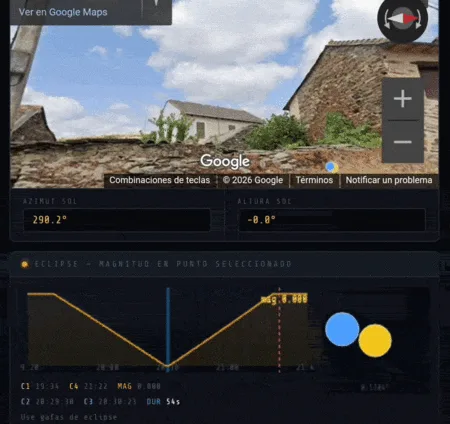
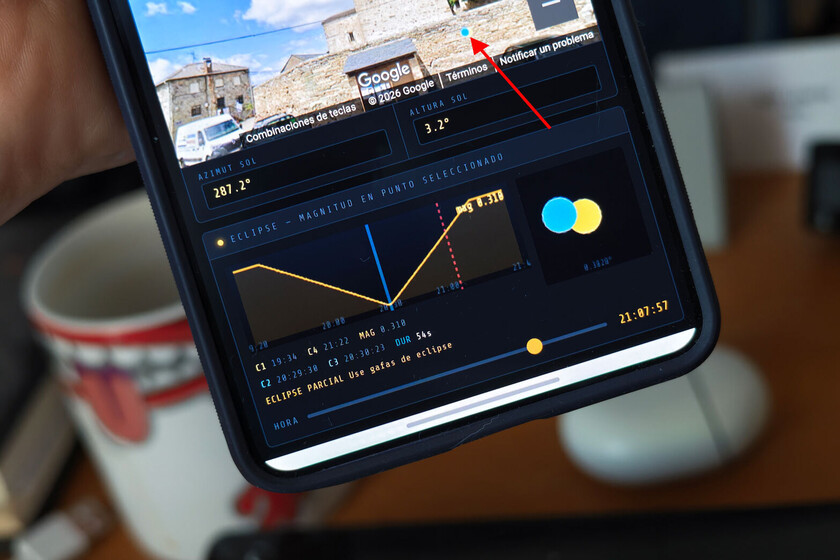
The core functionality of "Eclipse 26" lies in its ability to superimpose the projected paths of the Sun and Moon onto a real-world panoramic view provided by Google Street View. Users can select any point on the map within the eclipse path, and the app will then render a precise simulation, showing the exact altitude and azimuth where the eclipse will occur. More importantly, it highlights any potential obstructions in the foreground – be it a distant peak, a city skyscraper, or a prominent landmark – that could impede the view during totality. If the app indicates an obstacle, users can adjust their planned viewing location virtually, saving them from a potentially disappointing real-world experience.
How "Eclipse 26" Empowers Eclipse Chasers
The user interface of "Eclipse 26" is designed for intuitive use. After downloading the app, users can navigate a map to their intended viewing location. While it doesn’t automatically detect the user’s current location (a deliberate choice to enhance privacy), it allows for precise manual selection. Once a point is chosen, the app displays a Street View panel, overlaid with animated lines representing the celestial paths. By dragging a timeline slider, users can simulate the eclipse progression, observing where the Sun and Moon will align in the sky relative to the surrounding landscape captured by Street View. This interactive feature allows for a dynamic assessment of visibility.
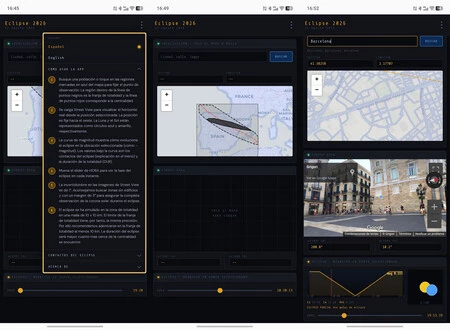
One of the app’s key advantages is its ability to provide a "virtual reconnaissance" of a potential viewing site. Instead of relying on guesswork or making a physical trip to scout locations months in advance, users can leverage the vast photographic database of Google Street View. This is particularly beneficial for those traveling from afar or planning to observe from unfamiliar terrain. The app effectively translates complex astronomical calculations into an easily digestible visual format, making advanced eclipse planning accessible to the general public.
Limitations and Practical Considerations
While "Eclipse 26" offers an unparalleled level of detail for eclipse planning, it does have a notable limitation directly tied to its reliance on Google Street View data. The app performs optimally in urban and semi-urban areas where Google’s vehicles have extensively mapped streets and landscapes. Consequently, its utility diminishes in remote or sparsely populated regions that lack Street View coverage. For those planning to observe the eclipse from truly wild or unmapped natural areas, the app’s ability to show ground-level obstructions might be limited, requiring alternative methods of reconnaissance.
Despite this, for the vast majority of planned viewing locations in Spain’s path of totality – which includes numerous towns, cities, and accessible rural roads – "Eclipse 26" remains an invaluable resource. Its commitment to user privacy, notably by not tracking location or requiring user registration, adds another layer of appeal. The app is available for Android devices at a modest cost of 2.49 euros, a small investment considering the potential for a once-in-a-lifetime experience. This one-time purchase supports its development and ensures an ad-free experience, focused solely on its core functionality.
Beyond Viewing: Essential Safety Precautions and Scientific Significance
While securing a perfect viewing spot is crucial, it pales in comparison to the absolute necessity of safe viewing practices. Directly observing the Sun, even during a partial eclipse, without proper eye protection can cause severe and irreversible eye damage, including permanent blindness. Regular sunglasses, no matter how dark, are not safe for direct solar viewing. Only certified eclipse glasses or viewers that meet the ISO 12312-2 international safety standard should be used. These specialized filters block over 99.999% of sunlight, including harmful ultraviolet and infrared radiation.
During the brief period of totality, when the Sun’s disk is completely covered by the Moon, it is safe to remove eye protection and look directly at the majestic corona. However, observers must be absolutely certain that totality has begun and replace their filters immediately at the first sign of the Sun’s re-emergence. For those wishing to photograph the eclipse with smartphones or cameras, specialized solar filters are also required for the devices to prevent damage to the camera sensor and to capture clear images of the partially eclipsed Sun. Without such filters, attempting to photograph the Sun directly can damage the phone’s camera and still pose a risk if one attempts to view through the screen without proper precautions.
From a scientific perspective, total solar eclipses offer unique opportunities for research. The fleeting moments of totality allow astronomers to study the Sun’s corona, which is otherwise obscured by the Sun’s brilliance. Data collected during eclipses can help scientists understand solar flares, coronal mass ejections, and the mechanisms that heat the corona to millions of degrees, phenomena that directly impact space weather and can affect Earth’s technology and power grids. The 2026 eclipse will provide a valuable window for such observations, potentially involving ground-based telescopes and even research aircraft.
Economic and Societal Impact
The August 2026 total solar eclipse is expected to generate significant economic activity in the regions along the path of totality. Hotels, restaurants, local transportation, and tourism-related businesses in Galicia, Asturias, Cantabria, and the other affected areas are bracing for a substantial influx of visitors. "Eclipse tourism" is a well-established phenomenon, with thousands of enthusiasts traveling across continents to witness these events. Local governments and tourism boards have an opportunity to prepare for and capitalize on this surge, promoting local culture, cuisine, and attractions alongside the astronomical event. Planning for increased traffic, public safety, and infrastructure demands will be essential to ensure a positive experience for both residents and visitors.
Beyond the economic boost, the eclipse serves as a powerful public engagement tool for science education. Schools, planetariums, and amateur astronomy clubs will undoubtedly organize viewing events and educational programs leading up to August 2026, fostering a renewed interest in astronomy and STEM fields among people of all ages. The collective experience of witnessing a total solar eclipse can be profoundly moving and inspire a deeper appreciation for the cosmos.
The Eclipse Continuum: Beyond 2026
While the 2026 eclipse is a highlight, Spain is remarkably fortunate to be in the path of totality for another significant solar eclipse just a year later. On August 2, 2027, another total solar eclipse will sweep across the southern tip of Spain, including parts of Andalusia, and North Africa. This proximity of two total solar eclipses within such a short timeframe is exceptionally rare for any single country and further cements Spain’s status as a prime destination for eclipse chasers in the coming years. Following these, a partial solar eclipse will also be visible from Spain on January 26, 2028.
These successive celestial events highlight the dynamic and ever-changing nature of our solar system and provide ongoing opportunities for scientific discovery and public wonder. The meticulous preparation facilitated by tools like "Eclipse 26" ensures that as many people as possible can safely and fully experience these magnificent astronomical shows, transforming potential disappointment into unforgettable memories. The countdown to August 12, 2026, has truly begun, and with the right tools and knowledge, an unparalleled cosmic experience awaits.
