

Amazon Web Services (AWS) today announced the preview availability of new release management capabilities within its AWS DevOps Agent, marking a significant advancement in how software development teams manage the increasing velocity and complexity of code, particularly in the era of artificial intelligence (AI)-generated programming. These new features, encompassing release readiness review and autonomous release testing, are designed to serve as an "always-available teammate," seamlessly integrating across AWS, multicloud, and on-premises environments to streamline the software delivery lifecycle from code creation through to production deployment. This strategic enhancement aims to address critical bottlenecks in traditional DevOps pipelines, ensuring that the accelerated pace of AI-driven development does not compromise quality, security, or compliance.
The Evolving Landscape of Software Development and AI’s Impact
The past few years have witnessed a profound transformation in software development practices, largely driven by the proliferation of AI-powered coding tools. Tools like GitHub Copilot, Amazon CodeWhisperer, and others have empowered developers to generate code snippets, complete functions, and even entire modules at an unprecedented speed. Industry reports suggest that the adoption of these AI assistants has led to a significant surge in code generation velocity, with some development teams experiencing a 30-50% increase in the volume of pull requests (PRs) entering their delivery pipelines. While this innovation promises enhanced productivity and faster feature delivery, it has simultaneously introduced new challenges for traditional human-centric review and testing processes.
This unprecedented pace, while boosting initial coding speed, has strained the capacity of manual code reviews and static test suites. Development teams often find themselves under immense pressure to keep up with the volume, leading to rushed reviews where critical issues might be overlooked, or test environments that drift from production realities, failing to catch real-world regressions. A recent survey indicated that over 40% of developers feel pressured to approve pull requests without thorough examination due to time constraints, directly contributing to technical debt and potential security vulnerabilities. The value generated by AI coding agents often sits in review queues, delaying its impact on end-users and diminishing the intended efficiency gains. Furthermore, as AI models become increasingly sophisticated, they demonstrate a growing capability to identify functional and security issues that might elude human reviewers under tight deadlines, making speedy and safe delivery a paramount requirement rather than a trade-off. The financial impact of undetected bugs or security vulnerabilities released into production can be substantial, with estimates placing the cost of a post-release fix significantly higher than one caught earlier in the development cycle.
AWS DevOps Agent: An Overview and Its Evolution
The AWS DevOps Agent, previously generally available for post-deployment operations, has already established itself as a critical tool for maintaining operational excellence. Its existing capabilities include autonomously investigating incidents, providing root cause analysis, suggesting mitigation steps, and delivering targeted recommendations to prevent recurring issues in live production environments. This foundational understanding of an environment, its services, their dependencies, and their behavior in production forms the bedrock upon which the new release management capabilities are built. The agent’s deep contextual awareness allows it to act as an intelligent, proactive partner throughout the software lifecycle.
The introduction of release readiness review and autonomous release testing extends the AWS DevOps Agent’s purview upstream, effectively making it a comprehensive teammate that spans the entire software change and operations spectrum. This strategic expansion underscores AWS’s commitment to fostering a more autonomous, efficient, and secure DevOps practice, directly addressing the modern challenges posed by AI-augmented development.
Deep Dive into Release Readiness Review
The release readiness review feature represents a significant leap forward in automated code governance. It meticulously evaluates every code change against a comprehensive set of criteria, including production requirements, dependency safety, and the specific standards and best practices provided by the user to the DevOps Agent. This goes beyond superficial syntax checks, delving into the architectural and operational implications of each modification.

Specifically, the agent performs several critical checks:
- Cross-repository dependency risks: It identifies potential issues that a change in one repository might introduce into other dependent services, offering a holistic view often missed in siloed reviews.
- Access control changes: These are rigorously checked against the guidelines of the AWS Well-Architected Framework, ensuring security and operational excellence.
- Compliance with defined standards: Users can input their internal standards in natural language (plain English), allowing the agent to verify adherence to organizational policies for infrastructure, data encryption, network access, logging, observability, and sensitive data classification. When no specific standards are provided, the agent intelligently applies general best practices to maintain a baseline level of quality and security.
A crucial aspect of this review process is the pre-pipeline verification. As part of its assessment, the agent runs the software in an AWS-managed isolated environment. In this sandbox, it executes lightweight user journey tests to confirm that the software builds correctly, runs as expected, and passes basic functional checks before the change even enters the main delivery pipeline. This early detection mechanism is invaluable for preventing trivial but time-consuming issues from progressing further down the pipeline, saving developer time and computational resources.
The findings from these reviews are presented intuitively. They appear directly in the AWS DevOps Agent console and are also integrated as comments on pull requests in popular version control systems like GitHub or GitLab. For even earlier feedback, developers can invoke reviews directly from their Integrated Development Environments (IDEs) through plugins like Kiro power or Claude Code. This enables developers to identify and rectify dependency risks, standards violations, and access control issues proactively, often before the code is even committed to version control, significantly shortening the feedback loop and improving code quality at its source.
Autonomous Release Testing: Beyond Static Test Suites
Complementing the release readiness review, the autonomous release testing feature pushes the boundaries of automated quality assurance. Unlike traditional methods that rely on static, pre-defined test suites, this feature leverages AI to generate and execute change-specific test plans for web and API-based applications. This intelligent approach means the agent doesn’t just run every test in the book; it reasons about what a particular code change does and constructs a tailored set of tests designed to specifically validate that change.
These bespoke tests are executed in customer-provisioned, production-like environments before the code change is merged. The agent’s sophisticated reasoning capabilities allow it to cover a wide spectrum of testing needs, including:
- Functional correctness: Verifying that the intended new functionality works as designed.
- Behavioral regressions: Ensuring that existing functionalities are not inadvertently broken by the new change.
- Integration scenarios: Anticipating and testing how the change interacts with other parts of the system, including external services and dependencies, which a manually maintained test plan might easily miss.
Every autonomous test run produces structured artifacts, offering comprehensive transparency and auditability. These artifacts include detailed metrics, logs, traces, and an execution summary. This consistent record provides reviewers with a clear, objective account of what was tested, how it performed, and what the results were, fostering greater confidence in the release process. This proactive, intelligent testing paradigm significantly enhances the reliability of releases, reducing the likelihood of production incidents and accelerating the path to deployment.
Operationalizing the New Capabilities: A Practical Guide
Getting started with AWS DevOps Agent’s new release management features is designed to be straightforward. Users first need to ensure at least one GitHub or GitLab repository is connected to their Agent Space. This initial connection allows AWS DevOps Agent to index the codebase and build a comprehensive knowledge graph of cross-repository and cloud dependencies, providing the essential context for intelligent analysis.
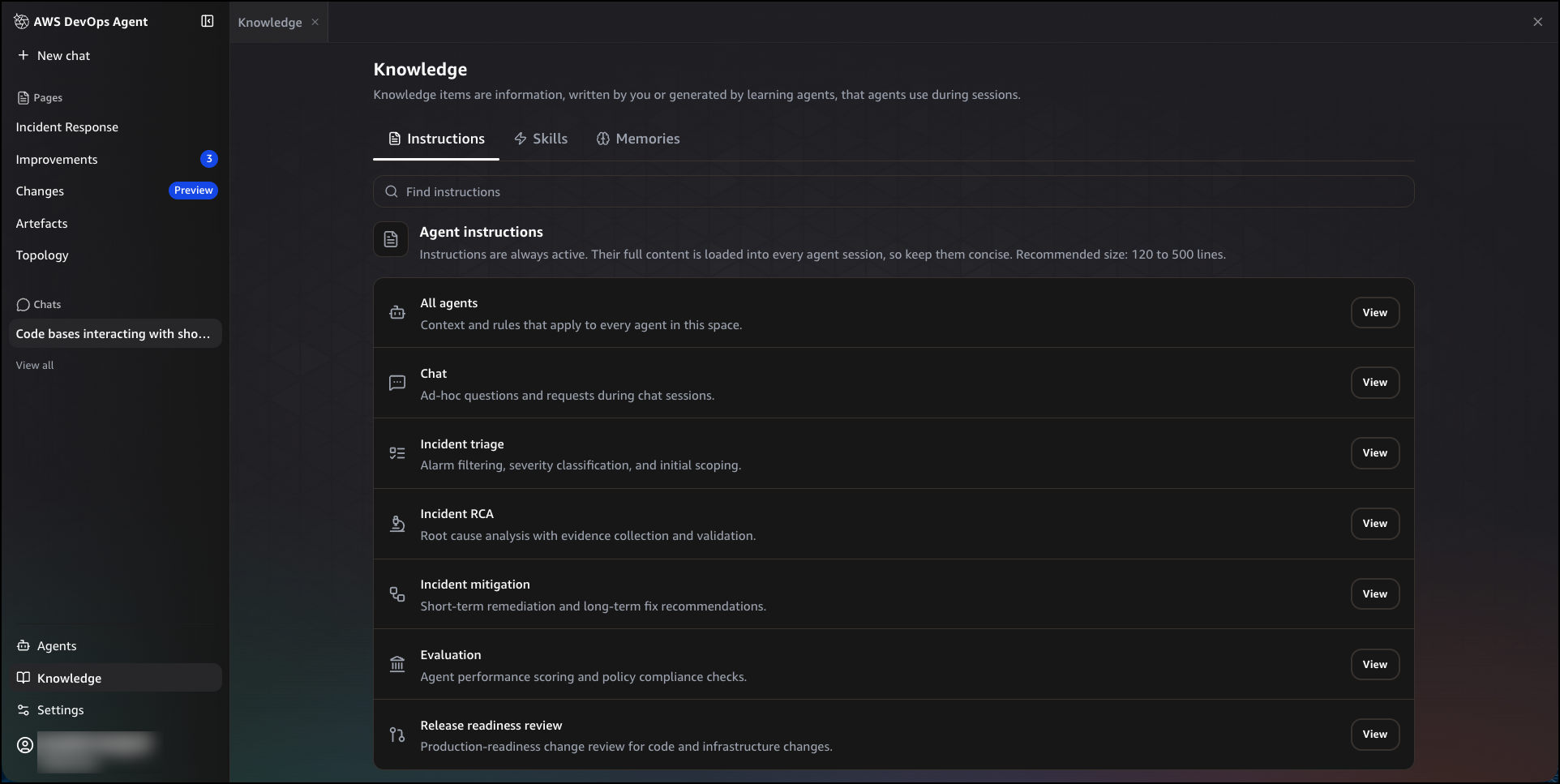
Accessing the features is done through the AWS DevOps Agent console, where users select their Agent Space and navigate to the "Web app" tab, then choose "Operator access." To tailor reviews to specific organizational requirements, users can navigate to "Knowledge" and then the "Instructions" tab. Here, instruction sets can be configured for specific agents or tasks. By choosing "View" next to "Release readiness review," users can define their internal standards in plain English, covering aspects like infrastructure, data encryption, network access rules, logging, observability requirements, and sensitive data classification. These natural language instructions enable the agent to apply context-aware governance.
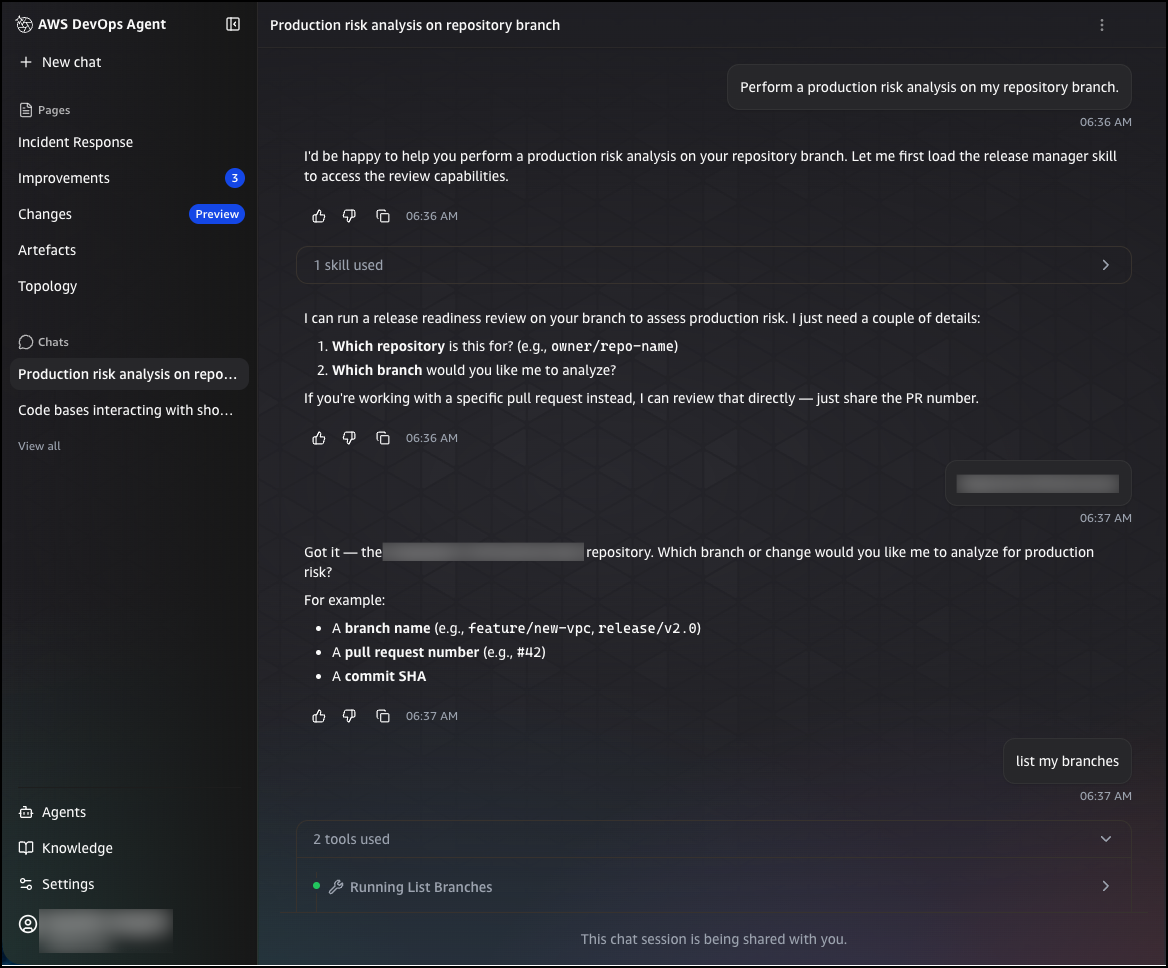
Release readiness reviews can be triggered in two primary ways: by submitting a pull request to a connected repository, which automatically initiates a review, or by entering an on-demand query in the chat interface. For instance, a user can type, "Perform a production risk analysis on my repository branch." The agent will then prompt for the specific repository and branch, pull request number, or commit SHA, queueing the review to analyze the change for infrastructure impacts, configuration changes, and potential issues.
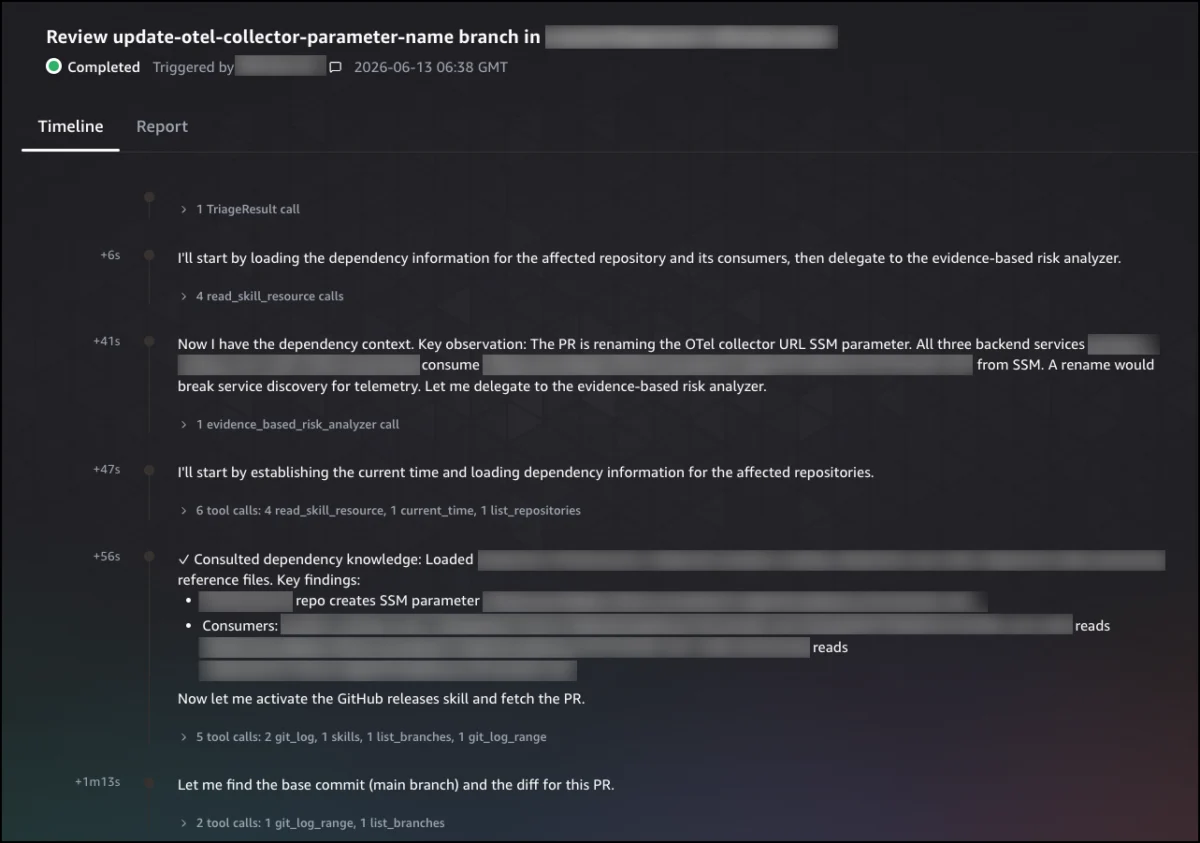
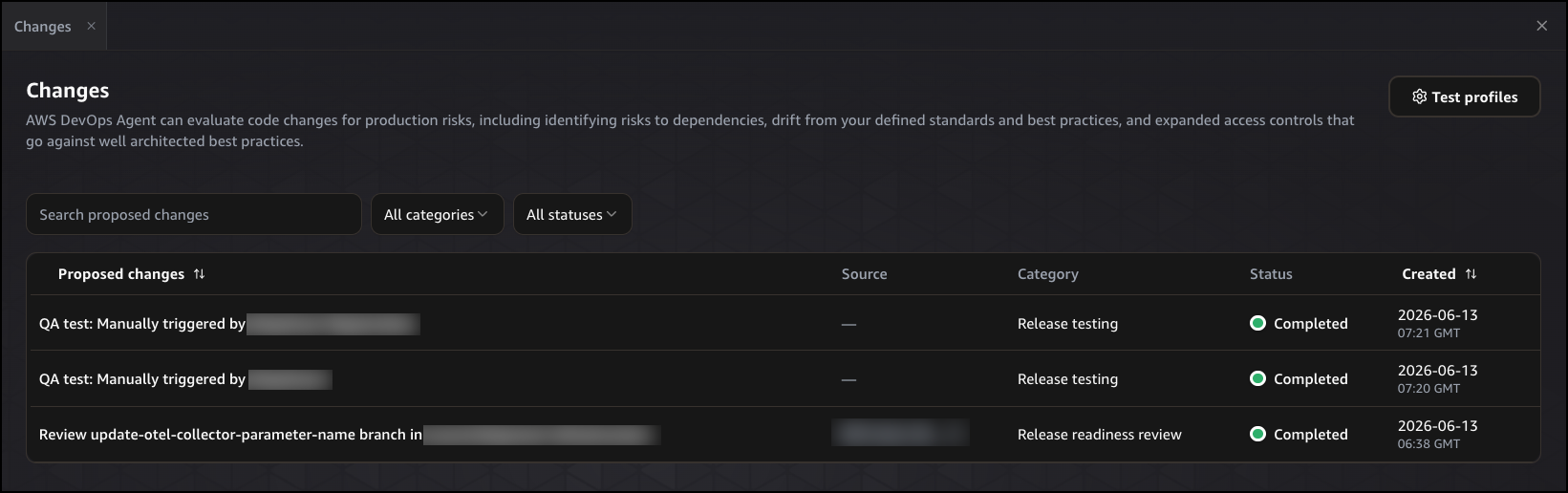
Upon completion, findings are accessible in the "Changes" section of the left navigation pane within the AWS DevOps Agent console. The "Proposed changes" table provides an overview of each review, detailing the change description, source, category, status, and creation time. Users can filter or search to locate specific reviews. Choosing an entry reveals the full execution detail. The "Timeline" tab offers a granular view of the agent’s step-by-step reasoning process, including the tools invoked, dependencies consulted, and observations made, complete with timestamps.
The "Report" tab presents the final recommendation, categorized as BLOCK, Proceed with Caution, or Safe to Release. This summary header also includes the number of critical issues, commit revision, and file changes. The "Analysis" section explains the recommendation with evidence, while the "Issues" section prioritizes findings by severity. The "Recommendations" section provides actionable steps for developers, and the "Changes" section lists modified files with their type, category, and description, giving reviewers a complete context.
Autonomous release testing can also be initiated from the chat interface. A query like "Run a release test on my application deployed at [application URL]" prompts the agent to generate and execute a change-specific test plan in the provisioned environment, with results viewable in the "Changes" section.
The Strategic Imperative: Speed, Quality, and Security in the AI Era
The introduction of these advanced release management capabilities within AWS DevOps Agent marks a pivotal moment for software development. It directly addresses the growing tension between the imperative for speed in modern development and the non-negotiable requirements for quality and security. By automating critical aspects of code review and testing with intelligent agents, AWS is enabling organizations to confidently embrace AI-generated code without inadvertently introducing new risks or bottlenecks.
An AWS spokesperson underscored the strategic importance of these new capabilities, stating, "As AI transforms the way developers write code, it’s crucial that our tools evolve to ensure that innovation doesn’t come at the expense of quality or security. AWS DevOps Agent is designed to be an intelligent partner, empowering teams to confidently accelerate their delivery pipelines while upholding the highest standards of operational excellence. These new features fundamentally change how teams can manage releases, shifting from reactive problem-solving to proactive prevention."
The implications are far-reaching. Developers can focus more on innovation rather than tedious manual checks, receiving immediate, actionable feedback. Reviewers, often overwhelmed by PR volumes, gain an intelligent assistant that flags critical issues and ensures compliance, allowing them to concentrate on higher-level architectural decisions. For organizations, this translates into faster time-to-market, reduced operational incidents, enhanced compliance with internal and external standards, and ultimately, a more robust and resilient software ecosystem. This move signifies a broader industry shift towards intelligent automation in DevOps, where AI not only helps write code but also helps govern its quality and safety, leading to a more streamlined and secure software delivery pipeline.
Availability and Future Outlook
The release readiness review and autonomous release testing features for AWS DevOps Agent are currently available in preview. During this preview period, these features are offered at no additional cost in the US East (N. Virginia) Region. For detailed pricing information on other AWS DevOps Agent features that are generally available, interested parties are encouraged to visit the official AWS DevOps Agent pricing page. Comprehensive configuration details and getting started guides are available in the AWS DevOps Agent user guide, enabling development teams to explore and integrate these transformative capabilities into their existing workflows today. This preview period will undoubtedly provide valuable feedback for AWS as it continues to refine and expand the capabilities of its intelligent DevOps assistant, paving the way for a more autonomous and secure future in software development.
