

Amazon Web Services (AWS) has announced a groundbreaking new feature for Amazon Elastic Kubernetes Service (Amazon EKS): Kubernetes version rollbacks. This capability allows cluster administrators to revert a Kubernetes version upgrade within seven days if unforeseen issues arise, effectively providing an "undo" button for a process historically fraught with risk and complexity. The introduction of this feature directly addresses a critical pain point in the lifecycle management of Kubernetes clusters, particularly for enterprises and organizations operating in highly regulated environments, promising enhanced operational stability, improved security posture, and significantly reduced upgrade anxieties.
Addressing a Critical Industry Challenge: The Kubernetes Upgrade Dilemma
For years, upgrading a Kubernetes control plane has been a one-way street. The open-source Kubernetes project fundamentally lacks native support for control plane rollbacks, meaning that once an upgrade is initiated and completed, reverting to a previous state was not officially supported. While the Kubernetes community has been making strides, evidenced by initiatives like KEP-4330, which introduces "emulated versions" to facilitate rollback, these efforts often present a transitional or semi-validated state rather than a full return to a previously stable production environment.
This inherent limitation has forced organizations worldwide to develop elaborate, time-consuming, and often costly compensating mechanisms. These include "bake periods" for extensive testing post-upgrade, staggered deployment groups to minimize blast radius, automated sign-off processes involving multiple stakeholders, and ultimately, upgrade cycles that could stretch for months. The challenge is compounded by Kubernetes’ rapid release cadence, with three minor versions typically released per year. For organizations managing hundreds of clusters, especially those with stringent compliance requirements, this often led to a difficult choice: delay upgrades entirely due to the fear of irreversible errors, or invest heavily in complex mitigation strategies. The consequence of delayed upgrades is significant, resulting in clusters running on older versions, missing crucial security patches, and eventually falling out of extended support timelines, exposing them to heightened risks and potential compliance violations.
The absence of a reliable rollback mechanism has been a major contributor to "Kubernetes upgrade paralysis," where the perceived risk of an upgrade outweighs the benefits of newer features or security enhancements. This paralysis can lead to a widening gap between the Kubernetes versions in production and the latest stable releases, creating technical debt and increasing the attack surface. Furthermore, the operational overhead associated with the manual or semi-automated workarounds drains significant engineering resources that could otherwise be directed towards innovation and application development. The new EKS version rollback feature is poised to fundamentally alter this dynamic, providing a robust safety net that was previously unavailable.
Deep Dive into EKS Version Rollbacks: Mechanics and Benefits
The core of the Amazon EKS version rollback feature lies in its ability to restore a cluster to a fully validated previous version that demonstrably ran in production, not merely an emulation. This distinction is crucial, as it provides administrators with genuine confidence that their rolled-back environment is stable and functional. If, for instance, a cluster is upgraded from Kubernetes 1.34 to 1.35, and a compatibility issue with existing applications or add-ons is discovered post-upgrade, EKS allows for a seamless reversion to 1.34 within a seven-day window. This capability eliminates the need for frantic troubleshooting under pressure, complex cluster rebuilds, or lengthy recovery procedures, effectively serving as a critical "undo" button for Kubernetes version changes.
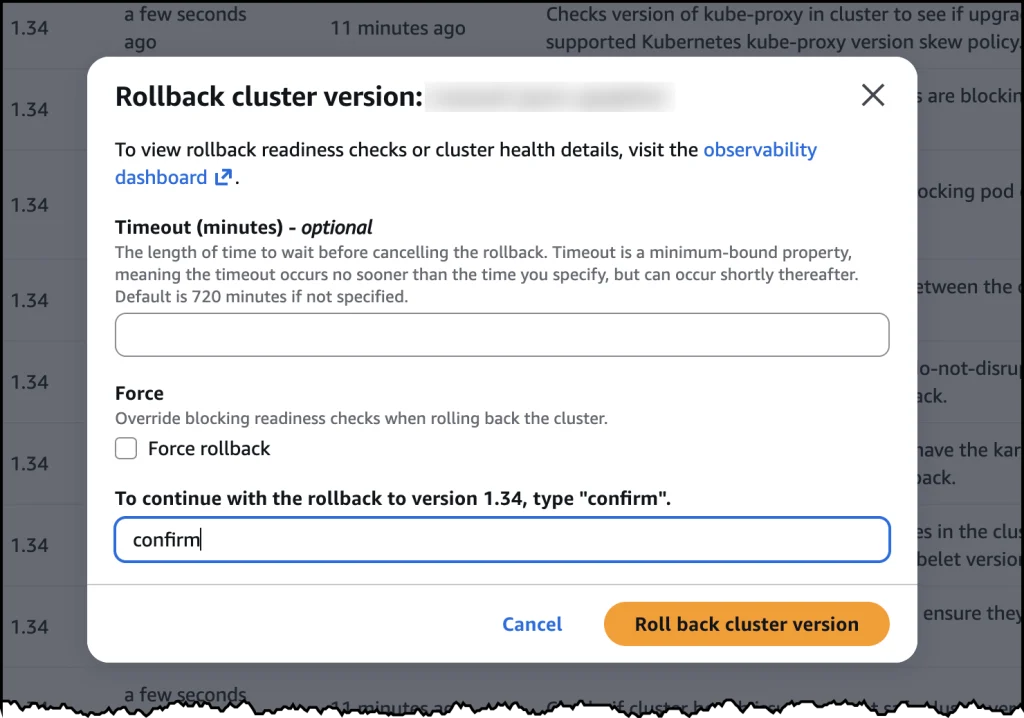
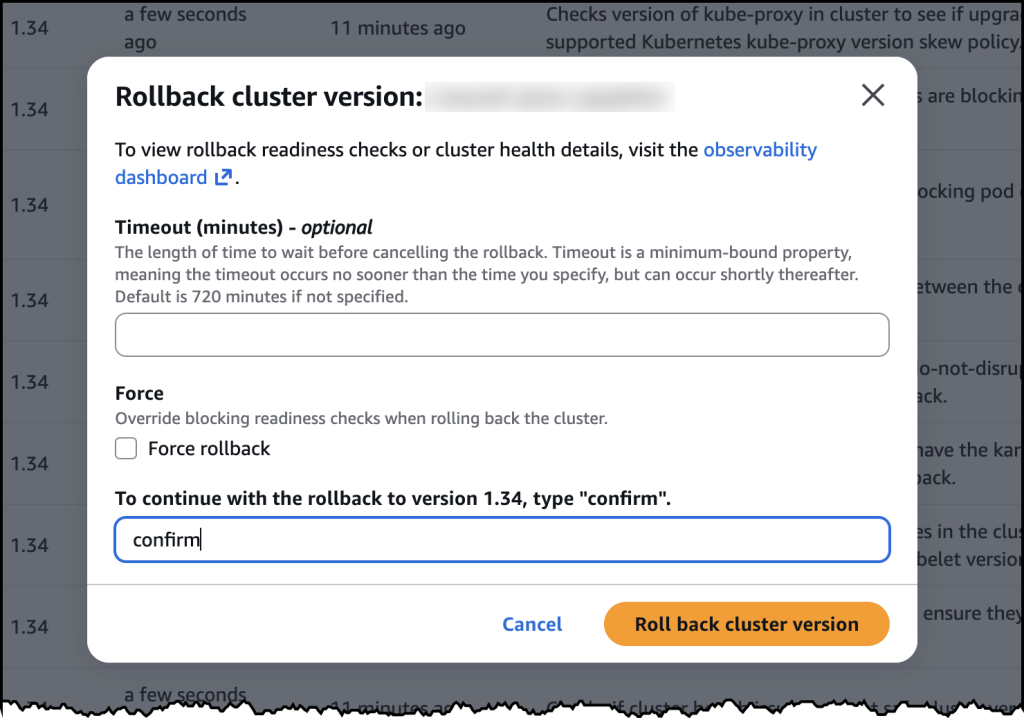
The rollback mechanism is designed to align with EKS’s existing incremental upgrade approach, supporting the reversal of one minor version at a time. This controlled methodology ensures that administrators maintain granular control over their cluster’s state. To further bolster the safety of the rollback process, EKS integrates "cluster insights," an automated evaluation system that assesses the cluster’s readiness for a rollback. This system proactively flags potential issues, such as node version compatibility discrepancies or add-on dependencies, before the rollback is initiated. This pre-emptive analysis empowers administrators to address any potential conflicts, thereby minimizing the likelihood of further complications. For experienced users or in urgent situations where immediate action is paramount, EKS provides a --force flag, allowing administrators to bypass these automated checks and proceed directly with the rollback.
A fundamental design principle of EKS version rollbacks is the prioritization of workload stability. During any rollback operation, EKS strictly adheres to defined Pod Disruption Budgets (PDBs) by default. This ensures that critical applications continue to operate with minimal interruption, preventing service outages during the reversion process. While EKS will not bypass these budgets automatically, administrators retain the flexibility to modify or remove PDBs themselves if they deem it necessary to accelerate the rollback process in specific scenarios. This balanced approach offers both robust default safety and user-configurable control. The control plane rollback capability is universally available for all EKS clusters, regardless of whether customers manage their own worker nodes or utilize AWS-managed node groups. This broad applicability ensures that a vast majority of EKS users can benefit from this crucial safety feature.

Enhanced Capabilities for EKS Auto Mode
For customers who have embraced the fully managed infrastructure benefits of EKS Auto Mode, the version rollback feature extends its capabilities to provide an even more comprehensive solution. EKS Auto Mode simplifies the deployment of production-ready Kubernetes clusters by automating compute, networking, and storage management, allowing developers to concentrate solely on their applications rather than the underlying infrastructure. In this context, version rollbacks in EKS Auto Mode necessitate the simultaneous rollback of both the control plane and the associated managed nodes to ensure a consistent and stable environment.
The process of rolling back nodes, while respecting pod disruption budgets to maintain workload stability, can inherently take time depending on the cluster’s configuration and the number of applications running. Recognizing the need for administrative oversight and control during this phase, AWS has introduced a dedicated cancel API for EKS Auto Mode node rollbacks. This API empowers administrators to stop a node rollback at any point, providing an essential escape hatch. If, for example, an administrator determines that the rollback is taking longer than acceptable, or if a change in strategy is required, they can cancel the ongoing process. This flexibility allows for immediate adjustments to disruption budgets to accelerate the rollback or the exploration of alternative paths forward, ensuring that operational teams retain full command over their cluster’s state during critical operations.
Implications for Enterprise and Regulated Environments
The introduction of Kubernetes version rollbacks for Amazon EKS represents a paradigm shift for enterprise-grade Kubernetes operations. The implications are far-reaching, particularly for organizations grappling with stringent regulatory requirements, such as those in financial services, healthcare, or government sectors.
- Reduced Risk and Enhanced Confidence: The primary benefit is the dramatic reduction in the risk associated with Kubernetes upgrades. The fear of irreversible changes, which has historically led to cautious and often delayed upgrade strategies, is significantly mitigated. This newfound safety net instills greater confidence among cluster administrators and DevOps teams, encouraging more frequent and timely upgrades.
- Improved Security Posture: By lowering the barrier to upgrades, organizations are more likely to adopt the latest Kubernetes minor versions promptly. This ensures that clusters benefit from the newest security patches, vulnerability fixes, and platform enhancements, thereby strengthening the overall security posture and reducing the attack surface. Staying current with Kubernetes versions is a critical component of a robust cybersecurity strategy.
- Operational Efficiency and Cost Savings: The elimination of the need for elaborate compensating mechanisms – such as extended bake periods, manual validation, and complex rollback plans – translates directly into significant operational efficiencies. Engineering teams can redirect time and resources previously spent on mitigating upgrade risks towards innovation and business-critical application development. This reduction in operational overhead also translates into tangible cost savings by minimizing downtime, preventing costly errors, and optimizing resource allocation.
- Compliance and Governance: For regulated industries, maintaining up-to-date software versions is often a compliance mandate. The EKS rollback feature simplifies the process of achieving and demonstrating compliance by making regular upgrades more feasible and less risky. The ability to quickly revert to a known good state provides an additional layer of assurance for auditors and internal governance teams.
- Accelerated Innovation: With a reliable safety net in place, organizations can be more agile in adopting new Kubernetes features and API changes, fostering a culture of continuous improvement and innovation within their containerized environments. This allows them to leverage the latest advancements in Kubernetes ecosystem more quickly, translating into competitive advantages.
Availability and Cost Structure
Kubernetes version rollbacks for Amazon EKS are now available at no additional cost in all commercial AWS Regions where Amazon EKS is offered. Customers will only incur the standard EKS and compute costs they would normally pay for their clusters and worker nodes. There are no separate or extra charges specifically for utilizing the rollback capability, making it an accessible and value-added feature for all EKS users.
The feature supports control plane rollbacks for all EKS clusters and extends to node rollbacks for clusters running EKS Auto Mode. Furthermore, version rollbacks are compatible with EKS clusters running Kubernetes versions that are currently within EKS standard support and extended support timelines, ensuring broad applicability across existing deployments.
A Step-by-Step Experience: A Typical Rollback Scenario
To illustrate the practicality of this new feature, consider a typical scenario where a cluster administrator has recently upgraded an EKS cluster from Kubernetes version 1.34 to 1.35. A few days after the upgrade, an obscure application bug surfaces, which is traced back to an unexpected incompatibility with the new Kubernetes version.
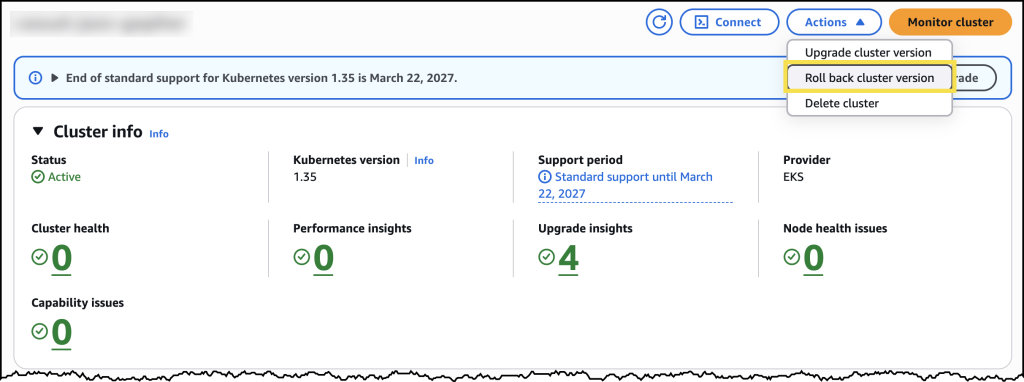
- Initiating Rollback: The administrator navigates to the Amazon EKS console. On the cluster’s configuration page, a new "Version Rollback" option is prominently displayed, along with information detailing the available seven-day rollback window.
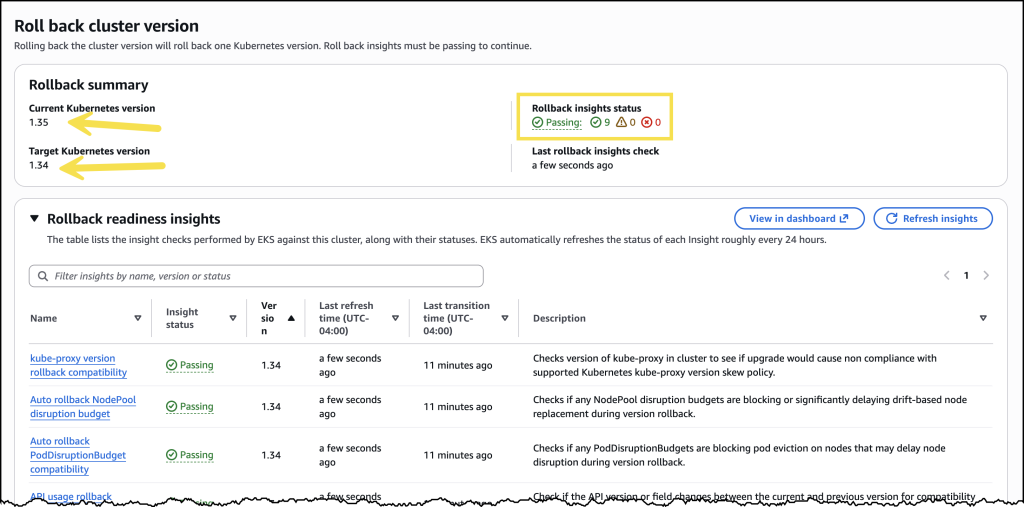
- Reviewing Rollback Insights: Before proceeding, the administrator initiates a review of the "rollback insights." This automated check assesses the cluster’s current state, evaluating factors such as node version compatibility and add-on dependencies. In this hypothetical scenario, the insights might flag an outdated add-on or a specific node group configuration that could be affected, providing actionable information to the administrator.
- Confirmation and Execution: After reviewing the insights and addressing any critical warnings, the administrator confirms the rollback. The process begins, and importantly, the cluster remains fully functional throughout the operation, ensuring minimal disruption to ongoing workloads.
- Monitoring Progress: The control plane rollback, similar to a standard upgrade, typically takes approximately 20 minutes. For EKS Auto Mode clusters, the associated nodes gracefully roll back, adhering strictly to the configured pod disruption budgets. The administrator monitors the progress through the console, observing the various stages of the rollback.
- Return to Previous State: Upon completion, the cluster is successfully reverted to its previous Kubernetes version (1.34 in this example), operating as expected, with all applications restored to their prior compatible state. The administrator can then address the root cause of the compatibility issue at a more measured pace, with the pressure of an active outage alleviated.
This streamlined process dramatically reduces the stress and potential financial impact of post-upgrade issues, transforming what was once a high-stakes operation into a manageable and reversible procedure.
Broader Market Context and AWS’s Strategic Play
The introduction of Kubernetes version rollbacks for Amazon EKS is a strategic move by AWS that further solidifies its position as a leading provider of managed Kubernetes services. In a competitive landscape that includes Google Kubernetes Engine (GKE) and Azure Kubernetes Service (AKS), differentiated features that enhance reliability, security, and ease of management are crucial. While other platforms offer various upgrade strategies and pre-check mechanisms, a fully supported, one-click rollback to a validated previous production state within a generous time window is a significant differentiator.
This feature underscores AWS’s commitment to providing enterprise-grade solutions that directly address the complex operational realities faced by large organizations. By removing a major impediment to consistent Kubernetes adoption and maintenance, AWS empowers its customers to fully embrace the benefits of containerization without being held back by the inherent complexities of version management. It reflects a deep understanding of customer pain points and a proactive approach to developing solutions that enhance the overall developer and operator experience.
The market for managed Kubernetes continues to expand rapidly, with organizations increasingly relying on these services for their critical applications. Features like version rollback are not merely conveniences; they are essential tools that enable enterprises to scale their Kubernetes deployments with confidence, meet stringent compliance requirements, and maintain a robust security posture in a constantly evolving technological landscape. This release is expected to be met with widespread approval from the EKS community and will likely set a new benchmark for managed Kubernetes service offerings.
Conclusion
Amazon EKS’s new Kubernetes version rollback feature marks a pivotal moment in the evolution of managed container services. By transforming the traditionally high-risk process of Kubernetes upgrades into a reversible operation, AWS has delivered a powerful tool that promises to enhance operational stability, improve security, and significantly reduce the administrative burden on organizations. This capability will enable EKS users to maintain more current, secure, and performant Kubernetes environments with unprecedented confidence, fostering greater agility and innovation across their cloud-native strategies. The "undo" button for Kubernetes upgrades is here, and its impact on the industry is expected to be profound.
