

Amazon Web Services (AWS) today announced the general availability of managed daemon support for Amazon Elastic Container Service (Amazon ECS) Managed Instances, a significant advancement designed to empower platform engineers with unprecedented control and efficiency in managing operational tooling within containerized environments. This new capability extends the existing managed instances experience, initially introduced in September 2025, by decoupling the lifecycle management of essential software agents—such as monitoring, logging, and tracing tools—from application development teams. The enhancement promises improved reliability, consistent deployment of critical daemons, and comprehensive host-level monitoring, addressing a long-standing operational challenge for organizations running containerized workloads at scale.
A New Paradigm for Operational Agent Management
The introduction of managed daemon support marks a pivotal shift in how platform teams interact with their underlying container infrastructure. Historically, the deployment and updates of operational agents were tightly interwoven with application lifecycle management. This often necessitated intricate coordination between platform and application development teams, requiring modifications to application task definitions and subsequent redeployments of entire applications even for minor agent updates. For enterprises managing hundreds or even thousands of microservices, this process translated into a significant operational burden, consuming valuable time and resources while increasing the risk of deployment errors and application downtime.
AWS’s solution directly tackles this complexity by introducing a dedicated "managed daemons" construct within Amazon ECS. This separation of concerns allows platform engineers to independently deploy, update, and manage these critical agents directly onto the infrastructure, ensuring that every container instance consistently runs the required tools without any intervention from application teams. The system guarantees that daemons initiate before application tasks and are the last to drain, thereby ensuring an uninterrupted flow of logging, tracing, and monitoring data, crucial for maintaining visibility and operational integrity.
The Evolution of Container Orchestration and Operational Challenges
Amazon ECS, a fully managed container orchestration service, has been a cornerstone for many organizations adopting containerization on AWS. It simplifies the deployment, management, and scaling of Docker containers, abstracting away much of the underlying infrastructure complexity. However, as organizations mature in their cloud-native journeys, the operational aspects of maintaining a healthy and observable environment become increasingly complex.
The rise of microservices architectures, while offering agility and scalability, also proliferated the need for robust operational tooling. Each service, or even each instance, often requires agents for collecting metrics (e.g., Prometheus Node Exporter, CloudWatch Agent), forwarding logs (e.g., Fluent Bit, Splunk Universal Forwarder), and distributing traces (e.g., OpenTelemetry agents, DataDog Agent). Managing these "sidecar" or "daemon" containers traditionally meant baking them into application task definitions or custom Amazon Machine Images (AMIs), leading to tight coupling and operational bottlenecks.
Prior to this announcement, platform teams faced a dilemma: either tightly couple agents with applications, creating coordination overhead, or manage them through complex, custom scripts and automation outside of ECS, which could lead to inconsistencies and higher maintenance costs. The new managed daemon support directly addresses this by providing a native, integrated solution within ECS, aligning with the broader industry trend towards platform engineering where infrastructure teams aim to provide self-service, opinionated platforms for developers.
Key Features and Architectural Innovations
The managed daemon support for Amazon ECS Managed Instances introduces several key features that enhance its utility and operational benefits:
-
Decoupled Lifecycle Management: Platform teams can now define and manage daemon task definitions independently of application task definitions. This allows for separate update cycles, reducing coordination overhead and accelerating the deployment of security patches or new monitoring capabilities.
-
Centralized Resource Management: CPU and memory parameters for daemons can be configured separately from application configurations. This ensures optimal resource utilization, as each instance runs exactly one copy of a daemon, shared across multiple application tasks. It also eliminates the need to rebuild AMIs or modify application task definitions for agent updates.
-
Targeted Deployment: Platform engineers gain flexibility in deployment strategies, able to deploy managed daemons across multiple capacity providers or target specific ones. This granular control is vital for staged rollouts or for applying agents to specific infrastructure tiers.

-
Guaranteed Startup and Drain Order: Daemons are guaranteed to start before any application tasks on an instance and drain last when an instance is being terminated or updated. This "start before stop" mechanism ensures continuous coverage for monitoring, logging, and tracing, preventing data gaps during instance lifecycle events.
-
Advanced Host-Level Access: The system supports advanced host-level access capabilities crucial for operational tooling. Daemon tasks can be configured as privileged containers, granted additional Linux capabilities, and can mount paths from the underlying host filesystem. These capabilities are indispensable for security agents requiring deep visibility into host-level metrics, processes, and system calls, or for monitoring agents needing access to kernel-level information.
-
daemon_bridgeNetwork Mode: A newdaemon_bridgenetwork mode enables daemons to communicate effectively with application tasks while maintaining isolation from application networking configurations. This ensures that the operational agents operate efficiently without interfering with application-specific network setups. -
Automated Rolling Deployments with Rollbacks: When a daemon is updated, ECS automatically handles the rolling deployment. New instances are provisioned with the updated daemon, which starts first, then application tasks are migrated to these new instances before the old ones are terminated. This automated process, coupled with support for automatic rollbacks, instills confidence in agent updates, minimizing potential disruptions. The pace of this replacement can be controlled through configurable drain percentages, providing full control over addon updates without application downtime.
Implementation and User Experience
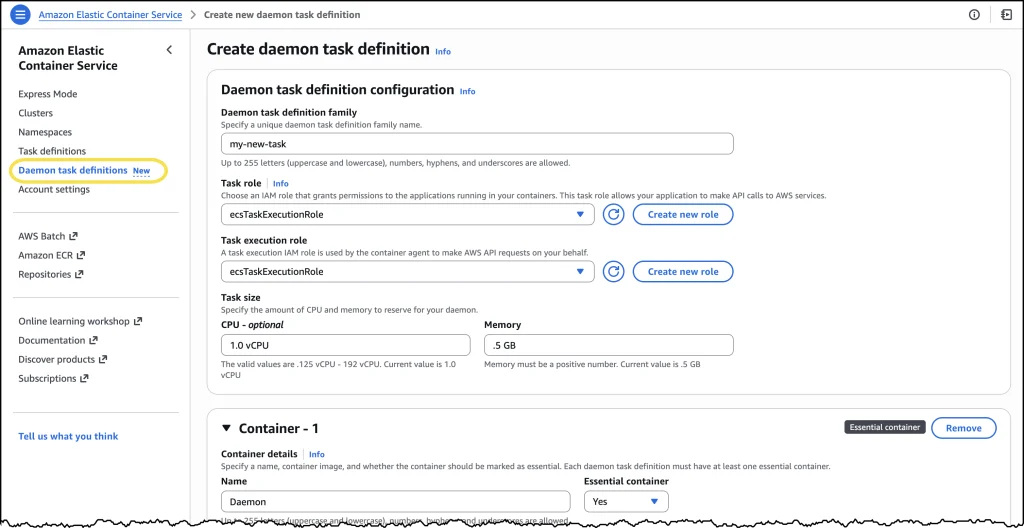
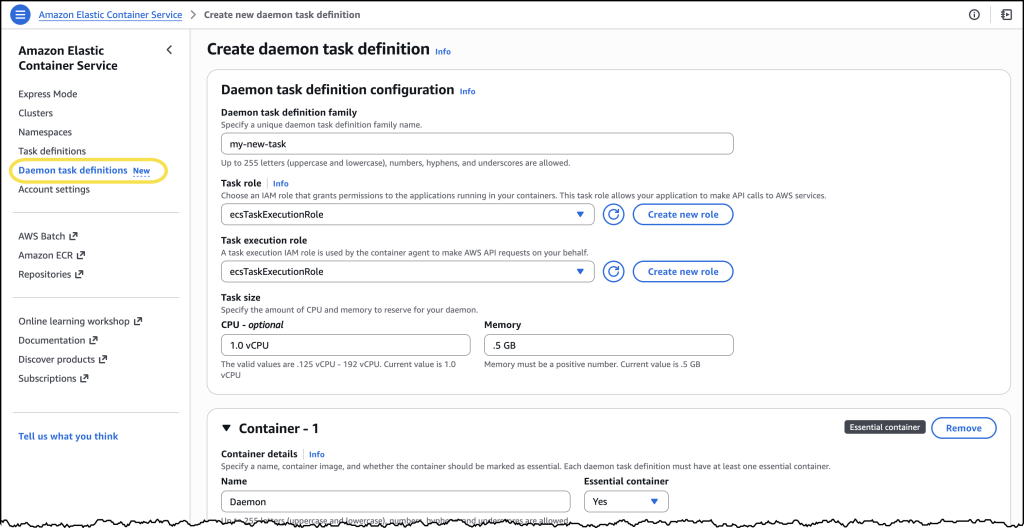
For platform engineers eager to leverage this new functionality, the implementation process is streamlined through the Amazon ECS console. A new "Daemon task definitions" option in the navigation pane allows for the creation and management of these specialized task definitions. Users define parameters like vCPU, memory, and container image URI (e.g., public.ecr.aws/cloudwatch-agent/cloudwatch-agent:latest for the Amazon CloudWatch Agent).
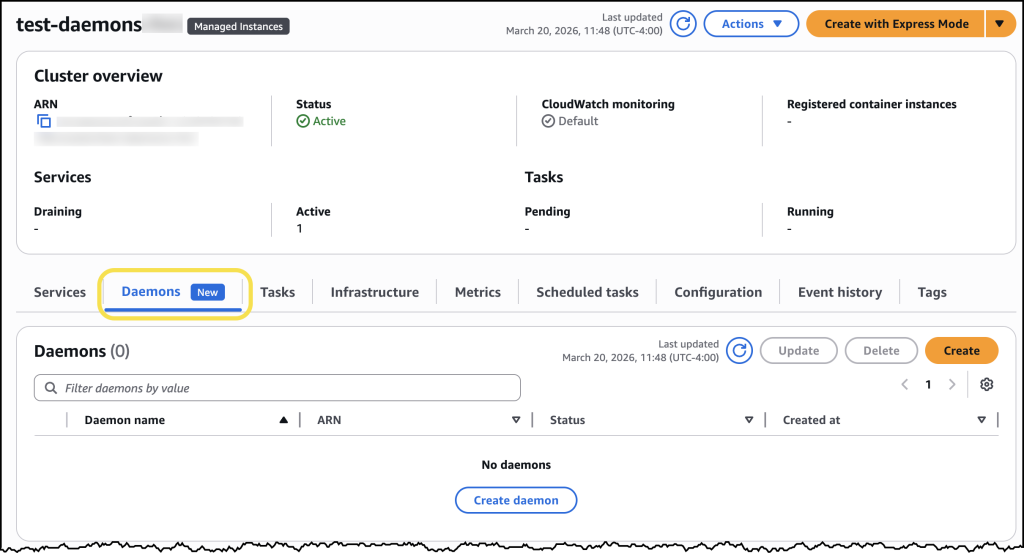
Once a daemon task definition is established, deploying it to an ECS cluster is straightforward. On the cluster’s "Daemons" tab, engineers can associate their daemon task definition with specific ECS Managed Instances capacity providers. From that point forward, ECS automatically ensures that the defined daemon task launches on every provisioned managed instance within the selected capacity provider, before any application tasks.
A typical workflow might involve:
- Creating a daemon task definition for a logging agent like Fluent Bit, specifying its resource requirements and image.
- Navigating to an ECS cluster configured with Managed Instances capacity providers.
- Creating a new daemon instance, selecting the Fluent Bit daemon task definition and the target capacity provider.
- ECS then automatically deploys Fluent Bit to all instances in that capacity provider.
- When an application service is deployed or scaled, ECS ensures Fluent Bit is already running on the underlying instance.
- If a new version of Fluent Bit is released, the platform team simply updates the daemon task definition, and ECS orchestrates a rolling update across the fleet, ensuring continuous log collection.
This intuitive console experience, coupled with the underlying automation, significantly reduces the cognitive load and manual effort previously associated with managing operational agents.
Broader Impact and Strategic Implications
The managed daemon support for Amazon ECS Managed Instances has far-reaching implications for organizations committed to cloud-native development and robust operational practices.
-
Enhanced Operational Efficiency: By decoupling agent management, platform teams can operate more independently and efficiently. This reduces the friction points between development and operations, fostering a more agile DevOps culture. It liberates application developers from concerns about operational tooling, allowing them to focus purely on business logic.
-
Improved Reliability and Consistency: Guaranteed daemon startup and consistent deployment across all instances ensure that critical monitoring, logging, and tracing capabilities are always present. This reduces the risk of "blind spots" in observability, which can be detrimental during incidents. Automated rolling updates with rollbacks further enhance the reliability of agent deployments.
-
Stronger Security Posture: Security agents, often deployed as daemons, require deep host-level access. The ability to configure privileged containers and mount host filesystems securely within a managed framework means organizations can enforce consistent security monitoring and compliance across their entire container fleet without compromising operational agility.
-
Reduced Operational Cost and Technical Debt: Eliminating the need for custom scripting, manual coordination, and application redeployments for agent updates directly translates into reduced operational costs. It also mitigates technical debt associated with maintaining complex, bespoke solutions for agent management.
-
Accelerated Innovation: With a more stable and observable platform, development teams can innovate faster, confident that their applications are well-supported by robust operational tooling, consistently applied and managed by dedicated platform teams.
-
Alignment with Platform Engineering Trends: This feature is a strong affirmation of AWS’s commitment to supporting the evolving role of platform engineering. By providing native constructs for common platform concerns like agent management, AWS empowers platform teams to build more opinionated and self-service internal developer platforms.
Availability and Cost Structure
Managed daemon support for Amazon ECS Managed Instances is available today across all AWS Regions, allowing global enterprises to immediately benefit from this new capability. AWS has confirmed that there is no additional cost associated with using managed daemons themselves. Customers will only incur charges for the standard compute resources (CPU and memory) consumed by their daemon tasks, aligning with AWS’s pay-as-you-go model.
Industry analysts are likely to view this announcement as a strategic move by AWS to further solidify ECS’s position in the highly competitive container orchestration market. "This feature is a game-changer for large enterprises grappling with the complexity of managing operational agents at scale," noted a prominent cloud infrastructure analyst, speaking on background. "It addresses a fundamental pain point in modern cloud operations, demonstrating AWS’s continued investment in making containerization more robust and manageable for its customers. The focus on decoupling and automation aligns perfectly with best practices in DevOps and platform engineering, ultimately leading to more resilient and efficient cloud environments."
The managed daemon support represents a thoughtful evolution of the Amazon ECS offering, providing platform engineers with the tools necessary to build and maintain highly observable, secure, and reliable containerized applications with unprecedented ease and independence. As organizations continue to scale their cloud-native initiatives, features like this will be crucial in unlocking further operational efficiencies and accelerating the pace of innovation.
