

Amazon Web Services (AWS) today announced a significant expansion of its AWS DevOps Agent capabilities, introducing a new suite of release management features now available in preview. This strategic enhancement positions the AWS DevOps Agent as an even more comprehensive "always-available teammate," designed to streamline software changes and operations across diverse environments, including AWS, multicloud setups, and on-premises infrastructure. The core mission of DevOps — to foster smooth and increasingly autonomous software delivery — receives a substantial boost through these new functionalities, which leverage the agent’s deep understanding of an organization’s unique environment, service architecture, interdependencies, and production behaviors.
Historically, the AWS DevOps Agent has proven invaluable for post-deployment operations, autonomously investigating incidents, providing precise root cause analyses, recommending mitigation steps, and delivering targeted recommendations to prevent recurring issues. With the current preview release, its operational scope dramatically expands upstream into the development lifecycle, encompassing critical pre-deployment phases: release readiness review of code changes and autonomous release testing. These innovative features are engineered to meticulously verify every code alteration against natural language standards provided by the DevOps Agent user and to execute change-specific tests within production-like environments. This integrated approach now supports development teams from the initial stages of code creation all the way to production deployment, offering crucial assistance to reviewers and testers struggling to keep pace with the burgeoning volume of AI-generated code.
The Evolving Landscape of Software Development and the AI Imperative
The announcement comes at a pivotal moment for the software development industry. The rapid adoption of AI coding tools, such as Amazon CodeWhisperer, GitHub Copilot, and other generative AI assistants, has fundamentally reshaped development workflows. While these tools offer undeniable benefits—accelerating development velocity, automating boilerplate code generation, and providing intelligent suggestions—they also introduce new complexities. The sheer volume of pull requests (PRs) flowing through continuous integration/continuous delivery (CI/CD) pipelines has escalated dramatically, often outpacing the capacity of traditional, human-centric review and testing processes.
This surge creates a critical bottleneck. Under pressure to maintain rapid release cycles, development teams can find themselves approving reviews without the thorough examination required to catch subtle bugs, security vulnerabilities, or architectural misalignments. Concurrently, test environments, which are crucial for replicating production conditions, can gradually drift from reality, diminishing the efficacy of pre-deployment validation. The net effect is that the immense value generated by AI coding agents often sits in lengthy review queues, delaying the delivery of innovations to end-users. This paradox highlights a pressing industry need: how to harness the speed of AI code generation without compromising on safety, quality, and compliance. AWS’s new release management capabilities directly address this challenge by enabling speedy and safe delivery to become a complementary requirement rather than an inherent trade-off.
Deep Dive into New Capabilities: Release Readiness Review
One of the cornerstone features introduced in this preview is the Release Readiness Review. This capability empowers the AWS DevOps Agent to act as an intelligent, automated gatekeeper, evaluating every incoming code change against a comprehensive set of criteria. These criteria include production requirements, dependency safety, and specific standards and best practices that organizations define in plain language for the agent.

The agent’s analytical prowess extends to checking cross-repository dependency risks, which could potentially impact other interconnected services within a complex microservices architecture. It scrutinizes access control changes against the rigorous guidelines of the AWS Well-Architected Framework, ensuring security and operational excellence. Furthermore, it verifies compliance with any internal standards an organization has explicitly defined. In instances where no specific standards are provided, the agent intelligently applies a set of general best practices, ensuring a baseline level of scrutiny for all changes.
Beyond static code analysis, the Release Readiness Review incorporates dynamic verification. As part of its comprehensive assessment, the agent executes the software in an AWS-managed isolated environment. Here, it runs lightweight user journey tests, designed to quickly verify that the software successfully builds, runs, and passes basic functional checks before the change is allowed to progress further into the CI/CD pipeline. The findings generated by these reviews are seamlessly presented within the AWS DevOps Agent console and, crucially, appear as actionable comments directly on pull requests in popular version control systems like GitHub or GitLab. This direct integration with developer workflows ensures that feedback is delivered contextually and promptly. Moreover, developers can invoke these reviews proactively from their Integrated Development Environments (IDEs) through plugins like Kiro power or Claude Code. This "shift-left" approach enables developers to identify and rectify dependency risks, standards violations, and access control issues even before committing changes to version control, significantly reducing rework and improving code quality earlier in the cycle.
Autonomous Release Testing: Intelligent Verification for Complex Applications
Complementing the Release Readiness Review, the Autonomous Release Testing feature pushes the boundaries of automated quality assurance. This advanced capability focuses on web and API-based applications, generating and executing change-specific test plans in customer-provisioned, production-like environments before a change is merged into the main codebase. This represents a significant departure from traditional testing methodologies that often rely on static, pre-defined test suites.
Instead of merely re-running a fixed set of tests, the AWS DevOps Agent employs sophisticated reasoning to understand the precise nature and scope of the proposed code change. Based on this understanding, it constructs a tailored test plan designed to cover functional correctness, identify behavioral regressions, and validate integration scenarios that a manually maintained test plan might inadvertently overlook or fail to anticipate. This intelligent, adaptive testing ensures that the verification process is highly relevant to the specific modification, maximizing efficiency and coverage.
Every test run conducted by the autonomous agent produces a rich set of structured artifacts. These include detailed metrics, comprehensive logs, precise traces, and an execution summary. This wealth of information provides reviewers with a consistent, auditable record of what was tested, how it was tested, and the precise outcomes. Such transparency fosters trust in the automated process and provides invaluable data for troubleshooting or further analysis, ensuring that critical decisions about software releases are backed by robust evidence.
Operational Workflow and User Experience: Seamless Integration
Getting started with AWS DevOps Agent’s new release management capabilities is designed for operational simplicity. The initial step involves connecting at least one GitHub or GitLab repository to an Agent Space. Once connected, the AWS DevOps Agent intelligently indexes the code, constructing a comprehensive knowledge graph that maps cross-repository and cloud dependencies. This foundational knowledge graph is critical for the agent’s ability to understand the broader impact of any given code change.
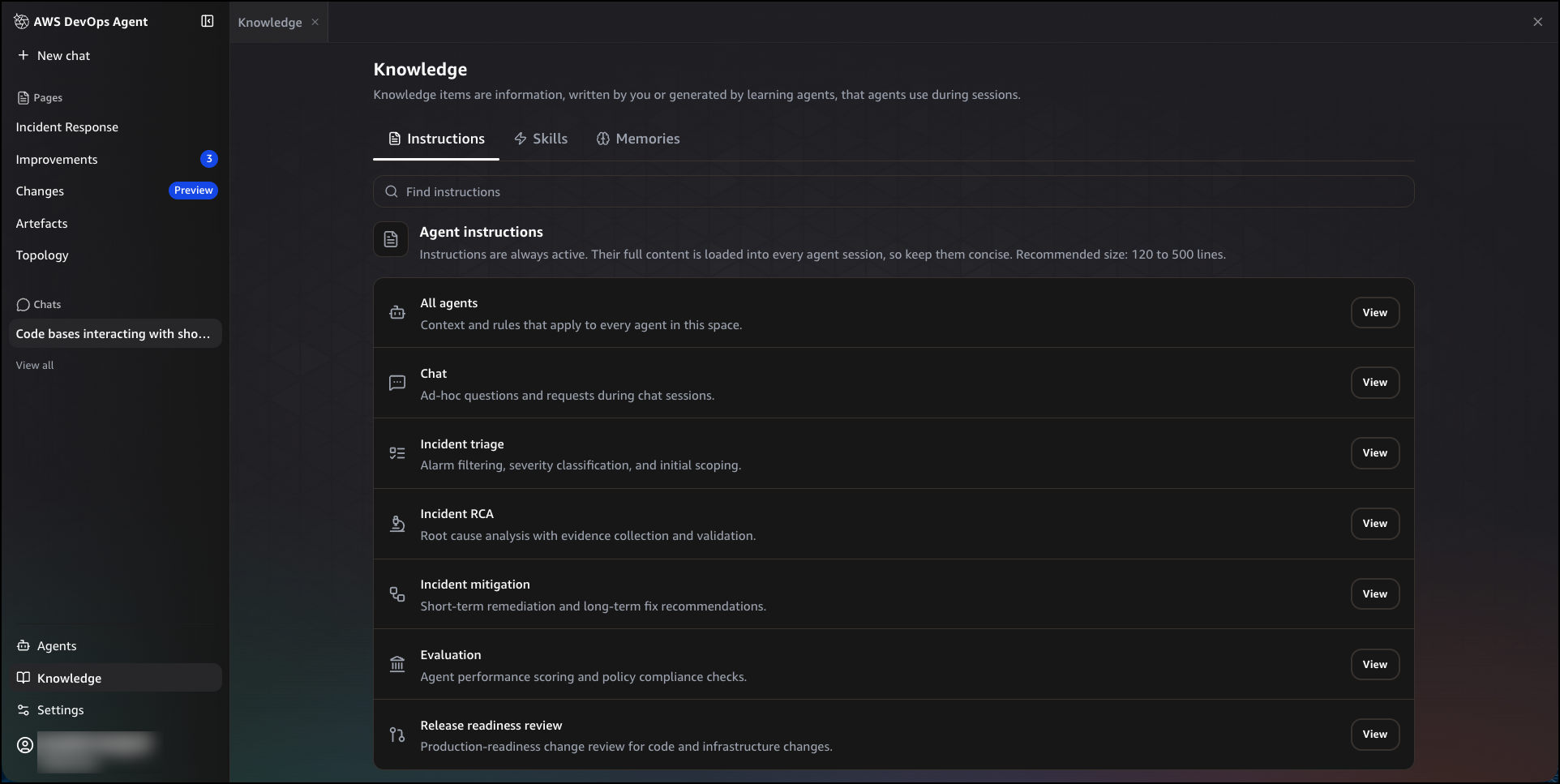
Accessing the web application is straightforward through the AWS DevOps Agent console. Users navigate to their Agent Space and select the ‘Web app’ tab, then choose ‘Operator access’ to launch the interface. A key feature for tailoring the agent’s behavior is the ability to configure internal standards. While the agent applies general best practices by default, organizations can navigate to the ‘Knowledge’ section, select the ‘Instructions’ tab, and edit the ‘Release readiness review’ instructions. Here, internal standards can be articulated in plain English. For example, users can define infrastructure and data standards related to encryption or network access rules, establish best practices that issue warnings without blocking (e.g., logging and observability requirements), or classify sensitive data applications/resources that demand higher security measures. Instructions can be scoped to specific agents or applied universally across all agents in the space.
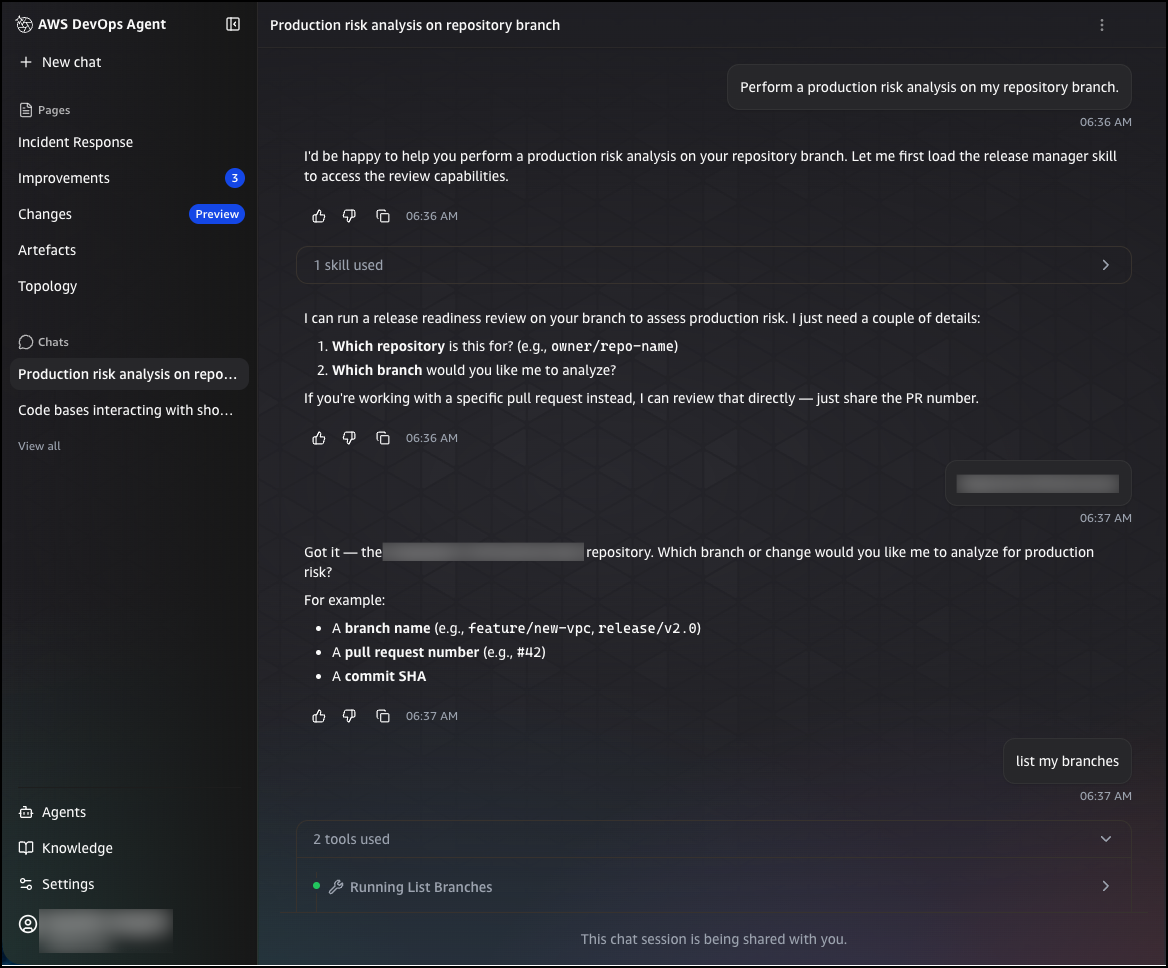
Release readiness reviews can be triggered in two primary ways: by submitting a pull request to a connected repository, which automatically initiates a review, or by entering an on-demand query within the chat interface. For an on-demand review, users can simply type a request such as "Perform a production risk analysis on my repository branch." The agent will then prompt for the specific repository and branch, pull request number, or commit SHA to be analyzed. Upon confirmation, the agent queues the review, meticulously analyzing the change for potential production risks, including infrastructure impacts, configuration alterations, and other potential issues.
Post-review, users can engage in follow-up questions directly within the chat interface, delving deeper into the findings. For instance, querying "which downstream consumers a change affects" will yield a structured breakdown of both in-repository and cross-repository consumers likely to be impacted, identifying specific files and line numbers, and providing recommended steps for resolution before deployment.
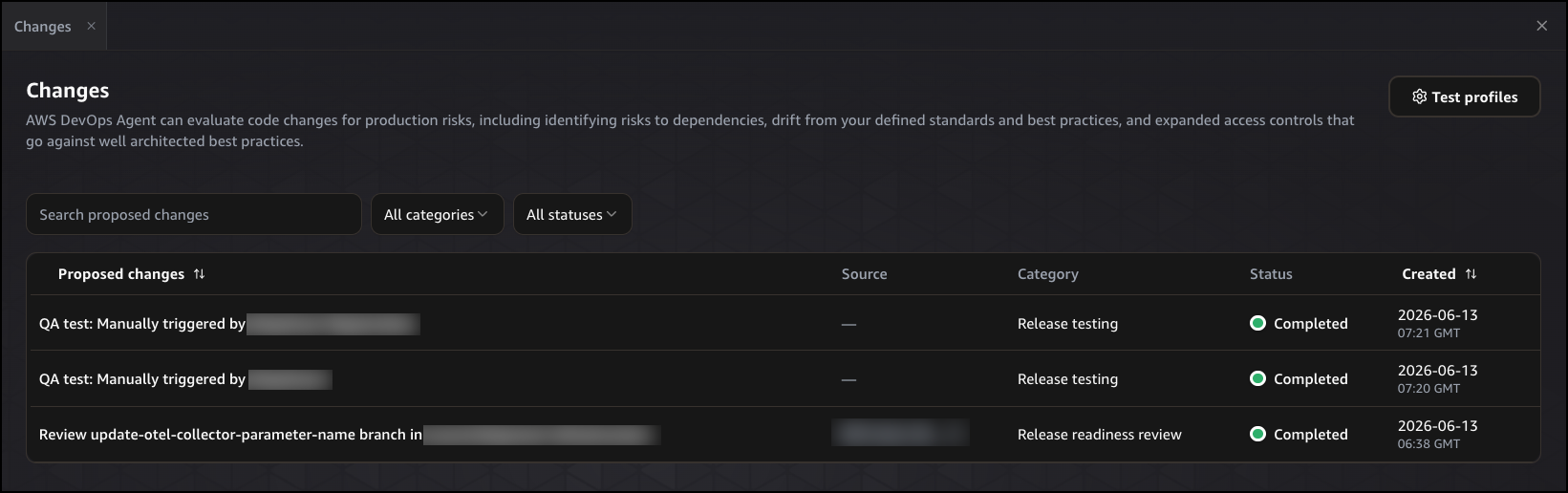
All initiated reviews are meticulously cataloged under the ‘Changes’ section in the left navigation pane. The ‘Proposed changes’ table provides a clear overview of each review, detailing its description, source, category, status, and creation timestamp. Filtering and search capabilities allow for efficient navigation. Selecting any entry reveals the full execution detail.
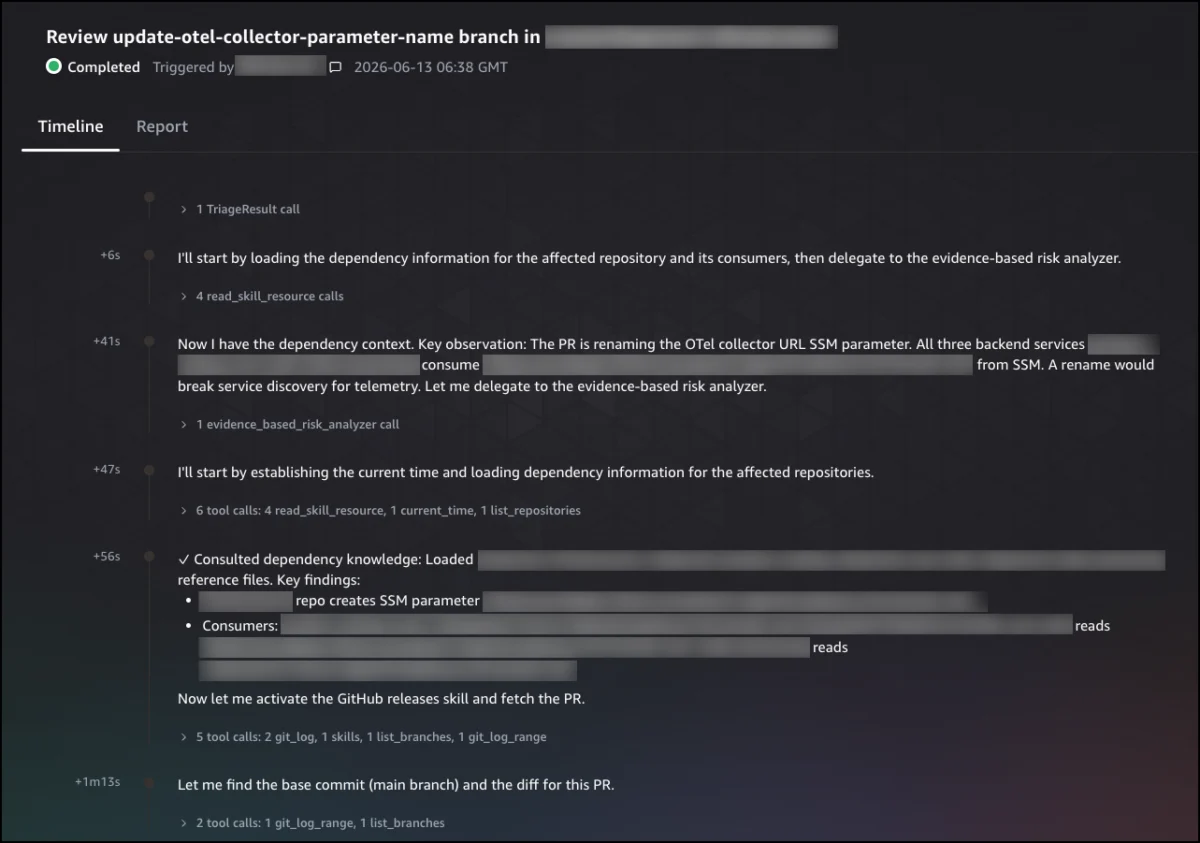
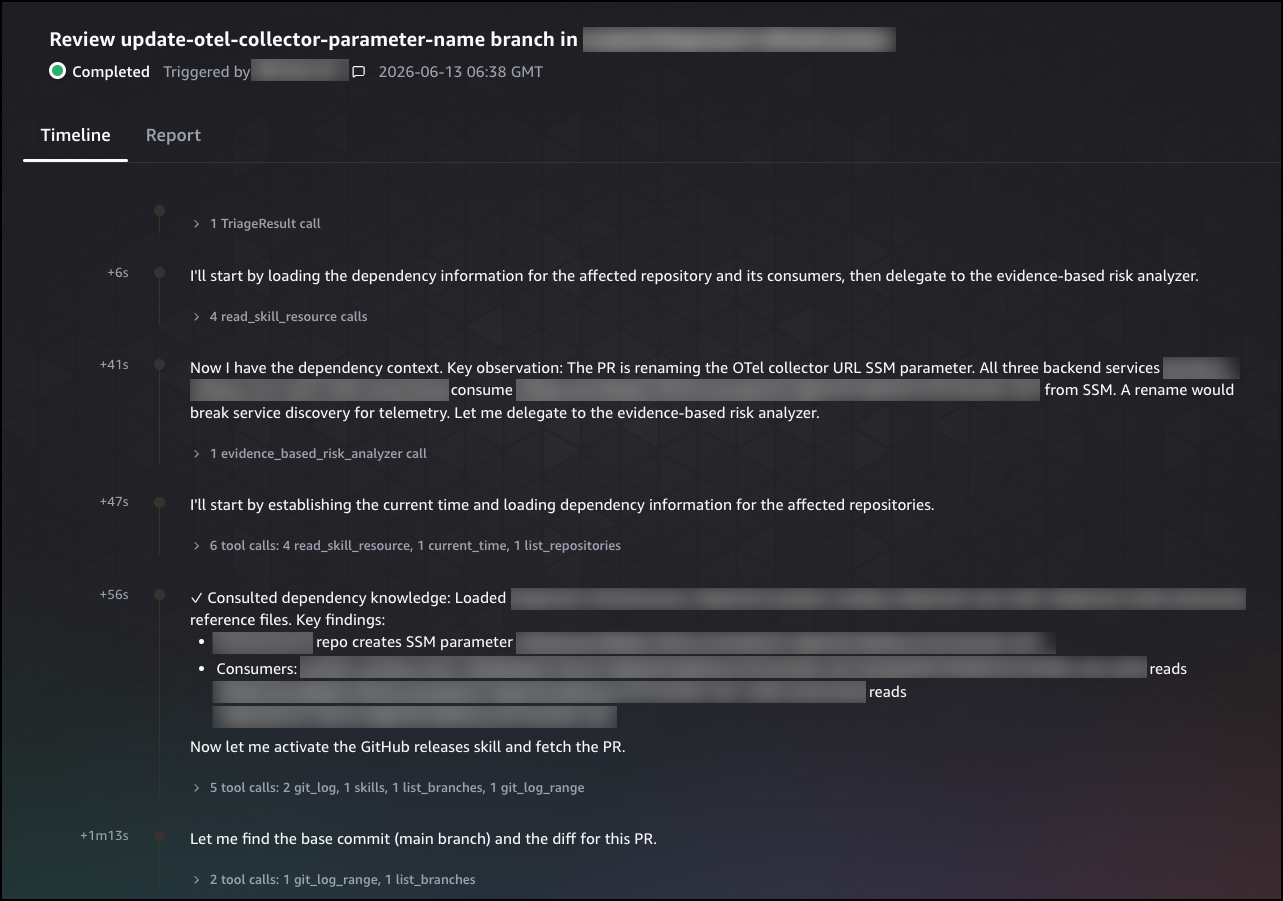
The ‘Timeline’ tab offers unparalleled transparency into the agent’s operations, illustrating its step-by-step reasoning process. This includes a chronological record of the tools it invoked, the dependencies it consulted, and the observations it made at each stage. Each entry is timestamped, providing a complete, auditable record of how the agent constructed its understanding of the change and arrived at its conclusions.
The final recommendation is presented in the ‘Report’ tab. This report begins with a concise summary header, indicating the recommended action (either BLOCK, Proceed with Caution, or Safe to Release), the number of critical issues identified, the commit revision, and the total number of files modified. Below this summary, the ‘Analysis’ section provides a detailed explanation for the recommendation, citing specific risks and the evidence the agent uncovered to support its conclusion. The ‘Issues’ section prioritizes findings by severity, offering a clear roadmap of what needs attention. The ‘Recommendations’ section provides specific, actionable steps for developers to resolve each identified issue. Finally, the ‘Changes’ section lists every modified file, detailing the type of change, its category, and a description of the alteration, providing reviewers with a complete contextual picture before approval.
Autonomous release testing can also be invoked directly from the chat interface. For web or API-based applications, a simple query like "Run a release test on my application deployed at [application URL]" will prompt the agent to generate and execute a change-specific test plan in the customer-provisioned environment. Results are then accessible in the ‘Changes’ section, offering a structured summary of the tests performed and their outcomes.
Broader Implications and Future Outlook
This strategic move by AWS carries significant implications for the future of software development and DevOps practices. By integrating AI-powered capabilities directly into the release management process, AWS is addressing critical pain points faced by development teams globally. The ability to autonomously review and test code, especially in the context of increasing AI-generated content, promises to enhance developer productivity by offloading repetitive, time-consuming tasks. This allows human reviewers and testers to focus on more complex, strategic issues that require nuanced human judgment.
Moreover, the emphasis on proactive quality assurance, dependency safety, and compliance checks will undoubtedly lead to higher software quality, improved reliability, and enhanced security posture for organizations leveraging these features. Catching issues earlier in the development cycle translates to reduced costs, fewer production incidents, and ultimately, a better end-user experience. The integration with the AWS Well-Architected Framework ensures that best practices are not just aspirational but actively enforced.
From a competitive standpoint, AWS is reinforcing its position as a comprehensive cloud provider that deeply understands the end-to-end software development lifecycle. By offering an integrated, AI-driven solution for DevOps, it streamlines workflows for its customers, potentially reducing the need for disparate third-party tools and fostering a more cohesive development ecosystem within the AWS cloud. Industry analysts suggest that such capabilities will become increasingly essential as the complexity of modern applications continues to grow and the demand for rapid, secure deployments intensifies.
The preview of the release readiness review and autonomous release testing features for AWS DevOps Agent is currently available in the US East (N. Virginia) Region. During this preview period, these features are offered at no additional cost, providing organizations with an opportunity to explore their transformative potential. For pricing details on other AWS DevOps Agent features, interested parties can visit the official AWS DevOps Agent pricing page. Detailed configuration information and comprehensive guidance are available in the AWS DevOps Agent user guide, enabling teams to begin leveraging these advanced capabilities today. This initiative marks another significant step towards a more autonomous, intelligent, and resilient future for software delivery.
