
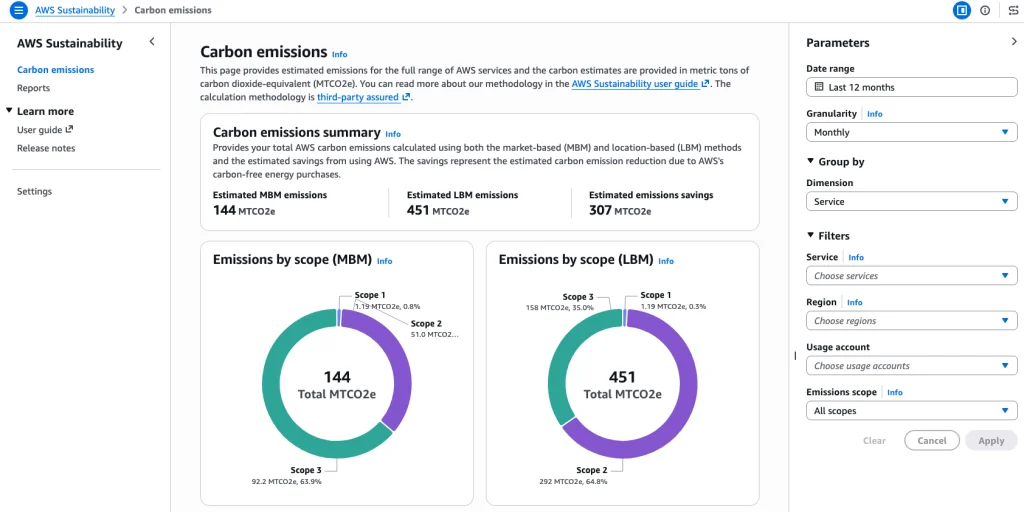

Seattle, WA – Amazon Web Services (AWS) has announced the launch of its new AWS Sustainability Console, a standalone service designed to consolidate all AWS sustainability reporting and resources into a single, accessible platform. This strategic move aims to significantly enhance transparency and control for organizations seeking to measure and reduce the environmental footprint of their cloud workloads, aligning with Amazon’s broader commitment to The Climate Pledge.
The introduction of the AWS Sustainability Console marks a pivotal step in making cloud sustainability more manageable and actionable for enterprises worldwide. By providing a dedicated hub for carbon emissions data, AWS is addressing a long-standing challenge faced by sustainability professionals who previously required billing-level permissions to access crucial environmental metrics. This separation of concerns streamlines workflows and empowers specialized teams to focus on their sustainability objectives without navigating complex internal access protocols.
The Genesis of the AWS Sustainability Console: A Commitment to Climate Action
The launch of the AWS Sustainability Console is a direct outgrowth of Amazon’s ambitious Climate Pledge, established in 2019. Through this pledge, Amazon committed to reaching net-zero carbon across its operations by 2040, a decade ahead of the Paris Agreement’s 2050 target. This foundational commitment permeates every aspect of Amazon’s business, including how AWS designs, builds, and operates its global data centers and cloud services. The company has made significant investments in renewable energy, aiming to power its operations with 100% renewable energy by 2025, a goal initially set for 2030 and accelerated due to rapid progress.
Prior to the console’s debut, AWS offered the Customer Carbon Footprint Tool (CCFT) within the AWS Billing Console. While the CCFT provided valuable insights into carbon emissions attributable to AWS usage, its integration within the billing infrastructure presented a practical hurdle. Sustainability teams and reporting specialists often found themselves needing access to sensitive financial data solely to retrieve environmental performance metrics. This constraint necessitated navigating intricate permission structures that were not inherently designed with sustainability workflows in mind, creating inefficiencies and potential security concerns.
The new AWS Sustainability Console directly addresses this challenge by featuring its own independent permissions model. This separation allows sustainability professionals to gain direct access to emissions data without the prerequisite of being granted billing permissions, thereby enhancing operational efficiency and data security. The console leverages the same robust underlying data and methodology previously employed by the CCFT, ensuring continuity and consistency in reporting, but significantly improves the accessibility and utility of this critical information.
Key Features and Enhanced Capabilities for Comprehensive Reporting

The AWS Sustainability Console is engineered to provide a holistic view of an organization’s cloud carbon footprint, offering granular detail and flexible reporting options.
-
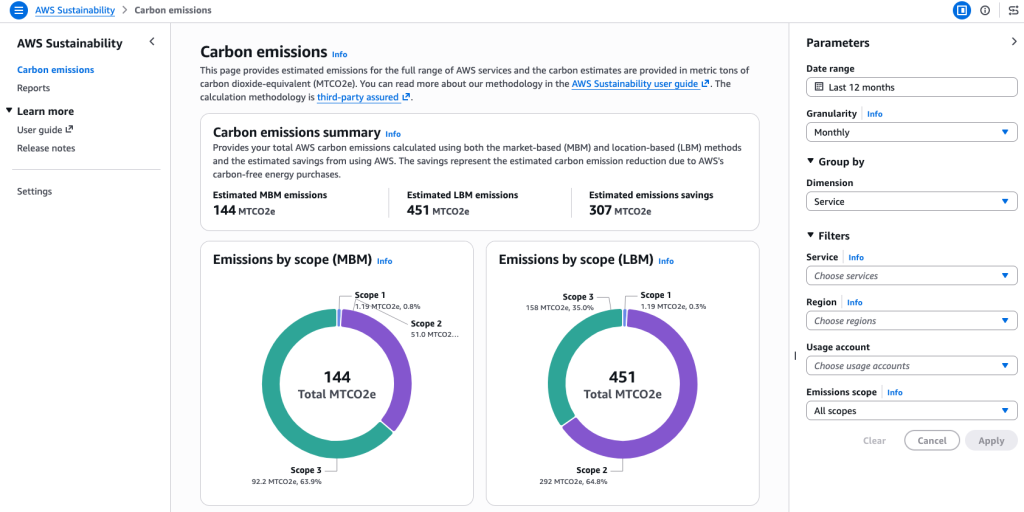
Comprehensive Emissions Breakdown: The console reports Scope 1, 2, and 3 emissions attributed to AWS usage. These scopes are critical for comprehensive corporate environmental reporting:
- Scope 1: Direct emissions from owned or controlled sources, such as fuel combustion in AWS data center generators.
- Scope 2: Indirect emissions from the generation of purchased electricity, steam, heating, or cooling consumed by AWS data centers. The console provides both Market-Based Method (MBM) and Location-Based Method (LBM) data for Scope 2:
- Market-Based Method (MBM): Accounts for contractual instruments like Energy Attribute Certificates (EACs) or Renewable Energy Certificates (RECs) purchased by AWS, reflecting the company’s efforts to procure renewable energy.
- Location-Based Method (LBM): Reflects the average emissions intensity of the local electricity grid where the AWS data center operates, providing a baseline comparison.
- Scope 3: Other indirect emissions that occur in the value chain of the reporting company, including upstream and downstream emissions. For AWS customers, this includes emissions related to the manufacturing of servers, data center construction, and other indirect activities associated with providing cloud services.
This detailed breakdown is crucial for organizations adhering to international reporting standards like the Greenhouse Gas (GHG) Protocol. The underlying methodology, independently verified by third-party consultants like Apex, assures the credibility and accuracy of the reported data.
-
Granular Data Visualization: Users can view their emissions data broken down by AWS Region and specific AWS services, such as Amazon CloudFront, Amazon Elastic Compute Cloud (Amazon EC2), and Amazon Simple Storage Service (Amazon S3). This level of detail enables organizations to identify "hotspots" of carbon intensity within their cloud architecture, facilitating targeted optimization efforts and more informed decision-making regarding workload placement and resource utilization.
-
Flexible Reporting and Customization: Recognizing the increasing complexity of sustainability reporting requirements, the console introduces a robust Reports page. This feature allows users to download preset monthly and annual carbon emissions reports, covering both MBM and LBM data. Furthermore, organizations can build custom comma-separated values (CSV) reports by selecting specific fields, time granularity, and other filters. This flexibility ensures that businesses can tailor their reports to meet internal stakeholder needs, regulatory demands, or investor requirements.
-
Fiscal Year Alignment: A significant enhancement for finance and sustainability teams is the ability to configure the console to match an organization’s fiscal year. This feature ensures that all data views and exports reflect the company’s specific reporting period, eliminating a common friction point and streamlining parallel efforts between financial and environmental reporting.
-
API and SDK Integration: For organizations with advanced data integration needs, the console offers programmatic access through a new API and AWS SDKs. This capability allows teams to seamlessly integrate emissions data into their existing reporting pipelines, custom dashboards, or compliance workflows. This is particularly valuable for large enterprises managing numerous AWS accounts or those requiring specific data aggregation that goes beyond standard AWS Organizations structures. The AWS Command Line Interface (CLI) also supports programmatic data retrieval, further enhancing automation possibilities.
Driving Amazon’s Broader Sustainability Vision
The AWS Sustainability Console is more than just a reporting tool; it is an embodiment of Amazon’s holistic approach to sustainability. The Climate Pledge, co-founded by Amazon and Global Optimism, now counts over 400 signatories, representing a collective commitment to decarbonization. Amazon’s own efforts include massive investments in renewable energy projects globally, innovative packaging solutions, and electrification of its delivery fleet.

"Our commitment to sustainability extends beyond our own operations to empowering our customers with the tools and insights they need to build greener cloud environments," an AWS spokesperson emphasized. "The AWS Sustainability Console is a testament to this philosophy, providing unprecedented transparency and control over their cloud carbon footprint. We believe that by making this data easily accessible and actionable, we can collectively accelerate the transition to a low-carbon economy."
Industry Context and Expert Perspectives
The launch comes at a time when environmental, social, and governance (ESG) reporting is no longer a niche concern but a mainstream imperative for businesses across all sectors. Regulatory bodies worldwide are enacting stricter disclosure requirements, while investors increasingly factor ESG performance into their decision-making. Consumers are also demonstrating a growing preference for environmentally responsible brands.
Industry analysts have lauded the move, recognizing its potential to alleviate significant pain points for enterprises. "This is a significant step forward for cloud sustainability reporting," noted one analyst from a leading technology research firm. "The separation of sustainability data from billing permissions is a critical user experience improvement that will empower chief sustainability officers and their teams. Furthermore, the granular reporting and API access set a new standard for transparency and integration in the cloud industry, positioning AWS as a leader in helping customers achieve their own net-zero ambitions."
The console also reflects a broader trend among cloud providers to offer more sophisticated tools for environmental management. As cloud adoption continues its exponential growth, the energy consumption of data centers remains a critical area of focus. By providing detailed carbon footprint data, AWS enables its customers to make more sustainable choices, from optimizing application architectures to selecting regions powered by a higher percentage of renewable energy.
Implications for Businesses and the Cloud Landscape
The introduction of the AWS Sustainability Console carries significant implications for both AWS customers and the wider cloud computing industry.
-
For Customers:
- Enhanced Compliance: Simplifies adherence to increasingly stringent ESG reporting mandates and investor expectations.
- Improved Decision-Making: Provides actionable data to inform architectural choices, resource provisioning, and workload placement, enabling customers to proactively reduce their environmental impact.
- Operational Efficiency: Identifying carbon hotspots can often correlate with inefficient resource use, leading to opportunities for both environmental and cost savings.
- Competitive Advantage: Transparent and verifiable sustainability reporting can bolster a company’s brand reputation and appeal to environmentally conscious customers and investors.
- Democratization of Data: By making carbon data accessible without billing permissions, more stakeholders within an organization can contribute to sustainability initiatives.
-
For AWS and the Cloud Industry:
- Reinforced Leadership: Strengthens AWS’s position as a leader in sustainable cloud computing, differentiating it from competitors.
- Fostering Trust: Increases customer trust by providing transparent data and tools for managing environmental impact.
- Driving Innovation: Sets a benchmark for other cloud providers, potentially spurring further innovation in green cloud technologies and reporting.
- Contribution to Global Goals: By empowering millions of cloud users to reduce their carbon footprint, AWS plays a crucial role in broader global decarbonization efforts.
Looking Ahead: The Evolution of Cloud Sustainability
AWS has stated that the Sustainability Console is "designed to grow," with plans for continuous release of new features and capabilities. Future enhancements could include AI-driven recommendations for carbon reduction, integration with broader enterprise sustainability management platforms, or even multi-cloud reporting capabilities as organizations increasingly adopt hybrid and multi-cloud strategies.
The availability of historical data going back to January 2022 means that organizations can immediately begin exploring their emissions trends and benchmarking their progress. This immediate access to past performance data is invaluable for establishing baselines and setting future sustainability targets.
The AWS Sustainability Console is available today at no additional cost and can be accessed directly from the AWS Management Console. This no-cost model further underscores AWS’s commitment to making sustainability accessible to all its customers, regardless of their size or budget. By providing a centralized, intuitive, and powerful tool for managing cloud carbon footprints, AWS is not only helping its customers achieve their environmental goals but also advancing the collective effort towards a more sustainable digital future.
