

AWS WAF has launched a groundbreaking AI traffic monetization capability, offering digital content owners and publishers an unprecedented avenue to charge AI bots and agents for access to their protected web content directly at the network edge. This innovative feature addresses a critical challenge faced by content providers in the era of generative AI, allowing them to establish granular, per-request pricing based on content path, bot category, or verification tier without necessitating modifications to their origin infrastructure or the development of custom application code. Content owners are now equipped to define intricate access policies for various agent types, collect payments in stablecoins directly into their preferred digital wallets, and comprehensively monitor revenue streams and bot activity from a unified, intuitive dashboard.
The Evolving Web Landscape and the Publisher’s Dilemma
The digital ecosystem has undergone a profound transformation in recent years, largely driven by the explosive growth of artificial intelligence. While AI advancements promise significant societal benefits, they have simultaneously created an existential dilemma for content publishers. Data from recent analyses indicates that AI bot traffic now constitutes over 50% of total web traffic for a substantial number of content providers, with AI-specific crawlers demonstrating an astounding growth rate exceeding 300% year-over-year. This surge in automated access contrasts sharply with the traditional model of web interaction. Historically, search engine crawlers indexed content primarily to return measurable referral traffic back to publisher websites, generating page views, ad impressions, and subscription conversions that offset infrastructure costs.
However, the new wave of AI bots operates differently. These advanced agents consume vast quantities of web content not to direct users back to the source, but to synthesize summaries, generate responses, and inform large language models (LLMs) within AI interfaces. This fundamental shift means that publishers bear the full burden of infrastructure costs—bandwidth, storage, and processing power—associated with serving this traffic, yet receive little to no compensatory return in the form of traffic referrals, advertising revenue, or new subscribers. This imbalance has created an unsustainable economic model for many content creators, who find themselves inadvertently subsidizing the training and operation of AI models without fair compensation. The lack of a clear mechanism to differentiate between beneficial human traffic and costly, non-reciprocating AI bot traffic has been a persistent pain point.
AWS WAF’s Solution: A New Paradigm for AI Traffic Monetization
Recognizing this escalating challenge, AWS WAF has extended its capabilities beyond mere bot control to encompass a comprehensive monetization framework. Prior to this release, AWS WAF Bot Control provided customers with crucial visibility into bot activity and the ability to block or rate-limit unwanted traffic. While effective for security and resource management, it did not offer a pathway for content owners to monetize the legitimate, albeit non-referring, consumption of their intellectual property by AI agents. The introduction of AI traffic monetization closes this critical gap, providing a robust, scalable, and secure solution for publishers.
This new Bot Control capability empowers content owners to configure precise pricing rules directly through the AWS WAF console. The system facilitates payment collection from AI agents via integrated third-party payment services, eliminating the need for publishers to build bespoke payment infrastructure or engage in complex, individual licensing negotiations with AI developers. The initial payment settlement and verification flows are powered by Coinbase’s x402 Facilitator, a testament to the growing convergence of blockchain technology and enterprise solutions. Looking ahead, AWS has announced upcoming integrations with Stripe for direct account payments and support for the Machine Payments Protocol (MPP), further broadening the scope and flexibility of payment options.
Getting Started with AI Traffic Monetization: A Step-by-Step Guide
To leverage the new AI traffic monetization feature, content owners must first ensure that AWS WAF Bot Control is enabled at either the Common or Targeted level on the web ACL associated with their CloudFront distribution. This foundational step is crucial because Bot Control provides the essential agent classification data upon which monetization rules depend. Detailed instructions for setting up Bot Control are available in the AWS WAF Developer Guide, specifically under "Adding the AWS WAF Bot Control managed rule group to your web ACL." Users can initiate the process by navigating to the WAF & Shield console and selecting "Protection packs (web ACLs)" in the left navigation pane.

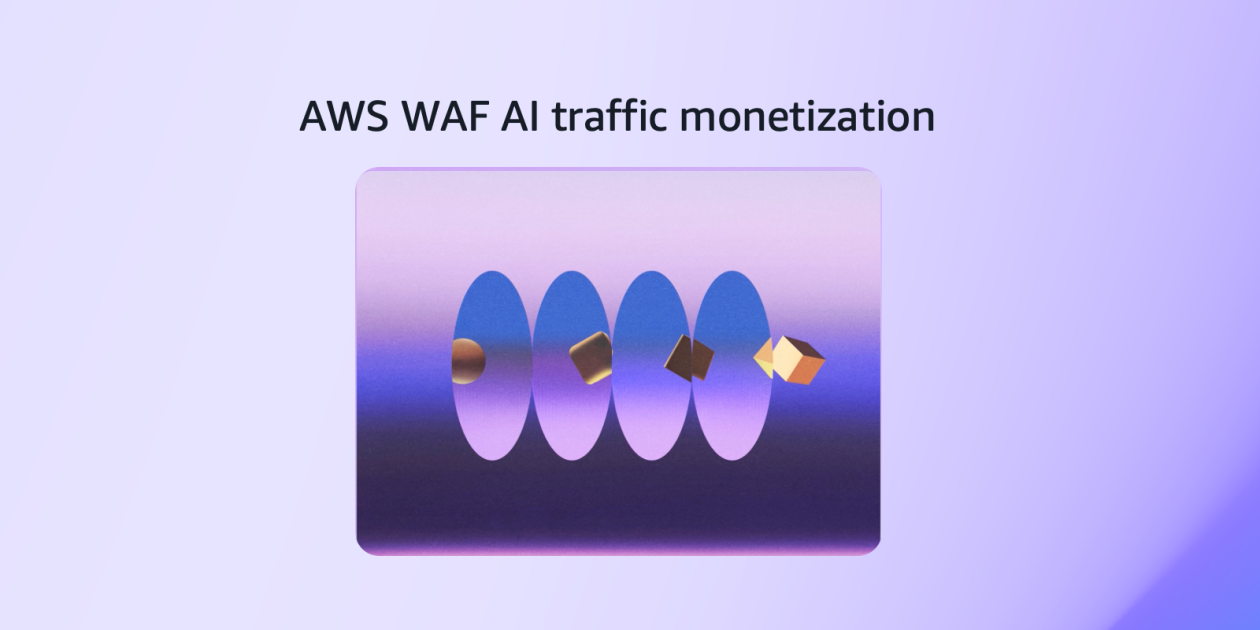
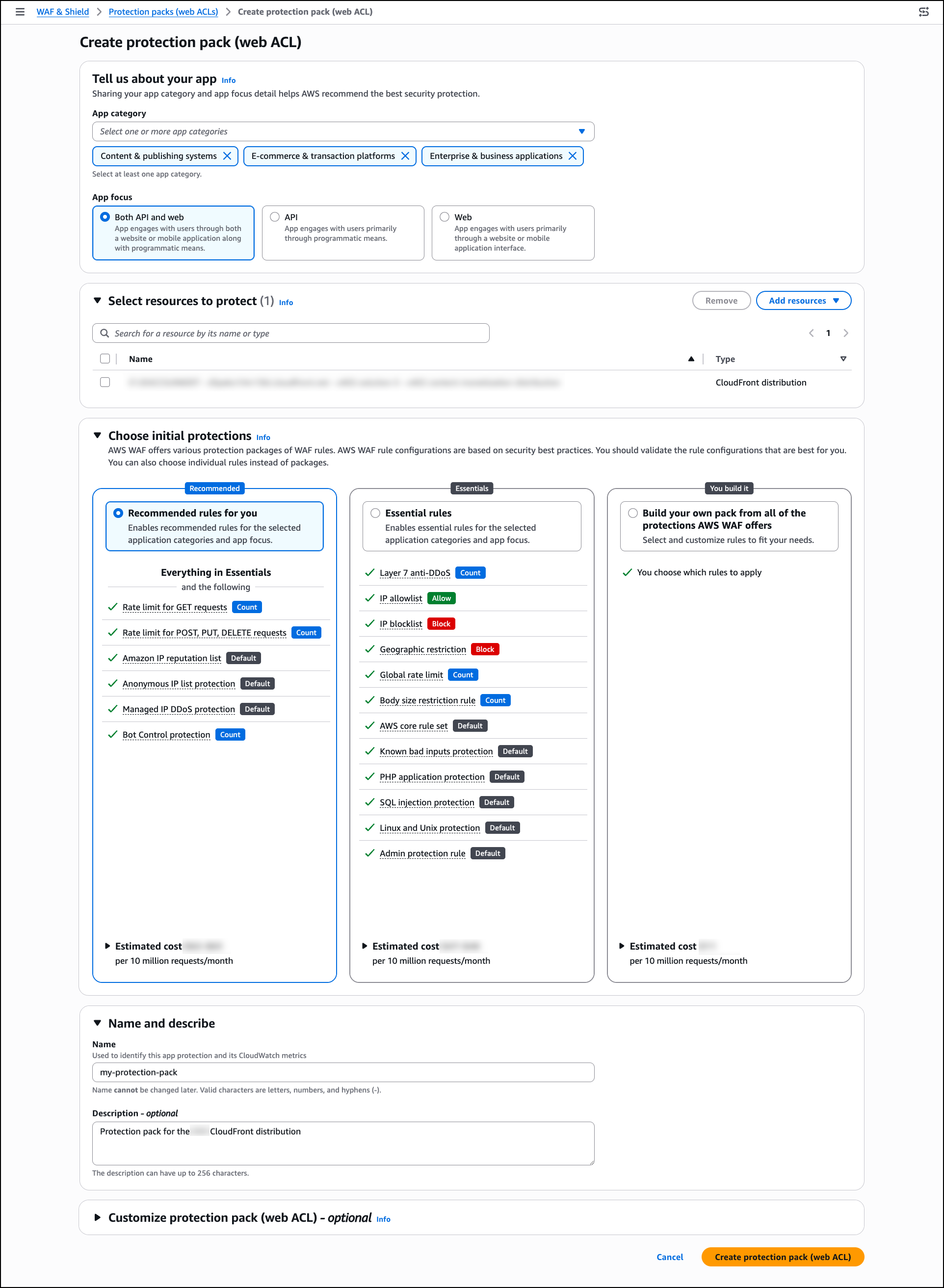
A "protection pack" serves as the central configuration unit for AI traffic monetization. It encapsulates definitions for monetized content paths, specifies charges for each agent verification tier, lists accepted payment methods, and outlines applicable license terms. To create a new protection pack, users select "Create protection pack (web ACL)." During the setup, users are prompted to categorize their content (e.g., "Content & publishing systems," "E-commerce & transaction platforms") and choose an "App focus." These selections guide AWS WAF in recommending optimal security protections. Resources, such as CloudFront distributions, can be associated with the protection pack either during initial creation or at a later stage. Users then select appropriate AWS WAF managed rule packages or individual rules, provide a name and description for the pack, and optionally customize advanced settings like pricing tiers, payment methods, content scope, and license terms.
Operational Insights: AI Traffic Analysis and Revenue Tracking
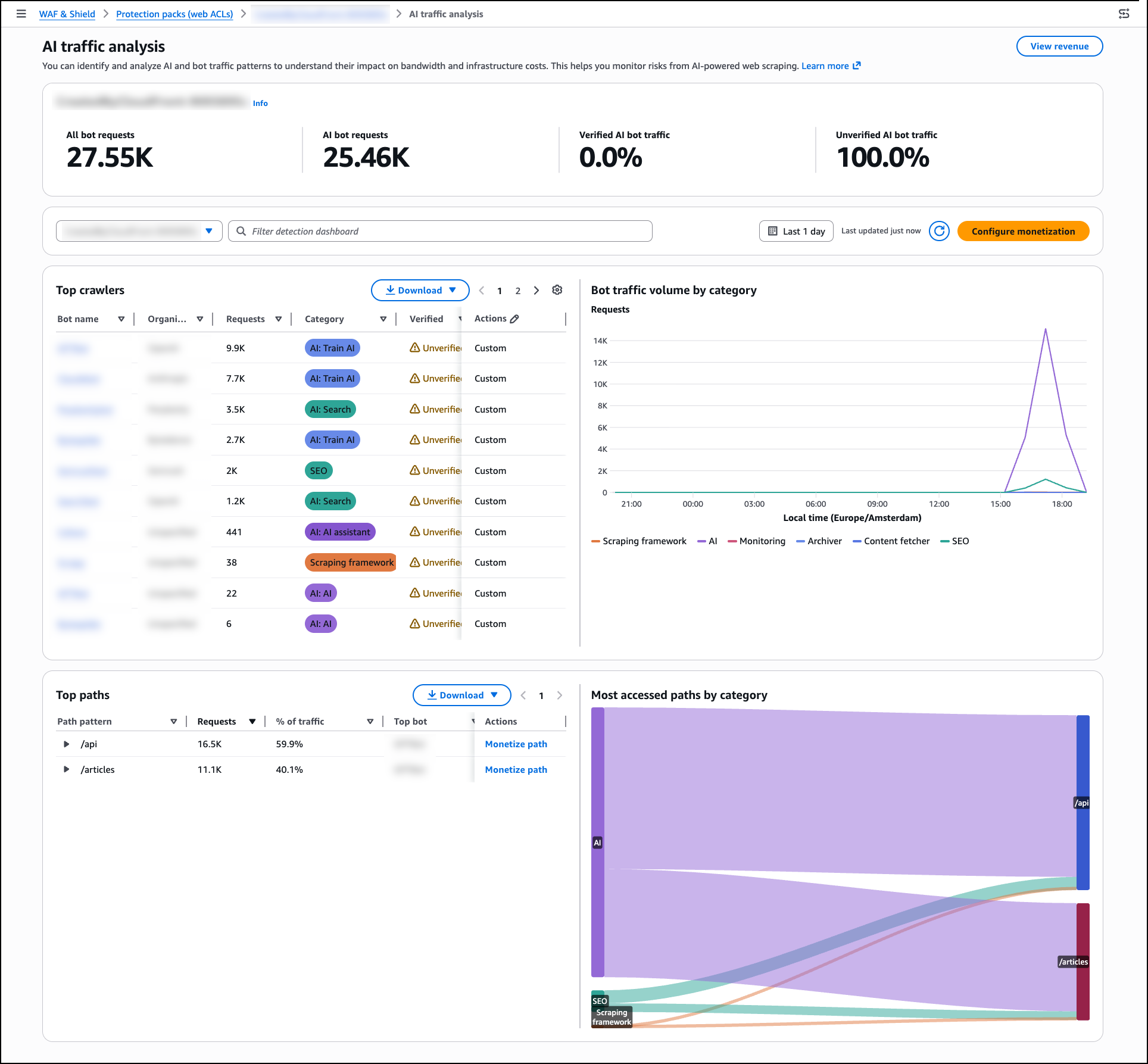
Before finalizing a pricing strategy, publishers are strongly advised to analyze the impact of AI bot traffic on their content. The AI traffic analysis dashboard, accessible via the WAF & Shield console, provides invaluable insights. After selecting the relevant protection pack, the dashboard presents a detailed breakdown of traffic into four key categories: "All bot requests," "AI bot requests," "Verified AI bot traffic," and "Unverified AI bot traffic." This analytical tool surfaces critical infrastructure impact metrics, including consumed bandwidth, estimated monthly costs, and peak request rates. A per-path heatmap visually represents AI bot activity by content path and hour, equipping content owners with data-driven insights to inform their pricing decisions.
AWS WAF Bot Control’s sophisticated classification engine can identify over 650 distinct AI bot and agent types, including prominent ones like GPTBot, Claude-Web, and Perplexity-Bot. Each identified bot is assigned a verification tier, enabling granular policy enforcement. Once traffic patterns are understood, users can return to "Protection packs (web ACLs)," select their pack, and choose "Configure AI monetization" to define pricing and access policies. A single protection pack can define pricing, agent policies, accepted payment methods, and license terms for a specific set of content paths, allowing for differentiated pricing across various content zones within the same distribution.
For each agent verification tier within a protection pack, content owners can assign one of six distinct actions:
- Monetize: Returns an HTTP 402 Payment Required response with pricing details.
- Allow: Grants free access to the content.
- Block: Denies access entirely.
- Count: Logs the request without charging or blocking.
- CAPTCHA: Presents a puzzle to verify human interaction.
- Challenge: Runs a silent check to verify the client is a legitimate browser.
Payment Settlement, Protocols, and Testing
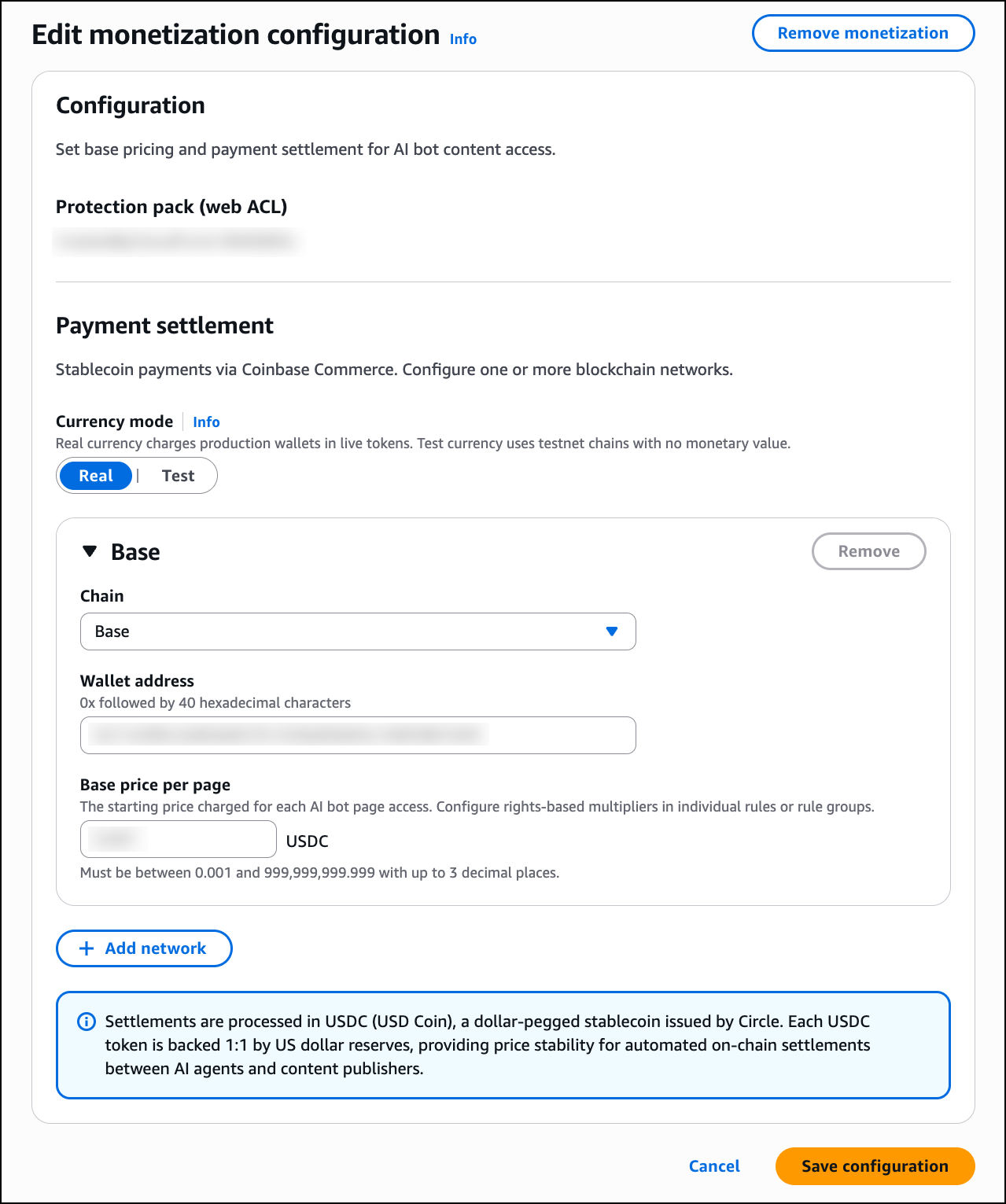
Within the "Edit monetization configuration" page, content owners configure payment settlement details. This includes selecting one or more blockchain networks for stablecoin payments, such as Base or Solana. Any valid wallet address on the supported networks is accepted, whether self-managed or provided by a wallet service like Coinbase. For each selected network, users specify their wallet address and set a "Base price per page" in USDC (USD Coin). AWS explicitly states that it does not process payments or collect fees on content revenue; disbursement is managed by the content owner or their chosen wallet provider.
When a "Monetize" rule is triggered by an incoming request, AWS WAF responds with an HTTP 402 Payment Required status. Crucially, the response body contains a machine-readable price manifest in JSON format, adhering to the x402 open protocol for machine-to-machine payments. This manifest includes the content price in USDC, the accepted blockchain networks, the destination wallet address, a maximum payment timeout, and the payment scheme. Any x402-compatible agent runtime can autonomously complete this payment flow. The client submits a signed payment authorization on its preferred payment network. AWS WAF then verifies this authorization, retrieves the content, integrates with third-party facilitator services for on-chain payment settlement, and finally serves the requested response. It is important to note that the "Monetize" action is currently supported exclusively for web ACLs associated with Amazon CloudFront distributions, with regional web ACLs not yet supported for this specific action.
To ensure proper configuration before live deployment, AWS WAF provides a "Currency mode" toggle, allowing users to switch between "Real" and "Test" modes at any time. In "Test" mode, x402 payments are still enforced, but they occur on testnets (e.g., Base Sepolia, Solana Devnet) using test funds obtained from faucets. This allows publishers to validate pricing, wallet configurations, and the entire x402 payment flow without incurring real costs. All test events are logged with CurrencyMode: TEST. Once satisfied with the configuration, switching "Currency mode" back to "Real" activates real payment processing.
The "AI access monetization" dashboard, accessible from the left navigation pane, provides real-time tracking of monetization outcomes once "Currency mode" is set to "Real." This dashboard offers a comprehensive view of "Total revenue," revenue broken down by "Verified bots" and "Unverified bots," and "Avg. per request." The "Top revenue sources" panel categorizes earnings by bot type, while the "AI access patterns" panel ranks content paths based on revenue generated. A "Settlements" tab further aids reconciliation by providing details on payments by provider, payment method distribution, and failed payment attempts.
Industry Reactions and Broader Implications
The introduction of AI traffic monetization by AWS WAF is poised to be a significant turning point for the digital content industry. For publishers and content owners, this represents a long-awaited solution to the problem of uncompensated AI consumption. Industry experts anticipate a positive reception, particularly from independent publishers, news organizations, and specialized content creators who have struggled to maintain profitability amidst rising infrastructure costs and diminishing traditional revenue streams. This capability could democratize access to monetization tools, previously reserved for large enterprises capable of negotiating bespoke licensing deals.
An inferred statement from an AWS representative might highlight the company’s commitment to innovation that supports its diverse customer base: "AWS is dedicated to empowering content creators with the tools they need to thrive in an evolving digital landscape. Our new AI traffic monetization capability provides a fair and sustainable model for publishers to be compensated for their valuable content, while also offering AI developers a transparent and standardized way to access the data they need."
From the perspective of AI developers and bot operators, this feature introduces a new cost of doing business. However, it also provides a clear, legitimate, and standardized pathway to access copyrighted content, potentially reducing legal risks and fostering a more transparent ecosystem for AI training data. Rather than relying on scraping and the uncertainty of fair use claims, developers can now engage in direct, micro-payment-based transactions. This could lead to a more ethical development of AI models, where the creators of the foundational data are appropriately recognized and compensated. The adoption of open protocols like x402 further promotes interoperability and standardization, simplifying the payment process for both content providers and AI consumers.
The broader implications extend to the future of digital economics and content creation. This model could incentivize the creation of high-quality, specialized content, as publishers gain a direct revenue stream from AI consumption. It may also shift the dynamics of web search and information retrieval, potentially leading to a bifurcated internet where some content is freely browsed by humans and traditional bots, while premium or high-value content requires payment for AI access. The integration of stablecoin payments via blockchain networks also signifies a growing acceptance and practical application of decentralized finance in mainstream enterprise solutions, offering benefits like transparency, immutability, and efficient global transactions.
Availability and Future Outlook
The AI traffic monetization capability is now available to all Amazon CloudFront customers at no additional charge beyond standard AWS WAF pricing. This widespread availability, across all edge locations where AWS WAF web ACLs are associated with Amazon CloudFront distributions, ensures that a broad spectrum of content providers can immediately begin to explore and implement this new revenue model. The feature is expected to evolve further with upcoming integrations and enhanced analytics, continuously adapting to the dynamic needs of the digital content and AI industries.
This development marks a significant step towards establishing a more equitable and sustainable digital economy, where the value of intellectual property is recognized and compensated, even in the realm of automated consumption. For content owners navigating the complexities of the AI age, AWS WAF’s new capability offers a powerful tool to reclaim value and secure their financial future. Further details and technical documentation are available in the AWS WAF Developer Guide.
