
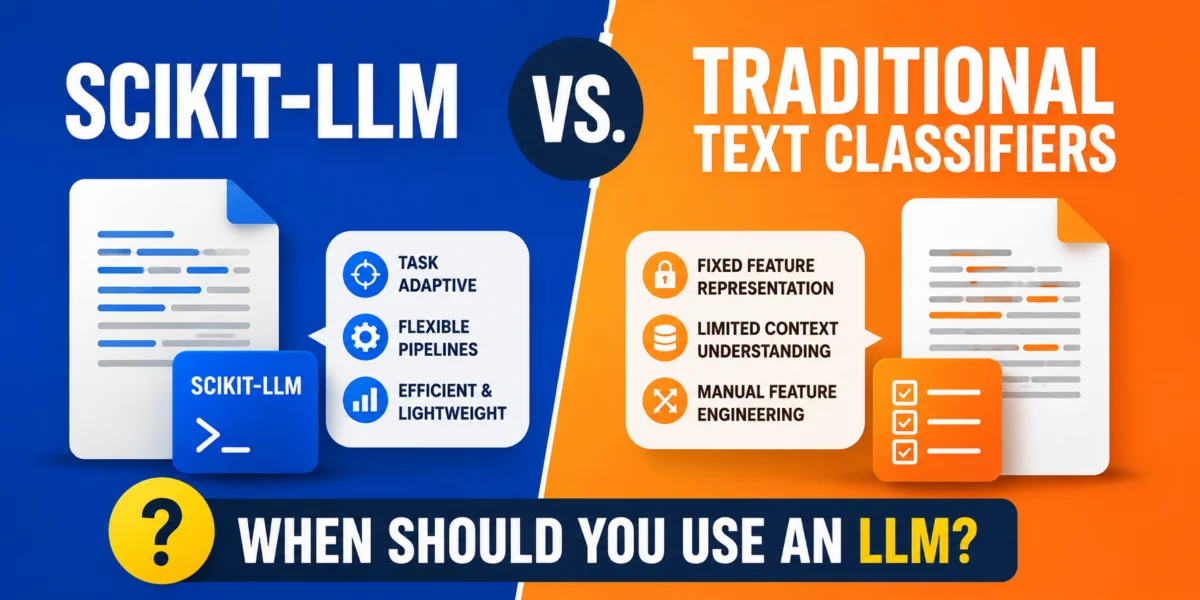

The evolving landscape of artificial intelligence continues to redefine the boundaries of what’s possible in natural language processing, particularly in text classification. Recent years have witnessed a significant shift, with generative AI models like Large Language Models (LLMs) increasingly challenging, and in many cases surpassing, classical machine learning approaches for complex tasks such as categorizing text. However, the notion of a universal "one-size-fits-all" solution remains elusive. Instead, developers and researchers are faced with critical trade-offs, prompting a rigorous examination of when to adhere to established, battle-tested conventional models, when to invest in fine-tuning sophisticated transformer-based LLMs, or when to leverage the potent zero-shot reasoning capabilities of pre-trained LLMs. A recent benchmarking exercise meticulously compared three distinct methodologies for text classification, shedding light on their respective strengths, weaknesses, and optimal application scenarios.
The Evolution of Text Classification: A Historical Context
Text classification, a fundamental task in natural language processing, has undergone several transformative phases. Initially, approaches were largely rule-based, relying on manually crafted patterns and dictionaries. While effective for highly structured texts, these systems lacked flexibility and scalability. The advent of statistical machine learning marked a significant leap, with techniques like Naive Bayes, Support Vector Machines (SVMs), and Logistic Regression becoming standard. These models often operated on feature representations derived from text, such as bag-of-words or Term Frequency-Inverse Document Frequency (TF-IDF). TF-IDF, which assigns weights to words based on their frequency in a document relative to their frequency across a corpus, became a cornerstone for its simplicity and effectiveness in capturing keyword relevance.
The early 2010s saw the rise of deep learning, introducing neural networks like Recurrent Neural Networks (RNNs) and Long Short-Term Memory (LSTM) networks, capable of understanding sequential data and capturing long-range dependencies in text. However, these models often required extensive labeled datasets and significant computational resources for training. The most recent paradigm shift arrived with transformer architectures, pioneered by Google’s "Attention Is All You Need" paper in 2017. Models like BERT, GPT, and BART, built upon the attention mechanism, demonstrated unprecedented capabilities in understanding context and generating human-like text. Their pre-training on massive text corpora enabled them to learn deep linguistic patterns, making them highly versatile for various downstream tasks, often with minimal or no additional training (few-shot or zero-shot learning).
The emergence of Large Language Models (LLMs) as a subset of these transformer models has further democratized advanced NLP capabilities. LLMs, with billions or even trillions of parameters, encapsulate a vast amount of world knowledge and intricate language understanding, allowing them to perform complex reasoning and generation tasks with remarkable proficiency. This background provides crucial context for understanding the comparative performance of the three approaches benchmarked: a classical TF-IDF pipeline, a transformer-based zero-shot model, and a state-of-the-art zero-shot LLM.
Designing the Benchmarking Initiative
To provide a clear comparison, the benchmarking initiative focused on a common, real-world application: customer support ticket classification. The objective was to categorize incoming messages into five distinct classes: "Technical," "Billing," "Account," "Sales," and "Refund." A small, synthetic dataset was deliberately created for this purpose, comprising 50 customer support messages, 10 for each category. The choice of a limited dataset was strategic, aiming to highlight scenarios where data scarcity is a common challenge, thereby underscoring the value proposition of models that can perform effectively without extensive task-specific training.
The dataset was structured into a Pandas DataFrame and subsequently split into training and test sets using a stratified sampling approach. This ensured that each of the five categories was proportionally represented in both the training (70%) and testing (30%) subsets, crucial for obtaining reliable performance metrics from a small sample. This rigorous setup aimed to simulate real-world conditions where rapid deployment and accurate classification on new, unseen data are paramount. The tutorial was made entirely free, utilizing scikit-LLM alongside a model provided by Groq, requiring only a Groq API key for the LLM evaluation phase.
Approach 1: The Traditional Workhorse – TF-IDF with Logistic Regression
The first approach served as a foundational baseline: the combination of TF-IDF for feature extraction and Logistic Regression for classification. This pipeline represents a classical machine learning methodology, renowned for its simplicity, speed, and interpretability. TF-IDF vectorizes text by quantifying the importance of words in a document relative to a collection of documents, effectively filtering out common words while highlighting unique terms. Logistic Regression, a linear model, then learns to classify these vectorized texts.
Implementation:
The process involved creating a scikit-learn pipeline with TfidfVectorizer and LogisticRegression. The model was trained on X_train and y_train, and predictions were made on X_test. Latency was meticulously measured from the start of training to the completion of inference.
Performance Analysis:
The Logistic Regression classifier demonstrated remarkable speed, completing the entire process in approximately 0.0615 seconds. However, its classification performance was notably mixed. While it achieved perfect precision and recall for the "Billing" category (1.00 for both) and strong results for "Refund" (0.67 for both), it struggled significantly with "Account" and "Sales" (0.25 precision, 0.33 recall for both), and "Technical" (1.00 precision, 0.33 recall). The aggregated accuracy ranged between 0.53 and 0.55.
This outcome is characteristic of TF-IDF’s limitations. While efficient, it operates at a lexical level, failing to capture the complex semantic nuances and contextual meanings inherent in human language. For instance, "My screen is black" and "The app keeps crashing" are both "Technical" issues, but TF-IDF might struggle to generalize if the exact keywords aren’t present in its learned vocabulary or if the phrasing deviates. Its limited ability to capture intricate linguistic patterns restricts its performance on tasks requiring deeper understanding, despite its impressive speed.
Approach 2: The Transformer Bridge – Zero-Shot Classification with BART
The second approach introduced a significant leap in complexity and capability: zero-shot classification using a transformer model, specifically facebook/bart-large-mnli. Transformers revolutionized NLP by employing attention mechanisms, allowing models to weigh the importance of different words in a sentence, thereby grasping context more effectively than previous architectures. BART, an encoder-decoder transformer, is pre-trained on various tasks, including denoising text, making it highly adept at language understanding. The mnli (Multi-Genre Natural Language Inference) variant is particularly suited for zero-shot classification because it can frame the classification task as an entailment problem: "Does the input text entail the label?"
Implementation:
A HuggingFace zero-shot classification pipeline was instantiated with facebook/bart-large-mnli. The model was provided with a list of candidate_labels ("Technical", "Billing", "Account", "Sales", "Refund"). Each text in X_test was then passed through the classifier, and the label with the highest score was selected as the prediction. Latency was measured across the entire inference loop.
Performance Analysis:
The transformer-based approach demonstrated a substantial improvement in accuracy compared to the classical method, achieving an overall accuracy between 0.64 and 0.67. It showed better performance across categories, with "Refund" and "Technical" reaching impressive f1-scores of 0.86, and "Account" improving to 0.50. This improvement highlights the transformer’s superior ability to understand linguistic context and semantics, even without direct training on the specific classification task.
However, this enhanced understanding came at a significant cost in terms of latency. The inference time for the BART model was approximately 32.2503 seconds, a dramatic increase compared to the 0.06 seconds of the TF-IDF pipeline. This elevated latency is typical for large transformer models, which require more computational resources for processing due to their complex architecture and parameter count. While the accuracy gain was modest, it confirmed that more sophisticated models could indeed discern more subtle distinctions in text.
Approach 3: The LLM Frontier – Zero-Shot Classification with scikit-LLM and Groq
The final and most advanced approach involved zero-shot classification using a Large Language Model (LLM) powered by Groq’s specialized hardware, integrated via the scikit-LLM library. scikit-LLM is designed to bridge the gap between traditional scikit-learn interfaces and modern LLMs, providing a familiar API for developers to leverage state-of-the-art language models. Groq, on the other hand, is known for its Language Processing Unit (LPU) inference engine, engineered to deliver unparalleled speed for LLM workloads. The specific model used was llama-3.3-70b-versatile, hosted on Groq’s platform.
Implementation:
The setup involved configuring scikit-LLM with a Groq API key and specifying Groq’s OpenAI-compatible API endpoint. The ZeroShotGPTClassifier from scikit-LLM was initialized with the llama-3.3-70b-versatile model. Crucially, in a zero-shot setup, the LLM leverages its extensive pre-training to classify text based on the provided labels, without requiring any specific training phase on the target dataset. The fit method here primarily configures the classifier with the available labels, rather than learning from data in the traditional sense. Predictions were then generated for X_test, and latency was recorded.
Performance Analysis:
This approach yielded the most compelling results, demonstrating a classification accuracy of 0.86 to 0.87, significantly outperforming both the TF-IDF and BART models. Categories like "Refund" and "Sales" achieved perfect f1-scores of 1.00, while "Technical" and "Billing" also showed strong performance.
What was particularly surprising and noteworthy was the LLM’s latency: approximately 2.5905 seconds. This speed was not only drastically faster than the BART transformer (32.25 seconds) but also highly competitive, especially considering the massive scale and capability of the LLM. This exceptional speed can be directly attributed to Groq’s innovative LPU architecture, which is specifically optimized for high-throughput, low-latency LLM inference. Unlike general-purpose GPUs, LPUs are designed to eliminate bottlenecks in sequential operations common in transformer models, enabling faster token generation and, consequently, quicker classification.
The LLM’s superior accuracy stems from its vast pre-trained knowledge base. Having been exposed to an immense diversity of text during its training, the model already possesses a profound understanding of language, context, and common real-world scenarios. It doesn’t need to "learn" what a customer support ticket about a "black screen" or a "double charge" implies; it already "knows" through its inherent linguistic intelligence, making it incredibly effective in zero-shot settings with limited domain-specific data.
Comparative Data and Strategic Implications
To consolidate the findings, a direct comparison of the three approaches highlights the critical trade-offs:
| Approach | Key Technology | Latency (seconds) | Overall Accuracy (F1-score range) | Data Requirement | Computational Cost (Inference) | Semantic Understanding | Best Use Case |
|---|---|---|---|---|---|---|---|
| Classical ML | TF-IDF + LogReg | 0.06 | 0.53 – 0.55 | High (labeled) | Very Low | Low (lexical) | High-volume, simple tasks, resource-constrained env. |
| Zero-Shot Transformer | BART-large-mnli | 32.25 | 0.64 – 0.67 | Low (zero-shot) | Moderate to High | Moderate | Nuanced tasks, limited data, acceptable latency |
| Zero-Shot LLM (Groq) | Llama-3.3-70b-versatile | 2.59 | 0.86 – 0.87 | Very Low (zero-shot) | Low (with specialized hardware) | High | Complex tasks, data scarcity, high accuracy/speed |
Note on Costs: While the tutorial utilized Groq’s service without API rate limits for the purpose of the exercise, real-world deployment of LLMs via API typically involves usage-based costs. These costs can vary significantly depending on the model, provider, and volume of requests, making it an important factor for commercial applications. Conversely, self-hosting transformer models or classical ML approaches entails upfront hardware and maintenance costs.
When Should You Use an LLM for Text Classification?
The findings of this benchmark provide a clear answer to the central question: when should you use an LLM for text classification? The choice is highly dependent on the specific requirements of the task, the available data, and resource constraints.
-
Classical ML (TF-IDF + Logistic Regression): This approach remains highly relevant for tasks where:
- Latency is paramount: When classification needs to happen in milliseconds.
- Data is abundant: You have a large, well-labeled dataset for training.
- Complexity is low: The classification problem doesn’t require deep semantic understanding or nuanced interpretation.
- Resources are limited: Computational power or budget for advanced models is restricted.
- Examples include simple spam detection, basic sentiment analysis with clear keyword indicators, or high-throughput routing of well-defined categories.
-
Zero-Shot Transformers (like BART): These models occupy a valuable middle ground when:
- Semantic understanding is required: The task demands more context and nuance than classical methods can provide.
- Labeled data is scarce: You don’t have enough data to fine-tune a task-specific model, but want to leverage pre-trained intelligence.
- Latency is a consideration, but not critical: You can tolerate response times in the seconds-to-tens-of-seconds range.
- They are suitable for prototyping or applications where a moderate accuracy boost over classical methods is acceptable, and the cost of dedicated LLM APIs might be prohibitive.
-
Zero-Shot LLMs (e.g., Llama-3.3-70b-versatile via scikit-LLM/Groq): This is the clear winner for tasks that demand:
- Deep linguistic reasoning and contextual understanding: When the classification requires interpreting subtle meanings, sarcasm, or complex phrasing, especially on a small, toy dataset as demonstrated.
- Data scarcity: When labeled data is extremely limited, and you need to deploy a highly accurate classifier quickly without extensive data annotation or model fine-tuning. This drastically reduces the time and infrastructure costs typically associated with training models of such magnitude from scratch.
- High accuracy and competitive speed: For mission-critical applications where precision is key, and rapid inference is achievable through specialized hardware like Groq’s LPUs.
- Rapid prototyping and deployment: Leveraging
scikit-LLMallows developers to integrate powerful LLMs into existingscikit-learn-like pipelines with minimal effort, accelerating the development cycle. - Examples include sophisticated customer support routing, nuanced legal document classification, medical text analysis, or any domain where human-level understanding of text is essential.
Broader Impact and Future Directions
The convergence of powerful LLMs and high-performance inference platforms like Groq signals a significant shift in the MLOps landscape. The ability to achieve superior accuracy with competitive latency in zero-shot settings reduces the dependency on large, domain-specific labeled datasets, which are often expensive and time-consuming to acquire. This democratizes access to advanced AI capabilities, allowing smaller organizations or projects with limited resources to deploy sophisticated NLP solutions.
Furthermore, libraries like scikit-LLM play a crucial role in making these cutting-edge technologies accessible to a broader developer community. By providing a standardized, scikit-learn-like interface, they lower the barrier to entry, enabling seamless integration of LLMs into existing machine learning workflows. This "bridge" between classical and modern AI empowers developers to easily swap between different model architectures, from a traditional logistic regressor to a state-of-the-art LLM, optimizing for specific performance and resource trade-offs as needed.
The future of text classification will likely see continued innovation in LLM efficiency, with specialized hardware and optimized model architectures pushing the boundaries of speed and accuracy. The increasing focus on zero-shot and few-shot learning will empower developers to build highly capable AI systems with less data, accelerating the adoption of AI across various industries. This benchmark serves as a timely reminder that while new technologies bring unprecedented power, a thoughtful and empirical comparison remains essential for making informed decisions about their application.
