
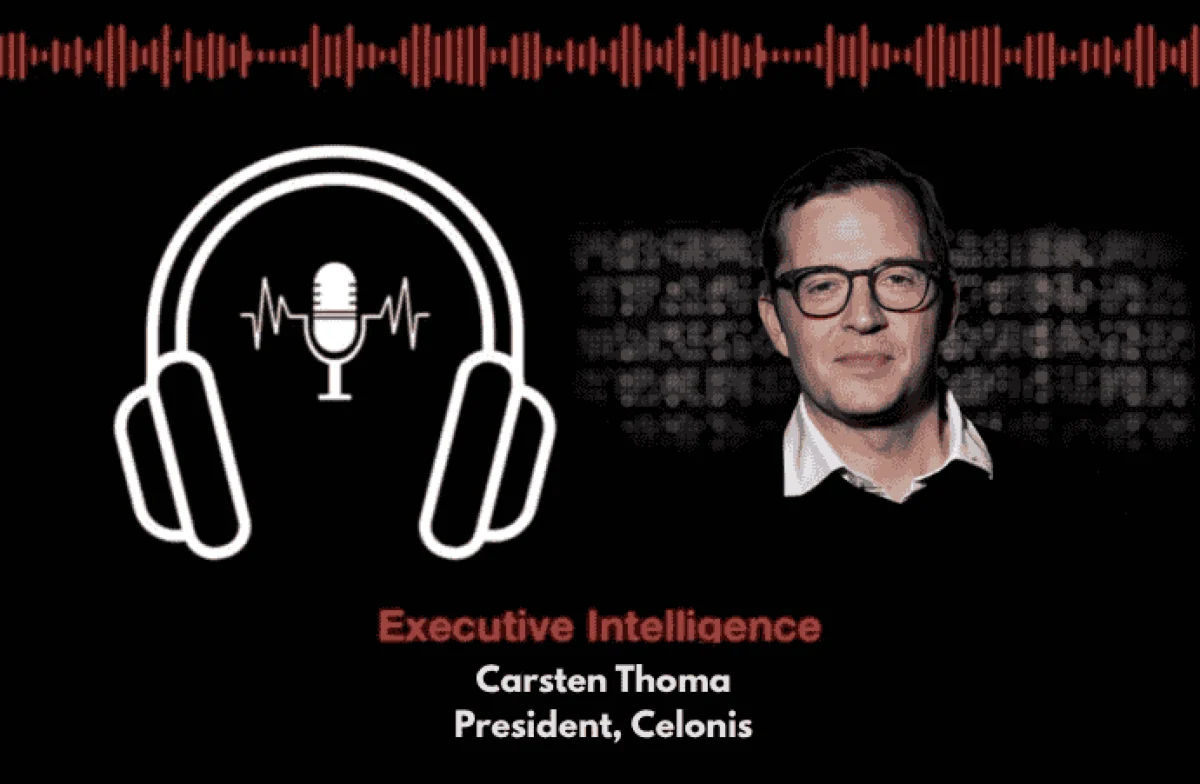

The enterprise artificial intelligence market is currently navigating a profound structural paradox. While technology vendors are accelerating the release of autonomous agents and sophisticated automation tools at an unprecedented pace, Chief Information Officers (CIOs) across the global landscape report a persistent lack of material returns on these investments. This widening disconnect between the hype of generative AI and the reality of operational efficiency was the central theme of a recent deep-dive discussion with Carsten Thoma, President of Celonis, on the diginomica Executive Intelligence podcast. Thoma, a veteran of multiple technology cycles, argues that the missing link in the current AI gold rush is not a lack of features or agents, but a fundamental lack of operational context—a grounded, system-agnostic understanding of how a business actually functions before automation is ever applied.
The Architect of Modern Enterprise Commerce
To understand Thoma’s perspective is to understand the evolution of enterprise software over the last three decades. His insights are informed by a career defined by navigating major technological disruptions. In 1997, Thoma co-founded Hybris, which eventually became the industry-leading enterprise e-commerce platform. Following its acquisition by SAP in 2013 for approximately $1.5 billion, Thoma transitioned to lead SAP’s Customer Experience (CX) division as President. His relationship with Celonis began in 2016 as the company’s first external investor and board adviser. In 2023, he stepped into the role of President to lead corporate strategy and innovation alongside co-CEOs Alex Rinke and Bastian Nominacher.
This trajectory provides Thoma with a unique vantage point on the current AI cycle. Having seen the rise of e-commerce, the transition to the cloud, and the consolidation of the SaaS market, his assessment of the "AI era" is one of cautious pragmatism. He suggests that while Large Language Models (LLMs) have mastered the nuances of human language and unstructured data, they remain fundamentally disconnected from the "system level" where the actual work of a modern corporation occurs.
The Limits of Language and the Need for Process Intelligence
The core of the current AI struggle lies in the complexity of modern business processes. According to Thoma, LLMs are exceptionally proficient at interpreting user intent, generating code, and summarizing documents. However, enterprise operations are rarely contained within a single, tidy application. Instead, core processes—such as "Order-to-Cash" or "Procure-to-Pay"—typically span an average of 25 to 30 different heterogeneous systems. These systems generate cryptic event logs and data points that, without translation, remain indecipherable to standard AI models.
To bridge this gap, Celonis has developed specialized transformer models designed to translate system-level event codes into a coherent "process language." This creates what Thoma calls an "operational digital twin"—an unbiased, real-time map of how processes actually flow across an organization, rather than how management assumes they flow. Without this digital twin, Thoma argues that organizations deploying AI agents are essentially "flying blind." They lack the necessary visibility to determine if a process is stable enough for automation, if it requires human intervention, or if the process itself is so broken that it needs to be completely redesigned before any technology is applied.
Data Sovereignty and the Free the Process Movement
A significant portion of the current tension in the tech sector revolves around value capture and vendor lock-in. As AI vendors build proprietary ecosystems, there is a growing concern that they are creating "walled gardens" that restrict a customer’s ability to see their entire operational reality. Thoma’s "Free the Process" initiative is a direct challenge to these dynamics.
The argument is rooted in the principle of data ownership. Thoma asserts that the data generated by a company’s operations—its transactions, logistics, and customer interactions—belongs exclusively to that company, not the software vendor providing the platform. "The data reflects the business reality of the customer," Thoma noted. "The customer already pays for those systems to host the data. So who does it belong to? For sure, not the vendor."
This perspective aligns with a broader shift in the market where enterprises are becoming increasingly wary of "AI tax" models—pricing structures where vendors charge premiums for AI features that rely on the customer’s own data. By advocating for a system-agnostic view of processes, Celonis is positioning itself as a neutral layer that allows companies to orchestrate AI agents across multiple vendor platforms (such as SAP, Oracle, and Salesforce) without being tethered to a single provider’s roadmap.
The SaaS-pocalypse and the Evolution of BPO
The discussion also touched upon the controversial concept of the "SaaS-pocalypse." While the term is often dismissed as hyperbole, it reflects a genuine shift in how CIOs view their software stacks. Recent market data suggests that as the cost of internal software development drops—aided by AI-assisted coding—enterprises are reconsidering the value proposition of generic SaaS tools that lack deep, differentiated data or critical business context.
Thoma predicts a bifurcation in the market. Tools that offer little more than a user interface for standard tasks are at high risk of being replaced by internal builds or automated agents. Conversely, large-scale vendors with deep operational history will likely evolve. Thoma offered a provocative vision of the future: a next generation of Business Process Outsourcing (BPO), powered by AI. In this scenario, the relationship between a vendor and a customer shifts from a software license model to an operational service model, where the vendor is paid based on the successful execution of a business function rather than the number of "seats" or users on a platform.
A New Social Contract for the AI Era
Perhaps the most striking part of Thoma’s analysis was his focus on the societal and organizational impact of widespread automation. While many tech executives focus purely on efficiency gains and "upskilling," Thoma addressed the more difficult questions of purpose and belonging.
He acknowledged that organizations must pursue AI-driven efficiency to remain competitive and protect their long-term viability. However, he warned that economic security alone—such as the implementation of a Universal Basic Income (UBI)—does not address the psychological needs of the workforce. "General income doesn’t solve the state of happiness and stability for individuals," Thoma argued. He suggested that as AI takes over more defined business functions, society must renegotiate the "social contract" to ensure that people can find purpose in a world where traditional job roles are fundamentally altered.
This level of candor is rare in the executive suite. It reflects an understanding that the AI transition is not merely a technical upgrade, but a profound shift in the relationship between labor, value, and identity. Thoma’s advice to leaders is to practice radical honesty with their employees as early as possible, acknowledging the changes ahead while actively working to define new forms of organizational contribution.
Geopolitical Implications: Europe’s Applied AI Opportunity
Finally, the conversation turned to the global AI value chain. While the United States currently holds a dominant position in the development of foundational LLMs—driven by the likes of OpenAI, Google, and Anthropic—Thoma believes that the next phase of the AI revolution favors regions with deep industrial and enterprise expertise.
Europe and Asia, with their strong manufacturing bases and complex supply chains, are well-positioned to lead in "applied AI." The challenge, however, lies in regulatory alignment and ambition. For Europe to seize this opportunity, it must move beyond being a "regulatory superpower" and become an "adoption superpower," creating an environment where process intelligence can be used to modernize its industrial core.
Chronology of the Enterprise AI Shift
To contextualize Thoma’s insights, it is helpful to look at the timeline of the current AI cycle:
- 2022-2023: The "Hype Phase." The release of ChatGPT triggers a rush to integrate LLMs into every enterprise software category.
- Early 2024: The "Reality Check." CIOs begin to report that while pilots are successful, scaling AI across complex processes is yielding diminishing returns.
- Mid-2024 to Present: The "Contextual Turn." The industry shifts focus from general-purpose models to "agentic AI" and specialized models that require deep operational context and process mining to function.
Fact-Based Analysis of Implications
The implications of Thoma’s "context-first" approach are significant. For the enterprise, it means that the first step toward AI maturity is not buying more software, but achieving "process excellence." According to industry data, companies that invest in process mining before automation see a 30% higher ROI on their digital transformation projects compared to those who do not.
Furthermore, the emphasis on data sovereignty suggests a coming clash between "platform" vendors and "orchestration" vendors. If customers successfully assert ownership over their operational data, the power dynamic in the software industry will shift. Value will migrate away from the systems that store the data and toward the systems that understand and act on it.
In conclusion, Carsten Thoma’s perspective serves as a sobering reminder that in the world of enterprise technology, there are no shortcuts. The promise of AI agents and autonomous businesses can only be realized when they are built upon a foundation of deep, system-agnostic operational intelligence. As the market moves from the excitement of "what AI can say" to the utility of "what AI can do," the winners will be those who prioritize context over features and transparency over lock-in.
