
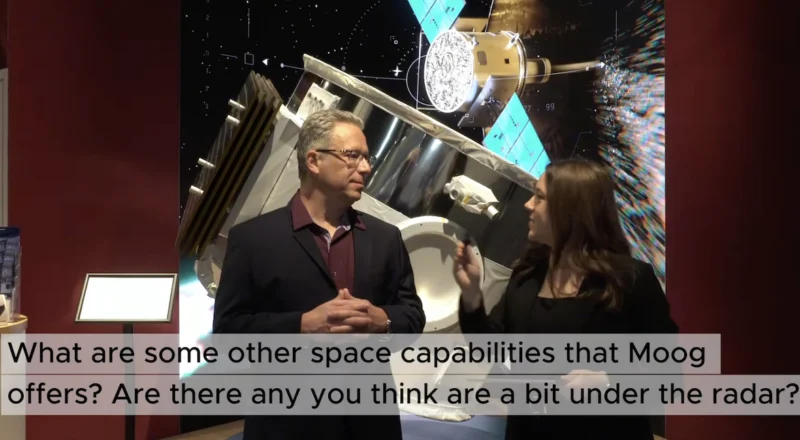

The aerospace industry is currently witnessing a transformative era defined by the return to lunar exploration and the rapid proliferation of versatile satellite constellations. At the center of this evolution is Moog Inc., a long-standing leader in precision control systems, whose contributions are foundational to NASA’s Artemis program and the broader commercial satellite market. During the 39th annual Space Symposium in Colorado Springs, Mark Covelli, Senior Vice President of Moog’s Space business, detailed the company’s dual focus on supporting the next generation of human spaceflight and scaling its internal production capacity to meet an unprecedented surge in global demand. Through its work on the Space Launch System (SLS) and the Orion crew capsule, as well as the promotion of its modular Meteor satellite bus, Moog is positioning itself as a critical architect of the modern space economy.
The Role of Moog in the Artemis II Mission
The Artemis II mission represents a pivotal milestone for NASA and its international partners, marking the first time in over fifty years that humans will travel to the vicinity of the Moon. As the successor to the successful uncrewed Artemis I mission, Artemis II will test the integrated systems of the SLS rocket and the Orion spacecraft with a crew of four astronauts on board. Moog’s involvement in this mission is both extensive and mission-critical, spanning across the launch vehicle and the crew module.
Moog’s contributions to the Space Launch System are centered on the rocket’s propulsion and steering mechanisms. The company provides the Thrust Vector Control (TVC) systems for both the core stage and the solid rocket boosters. These systems are responsible for pivoting the rocket engines to steer the vehicle during its ascent through the atmosphere. Without the precision provided by Moog’s actuators and controllers, the SLS would be unable to maintain its trajectory or achieve the precise orbital insertion required for lunar transit.
Furthermore, Moog’s technology is deeply embedded within the Orion crew capsule. One of the most vital aspects of the Orion spacecraft is the Environmental Control and Life Support System (ECLSS). During the interview at the Space Symposium, Covelli highlighted Moog’s role in ensuring the safety and survival of the crew through these systems. The ECLSS is a complex network of hardware designed to regulate cabin pressure, manage oxygen levels, remove carbon dioxide, and control the temperature within the capsule. Moog provides the specialized valves, regulators, and fluid control components that allow these life-sustaining processes to function reliably in the harsh vacuum of space. The reliability of these systems is paramount, as Artemis II will take the crew further into deep space than any previous human-rated spacecraft.
Technical Versatility: The Meteor Satellite Bus
While Moog’s heritage is firmly rooted in heavy-lift launch vehicles and crewed spacecraft, the company is also making significant strides in the rapidly expanding small and medium satellite markets. A centerpiece of Moog’s exhibit at the Space Symposium was a scale model of the Meteor satellite bus. This platform is designed to offer a balance between high performance and cost-effectiveness, catering to both government and commercial operators.
The Meteor bus is built upon Moog’s Integrated Avionics Unit (IAU), a sophisticated command and data handling system that has achieved a remarkable flight heritage. The IAU has been deployed on hundreds of missions, providing a proven foundation for the Meteor platform. This heritage reduces the technical risk for customers, a crucial factor in an industry where mission failure can result in the loss of hundreds of millions of dollars.
One of the defining characteristics of the Meteor bus, as emphasized by Covelli, is its modularity. In the modern space sector, customers frequently require platforms that can be tailored to specific mission profiles without the need for a ground-up redesign. The Meteor architecture allows Moog to scale the bus for a wide range of applications. These include:
- Earth Observation (EO): The bus can support high-resolution cameras and sensors used for environmental monitoring, urban planning, and agricultural analysis.
- Synthetic Aperture Radar (SAR): Because SAR missions require high power and precise pointing, the Meteor bus’s robust power systems and stable platform make it an ideal candidate for all-weather, day-and-night imaging.
- National Security Space: The modular nature of the bus allows for the integration of classified payloads and secure communication links required by defense agencies.
By offering a standardized yet flexible bus, Moog is addressing the industry-wide shift toward "plug-and-play" satellite architectures, which significantly reduces the time from contract award to launch.
Strategic Investment in Production Capacity
The global space industry is no longer characterized by sporadic, bespoke missions. Instead, it has transitioned into a high-cadence environment driven by the deployment of large-scale constellations and the acceleration of lunar exploration schedules. To keep pace with this shift, Moog has embarked on a strategic initiative to expand its production capacity.
Covelli noted that Moog is investing heavily in its manufacturing infrastructure to ensure that it can support an increasing number of customer missions simultaneously. This scaling effort involves more than just increasing floor space; it includes the adoption of advanced manufacturing techniques such as additive manufacturing (3D printing), automated assembly, and digital twin technology. These innovations allow Moog to produce complex components—such as bipropellant valves and high-pressure regulators—with greater speed and tighter tolerances than traditional methods allowed.
The focus on production capacity is also a response to the broader supply chain challenges that have impacted the aerospace sector over the last several years. By vertically integrating more of its manufacturing processes and securing long-term agreements with key suppliers, Moog aims to insulate its customers from delays. This industrialization of space hardware production is essential for the sustainability of programs like Artemis, which requires a steady pipeline of hardware for subsequent missions (Artemis III, IV, and beyond).
Context: The Significance of the Space Symposium
The Space Symposium, held annually in Colorado Springs, serves as the premier gathering for the global space community. It brings together leaders from military, civil, and commercial sectors to discuss the future of space exploration and security. For a company like Moog, the event provides a platform to demonstrate how its legacy of precision engineering is evolving to meet the needs of "New Space" players.
The 2024 symposium occurred at a time of heightened international competition and cooperation. With the Artemis Accords gaining more signatories and commercial companies like SpaceX and Blue Origin making rapid progress, the role of established Tier 1 suppliers like Moog has become more critical. These companies provide the "picks and shovels" of the space gold rush—the essential, high-reliability components that make complex missions possible.
Chronology of Moog’s Space Evolution
To understand Moog’s current position, it is necessary to look at the timeline of its contributions to the field:
- 1950s-1960s: Moog establishes itself as a leader in servovalves, contributing to the early U.S. space program, including the Saturn V rocket that powered the Apollo missions.
- 1980s-2011: The company becomes a staple of the Space Shuttle program, providing critical flight control actuators and propulsion components.
- 2010s: Moog begins the development of the IAU and expands its satellite bus offerings, recognizing the shift toward smaller, more agile spacecraft.
- 2022: Artemis I successfully launches, validating Moog’s TVC and ECLSS components in a flight environment.
- 2024: Moog showcases the Meteor bus and announces expanded production capabilities at the Space Symposium, preparing for the crewed Artemis II mission.
Official Perspectives and Market Implications
Industry analysts view Moog’s strategy as a necessary adaptation to a bifurcated market. On one hand, there is the high-reliability, "fail-safe" requirement of NASA’s human spaceflight programs. On the other, there is the rapid-turnaround, cost-sensitive commercial satellite market. By leveraging the flight heritage of the IAU and the modularity of the Meteor bus, Moog is effectively straddling both worlds.
While official statements from NASA have consistently praised the performance of the SLS and Orion systems during Artemis I, the pressure is on for all contractors to maintain this excellence for Artemis II. The transition from an uncrewed test to a crewed mission raises the stakes exponentially. Covelli’s emphasis on ECLSS highlights this reality; when human lives are at stake, there is zero margin for error in atmospheric regulation.
The market implications of Moog’s Meteor bus are also significant. As more nations seek to establish their own domestic space capabilities, they are looking for "off-the-shelf" solutions that can be customized. Moog’s ability to scale the Meteor bus for missions ranging from low-Earth orbit (LEO) to geosynchronous orbit (GEO) positions them to capture a significant share of the international satellite market.
Analysis: The Future of Modular Space Architecture
The move toward modularity, as described by Covelli, reflects a broader trend in aerospace engineering. In the past, a satellite bus was often designed specifically for a single payload. This led to long development cycles and high costs. Moog’s approach with the Meteor bus—using a common avionics core (the IAU) and a scalable structure—mirrors the automotive industry’s use of common vehicle platforms.
This shift has three primary benefits for the space industry:
- Cost Reduction: Shared components and assembly lines lower the per-unit cost.
- Reliability: Using a platform with hundreds of successful missions reduces the likelihood of "infant mortality" in new satellites.
- Speed to Market: Modular designs allow for faster integration of new sensors, enabling operators to respond more quickly to market demands or emerging threats.
As Moog continues to invest in its production capacity, the company is not merely selling hardware; it is providing the infrastructure for the next century of space activity. Whether it is steering the world’s most powerful rocket or providing a stable platform for a SAR satellite to peer through clouds, Moog’s precision control systems remain the silent enablers of orbital and lunar success. The insights shared by Mark Covelli at the Space Symposium underscore a company that is deeply proud of its history but remains focused on the rigorous demands of the future.
