
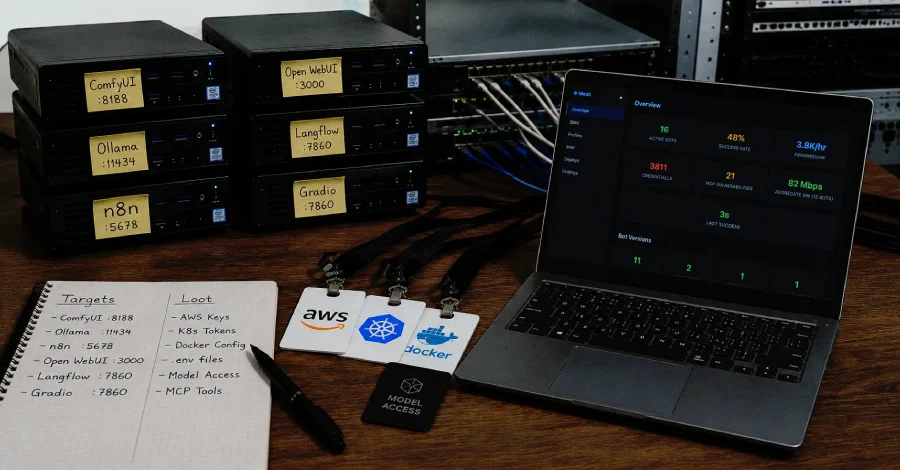

A sophisticated Go-based botnet, dubbed NadMesh, emerged in early July, specifically engineered to hunt for exposed Artificial Intelligence (AI) services and harvest sensitive cloud credentials. The threat, meticulously detailed in a recent report by QiAnXin’s XLab, underscores a critical and evolving vulnerability landscape within the rapidly expanding AI infrastructure. Initial findings from the botnet operator’s own dashboard indicate a successful acquisition of at least 3,811 unique AWS keys, signaling a dangerous shift in cybercriminal focus from simple resource exploitation to deep cloud environment compromise.
The Rise of NadMesh: A New Threat to AI Infrastructure
NadMesh, named after the "n4d mesh controller" string found within its source code, represents a "product-grade threat" for the burgeoning AI service era. Its emergence highlights the precarious security posture of many AI development and deployment environments, which are often stood up quickly by development teams, with security considerations, particularly robust firewalling and authentication, implemented as an afterthought. This speed-over-security paradigm has created fertile ground for advanced persistent threats like NadMesh.
The botnet’s scanning mechanism, powered by a Shodan harvester, is designed to keep its queue perpetually stocked with targets. It specifically seeks out a range of popular AI-related services, including ComfyUI (an image generation workflow tool), Ollama (a local large language model runner), n8n (a workflow automation platform), Open WebUI, Langflow (AI flow builders), and Gradio (a tool for creating web UIs for machine learning models). These platforms, while enabling rapid innovation, often present an expansive attack surface when exposed without adequate protection.
Deep Dive into NadMesh’s Intelligence and Operational Data
According to XLab’s analysis of the botnet operator’s dashboard, captured on July 10, the intelligence feed driving NadMesh’s operations is highly active. Out of its last 100 recorded activities, 47 involved successful credential hauls, and 41 entailed model inventories. The presence of DeepSeek, GLM, and Kimi identifiers tagged with ":cloud" within these inventories is particularly alarming. This suggests that the botnet’s cataloging efforts extend beyond the immediate host environment, reaching into the broader cloud infrastructure to which these AI models are connected. This capability implies a strategic intent to not just compromise individual servers but to gain pervasive access to cloud resources, potentially leading to widespread data exfiltration, intellectual property theft, or further resource abuse.
However, XLab’s report also highlights significant inconsistencies within the operator’s self-reported metrics, raising questions about the true scale and success rate of the operation. For instance, the dashboard displayed a counter of 17,700 total deploys alongside a funnel claiming 95,700 deploys in the past 24 hours. Similarly, one tile reported 16 active bots, while another stated 12. The number of unique credentials harvested was, at least, consistently stated twice. These discrepancies could be indicative of internal tracking issues, or more strategically, a deliberate attempt by the operators to obfuscate their true operational scale from potential monitors and researchers.

In contrast to the operator’s potentially misleading figures, XLab’s own sensors provide an external, more reliable measure of NadMesh’s activity. Through late June, distinct source IPs pushing NadMesh activity remained near zero. However, in the first week of July, this number spiked dramatically, reaching approximately 139 unique IPs per day. This sudden surge corroborates the botnet’s aggressive deployment timeline and its rapid expansion in targeting vulnerable AI services.
The Strategic Objective: Cloud Credential Harvesting
The core objective of the NadMesh botnet is unequivocally clear: to harvest cloud credentials and obtain privileges within cloud environments and Kubernetes clusters. Researchers from QiAnXin explicitly stated that the operator is after "not the host itself, but the cloud credentials, Kubernetes cluster privileges" residing on it. The botnet meticulously siphons off sensitive information such as cloud keys from environment variables, Kubernetes service account tokens, and the contents of critical configuration files like ~/.aws/config, .env, and ~/.docker/config.json. Furthermore, model access and the ability to call Multi-Cloud Protocol (MCP) tools round out the list of coveted assets.
The priority order for exploitation, as observed in the controller’s configuration, places MCP at the top, superseding Kubernetes, Docker API, and Redis. The specific vector noted by XLab in conjunction with MCP is a JSON-RPC tools/call to execute_command. While no specific CVE is attached to this line, and the report does not claim a new one, it highlights a critical vulnerability in how MCP is often deployed.
The Model Context Protocol: An Exploitable Blind Spot
The Model Context Protocol (MCP) is designed to facilitate communication and control within AI model ecosystems. However, its initial specification, released on November 5, 2024, conspicuously placed authentication outside the core protocol. Although an authorization flow was added in March 2025, the specification itself notes that this feature remains optional. This optionality has led to numerous deployments skipping robust authentication, inadvertently creating a significant security loophole.
Censys, a leading attack surface management platform, highlighted this vulnerability in its own research. As of April 28, Censys counted 12,520 reachable MCP services across 8,758 IP addresses, a number that swelled to over 21,000 by May 6. Alarmingly, approximately 90 of these services openly advertised a tool that could run commands, with 39 specifically exposing the execute_command function – the exact call prioritized by NadMesh.
Despite the botnet’s apparent focus on MCP, its own internal counters regarding MCP vulnerabilities are perplexing. The dashboard listed 12,100 MCP services as exploitable and 21 overall MCP vulnerabilities, yet reported none among the last 100 intel records on display. This disparity further complicates the assessment of the botnet’s true success in exploiting MCP.

Exploitation Vectors: Beyond AI-Specific Flaws
While AI services and MCP are primary targets, NadMesh does not exclusively rely on novel AI-specific exploits. XLab’s observed exploit traffic reveals a broader attack strategy that incorporates common, yet persistently exploited, vulnerabilities. The firm charted the exploit traffic it observed, showing that docker_containers_api_rce accounts for a substantial 30.31% of attempts, followed by jenkins_scripttext_rce at 22.28%. Weak Telnet passwords contribute 10.36%, and Redis vulnerabilities make up 8.29% of the observed exploit attempts.
Interestingly, while mcp_cmd_execute is present on XLab’s chart, indicating its use in observed traffic, it resides in the unlabeled "tail" of vulnerabilities, accounting for a mere 0.78%. This discrepancy between the operator’s stated priority and the observed exploit distribution suggests that NadMesh operators are opportunistic, leveraging a diverse set of well-known vulnerabilities while also actively probing for specific AI-related weaknesses. The chart’s labels represent XLab’s sensor view of attempts, not the operator’s ledger of success, which further explains why traditional exploits might dominate the observed traffic while AI-specific credential harvesting remains the ultimate goal.
The botnet also incorporates several specific CVEs into its attack repertoire:
- CVE-2026-39987: A pre-authentication Remote Code Execution (RCE) flaw affecting Marimo notebooks before version 0.23.0. This vulnerability was added to CISA’s Known Exploited Vulnerabilities (KEV) catalog in April 2026, having been actively exploited within hours of its disclosure. Its inclusion by NadMesh underscores the botnet’s agility in weaponizing newly disclosed critical flaws.
- CVE-2026-41176: This flaw allows an unauthenticated caller to manipulate the
rc.NoAuthsetting on rclone RC servers (versions 1.45.0 up to 1.73.5) that were initiated without HTTP authentication. Given that rclone configurations frequently contain cloud credentials, this exploit is a direct path to the botnet’s primary objective. - CVE-2022-22947: While accounting for 6.48% of attempts, this Spring Cloud Gateway Actuator endpoint vulnerability only poses a risk if the endpoint is enabled and exposed without proper security.
- CVE-2017-12611: At 4.15%, this refers to the Apache Struts Freemarker tag flaw, an older but still occasionally effective vulnerability.
Sophisticated Operations: Scanning, Evasion, and Persistence
NadMesh’s operational sophistication extends beyond its diverse exploit arsenal. Its scanning infrastructure is highly adaptive and persistent. Subnets that yield successful hits are resampled more densely every five minutes. IPs flagged as "dangerous" within the last 24 hours are rescanned every quarter hour as /32 scans, prioritizing AI-specific ports. A full sweep of all targets marked "dangerous" in the last seven days is also regularly conducted.
The botnet incorporates mechanisms to evade detection by security researchers. Any target that absorbs ten deployment attempts without returning a result is automatically blacklisted as a suspected honeypot. XLab interprets this as a clear indication that the botnet’s author is aware of and actively attempting to circumvent security monitoring efforts. Should the scan queue run dry, bots are programmed to generate a random /24 subnet and continue their reconnaissance.
Multiple build versions of the botnet run concurrently, demonstrating continuous development and deployment. For example, eleven bots were observed on the 33.8-GO-TITAN build, while others were still running older 30.0 versions. A "canary endpoint" is used to stage and test new builds on a subset of the fleet, logging responses and null results to refine deployment strategies.

To ensure persistence and hinder analysis, the NadMesh agent is designed to be highly resilient. It employs three distinct persistence mechanisms simultaneously, meaning that even if one component is removed, the others can re-establish the agent. Furthermore, every build undergoes Garble obfuscation, UPX -9 packing, and random padding. This multi-layered obfuscation ensures that no two agents share an identical hash, rendering detection by simple signature-based methods largely ineffective and making it challenging for security researchers to track and contain the botnet effectively. As XLab notes, a published sample hash will only catch that specific build and miss the multitude of others.
Perhaps the most telling detail about the operator’s true intent lies in a footnote on their control panel: "success is scored on an outcome allowlist that explicitly excludes the Ollama and AWS harvest." This critical piece of information confirms that the operator’s scoreboard deliberately omits the very assets they are primarily targeting, highlighting a calculated effort to conceal the true extent of their success in harvesting cloud credentials.
Broader Implications and the Evolving Threat Landscape
The emergence of NadMesh signifies a critical evolution in the cyber threat landscape, particularly concerning AI and cloud security. The shift from cryptojacking (as seen with a different operator targeting ComfyUI for GPU mining in April) to sophisticated credential harvesting for deeper cloud access indicates a higher level of ambition and potential for damage. While previous botnets sought computational resources, NadMesh aims for the keys to the entire cloud kingdom, enabling broader access, data exfiltration, and potentially more destructive actions.
The "stand up fast and firewall late" mentality prevalent in many rapidly developing AI projects is proving to be a severe blind spot. As AI technologies become more integrated into critical business operations, the security of their underlying infrastructure becomes paramount. Unsecured development instances, often seen as temporary or low-risk, can become gateways to an organization’s most valuable assets.
The vulnerabilities in protocols like MCP, where security features are optional, underscore a systemic problem in the design and deployment of emerging technologies. The convenience of skipping authentication for rapid deployment can lead to catastrophic consequences when exploited by determined adversaries. This incident serves as a stark reminder for developers and architects to prioritize security from the outset, adopting a "security by design" approach.
Recommendations for Mitigation and Defense
Organizations running AI services, especially those identified as targets by NadMesh, must take immediate and decisive action to mitigate their risk:

-
Immediate Isolation and Credential Revocation: If any indicators of compromise (IoCs) are detected (C2 at 209.99.186[.]235, domain cdnorigin[.]net, or agent sample SHA1 31c69b3e12936abca770d430066f379ec1d997ec), the affected host must be immediately isolated from the network. Crucially, all credentials it could have accessed – including AWS keys, Kubernetes cluster tokens,
.envfile contents, and registry logins – must be revoked before issuing replacements. Failure to do so risks the new credentials being compromised instantly. A thorough review of how the old credentials were used during their live period is also essential. -
Harden Exposed Services: The primary vector for NadMesh remains exposed services and administrative functionalities left callable on the public internet. These must be secured without delay.
- Authentication and Network Restrictions: Implement robust authentication mechanisms or move critical services behind private networks. Specifically target ports 8188 (ComfyUI), 11434 (Ollama), 7860 (Gradio), and 5678 (n8n).
- Secure APIs: Ensure that Docker API (port 2375), Jenkins script consoles, Redis instances, and Telnet/SSH services are not openly exposed or secured with strong, unique credentials.
-
Patch Management: While many exploits target misconfigurations, keeping systems patched against known vulnerabilities is crucial. Prioritize patches for CVEs actively exploited in the wild, such as CVE-2026-39987 (Marimo notebooks) and CVE-2026-41176 (rclone RC servers). Regularly review and update all software components.
-
Implement Security Best Practices:
- Least Privilege: Ensure that services and users only have the minimum necessary permissions.
- Network Segmentation: Isolate critical AI and cloud infrastructure from less secure parts of the network.
- Multi-Factor Authentication (MFA): Enforce MFA for all access to cloud consoles and critical services.
- Security Audits: Conduct regular security audits and penetration testing of AI deployments and cloud environments.
- Developer Education: Educate development teams on secure coding practices and the importance of security configurations from the initial stages of project development.
The NadMesh botnet is a stark reminder of the escalating risks associated with the rapid expansion of AI technologies. As Censys presciently noted in May, many exposed shell tools and services would inevitably become "part of some future botnet or abuse infrastructure." Just seven weeks later, XLab published its report on NadMesh, validating that prediction and underscoring the urgent need for a more proactive and robust approach to cybersecurity in the AI era.
