
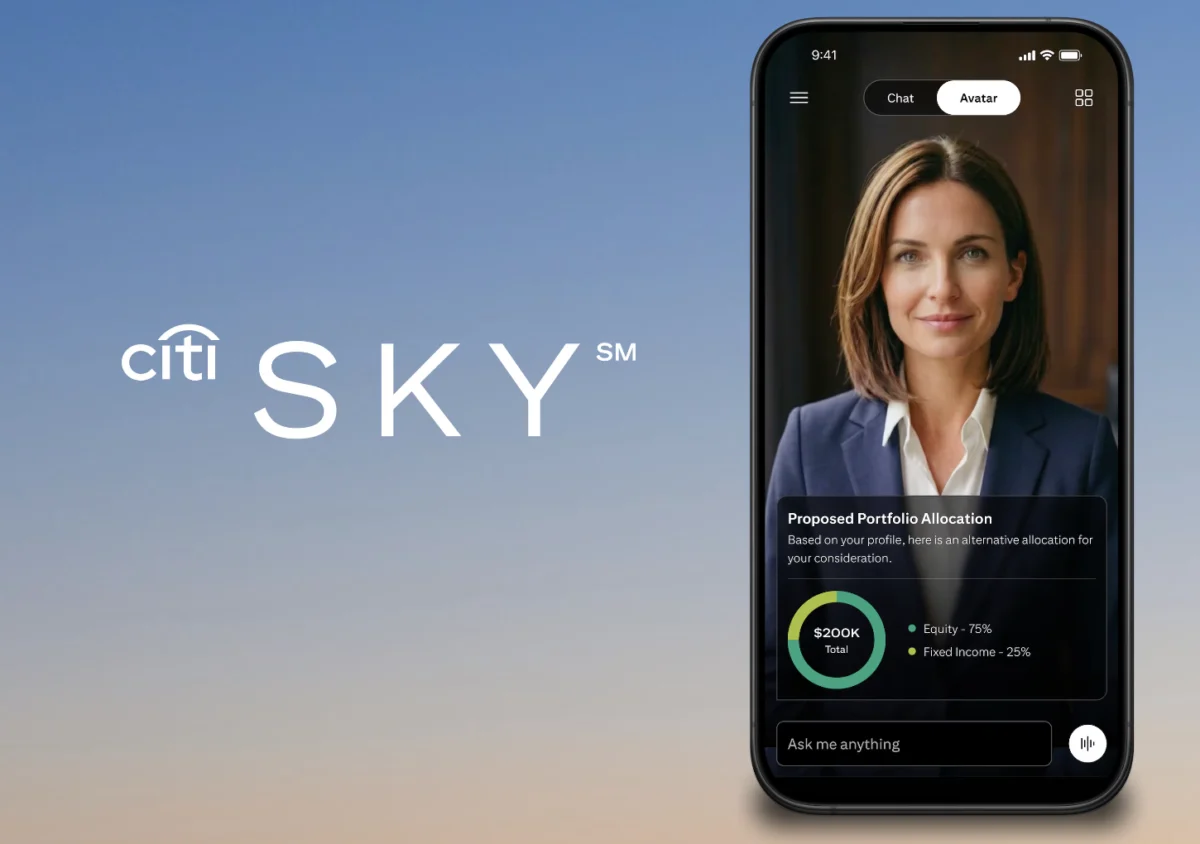

Citi Wealth, a global leader in financial services managing approximately $1 trillion in assets, has officially launched Citi Sky, an advanced artificial intelligence-powered avatar designed to transform how the firm interacts with its vast client base. Unveiled at the Google Cloud Next conference in Las Vegas, Citi Sky represents a significant leap in "agentic AI," moving beyond traditional back-office automation toward a sophisticated, client-facing interface capable of real-time voice and video communication. This initiative is part of a broader strategic overhaul led by Citi Wealth’s intelligence team and powered by Google Cloud’s most advanced generative AI technologies, including Google DeepMind and the Gemini Live API.
The introduction of Citi Sky marks a pivotal moment for Citigroup’s wealth management division, which serves a diverse spectrum of clients across 60 countries. In the United States, the firm’s Citigold brand caters to roughly 400,000 to 500,000 mass-affluent clients, while its private bank handles the portfolios of approximately 25 to 30 percent of the world’s billionaires. By deploying a digital avatar capable of handling complex queries and providing market insights, Citi aims to bridge the gap between its retail banking arm—which counts three million customers—and its high-touch advisory services.
A Strategic Pivot from Efficiency to Revenue Generation
While many financial institutions have focused their AI investments on cost reduction and internal productivity, Citi Wealth is positioning Citi Sky as an "offensive" tool designed to capture a larger share of the market. Joe Bonanno, who leads Citi Wealth’s intelligence team, emphasizes that the primary goal is not merely to shave seconds off administrative tasks but to drive revenue by deepening client engagement. Currently, Citi Wealth clients hold an estimated $5 trillion in total assets, but only $1 trillion of that is currently managed by the firm. The remaining $4 trillion represents a massive growth opportunity that Citi believes can be captured through more consistent and personalized digital interaction.
In the current wealth management landscape, US-based advisors often manage books of business ranging from 500 to 1,000 clients. This high ratio makes it physically impossible for human advisors to monitor every market movement, stock upgrade, or bond maturity for every individual client in real-time. Citi Sky is designed to act as a "digital team member" or "advisor twin," providing 24/7 coverage. For example, if a market shock occurs after business hours, the AI can conduct personalized portfolio reviews for thousands of clients simultaneously, initiating conversations to explain how specific market volatility affects their unique holdings.
The Technological Foundation: From Fragmentation to One Wealth
The journey to Citi Sky began roughly 18 months ago with a fundamental restructuring of Citi Wealth’s technological architecture. Following the 2008 financial crisis, the firm sold its Smith Barney unit to Morgan Stanley, a move that left Citi with a fragmented infrastructure for several years. By the time the current modernization effort began, the firm’s data was scattered across seven different "companies" worth of separate data lakes, warehouses, and product processors.
To remedy this, Citi developed "One Wealth," a unified platform that consolidates these disparate systems into a single architecture. This platform serves as the bedrock for the AI layer, integrating systems of record with client and advisor channels. While Citi initially explored partnerships with OpenAI, the firm has recently pivoted toward a deep integration with Google Cloud. This partnership utilizes Google’s Vertex AI platform and Gemini models to power "retrieval-augmented generation" (RAG) capabilities. This allows advisors to query the system with natural language, asking complex questions such as which clients are overweight in specific sectors like technology or which accounts have not been contacted within the last 30 days despite significant market news.
Agentic AI and the Mining of Opportunities
Beyond responding to queries, the One Wealth platform utilizes autonomous agents to mine data for "signals" that suggest cross-selling or retention opportunities. For instance, if a retail bank customer updates their direct deposit information to reflect a new employer, the system identifies this as a potential life event. The AI can then alert an advisor that the client may have a 401(k) to roll over or may need a new investment strategy to match a higher salary.
These agents operate in the background, analyzing transactions such as luxury goods purchases or large cash deposits to build archetypal personas for every client. This level of granular analysis allows the system to suggest the most relevant talking points for an advisor’s daily calls, even tailoring the communication to different reading levels or languages, including Spanish and Mandarin.
Internal Adoption and the Stylus Tool
The rollout of Citi Sky is preceded by the successful internal deployment of "Stylus," a Gemini-powered tool currently used by approximately 180,000 of Citi’s 220,000 employees. Stylus allows advisors to generate comprehensive client briefings by pulling data from news outlets, LinkedIn, and internal market reports. This internal adoption has helped foster a culture of AI-readiness within the firm. Andy Sieg, the Head of Wealth at Citi, has been a vocal proponent of this shift, pushing for use cases that go beyond the technical and into the realm of client-centric innovation.
Technical Breakthroughs in Voice and Video
A critical differentiator for Citi Sky is its use of Google DeepMind’s real-time avatar technology. Unlike traditional voice AI, which typically involves a three-step process—converting speech to text, processing it through a large language model, and then converting the response back to speech—Citi Sky utilizes a "voice-to-voice" processing model. This approach significantly reduces latency and prevents the loss of emotional nuance or context that often occurs during text conversion.
Rohit Bhat, Google Cloud’s Managing Director of Financial Services, noted that this direct processing allows for more robust "inline" guardrails. Because the system monitors the audio stream directly, it can enforce compliance and safety protocols within the conversation itself. This ensures that the AI remains within regulatory boundaries and adheres to Citi’s strict internal policies regarding toxicity, bias, and financial advice.
Security, Compliance, and the Human in the Loop
In the highly regulated world of wealth management, security is a paramount concern. Citi has implemented a multi-layered compliance architecture for Citi Sky. When a client interacts with the avatar, the data is masked and double-encrypted to protect Personally Identifiable Information (PII). Every response generated by the AI is passed through a proprietary Citi checking layer and then through Google’s safety filters. Furthermore, the system verifies every interaction against the specific client’s risk tolerance and investment objectives to ensure suitability.
At its current stage of development, Citi Sky provides guidance and surfaces insights rather than issuing direct "buy" or "sell" recommendations. However, the firm has indicated that these more advanced capabilities are targeted for rollout toward the end of 2024 or early 2025, subject to further regulatory testing.
The reaction from Citi’s human advisors has been largely positive, viewing the AI as a tool for liberation rather than replacement. By automating routine queries regarding cost basis, document requests, and basic account information, the AI allows advisors to focus on high-value strategic planning and relationship building. The "human in the loop" model remains central; if Citi Sky encounters a query it cannot resolve, it logs the interaction and prepares a follow-up briefing for the human advisor to address the next morning.
Broader Industry Implications and Future Outlook
The launch of Citi Sky is likely to spark a new arms race in the wealth management sector. While competitors like Morgan Stanley have deployed AI assistants to help advisors search internal research databases, Citi’s move to place an AI avatar directly in front of the client is a bolder step. It signals a shift in the industry toward "mass personalization"—the ability to provide the level of service traditionally reserved for the ultra-wealthy to the mass-affluent segment.
As Citi Sky begins its phased rollout to US Citigold clients this summer, the financial industry will be watching closely to see if this technology can successfully convert engagement into "wallet share." If Citi proves that agentic AI can drive revenue while maintaining the rigorous compliance standards of a global bank, it may redefine the standard for client service in the digital age. For now, Citi Wealth is betting that the future of finance is not just automated, but conversational, visual, and available at the touch of a screen, any time of day or night.
